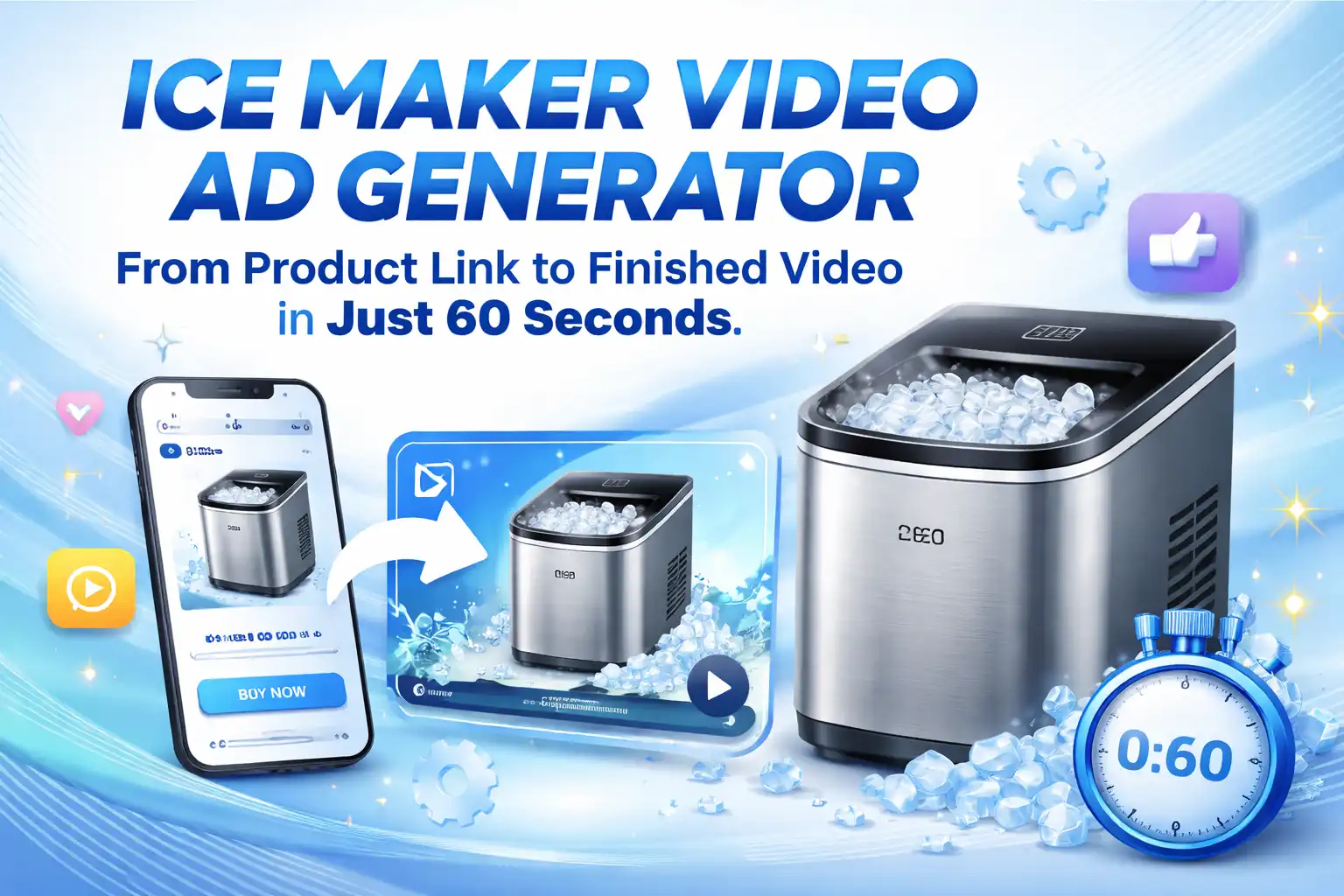
Ice Maker Video Ad Generator: From Product Link to Finished Video in Just 60 Seconds
If you’re a cross‑border e‑commerce seller of ice makers, you’ve probably felt the same pressure over the past two years. Platforms like TikTok Shop, Instagram Reels, and YouTube Shorts no longer treat video content as “nice to have”; it’s “must have.” Buyers are increasingly accustomed to judging whether an ice maker is worth purchasing by watching a short video of a few dozen seconds—does the ice come out fast, is it noisy, are the cubes transparent and odorless? The problem is that the vast majority of seller teams don’t have a dedicated video director. Every time a new product is launched, from filming the ice‑making process, writing a script, recording voice‑over, to editing and rendering, a complete video takes at least three to four hours, often half a day. By the time the video is finished, the platform’s trending topic window has already passed. This pace simply doesn’t work in the short‑video e‑commerce era.
What makes it feasible is an AI video generator. Its core logic is simple: paste the e‑commerce product link, the system automatically parses the product information, generates hook sentences, script, storyboard frames, and voice‑over, and finally outputs a ready‑to‑publish video. The whole process is completed in under a minute. This isn’t a far‑off tech concept; it’s a workflow that many sellers have already been using in production environments in 2024. This article uses the ice‑maker category as a case study to break down the AI video ad generation workflow, the practical pain points it solves, and how sellers can judge whether a tool is worth using.
Three Major Pain Points of Traditional Ice‑Maker Video Production
58 % of consumers prefer to learn about product features by watching a video (HubSpot Short‑Video Marketing Data), and this proportion is especially high for functional products like ice makers. Buyers want more than just specifications—they want to see the ice cubes drop out of the ice‑making tray, hear the machine’s operation, and intuitively feel the ice‑making speed. Traditional video production stalls at several stages.
Production cycle is too long. Ice makers, unlike clothing or accessories, need dynamic footage to convey their selling points. For example, to showcase “ice in 8 minutes,” you must set up the machine, fill water, start the timer, film the whole process, and then speed up the footage in post‑production. A complete product demo video, from shooting to final output, typically takes 3–6 hours. If you also need close‑up shots to demonstrate ice transparency or silent operation, the time only gets longer.
High cost and hard to scale. A single ice‑maker SKU may require dozens of different ad video versions to test various hooks, music, and lengths. From a labor‑cost perspective, running the entire shoot‑and‑edit workflow for each video is almost impossible. Most sellers end up creating one or two generic videos and reusing them throughout the campaign, so conversion rates naturally decline as the audience fatigues.
Multi‑platform adaptation is extremely tedious. The same ice‑maker video needs a 9:16 vertical format for TikTok, a 1:1 square version for Instagram, and a different cropping logic for YouTube Shorts. Manually adjusting each version’s aspect ratio, subtitle placement, and composition adds at least 15–20 minutes per video. Assuming you promote 10 ice‑maker models per month, each covering three platforms, that’s an extra 10 hours of repetitive work.
How AI Video Generators Transform Ice‑Maker Ad Creation
In the 2024 tech landscape, tools like VEONIB compress the entire workflow into a completely different scale. Their operation is not “assist‑editing” but end‑to‑end automatic generation. Users only need to provide the product’s e‑commerce link; the system reads the page’s title, description, specifications, and user reviews, extracts usable selling points, and automatically creates a complete ad video.
Take a household ice maker as an example. You copy the product link from Shopify or Amazon and paste it into the tool. The system identifies key selling points: ice‑making speed (e.g., 6–8 minutes for the first batch), ice capacity (e.g., 1.5 L water tank), silent design (e.g., 45 dB operating noise), and self‑cleaning function. AI then generates multiple hook sentences based on this information. Interestingly, many ice‑maker sellers initially think that simply listing parameters in the script is enough, but the AI hook generator prefers to start from “user pain points.” For instance, the hook “Does the ice from your fridge taste weird?” usually gets a higher click‑through rate than “200 cubes in 6 minutes,” because the former directly addresses a real‑world consumer frustration—much like how search engines capture user intent.
From input to output, the entire creative chain—hook, script, storyboard, voice‑over, subtitles, rendering—finishes in about 60 seconds. No need to open Premiere, hire a voice actor, or wait for repeated renders. Of course, the first script may not be 100 % perfect, but it gives you an editable starting point rather than a blank canvas.
How to Create an Ice‑Maker Video with an AI Video Generator
Step 1: Paste the product link. Copy the ice‑maker product URL from your store backend and paste it into the VEONIB input box. Mainstream tools support Shopify, Amazon, TikTok Shop, WooCommerce, and other common platforms, automatically parsing the product page. No manual entry of extra parameters is required.
Step 2: Preview and adjust the generated content. Within seconds, the tool returns a full set of creative assets: three to five hook sentences to choose from, scripts adapted to different lengths (15 s, 30 s, or 60 s), and storyboard frames. Some fine‑tuning is needed. According to 2024 industry feedback, about 30 % of AI‑generated hooks need human editing, especially for products like ice makers that need to showcase process and detail. For example, AI might generate a parameter‑style hook like “This ice maker produces 12 kg of ice per day,” but tests show that a version starting from the pain point “Your ice cubes smell bad” converts better. You can edit hooks and scripts directly in the editor; the system will automatically update the storyboard and voice‑over.
Step 3: Choose voice‑over and export format. AI voice‑over supports 30 languages, and subtitles are generated automatically. Output ratios include 9:16 (TikTok, Reels), 1:1 (Facebook), and 16:9 (YouTube) – one‑click selection. After confirming everything, click Export and wait 60–90 seconds for rendering to receive an MP4 file.
AI Video Generator vs. Manual Production: Ice‑Maker Ad Video Comparison
| Dimension | AI Video Generator | Traditional Manual Production |
|---|---|---|
| Time per video | ~60 seconds | 3–6 hours (shooting, editing, voice‑over) |
| Number of variants per product | 100 per month | Usually 1–2 |
| Platform adaptation | One‑click output of 3 ratios | Each ratio requires separate adjustment |
| Multi‑language support | 30 AI voice‑overs + auto subtitles | Need separate voice actors per language |
| Average cost per video | ~90 % lower | Includes equipment and labor; cost per video in hundreds of yuan |
This comparison means one thing for ice‑maker sellers: you can have a usable video within the first hour after a product goes live and push it to all major platforms to test market response. If a hook underperforms, you can generate a new version in minutes and replace the old one. In the traditional manual workflow, you can’t produce five different‑direction ads for A/B testing within two hours—writing the script alone would be impossible.
Platforms like RunwayML demonstrate the feasibility of machine‑generated video content at scale. The ice‑maker case is just one snapshot of the broader trend toward automated video in cross‑border e‑commerce.
Key Features to Look for When Choosing an AI Video Generator
Not every AI video tool suits functional products like ice makers. Focus on the following:
Support for direct e‑commerce URL parsing. Some tools only accept images or handwritten descriptions and cannot read product links. For ice‑maker sellers, manual entry of specs is inefficient and prone to missing key selling points. Tools that can directly parse Shopify, Amazon, TikTok Shop links should be on your shortlist.
Editability of script and storyboard. As mentioned, about one‑third of AI‑generated hooks need human adjustment. If the script editor is too restrictive—e.g., you can’t edit a single sentence or reorder storyboard frames—you’ll quickly get stuck. You need a flexible editor that lets you modify and re‑render on the fly. Canva AI Video offers decent editability but is geared more toward general design and doesn’t recognize product URLs as deeply as dedicated tools.
Multi‑language voice‑over and multi‑platform ratio export. If you sell ice makers in Southeast Asia, Europe, North America, etc., AI support for target‑language voice‑over and subtitles is crucial. One‑click export of 9:16, 1:1, and 16:9 ratios directly determines your multi‑platform workload.
Preview and payment model. Good tools let you generate and preview hooks, scripts, and storyboard frames for free, charging only when you export the final video. This on‑demand pay‑as‑you‑go model is more flexible than a monthly subscription, especially during product testing. You can directly generate a free preview to see which selling points the tool extracts from your ice‑maker page.
Commercial ownership of the video. Does the exported video belong to you? Can you run paid ads with it? Can you re‑edit it? Confirm these before you start. Most professional e‑commerce AI video tools (including the current mainstream options) grant full commercial rights, but some free or low‑cost tools may add watermarks or impose copyright restrictions.
FAQ
Q1: Can AI‑generated ice‑maker videos be used commercially?
Yes. Most professional tools assign full ownership of the exported video to the user, allowing direct use on TikTok Shop, Facebook Ads, Instagram Reels, etc., without additional royalties. Verify the service terms for explicit commercial‑use clauses before exporting.
Q2: Which e‑commerce platforms are supported?
Mainstream tools usually support Shopify, Amazon, TikTok Shop, WooCommerce, AliExpress, Etsy, eBay, and similar platforms. Compatibility with Temu and custom‑site URLs may be weaker; test with your own ice‑maker product link first.
Q3: Can the video length be customized?
Yes. Most tools offer preset lengths of 15 s, 30 s, and 60 s, and some allow custom durations. For ice‑maker ads, a 15‑second version is great for showcasing rapid ice output, while 30 seconds can cover silent design, capacity, and self‑cleaning features.
Q4: If I’m not satisfied with the AI‑written script, can I edit it?
Absolutely. The majority of tools provide a script editor where you can modify hook sentences, narration, or storyboard descriptions. After editing, the system automatically re‑renders the video without needing to re‑enter the product link.
Q5: Do I have to pay before exporting the video?
No. Most tools allow free preview generation—including hooks, scripts, and storyboard frames. You only pay when you confirm the content and click Export to produce the final video. This free‑preview mechanism lets you test multiple creative directions at zero cost, which is especially valuable for ice‑maker products that require script validation.
Share Article