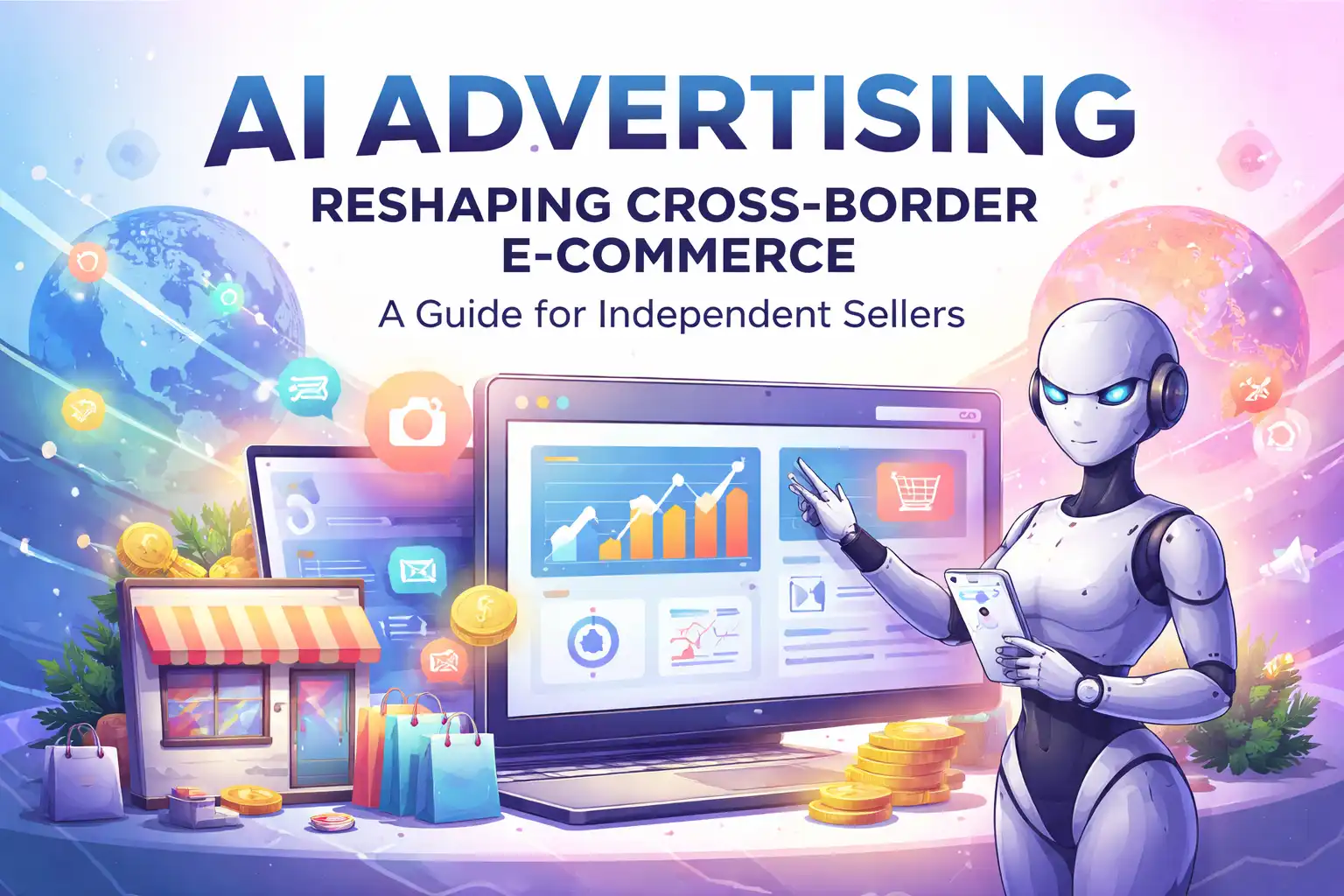
AI Advertising Reshapes Cross‑Border E‑Commerce: Advertising Strategy Guide for Independent Site Sellers
The daily life of an independent‑site seller looks like this: after listing a new product, you stare at the screen, knowing you must run ads today, but you have no finished video assets and no budget to hire an outsourcing team. A 15‑second TikTok ad costs the supplier at least ¥800 for a quote, and the back‑and‑forth communication takes half a day. By the time the video arrives, the product may have already passed its new‑product hype period.
I’ve hit many traps in this area. In the summer of 2023 our team tested 12 new products, spending over ¥10,000 on ad production, and only two of them generated a positive ROI. The rest of the money went into “looks polished but the market simply doesn’t buy” videos. Later I gradually realized that for independent‑site sellers, “wasting money testing a mediocre ad” is far more realistic than “spending time polishing a perfect ad.” The reason is simple: you can’t guess which creative will work; the only effective strategy is massive testing.
Traditional ad production takes on average 3–6 hours—writing scripts, sourcing assets, editing, voice‑over, exporting for different platforms. An AI‑generated ad takes only 60 seconds. This isn’t just a speed boost; it changes the entire testing logic: you no longer have to gamble on a single success, you can cover probability with quantity.
Why Traditional Ad Production Doesn’t Fit the Independent‑Site Model
Independent sites and dropshipping share characteristics—many products, fast SKU turnover, limited testing budgets—that directly clash with the high cost and long cycle of traditional ad production.
You may be running dozens or even hundreds of SKUs, most of which have a two‑month lifecycle. Outsourcing a full‑process ad costs ¥1,000–¥3,000, with a 2–3‑day wait. If the first version fails, you have to revise and wait again. More importantly, you don’t know which product will take off. That means a large portion of early ad budget is spent on “trial‑and‑error” rather than “scaling.”
At the end of 2022 I ran a batch of kitchen‑tool products, uploading eight competitor assets. One manual vegetable‑cutter ad was filmed with a rough unboxing video on a phone, costing almost nothing, and achieved an ROI of 3.5. Another electric mixer ad was outsourced for ¥2,500, well‑produced, but its CTR was only 0.3 %. My biggest takeaway that month: there is no inevitable linear relationship between an ad’s “quality” and its “performance”; the quantity of tests matters more.
Thus AI ad generation has a fundamental value proposition: it drives production cost down to near‑threshold levels, allowing you to spread budget across many creative directions. No more agonizing over “Is this script good enough?”—just generate 10 versions and let the data speak.
In traditional testing, the most expensive part isn’t the media spend, it’s the silent cost of creative production. When you spend a week polishing an ad only to find it can’t run, the frustration and monetary loss can make many sellers abandon testing more products. AI solves this bottleneck—compressing creative production from “days” to “seconds,” making you naturally willing to test more new products.

Core Framework of AI Ad Generation: Hook, Script, and Storyboard
To understand AI ad generation workflow, break it into three core components: hook, script, and storyboard.
The hook is the first judgment a user makes when scrolling—whether they stop. AI hook generators usually base themselves on historically best‑performing e‑commerce ads and produce multiple opening line styles. For example, a link selling an aromatherapy diffuser might be manually written as “Check out this high‑design diffuser,” while AI could suggest “Say no to cheap diffusers” or “This is the sleep companion you’ve been looking for.” The latter isn’t perfect, but it provides plenty of reference directions so you can pick the one that fits your target audience.
The script generator builds a complete narrative structure. A 15‑second ad script can’t exceed 40 Chinese characters; a 30‑second one can reach 80–100 characters. AI’s core ability here isn’t to write a masterpiece, but to mass‑produce versions that meet basic structural and pacing requirements. You can generate 20 scripts at once, discard the obviously unusable ones, and keep 3–5 for trial runs.
Storyboard planning is a key step many overlook. Without a storyboard, directly filmed or generated videos have jarring scene cuts. AI’s storyboard builder can plan frame‑by‑frame—e.g., first frame shows a product close‑up, second switches to usage scenario, third displays the effect, fourth shows price and CTA. The output includes not only textual descriptions but also visual previews for each scene.
Combined, these three steps can generate hundreds of ad variants for a single product. On the operational side, tools like VEONIB are great examples—paste a product link and it automatically handles everything from hook generation to storyboard planning, eliminating the manual labor and time of script writing, asset gathering, and editing. Previews are completely free; you only pay when exporting the final video.
The value isn’t in how “perfect” the content is, but in providing enough choices. The real decision‑making—filtering and fine‑tuning creatives—still rests with humans. AI supplies bulk material; people decide which hook captures the target audience and which pacing fits the platform’s tone.
If you’re interested in the workflow details, see How to Quickly Create Short Ads with AI Video, which breaks down the process from URL to final video.
For commercial deployment of AI video, Adobe’s detailed overview of AI video in business also discusses similar automated production logic and can serve as technical background.
Adapting Size, Length, and Procurement Logic for Multi‑Platform Placement
Ad format requirements vary widely across platforms; unadapted assets are essentially wasted.
TikTok and Instagram Reels use a 9:16 vertical ratio, recommended length 15–30 seconds. YouTube Shorts also uses 9:16, but users tend to prefer a complete story, so 30–60 seconds works better. Facebook’s 1:1 square ads remain stable, especially in feeds where the occupied area is reasonable. YouTube horizontal (16:9) suits product reviews or tutorial‑style longer content. A common mistake among independent‑site sellers is creating a single version and force‑fitting it to every platform—resulting in,Tok ads that are too long (e.g., 40 seconds) and get abandoned within the first three seconds.
AI ad generation tools solve format adaptation simply. Input a product URL, the system parses the original assets, then outputs finished videos in various ratios and lengths. The first render usually finishes within 60–90 seconds, giving you both a 9:16 TikTok version and a 1:1 Facebook version. For sellers running ads on multiple platforms, this eliminates repetitive resolution and cropping work.
I also noticed an interesting difference: “impulse‑purchase” scenarios demand different pacing across platforms. Temu and TikTok Shop have high impulse traffic—users aren’t browsing deeply but are scrolling and get hooked by a hook, then order immediately. Ads on these platforms must be faster: the core selling point and price must appear within the first three seconds; any lead‑in shots cause drop‑off. YouTube Shorts can be a bit slower, allowing a relatively complete narrative.
Cross‑border e‑commerce also needs multilingual voice‑overs and subtitles. AI tools typically support over 30 voice‑over languages, and with automatic subtitles you can quickly cover English, Spanish, French, Japanese, etc. One often‑overed detail: subtitle synchronization accuracy directly impacts completion rates. Misaligned or missing subtitles cause users to swipe away.
But we must also state the efficiency limits. The tool can quickly handle format adaptation and basic creative, but it cannot understand the cultural context of target markets. In the second half of 2023 we tested VEONIB for Southeast Asian markets; the automatically generated Chinese voice‑over with English subtitles performed well, but the Thai and Vietnamese versions saw a 50 % drop in views—because the voice‑over accent and intonation weren’t localized enough. AI voice engines default to standard American English or Mandarin, which sounds “fake” in Southeast Asian markets. This isn’t a tool flaw but a capability boundary—AI can mass‑produce material, but “localization” must be done by market‑savvy humans.
For the technical logic behind these differences, see Google Veo’s integration into Vids’ text‑to‑video capability, which demonstrates AI’s boundaries in generating videos of various styles.
For small teams, a practical approach is How Small E‑Commerce Stores Compete with Big Brands Using AI Videos—not by matching big‑company budgets, but by winning on creative iteration speed.
From Data Feedback to Ad Iteration: AI‑Driven Testing Loop
Real ad testing isn’t “make one → launch → see results → make another”; it’s a closed loop: generate multiple variants → launch → collect data → discard ineffective creatives → generate a new batch using winning elements → repeat.
AI ad generation tools add value to this loop by dramatically lowering the cost of each iteration. In traditional workflows, revising an ad means rewriting the script, re‑shooting or sourcing images, re‑editing, and re‑exporting—at least two hours per iteration. In an AI workflow, you just tweak a few backend parameters and get a new version in 60 seconds.
I’ve seen many sellers give up halfway: after launching two ads for a new product, they see negative ROI after two days and conclude “the product is bad.” But the problem may not be the product itself—it could be the creative direction. If they had tested 5–10 different hook‑script combos, the outcome could have been completely different. That’s the value of AI generation—it makes you willing to test thoroughly instead of abandoning after the second version.
At the same time, we must acknowledge that AI can only handle the creative production part of the loop; several stages remain irreplaceable.
Data analysis is the most obvious shortfall. The flood of metrics—CTR, CPC, CV, ROI—needs human interpretation of “why version A’s completion rate is 30 % higher than version B.” It could be hook pacing, voice‑over gender, or audience match. AI can tell you which version performed better, but not why.
Subjective judgment of the target market is also essential. I experienced a case where AI‑generated home‑goods ads performed well in the US after data‑driven selection, but the same assets dropped click‑through rates by half in Germany. The cause turned out to be the “exaggerated expressions and gestures” that US audiences liked but German viewers found unprofessional. Cultural sensitivity is something AI currently lacks.
Another fundamental issue: AI‑generated ads often lack genuine user‑generated‑content (UGC) feel. The footage can be too clean, too “advertorial.” For categories like clothing or food that rely heavily on trust, users prefer real‑person unboxings or reviews. AI‑generated ad quality isn’t bad, but it misses that imperfect, authentic vibe. In some categories this gap can cause conversion rate differences of double‑digit percentages.
Production cost reduction is significant. Sellers using this workflow typically achieve a 90 % reduction in creative production cost. If you want deeper details on conversion‑rate optimization, see How AI Product Videos Boost Amazon Conversion Rates.
For teams evaluating 2026 tool choices, read Best AI Video Generators for E‑Commerce Product Marketing in 2026, which compares tools, use cases, and limitations.
FAQ
Can AI‑generated videos be used for paid advertising?
Yes. Exported video rights belong to the user and can be used directly on TikTok Ads, Facebook Ads, Google Ads, etc., without royalties or additional licensing fees.
I don’t know video editing—can these tools export ready‑to‑run videos?
Yes. The full AI ad generation workflow involves no editing—paste the product link, the system automatically outputs a finished MP4 with voice‑over, subtitles, and transitions. You just select the appropriate platform size and length.
What are the size and length requirements for different platforms?
TikTok and Instagram Reels: 9:16 vertical, 15–30 seconds. YouTube Shorts: 9:16, up to 60 seconds. Facebook: 1:1 square, 15–30 seconds. YouTube horizontal (16:9): 45–90 seconds for product‑showcase or tutorial videos.
Will AI‑generated ads make my content look the same as others’?
There is some risk. AI generates content based on training data, so if many sellers use the same tool for the same product type, creative directions may converge. It’s recommended to manually adjust product‑ and brand‑specific differentiators on top of AI outputs.
I need to test many new products each month—does this tool suit that scenario?
Very suitable. Large‑scale new‑product testing is exactly the core use case for AI ad generation tools—low‑cost bulk creative output. Single‑product testing costs approach zero, allowing you to explore multiple creative directions before deciding which product deserves a larger ad budget.
Share Article