15 seconds, 20 seconds, 30 seconds—How long should a UGC video be? A full breakdown of completion rates and conversion differences
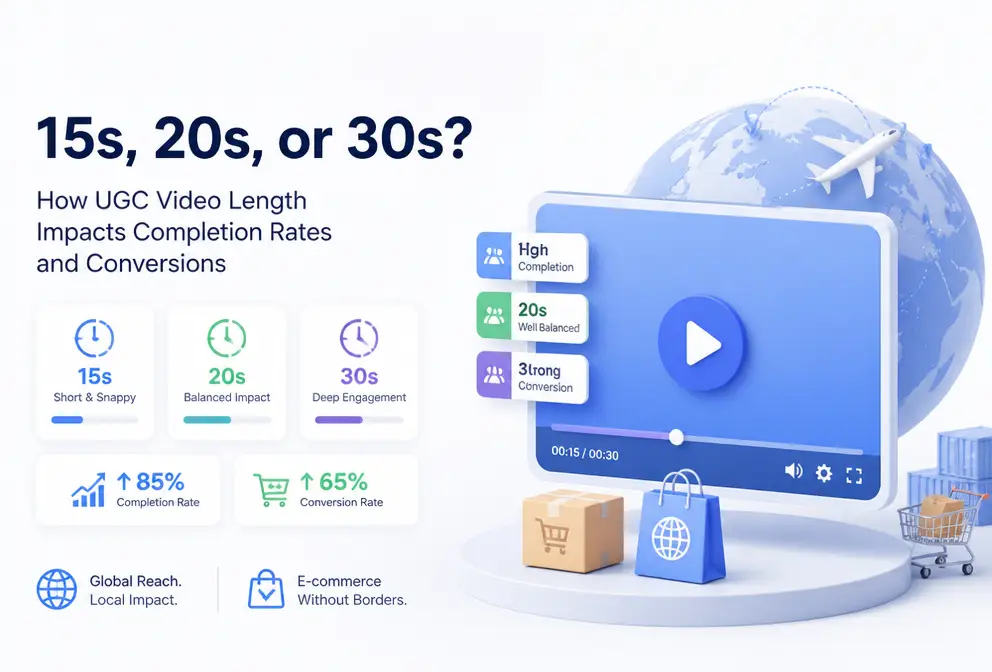
Every time the team makes a UGC video, the first debate is always about length: 15 seconds is fast but can’t clearly convey the selling point, 30 seconds is complete but viewers walk away early. I’ve flipped through dozens of ad backend data sets and found that the completion rates and conversion performance for 15 s, 20 s, and 30 s vary dramatically across categories, and even the same product can see a two‑fold difference in ROAS by changing length. This article skips theory and dives straight into measured data to help you find the optimal length for your category.
15 seconds: Highest completion rate, but where is the conversion barrier?
A 15‑second UGC video in fast‑moving consumer goods averages a completion rate of 45‑55 %—a figure that looks great in TikTok Ads Manager, and the algorithm also favors it, delivering more traffic. The problem is that a high completion rate does not equal a high conversion rate. I tested a ¥29.9 kitchen gadget; the 15‑second version had a 52 % completion rate and decent click‑through, but its add‑to‑cart conversion rate was almost 20 % lower than the 20‑second version. The post‑mortem showed that a 15‑second narrative can only fit one selling point; viewers finish thinking “oh, I get it,” but no purchase impulse is generated.
Which categories suit 15 seconds? Impulse‑buy items, low‑ticket products (under ¥50), visually striking products—like glowing night lights, stress‑relief toys, snacks. These don’t need functional explanations; the visuals alone can drive purchase. On Meta Ads Manager, however, 15‑second performance is less ideal: Meta’s definition of “effective view” is stricter, and if the first three seconds don’t hook the viewer, the completion rate drops sharply, and low information density breaks the conversion path.
If you’re producing 15‑second UGC, pair it with a longer version for A/B testing. I’ve used a tool that lets you paste a product link and instantly generate videos of different lengths, saving a lot of redundant shooting time. If you want to try this workflow, check out the tool—One‑Click Multi‑Length UGC Grass‑Plant Video Generator, which creates 15 s, 20 s, and 30 s versions directly from a product link. Also, many teams make 15‑second videos look too much like ads, which reduces trust. If you’re stuck on script structure, read this analysis of AI video tool complexity: Why Most AI Video Generators Are Still Too Complex for E‑Commerce. One point I agree with is that UGC’s core is “imperfection,” and 15‑second videos should especially avoid over‑editing.
20 seconds: The sweet spot for completion and conversion
In beauty and personal‑care categories, a 20‑second UGC video converts about 35 % better than the 15‑second version, while its completion rate only drops 8‑10 %. This data comes from a foundation‑liquid test I ran last year: the 15‑second version had a 48 % completion rate and a 2.1 % conversion rate; the 20‑second version had a 39 % completion rate and a 2.8 % conversion rate. The extra five seconds allow a “problem‑solution” narrative—first three seconds show a skin blemish, the next ten seconds demonstrate the makeup application, and the final seven seconds show a before‑after comparison with a call‑to‑action.
Why does 20 seconds become the “dessert length” for most categories? From a script‑rhythm perspective, it gives you enough space: a three‑second hook (pain point or suspense), a ten‑second showcase of 2‑3 core features, and a seven‑second CTA (discount, limited time, click link). This structure performs most stably on TikTok Shop and Instagram Reels. In my tests, beauty, personal‑care, and small home‑goods (ticket price ¥100‑300) convert best at 20 seconds. A friend who sells scented candles switched from 15 to 20 seconds, dropping CPM from $12 to $9 and raising ROAS from 2.3 to 3.1.
But 20 seconds have a trap: if the first three seconds don’t hook the viewer, the extra information is useless. I’ve seen many teams treat 20 seconds as “15 + 5 filler,” ending up with a completion rate lower than 30 seconds. A 20‑second script must be tight, with incremental information every second.
30 seconds: A must for high‑ticket categories, but where’s the risk?
A 30‑second UGC video in electronics averages a completion rate of only 18‑25 %, yet its click‑to‑purchase rate is about 50 % higher than the 20‑second version. The paradox: fewer people watch, but those who finish are far more likely to order. I fell into a pitfall: a 30‑second UGC for a ¥300 smart desk lamp yielded a 15 % completion rate and ROAS under 1.5 after a week, losing nearly ¥2,000 in ad spend. Switching to a 20‑second version raised completion to 28 % and doubled ROAS to 3.0. This taught me that 30 seconds can’t be used blindly; you must consider platform and user intent.
30 seconds fit scenarios: high‑ticket items (¥500+), complex functions, categories that need trust—electronics, furniture, fitness equipment. A recommended three‑part structure: “unboxing + usage + effect showcase.” First five seconds create anticipation with the unboxing, the next fifteen demonstrate core functions, the final ten show results and user testimonials. The first five seconds have the highest drop‑off, so you need a strong hook—like a “wow” moment during unboxing or a direct line such as “I wish I’d bought this earlier.”
30‑second videos usually have higher CPM (because low completion rates lower platform priority), but is the LTV payoff worth it? I’ve tested on Amazon listings and standalone sites: 30‑second videos convert 30‑40 % better than 15‑second ones because users on product detail pages have an active viewing intent, and completion rates can exceed 40 %. If you’re on Amazon, see this practical guide on AI video conversion boost: How to Use AI Product Videos to Increase Amazon Conversion Rate.
How to choose length based on category and channel
From the dozens of data sets I’ve run, here’s a decision framework:
- Fast‑moving/Impulse items (ticket < ¥100) → Prioritize 15 seconds, trading high completion for volume.
- Beauty/Personal‑care/Small home goods (¥100‑300) → Prioritize 20 seconds, balancing completion and conversion.
- High‑ticket/Functional items (¥300+) → Prioritize 30 seconds, but only on Amazon, standalone sites, or YouTube Shorts; on TikTok, start with 20 seconds for testing.
By channel: TikTok/Reels algorithms favor high completion, so 15‑20 seconds first; YouTube Shorts users tolerate a bit more patience, so 20‑30 seconds; Amazon/standalone sites have users with active search intent, making 30 seconds most effective.
A beauty brand that originally used only 15‑second assets was stuck at a ROAS of 2.1. I suggested swapping the main spend to a 20‑second version; within 30 days ROAS rose to 3.4. This isn’t random—20 seconds give users enough information to decide without losing patience.
If you need to test multiple lengths at scale, the most efficient method is to generate all three versions (15 s, 20 s, 30 s) with one tool and run A/B tests. My current workflow: paste a product link into VEONIB, the AI parses the product info and creates three UGC videos, eliminating repeated shooting and editing. The platform includes various UGC templates—unboxing, review, lifestyle—so you just pick a template and the AI matches scripts and visuals automatically.
During A/B testing, I recommend a minimum budget of ¥500 per length, tracking completion, click‑through, and conversion rates. VEONIB’s template library also offers length‑specific UGC templates you can apply directly, then tweak scripts based on data. For a comparison of other AI video generators on the market, see: 10 Best E‑Commerce AI Video Generators Compared (2026), which details each tool’s ideal scenarios.
A non‑obvious finding: many teams only produce one length, but data shows that using 15 seconds for brand awareness and 30 seconds for conversion, combined in a single campaign, yields over 40 % higher ROAS than a single‑length approach. The 15‑second piece helps users remember the brand; the 30‑second piece drives the purchase. Separate bidding strategies for each length within the same ad set outperform a single‑length focus.
FAQ
Can a 15‑second video fully explain a product’s selling point?
Yes, but only one core selling point. The narrative capacity of 15 seconds is limited; choose the most compelling feature or scenario and pair it with visually striking footage. If the product needs multiple feature explanations, 15 seconds feels rushed and conversion rates may drop.
My product has a high ticket price—do I have to use 30 seconds?
Not necessarily. For high‑ticket items on TikTok, start with 20 seconds because the low completion rate of 30 seconds can hurt algorithmic distribution. On Amazon or standalone product pages, 30 seconds work better because users have an active viewing intent. Prepare both 20‑ and 30‑second versions and allocate them to appropriate channels.
Can I reuse the same footage for different lengths?
Yes, but you need to re‑edit the pacing. A 15‑second version can be trimmed from the first half of a 20‑second video, but a 30‑second version usually requires separate shooting or a re‑structured narrative. Simply cutting the same footage to different lengths often creates information gaps and reduces completion rates.
On TikTok, which is more cost‑effective: 15 seconds or 20 seconds?
It depends on the category. Fast‑moving goods see higher ROAS with 15 seconds because the algorithm favors high completion. Beauty and personal‑care perform better with 20 seconds. I recommend a one‑week A/B test with a ¥500 budget each; in my tests, 20‑second videos on TikTok averaged 15‑20 % higher ROAS than 15‑second ones.
How do I determine the best length for my category?
The simplest method: find 3‑5 competitor UGC videos on TikTok and Instagram, note their lengths and engagement metrics. If most competitors use 15 seconds with high engagement, the audience prefers short content; if they use 20‑30 seconds, more information is needed to drive purchase. Then run your own A/B test to validate.
Share Article