Synthesia and D‑ID Create Enterprise Digital Humans; Shoppable UGC Is a Separate Production Line
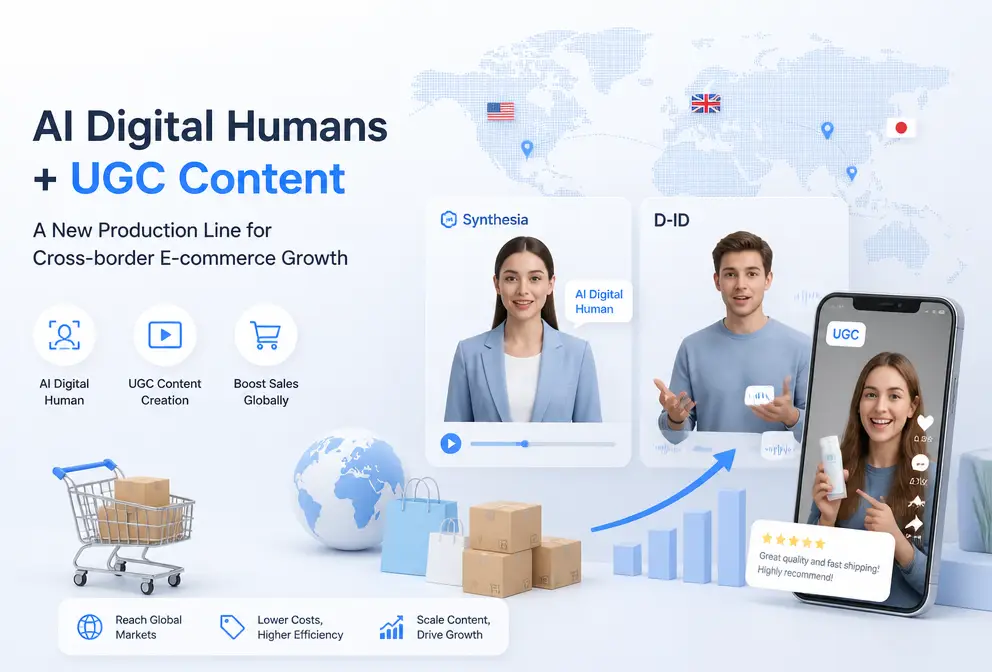
Many cross‑border teams encounter AI video for the first time through a Synthesia or D‑ID demo: enter a piece of text, pick a virtual presenter, and after a few seconds a narrated video appears. This workflow runs smoothly inside companies for multilingual training, employee onboarding, internal announcements, truly it really eliminates the need for a studio and post‑production. Consequently, some people quickly repurposed the same logic to produce TikTok shoppable content, only to see completion rates drop and mistakenly blame a weak script.
The quickest way to determine which category an AI video toolchain belongs to is to look at where the final product appears: on the corporate website, training system, or internal bulletin it’s an enterprise digital human; on TikTok feeds, Amazon listings, or recommendation sections it’s shoppable UGC. Placement determines attributes and is more reliable than a feature list.
The problem isn’t prompts; it’s the scenario. Enterprise digital humans and shoppable UGC are two distinct production lines. The former solves large‑scale formal communication; the latter supplies bulk external conversion material. Before choosing a tool, first confirm where the content will ultimately appear and for whom it will drive conversion.
The Essence of Enterprise Digital Humans: What Synthesia and D‑ID Solve
Synthesia’s typical use case is to feed a script, select a virtual presenter avatar, and generate a narrated video—common for corporate training, employee onboarding, internal announcements, and multilingual localization. D‑ID takes a different route: it drives character animation with a photo and supports real‑time dialogue, often used for customer service, marketing pages, and product demos. Although the technical approaches differ, both target formal communication—consistent branding, error‑free copy, and metrics such as completion rate, reach, and brand uniformity.
Enterprises are willing to pay annual seats because the benefits are clear: no studio, photography, or post‑production; scripts can be re‑issued anytime; multilingual versions are generated in one go. The trade‑off is a heavier pipeline, suitable for low‑frequency, high‑quality content, not for dozens of videos per day.
Both Synthesia and D‑ID were founded in 2017, and the digital‑human niche has been running for nearly a decade. Over those ten years they have served the same scenario: scaling formal communication. The logic is sound, but it has always differed from the production logic of shoppable content.
Why Shoppable UGC Is a Separate Production Line
The goal of shoppable UGC is completely different. Enterprise digital humans serve internal and official communication, measured by completion and reach; shoppable UGC serves external conversion, measured by clicks, add‑to‑carts, and sales.
Shoppable short videos typically run 15–30 seconds, with the first three seconds deciding whether the user scrolls past. Unboxing, reviews, recommendation, and social proof—all “human‑flavored” tones—naturally fit this length, while a formal broadcast opening struggles to retain viewers. Platforms reinforce this standard: TikTok, Reels, Shorts, TikTok Shop, and Amazon feeds demand a native, real‑life feel that far exceeds corporate video expectations.
The production chain also differs. Enterprise digital humans follow a three‑step process: write script → choose avatar → synthesize. Shoppable UGC follows: product link → extract selling points → generate script & storyboard → batch produce. Teams often face the dilemma of using five or six tools for a single product video—script, storyboard, voice‑over, editing each handled by a different tool. One team documented the current state of “a product video using five to six AI tools” (https://telegra.ph/Stop-Using-5-AI-Tools-to-Make-One-Product-Video-07-11). The more stages, the harder it is to keep material style consistent, leading to frequent rework.
Mismatched scenarios also send a hidden signal: enterprise digital humans aim for “the same face appearing repeatedly” to build brand consistency, whereas shoppable UGC wants each clip to feel like a different real person shooting casually. The same AI avatar appearing frequently in feeds is flagged as homogeneous material, and its delivery weight is reduced.
The differences between the two production lines can be summarized in a table:
| Comparison Dimension | Enterprise Digital Human (Synthesia / D‑ID) | Shoppable UGC Tools |
|---|---|---|
| Target Scenario | Training, announcements, multilingual localization | Feed, product detail page, recommendation |
| Typical Length | 1–10 minutes | 15–30 seconds |
| Content Form | Virtual presenter narration, formal broadcast | Unboxing, review, real‑person recommendation |
| Production Flow | Write script → choose avatar → synthesize | Product link → extract selling points → batch produce |
| Core Metrics | Completion rate, reach, brand uniformity | Completion rate, click‑through rate, conversion rate |
From Product Link to Shoppable Video: How a UGC Asset Is Produced
The entry point for shoppable UGC is usually not a blank script but a product page. Operators paste a Shopify, WooCommerce, Amazon, or TikTok Shop product link; the tool automatically extracts the title, selling points, price, and images, then proceeds to script and storyboard generation. The material grows out of the product information rather than being assembled from scratch.
A URL‑driven workflow example is VEONIB. After pasting a product link, the tool first understands the product, then generates a hook‑filled script and storyboard based on a template, and finally synthesizes the video without any manual editing timeline.
Scripts and storyboards are template‑driven. A product can be turned into six different story templates—problem‑solution, TikTok Review, unboxing, lifestyle, social proof, and custom—producing various angles and styles such as UGC, lifestyle, or brand‑focused. The same product can simultaneously yield a “review‑oriented” and a “brand‑oriented” piece, each fed into different traffic pools.
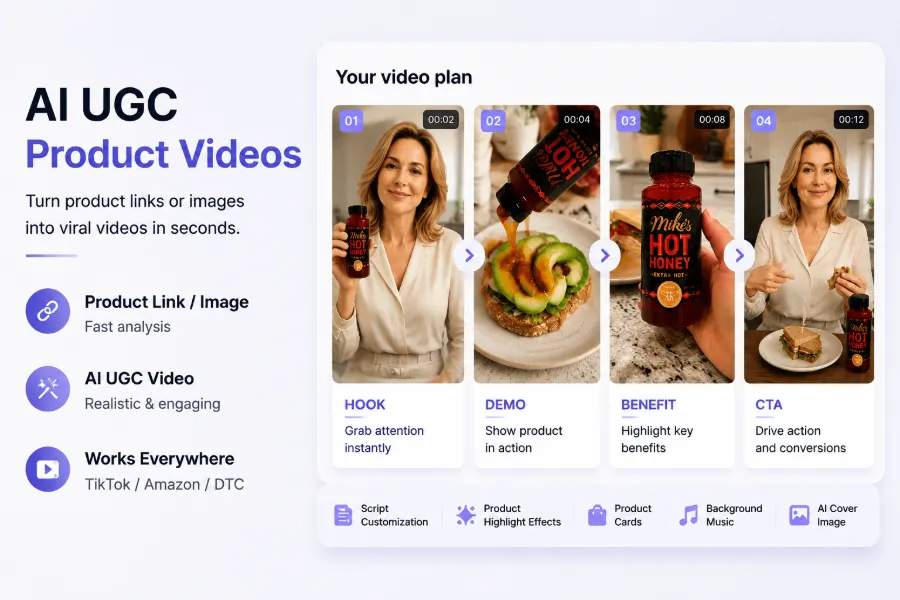
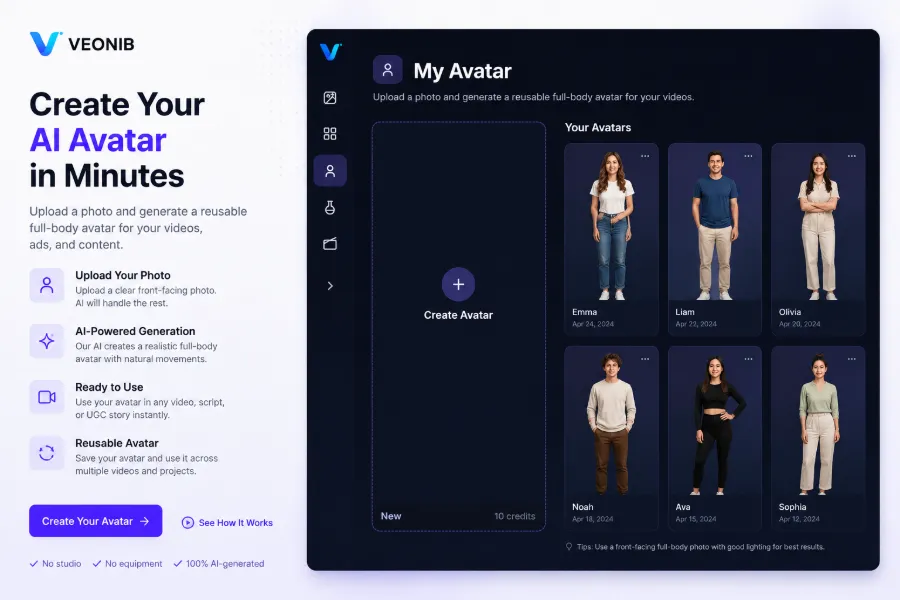
In terms of avatar, the built‑in digital‑human avatars can be used directly, or real‑person photos can be uploaded to create reusable shoppable avatars. The final video is exported by default in three durations—15 s, 20 s, and 30 s MP4—ready for feed placement and social media publishing. A full “link‑to‑video” workflow is illustrated in a case study: https://veonib.com/s/niches/veonib-jo-malone-fresh-floral-cologne-trio-beauty-product-url-to-emotion-driven-ad-video-in-60-seconds.
Batch production is where the two processes diverge most dramatically. Tools like VEONIB compress single‑video production time to an average of 60 seconds, allowing teams to shift from a few videos per week to dozens per day, and expanding material dimensions from “one product, one video” to “one product, multiple angles and versions.” Higher capacity creates bandwidth for placement testing instead of gambling on each individual asset.
Choose Scenario First, Then Tool: Three Decision Questions for Teams
Before selecting a tool, teams can answer three questions.
Who is the audience? Internal training, corporate website, official communication → enterprise digital human path; feed, product detail page, short‑form recommendation → shoppable UGC path. The same team can run both lines in parallel, but a single production line should not generate both types of content.
Which platform will host the content? Official channels (WeChat Official Account, website, internal system) demand high avatar consistency; TikTok, Reels, Shorts, Amazon listings demand a native feel. The platform dictates the production language.
What metrics will be used for acceptance? Completion and reach belong to one set; click‑through, conversion, and GMV belong to another. Different metrics lead to different tool choices.
The cost of a mismatched scenario is tangible. An e‑commerce team purchased an enterprise‑digital‑human subscription based on hype, used a single virtual presenter to produce 20 recommendation videos, and after a week of monitoring saw average completion rates below 20% and click‑through rates lower than contemporaneous UGC assets. After a quarter, all videos were reworked. The issue wasn’t the digital human itself but that the tool choice preceded content planning, wasting budget on the wrong scenario.
Supporting steps also consume capacity. Watermark removal, background removal, before‑after comparison generation—these material‑processing actions are often omitted from tool‑chain evaluations and become bottlenecks during batch production. A one‑click video‑watermark removal tool (https://veonib.com/s/tools/veonib-remove-any-video-watermark-in-one-click-with-ai) can eliminate a lot of repetitive work. The integration of such auxiliary tools with the main workflow determines whether the entire production line runs smoothly.
From the birth of digital humans in 2017 to the emergence of shoppable UGC tools in 2025, scenario differentiation took almost eight years. Those eight years proved one thing: AI video tools are not inherently good or bad; they belong to specific scenarios. Teams can self‑audit with three questions: Where will the material appear? Who will it convert for? Are the acceptance metrics completion or sales? Once the answers are clear, tool selection follows, and budget won’t be spent on the wrong scenario.
FAQ
Can enterprise‑digital‑human tools like Synthesia and D‑ID be used directly for shoppable videos?
They can produce videos, but mass production is usually not recommended. The default tone of enterprise digital humans is formal narration, lacking the “human flavor” needed for unboxing or review scenarios; consequently, completion and click‑through rates tend to be low in feeds. Occasionally you can produce one or two emergency videos, but for a stable supply of shoppable assets you should follow the shoppable UGC production chain.
Can enterprise digital humans and shoppable UGC tools be used together?
Yes. Mature teams often run both lines in parallel. Enterprise digital humans handle official content such as websites, training, and announcements; shoppable UGC tools handle conversion assets for feeds and product pages. Production processes, acceptance metrics, and style guidelines are managed separately; do not mix them in a single production line.
How should a team decide which type of tool to use?
Answer three questions first: Who is the audience? Which platform will host the content? Which metrics will be used for acceptance? If the content is internal or for a corporate site and the metric is completion, choose an enterprise digital human; if the content is for feeds or product pages and the metric is click‑through or conversion, choose shoppable UGC. Placement determines attributes, which is more reliable than a feature list.
Why do shoppable videos require higher “realness” than corporate videos?
Because the contexts differ completely. Shoppable assets appear in user‑driven feeds where the first three seconds see a high scroll‑away rate and users are highly skeptical of ads. Corporate videos are opened voluntarily or must be watched, so tolerance is higher. Shoppable assets need to feel like a casual real‑person shoot to earn trust and clicks in the feed.
What are common reasons for poor performance when using enterprise‑digital‑human material in feeds?
Three common reasons: (1) the same virtual avatar appears repeatedly, causing the system to flag the material as homogeneous and lower its delivery weight; (2) the narration is too formal and lacks hooks, failing to retain viewers in the first three seconds; (3) the material lacks unboxing, review, or social‑proof elements, keeping click‑through rates low.
Share Article