How AI Agents Reshape Cross‑Border E‑Commerce Marketing Workflows
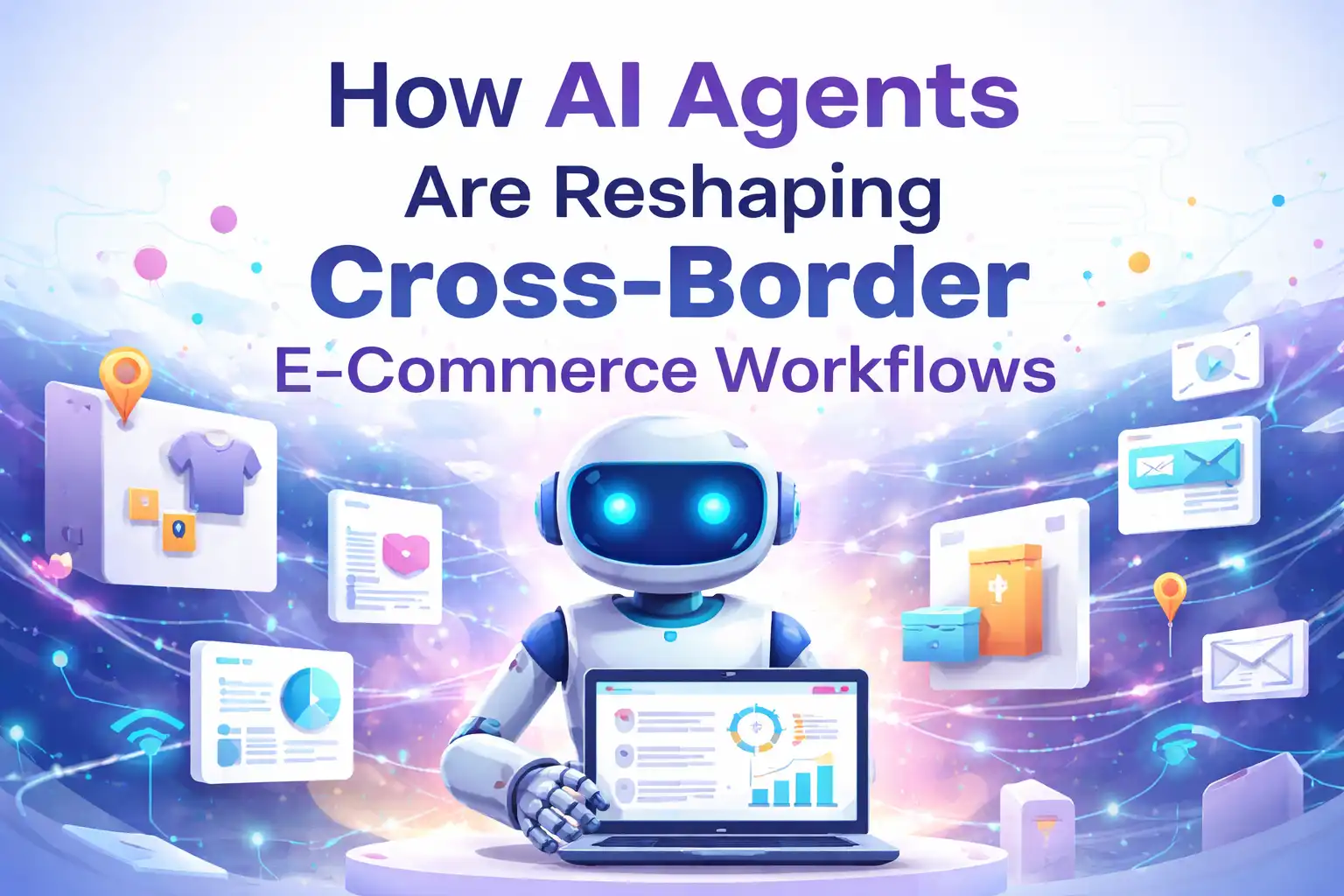
Open a shop’s product backend, copy a product link, paste it into an input box, and within seconds a completed script, voice‑over, subtitles, and storyboard video appears in the download list. This shift from “human‑driven material creation” to “material waiting for placement” is allowing more cross‑border sellers to redefine the speed of marketing output. This article follows the real‑world scenario of AI agents in e‑commerce ad video generation, breaking down how this capability is embedded into actual workflows.
AI Agents Solve Content Bottlenecks in Cross‑Border Marketing
Cross‑border sellers deal daily with dozens or even hundreds of SKUs, each needing to be adapted for Shopify, Amazon, TikTok Shop, Temu, AliExpress, WooCommerce, Etsy, eBay, and more—let alone multiple language markets such as English, Japanese, German, etc. Traditionally, creating a 15‑second ad video—from script writing to final export—takes an average of 3 to 6 hours. If the ad performs poorly after launch (e.g., CTR below 0.3%, a pitfall many sellers have hit), the whole process must start over. That timeline is often enough for sellers to abandon an entire product line.
AI agents are not meant to replace human creative judgment; they eliminate repetitive, low‑skill tasks—parsing product pages, generating multiple hook versions, matching platform ratios, adding voice‑overs, and subtitles. What used to require a specialist can now be handled by a single operator. The automated path from product link to finished video compresses the time to under 60 seconds and cuts costs by roughly 90 %. This compression rewrites the “create material first, then launch” rhythm.
A concrete example: a seller tried the traditional method for a scented‑lamp video. Script writing took 1 hour, sourcing royalty‑free assets 2 hours, editing and voice‑over 2 hours, and after export a segment’s picture didn’t match the audio, requiring another half‑hour of re‑editing. Total: 5.5 hours, and after two days of placement the CTR was under 0.2 %. The seller lacked the energy to produce a second video, so that product line was abandoned. The decision chain from execution to abandonment spanned about two weeks—not because the product was bad, but because content production couldn’t keep up with validation speed.
If you haven’t tried this workflow yet, you can preview and try VEONIB for free to see the actual output speed. Also, checking the Shopify e‑commerce video trends helps you understand how video content weight is changing in e‑commerce.
Core Capability of AI Agents: End‑to‑End Generation from Hook to Storyboard
When an AI agent parses a product link, it does far more than “generate a video.” Using VEONIB as an example, after parsing the product page the AI agent sequentially completes the following steps:
Hook Generation. Based on the best‑performing opening lines from historical ad data, it offers multiple eye‑catching options. For a $30 desktop lamp, a human might write “Super bright LED desk lamp,” while the AI agent could generate “POV: you found the only desk lamp you’ll ever need” or “Stop buying candles that don’t throw scent.” These hooks aren’t random; they’re extracted from the phrasing structures of many successful ads.
Automatic Script Generation. Adapts to 15‑, 30‑, and 60‑second lengths. A 15‑second script must hook the viewer in the first 3 seconds, then spend the remaining 12 seconds showcasing core selling points and a call‑to‑action. The AI agent automatically arranges sentences according to this rhythm.
Storyboard Construction and AI Voice‑Over. Each script is paired with a set of visual storyboard frames, matching scene descriptions to visuals. Voice‑over supports 30 languages, including English, Japanese, Korean, French, German, and other major tongues, with selectable accents. Subtitles are auto‑generated and time‑coded. If you’re unhappy with a line, you can manually edit the script or voice‑over text and the system will re‑render.
Multi‑Aspect Output. One‑click export to 9:16 (TikTok, Instagram Reels, YouTube Shorts), 1:1 (Facebook), 16:9 (YouTube), eliminating the need to recreate assets for each platform.
A single product can generate up to 100 ad variants for A/B testing with a single click—each variant swaps a hook, a storyboard set, or a voice‑over. Previously, creating those 100 variants would require 100× the labor; now it’s just a few mouse clicks. For deeper technical insight into AI video generation, see Adobe’s AI video generation capabilities.
Traditional Manual Process vs. AI Agent Workflow Efficiency Comparison
| Dimension | Traditional Workflow | AI Agent Workflow |
|---|---|---|
| Time | 3–6 hours | Under 60 seconds |
| Labor Requirement | Script + design + editing + voice‑over | 1 operator |
| Variants per SKU | 1–3 | Up to 100 |
| Multi‑Platform Adaptation | Manual export for each ratio | Automatic 9:16 / 1:1 / 16:9 |
| Multi‑Language Support | Outsourced or in‑house | AI voice‑over in 30 languages |
The table quantifies the efficiency gap clearly. In a traditional process each step needs a dedicated person: scriptwriter, asset hunter, editor, voice‑over artist. In the AI agent workflow, a single operator using one tool covers all steps. Cost reduction isn’t linear—what used to cost enough to make one video now yields 100 or more.
The deeper impact lies in the shift of “testing mindset.” Previously, a single video was expensive, so sellers refined it repeatedly, fearing wasted resources. If the ad performed poorly, they hesitated to restart. Now, producing 100 videos is cheap, dramatically increasing sample size and naturally boosting success rates. Most people overvalue the quality of a single video and undervalue the quantity of videos for algorithmic matching—AI agents actually switch to a volume‑driven, scalable logic.
Where AI Agents Fit in the Placement‑and‑Scale Loop
AI agents aren’t a one‑off tool; they’re a continuous material‑production pipeline. When your brand runs paid campaigns on TikTok Shop or Amazon, the placement algorithm constantly needs fresh assets to explore and scale. It’s normal for a piece of material’s CTR to drop after a few days, prompting the need for new variants immediately. VEONIB’s bulk‑generation capability fills this gap: when a new product launches, multiple video assets are generated instantly, and after launch the next batch of scripts can be quickly tweaked based on data feedback.
For multi‑SKU sellers, the cumulative effect of a 90 % reduction in creative cost is striking. Suppose you have 50 SKUs; previously each SKU required 2 videos costing 12 hours total (600 hours). Now each SKU can produce 100 variants in 60 seconds, and even if you only run 50 alternatives, total time stays under an hour. These assets can cover different platforms, languages, and placement strategies.
Localization for non‑English markets is especially challenging. Traditional methods involve hiring translators and outsourcing voice‑over, taking at least a week per batch. AI agents’ 30‑language voice‑over plus automatic subtitles compress the process to minutes. Sellers targeting Southeast Asia, the Middle East, or Latin America no longer need a second content team to overcome language barriers.
For the latest advances in AI video generation, see Google’s Veo integration with Vids: Text‑to‑Video Overview.
FAQ
Q1: Can AI‑generated video ads be used in paid campaigns?
Yes. The videos produced by the AI agent belong entirely to the user, with no copyright restrictions. Platforms such as TikTok Shop, Amazon, and Facebook accept these videos for paid placements as long as the content complies with platform policies.
Q2: Can a single AI‑agent tool handle product links from multiple e‑commerce platforms?
Yes. Most tools can directly parse product pages from Shopify, Amazon, TikTok Shop, Temu, AliExpress, WooCommerce, Etsy, eBay, and other major platforms without additional adaptation.
Q3: If I edit the script or voice‑over, does the AI agent have to start over from the link?
No. After you modify the script, voice‑over text, or storyboard description, the system re‑renders the video based on the new content without needing to re‑parse the link. The extra wait is usually just a few dozen seconds.
Q4: How long does it actually take to generate a video ad?
From past the link to exporting the finished video, real‑world tests show about 60 seconds. Rendering time depends on video length and resolution; the vast majority of 1080p 15‑second videos finish within 60–90 seconds.
Q5: I have no design experience—can I still produce a decent ad video with an AI agent?
Yes. The AI agent automatically handles storyboarding, voice‑over, subtitles, and aspect‑ratio adjustments. Users only need to select a hook and confirm the script. Operators require no design or editing background; the core work is selecting the right product and testing direction.
Share Article