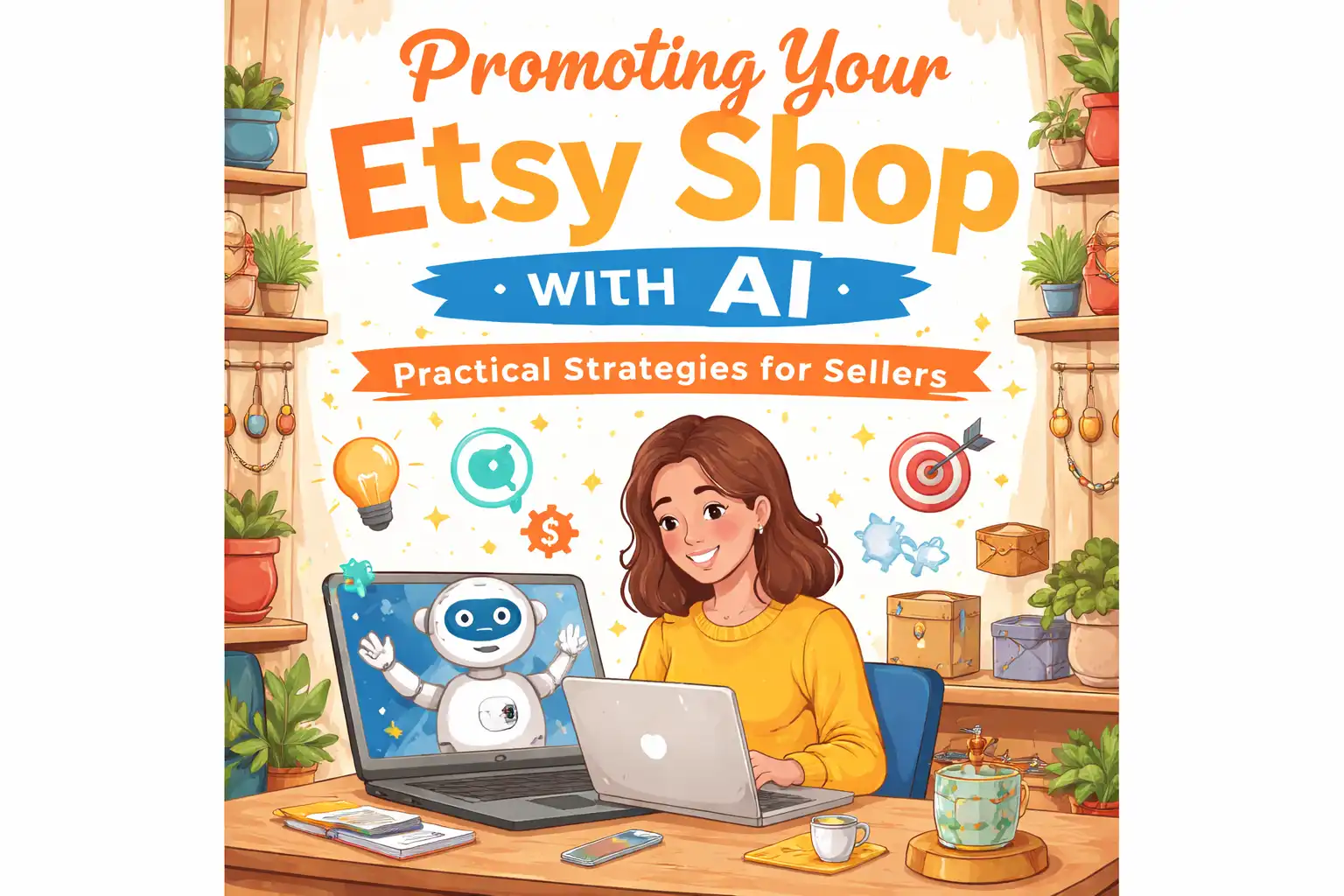
Using AI to Promote Your Etsy Shop: Practical Strategies for Sellers
You spent an evening writing product descriptions, adjusting photo sizes, and scheduling three social media posts. A week later, your shop has only 47 views and zero sales. On Etsy, millions of products compete for the same search results, and this kind of manual labor can’t be scaled. Every seller I know has tried the same tactics—more keywords, better lighting, lower shipping costs—but rankings still stall. AI tools can’t fix a terrible product, but they can compress hours of repetitive creative work into minutes. The key is knowing where to use them and where to keep human input.
Using AI to Optimize Your Etsy Product Listings
First, paste your current title into an AI writing assistant and ask it to generate ten variants that include secondary keywords your competitors are already ranking for. Most sellers stop at the first draft, but the real gain comes from feeding the tool your best‑performing tags and letting it expand the semantic cluster. Industry estimates suggest that optimized titles and tags increase the frequency of appearing in Etsy’s search results by about 40%. The algorithm heavily weights title relevance and tag density—generic copy like “beautiful handmade necklace” gets buried by listings such as “sterling silver dainty chain necklace for women layered.” AI tools can fill this gap without you having to think like a keyword researcher.
Auditing existing listings works just as well. Input your current description into an AI tool and have it highlight missing phrases or weak verbs. I once spoke with a seller who discovered that her top‑selling product tags lacked “birthday gift”—a search term that contributed 12% of traffic in her category. After adding it, her exposure rose within three days. For product photos, AI background‑removal tools can clean up cluttered images without hiring a photographer. While Etsy’s search doesn’t look at images, click‑through rates improve when photos are placed on a white or blurred background.
Using AI to Generate Video Ads for Etsy Products
Etsy is heavily promoting its video feature—according to Etsy’s official report, listings with video can boost conversion rates up to 40%. Shooting a product video for every SKU isn’t realistic. That’s where dedicated tools come in. VEONIB only requires a product link and can generate a 15‑second short clip with hooks, script, storyboard frames, voice‑over, and automatic subtitles in a minute. The workflow is simple: paste the link → generate a preview → choose a hook variant → export in 9:16 format for TikTok or Instagram Reels. You can rewrite the script before exporting to avoid the “uncanny valley” feel of pure AI narration.
A less obvious observation is that AI‑generated video ads perform best when the hook is customized for the platform’s native format. A generic 15‑second TikTok‑style clip looks lifeless in Etsy’s in‑app player because viewers expect a quick product demo rather than a storyline. Before exporting, adjust the hook based on the target platform—Etsy’s video player favors showing the product in use immediately rather than a five‑second intro. For the full process, see the guide “Automatically Turn Product Links Into Short Video Ads.” You can also read broader e‑commerce video marketing strategies to learn how large brands structure product short clips.
Your browser does not support the video tag.
Leveraging AI to Promote Your Etsy Shop on Social Media
Social promotion is the bottleneck for most Etsy sellers. Posting three times a week on Instagram, Pinterest, and TikTok takes more time than listing products. Studies show that Etsy sellers who post at least three times per week on social media see a 25% lift in shop visits. An AI title generator can turn a product listing into a batch of platform‑specific posts: long Instagram captions with emojis and calls to action, short trend‑focused hooks for TikTok, and description‑heavy Pinterest pins. The tool automatically recommends tags based on the product title and category.
The pitfall is that bulk‑generating identical content for all platforms reduces effectiveness. Pinterest rewards keyword‑dense, evergreen descriptions; Instagram Reels favor conversational, trend‑aligned hooks. If you copy the same AI output across all platforms, the algorithms will detect low engagement and stop showing your content. Use AI to create a base draft, then manually tweak the first sentence to match each platform’s culture. For a deeper dive on scaling this workflow, see “Automated Video Ads Guide for E‑Commerce Scale‑up.” Also reference Social Media Marketing Best Practices for platform‑specific publishing times and format suggestions.
Using AI to Analyze Performance and Optimize Promotion Strategy
Running ads and social posts without tracking is like flying blind. Etsy stats and Google Analytics tell you views, clicks, and conversion rates, but they can’t pinpoint which hook or image drove the result. An AI‑driven testing framework can automatically A/B test different video hooks or listing images and identify winners faster than manual testing. According to some estimates, using AI for A/B testing can cut the time to reach statistical significance by 60%. You can use tools like VEONIB to generate five hook variants, upload each as a separate ad creative, and let the testing framework aggregate click data across platforms.
I know a seller who used this method to test two hooks for the same product—one functional (“Keep your desk organized with this ceramic tray”) and one emotional (“The tray that finally made my husband tidy his workspace”). After three days, the emotional hook’s click‑through rate was 2.3× higher. Without AI, she might have guessed wrong and wasted a month of creative effort. For a complete workflow, see the “AI Workflow Guide for Cross‑Border Sellers”, which explains how to combine AI‑generated ad variants with your own conversion data.
Common Mistakes When Using AI to Promote Etsy (and How to Fix Them)
The most destructive mistake is publishing AI‑generated content without human editing. Etsy’s trust and safety filters flag duplicate meta descriptions or keyword‑stuffed titles. One seller uploaded AI‑generated product copy for ten items without reviewing a single line. Two weeks later, her search ranking dropped—exposure fell 15%—because Etsy’s algorithm detected repeated phrasing across her listings and penalized the entire shop. The solution is simple: use AI to draft a base, then manually rewrite at least one sentence per listing to ensure uniqueness. Etsy search penalizes shops that use the same meta description across products; bulk generation without differentiation backfires.
Another common error is using the same AI‑generated content on all platforms without adjusting format or tone. A 2025 consumer survey found that over 70% of shoppers can tell whether content is entirely AI‑generated. This perception damages trust. Add personal anecdotes, shift the tone from salesy to friendly, or include specific material details. AI’s speed is valuable only when the output still feels like a real person. For more on tool limitations, see “Best AI Video Tools for E‑Commerce Comparison”.
FAQ
Does AI‑generated content violate Etsy’s Terms of Service?
No, Etsy does not prohibit AI‑generated content as long as the item itself is handmade, vintage, or crafted from handmade materials. However, using AI alone for titles or descriptions that appear overly generic or repetitive may trigger quality filters. Be sure to add original edits.
How much time can AI save an Etsy seller each week?
For a shop with 30 products, AI tools can reduce product creation time from 10–15 hours to about 3–4 hours, assuming you review and tweak the output. The biggest time saver is video creation—compressing 3–6 hours of production into 5–10 minutes per ad.
Do I need technical skills to use AI tools to manage my Etsy shop?
Most tools only require a product link and basic editing. No coding or design experience is needed. The learning curve is roughly 20 minutes per tool, mainly to get familiar with which hook styles suit your brand.
Can AI help with international shipping and multilingual listings?
Yes. Some AI tools can generate multilingual scripts and subtitles for Etsy’s international markets. Paired with Etsy’s built‑in translation service, you can reach non‑English audiences without hiring translators.
Share Article