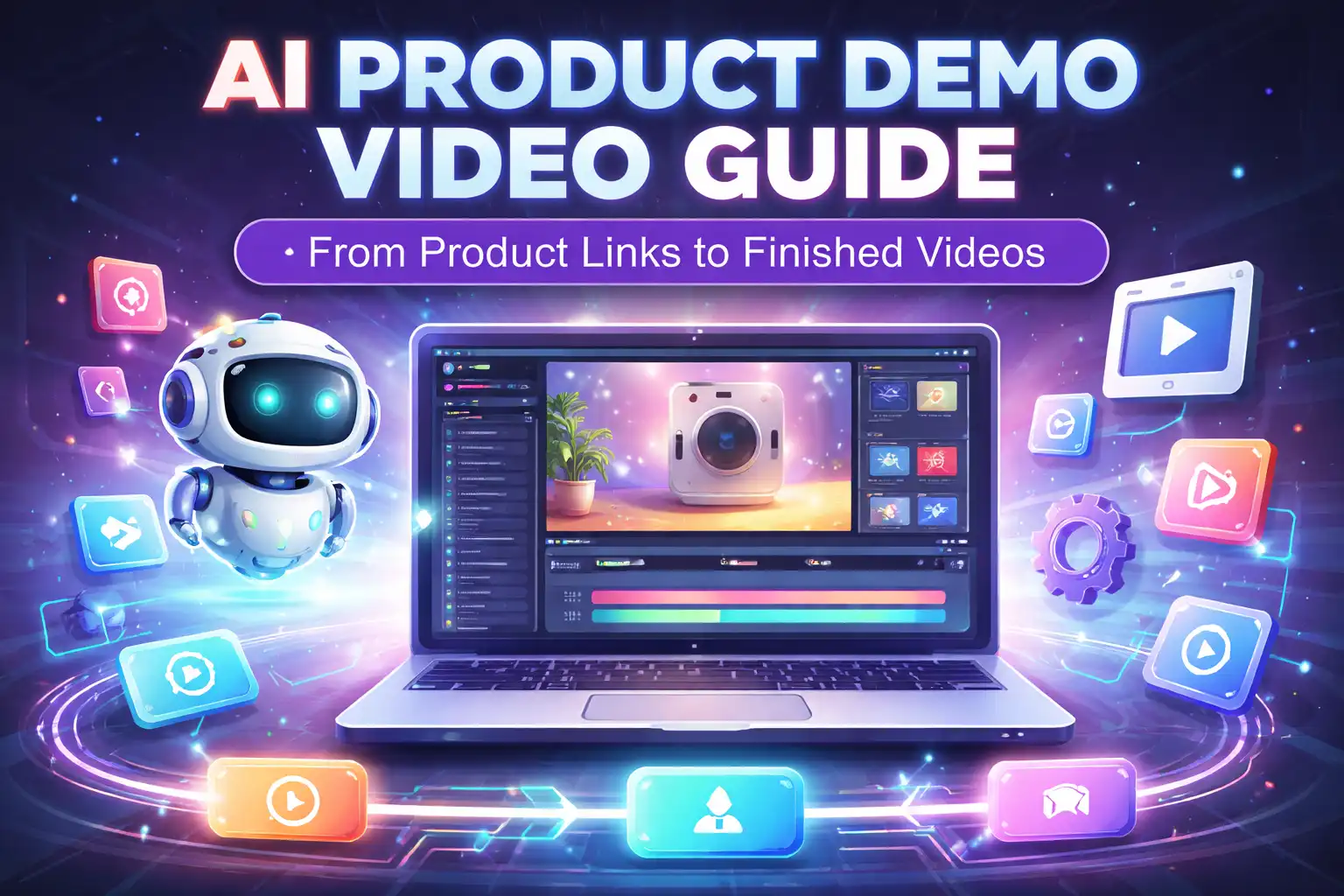
Guide to AI Demonstration Video Production for Tech Products: Workflow Analysis from Product Link to Final Video
Open any e‑commerce page for a tech product, and buyers make a purchase decision within 72 hours, yet most brands still need 3–6 hours to produce a single demo video. In a fast‑paced, multi‑category, multi‑SKU competitive environment, manual editing is not only slow but also impossible to scale. This article does not discuss the theoretical pros and cons of AI video generation; instead, it focuses on a reproducible operating process—how to turn a product link directly into a sales‑oriented demo video while maintaining consistent quality across batches of assets.
Why Traditional Tech Product Demo Video Production Is Inefficient
Traditional workflows usually consist of five to six separate stages: script writing, storyboard design, asset collection, video editing, voice‑over, and finally exporting versions adapted to different platforms. Each stage relies on different tools and personnel, so even a 30‑second video takes at least three hours when the team runs smoothly. If revisions are needed midway, the time doubles.
The iteration pace of tech products and video production cycles are structurally mismatched. Phones, headphones, and smart home devices update functional points every 6–12 months on average, but video content often lags by two versions. You finish editing a demo video, and the product already has a Pro version. Worse, the same product must be placed on TikTok, Instagram Reels, and YouTube Shorts, each with its own aspect ratio, duration norms, and user behavior. Traditional editing can only cut each video individually and cannot reuse structures.
Time Cost
A single 30‑second demo video that includes storyboard design, voice‑over recording, and subtitle addition takes an independent creator an average of 3–6 hours. By contrast, an AI video generation pipeline can compress this cycle to just over 60 seconds. The compression logic does not replace human creativity; it merges script generation, storyboard planning, voice‑over, and rendering into a single product‑link parsing step—product title, selling‑point description, specifications, and user reviews are extracted at once and turned into a video script.
Your browser does not support the video tag.
There is a memorable data comparison: traditional production takes 3–6 hours, while AI generation takes about 60 seconds. This almost 300‑fold efficiency gap translates into a qualitative change in ad‑testing frequency—the former can usually produce only two ads, while the latter allows you to run ten A/B sets in the same week.
The essence of this efficiency gap is not that machines replace human creativity, but that repetitive structural work is automated, letting operators focus on strategy and review. The next section breaks down the specific operational logic of this workflow.
Core Workflow for AI Demo Video Generation
Turning a product link into a deployable demo video involves four to five layers of processing inside the AI. Understanding these steps lets you decide where human intervention is needed and where you can fully trust the machine output.
Parse the product link. Whether the product lives on Shopify, Amazon, or TikTok Shop, the AI crawls structured page data to extract the title, core selling‑point list, specifications, and user‑review keywords. This is not a simple text copy; it converts unstructured product descriptions into fields the script engine can understand. Different platforms have different data formats—for example, Amazon’s “bullet points” versus Shopify’s “description” differ in hierarchy and keyword density, so the AI must adapt accordingly.
Hook generation. Based on best‑practice data from e‑commerce advertising, the AI outputs multiple opening lines. This stage currently depends heavily on the quality of the underlying training data—if the training set is dominated by consumer‑goods, the generated hooks may feel unnatural on tech products. Adobe’s description of its AI video generation technology notes that commercial‑grade AI video tools require safety and relevance filtering of training data, which directly determines how well hooks match the product.
Script and storyboard planning. For 15‑, 30‑, and 60‑second durations, the AI outputs a narrative logic—opening with a pain point, middle demonstrating product use, ending with a purchase call‑to‑action—while also generating frame‑level visual references (storyboard previews). The script produced at this stage is a critical human‑review node because changes after video export are costly.
Multilingual voice‑over and automatic subtitles. VEONIB supports AI voice‑over in 30 languages and simultaneously generates subtitle styles. For cross‑border sellers, this step eliminates the most time‑consuming localization translation. For example, if you list a Bluetooth earbud in Taiwan and Thailand, a single product‑link parse yields Chinese‑English voice‑over versions and Thai subtitles without a second editing pass.
One‑click rendering and export. Native support for 9:16, 1:1, and 16:9 aspect ratios automatically matches TikTok, Instagram, and YouTube. Rendering completes in 60–90 seconds, after which you can download the MP4 file.
The core of the entire chain is that five stages are compressed into one parsing and one rendering. You no longer need to switch between script tools, voice‑over platforms, and editing software. However, this also means that if the AI makes a mistake at any stage, the error propagates directly to the final video. Therefore, regardless of workflow efficiency, inserting a human‑review node at the script stage is essential.
Register for a free preview account to test this process yourself; you can still edit hooks, scene descriptions, or voice‑over text before export.
Cross‑Platform Adaptation and Bulk Production Strategy
Video consumption behavior differs across platforms far more than just aspect ratio. TikTok users decide within the first two seconds whether to scroll past, Instagram Reels emphasizes visual texture and rhythm, and YouTube Shorts tolerates a slower information density. The same product needs different opening pacing and editing intensity on each platform.
This is the core challenge of cross‑platform adaptation—you cannot use a single video for all channels. A horizontal comparison shows that ByteDance’s recommendation algorithm is extremely sensitive to the first three seconds’ completion rate, while YouTube cares more about overall engagement. If your smart lamp opens too quietly on TikTok, you’ll lose exposure the moment users swipe away.
Generating ad variants in bulk is the most effective way to address this. For a single SKU, you can produce multiple videos with different hooks and pacing from the same asset set for A/B testing. One seller shared their method: for a phone charger, they generated eight variants—four with a pain‑point opening (“Phone battery drains in half a day?”) and four with a benefit opening (“Charge three times faster than stock”)—and compared click‑through rates after two days. A single product can generate 100 ad variants for testing, a scale impossible for manual labor.
Localization and multi‑market deployment add another efficiency dividend. If you operate both US and German stores, traditional practice is to edit two videos and record two voice‑overs. The AI workflow can parse multilingual adaptation plans at the product‑link stage. One generation covers English and German scripts, voice‑overs, and subtitles, then exports each without any translation step.
Flexibility in editing is often underestimated in this process. Many operators assume AI‑generated videos are final and cannot be modified. In reality, you can still adjust the script, scene descriptions, and voice‑over copy before re‑rendering. This means you can treat the AI draft as a rapid creative material library, selecting frameworks for manual fine‑tuning. For tools like VEONIB, output quality depends on the amount of script‑stage review you invest—AI provides the first draft, and you perform the final quality check before export.
Avoiding the Three Common Pitfalls of AI Demo Videos
Pitfall 1: Low hook‑to‑product relevance. A seller once ran eight AI‑generated variants on TikTok; three hooks were completely unrelated to the charger’s core selling point—one started with “The heartbreak of changing your phone every year,” another with “The awkwardness of forgetting your charger on a business trip.” For a fast‑charging product, the most important factor—charging speed—was never highlighted. Click‑through rates dropped about 60 % because viewers thought the video promoted phones, not chargers. The operator had to rewrite parts of the script to recover performance.
The root cause is that the AI’s weight on core selling points during link parsing is insufficient. It extracts information uniformly across all text, while human sellers know that “fast charge in 30 minutes” is the conversion keyword. The simple solution: during script preview, go through each AI‑generated hook, keep those strongly related to the product, and delete or modify generic ones. About 70 % of ad clicks happen in the first three seconds, so hook quality directly determines conversion efficiency. More supporting data can be found in the Shopify blog on video marketing.
Pitfall 2: Rhythm mismatched with platform audience. Some AI‑generated videos are paced too slowly, suitable for YouTube but not TikTok. Tech products have a much higher information density than beauty or apparel, requiring users to see product usage quickly. Many sellers overestimate the completeness of a “30‑second video.” For high‑density tech products, a 15‑second loop with subtitle strips and high‑frequency hooks better fits current short‑video consumption habits. A 30‑second video often contains redundant information in the middle, causing a noticeable increase in users swiping away.
Pitfall 3: Ignoring updates and maintenance. Tech products frequently undergo revisions. A Bluetooth earbud may receive an upgraded version within six months, with minor design changes and added features. If you continue to run a video generated from a six‑month‑old link, users will see mismatched functionality, wasting ad spend and harming brand credibility. Recommended practice: after each product update, re‑generate the video using the same product link to obtain an AI‑output video based on the new page content.
The common thread among these three pitfalls is “full automation ≠ no quality review.” The true value of full automation lies in dramatically shrinking draft time—from three hours to one minute—while still retaining a critical human‑review node at the script or hook stage. Only at this point can speed and quality be balanced.
FAQ
Q1: Can AI‑generated demo videos be used for paid advertising?
Yes. Each exported video belongs to the creator and can be used for paid ads on TikTok, Facebook, Instagram, YouTube, or any commercial channel without additional royalties or usage restrictions.
Q2: How is video ownership defined? Are there copyright risks from the platform?
The exported video is entirely owned by the creator. The platform does not retain any copyright or usage rights. As long as the product link source is compliant, the video content itself has no copyright disputes.
Q3: If the product information updates later, do I need to regenerate the entire video?
Yes. After a product update, the best practice is to regenerate using the new product link. The AI will output a new script based on the updated title, selling points, and reviews. Reusing the old video may cause mismatched information for viewers.
Q4: Can the AI‑generated storyboard script be fully customized?
Yes. During the script stage before export, you can modify hooks, scene descriptions, voice‑over copy, and even subtitle styles. After changes, the system re‑renders the video without needing to re‑parse the product link. This stage is the key quality‑control node.
Share Article