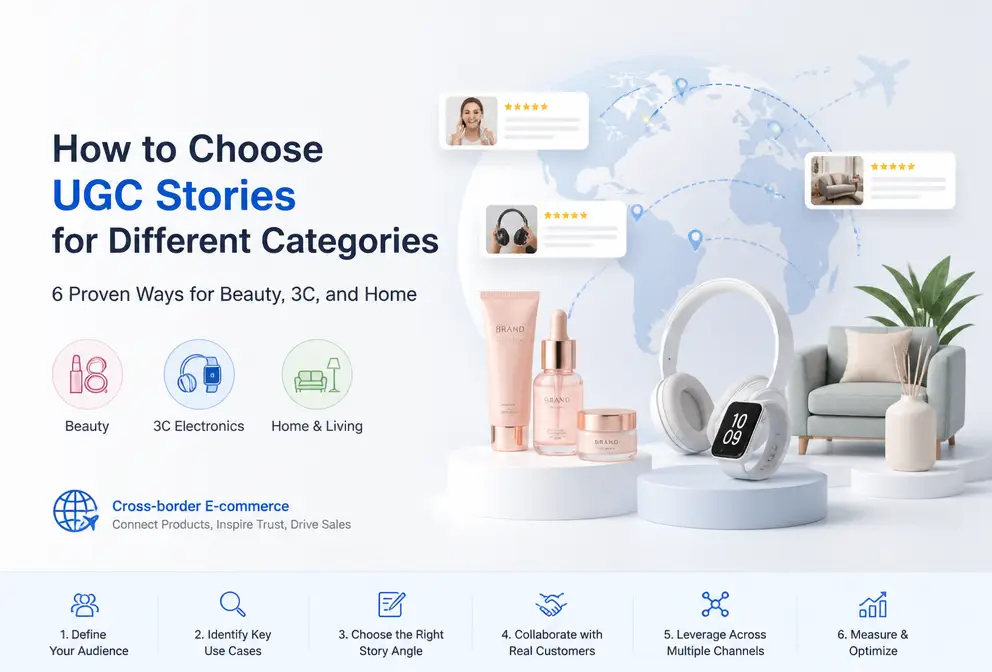
How to Choose UGC Stories for Different Categories: Six Implementation Methods for Beauty, 3C, and Home
The same product often needs a TikTok “grass‑planting” video, a product‑page video, and an ad video. Once production starts, teams quickly realize that putting every product into the same UGC Story may increase the number of videos, but conversion rates don’t improve accordingly. Beauty needs to answer “what happens after you use it,” 3C needs to prove “how to use it,” and home goods need to let consumers see how it looks in life beforehand.
When choosing a UGC Story, don’t start with the template style; start with the product’s purchase friction. The six Story types—Problem‑Solving, TikTok Review, Unboxing, Lifestyle, Social Proof, and Custom—address usage barriers, experience judgment, first contact, scenario imagination, trust building, and brand consistency respectively; the first video should prioritize the most obvious user doubt.
Choose Story by Purchase Friction First, Not by Video Style
UGC Story selection usually begins with five types of friction: consumers don’t know how to use it, fear buying the wrong thing, want to confirm actual results, need to compare with other products, or haven’t formed a concrete usage image. The product’s selling points are just information; the Story must embed that information into an experience the user can understand.

Problem‑Solving Story is good for showing “you can actually do this here”; TikTok Review is closer to a first‑person experience; Unboxing builds anticipation for the first encounter; Lifestyle places the product in commute, kitchen, bedroom, or travel settings; Social Proof carries comments and multiple feedback; Custom is used when the brand already has a fixed character, tone, or script order. The six Stories are not six mandatory rotating templates but six narrative units that can be tested independently.
A single product can have multiple Stories, but the first video should not spread information evenly. If consumers worry most about installation, the video should demonstrate installation first, not start with packaging or reactions. Product information display only needs name, specs, and price; the user‑experience narrative should explain who encounters what problem in what scenario, how they use it, and what judgment they reach after use.
After the production team gathers product links, images, and selling points, they can refer to the AI UGC Video Generation Method to plan scripts and shots. Automated generation shortens the time from material to first draft, but it does not replace the team’s judgment of purchase friction. If the input material does not specify skin type, connection conditions, or space dimensions, the generated video may skip the most important doubts.
Beauty & Apparel: Prioritize Effect, Experience, and Trust
For beauty, personal care, and apparel, the friction is often not “what the product is” but “what it looks like on a specific person.” Problem‑Solving Story can revolve around uneven skin tone, makeup steps, wear‑time concerns, care routines, or styling challenges, using before‑and‑after processes to convey experience change, but it should not turn visual effects into unverified efficacy claims.
TikTok Review is better for showing first‑person usage feelings. Consumers will watch texture, scent, spreadability, range of motion, and whether the product fits commuting or party settings. Pauses, hesitations, and usage conditions in the footage often provide more reference than a simple “great effect.” UGC authenticity comes not only from the speaker’s tone but also from when and how the product appears, and whether those actions are reproducible.
A 15‑second video is suitable for quickly stating a pain point and a conclusion; 20 seconds can add usage process; 30 seconds can fully unfold “pain point → experience → conclusion.” Different lengths are not just about cutting a few lines of voice‑over; the number of shots, subtitle density, and conclusion strength must be rearranged.
Lifestyle Story is especially useful for apparel and beauty. Preparing makeup before commuting, packing for travel, or completing an outfit before a date gives the product a clear moment of appearance instead of floating constantly in the frame. Teams can also extract characters, actions, and environments from the AI UGC E‑commerce Video Production format and rewrite scripts with the brand’s actual assets.
| Category | Main Purchase Friction | Primary Story | Visual Focus |
|---|---|---|---|
| Beauty | Uncertainty about effect and usage | Problem‑Solving, TikTok Review | Steps, texture, makeup effect process |
| Personal Care | Unclear usage scenarios and experience | TikTok Review, Social Proof | Frequency, feeling, feedback |
| Apparel | Lack of visual fit and styling imagination | Lifestyle, Custom | Body movement, environment, styling |
Social Proof can carry comments, user feedback, and multiple experiences, but genuine feedback must be separated from generalized promises. The footage may show different people describing color, fit, or convenience, but a few positive comments should not be taken to imply all consumers will get the same result. Effect expression cannot replace regulatory proof; subtitles, voice‑over, and landing pages must stay consistent.
3C & Small Appliances: Use Demonstrations, Unboxing, and Reviews to Reduce Understanding Cost
The first friction for 3C, smart devices, and small appliances is usually understanding cost. Consumers need to know what the product is, how to connect it, whether it’s compatible, how many steps installation requires, and what problem a particular feature solves. Therefore, Problem‑Solving Story often enters the production queue before a simple visual display.
When turning product‑page data into scripts and storyboards, tools like VEONIB can first read the product name, images, specs, and selling points to quickly generate a first‑draft video. Their workflow can export an editable or publishable draft within 60 seconds, but content review, spec verification, and platform publishing still require separate handling and cannot be counted as “time‑to‑market.”
3C videos need to state what the product is in the first few seconds. If the opening only shows pairing, installation, or button actions, viewers may see a motion without knowing whether they’re watching headphones, a charging dock, or a smart‑home accessory. TikTok Review can further supplement pros, cons, and usage conditions such as connection distance, battery‑life scenarios, noise environment, or the need for an extra app, rather than turning product specs into a parameter list.
Unboxing Story suits products with complete packaging, many accessories, or gift‑like attributes. A logical sequence is packaging → accessories → appearance → first power‑on → a key feature; if unboxing takes 20 seconds, the core feature gets only a subtitle, turning the video into a packaging showcase. For headphones, keyboards, chargers, and small appliances, Custom Story can be fixed as “Scene → Feature → Result,” making repeat production easier and allowing reviewers to check each element.
Hardware products can learn from the Hardware Demo Cases that present “environment first, then functional feedback.” Our team once applied the same TikTok Review template to all products; after about a week they realized 3C videos lacked functional demos, home videos missed usage scenes, and beauty videos didn’t address effect doubts. The issue wasn’t a lack of material but that more material led to rework and longer review times, eventually requiring a category‑specific primary Story and supplemental versions.
Home, Pets & Food: Place the Product in an Imagined Living Scenario
Home goods fit Lifestyle Story, but “cozy life” alone isn’t a scene. The footage must at least convey who, what space, what action, and when the product appears: a small‑apartment resident storing items, family members cleaning, a cook picking up a tool, or pet supplies showing up before feeding or tidying. This lets consumers judge whether the product fits their daily life rather than just admiring a pretty room.
Problem‑Solving Story also works for home, especially for space utilization, installation difficulty, cleaning maintenance, and efficiency. The realism of home products often comes from actions that match the target market’s lifestyle. Kitchen flow in North American homes, space conditions in Southeast Asian apartments, and European consumers’ focus on storage dimensions differ, so cross‑border releases cannot simply swap subtitle language.
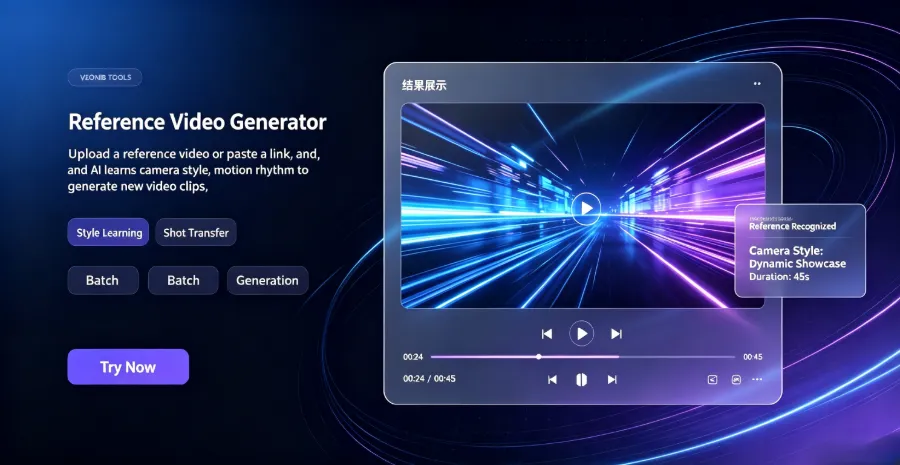
Matching scenarios after uploading reference images or videos can reduce mismatches between home visuals and product appearance, but there’s always a trade‑off between material controllability and scene authenticity. A clean‑looking generated frame doesn’t guarantee it matches a real room; smooth character motion doesn’t guarantee reproducible installation steps. Pet supplies and food are better suited for TikTok Review and Social Proof, adding concreteness through consumption, usage frequency, pet reactions, or family consumption moments, rather than relying on exaggerated expressions.
The same product can be made into 15‑second, 20‑second, and 30‑second versions to test quick showcase, full experience, and scenario storytelling respectively. Unboxing Story fits products with many accessories, complete packaging, or gift potential, but unboxing must serve the selling point. When splitting a high‑traffic piece into several short videos, the Content Multi‑Threading Splitting Method helps retain the original scenario while rewriting the intro and outro separately.
In home‑goods projects, VEONIB usually only handles the step from product data to an initial video draft; character actions, dimensional relationships, and family‑scene specifics for cross‑border markets still need manual review. If this boundary isn’t documented, teams may discover after uploading to TikTok Shop that product color, storage capacity, or usage method doesn’t match, leading to rework costs higher than creating a new short video.
Combining the Six Stories, Testing, and Cross‑Platform Publishing Checks
The six Stories can be combined as “Primary Story + Supporting Story” rather than cramming every narrative into each video. Problem‑Solving explains value, TikTok Review shows experience, Unboxing creates first contact, Lifestyle fuels scenario imagination, Social Proof builds trust, and Custom ensures brand consistency. 3C can use Problem‑Solving + Unboxing, home can use Lifestyle + Social Proof, beauty often uses TikTok Review + Problem‑Solving.
During testing, teams should vary the opening pain point, usage scenario, character tone, or call‑to‑action, not just replace background music. One version emphasizes “can’t install,” another emphasizes “how many steps are saved after installation”; they test different frictions. The first three seconds of a short‑video platform’s product identification and problem statement usually affect continued watching more than a brand slogan added later.
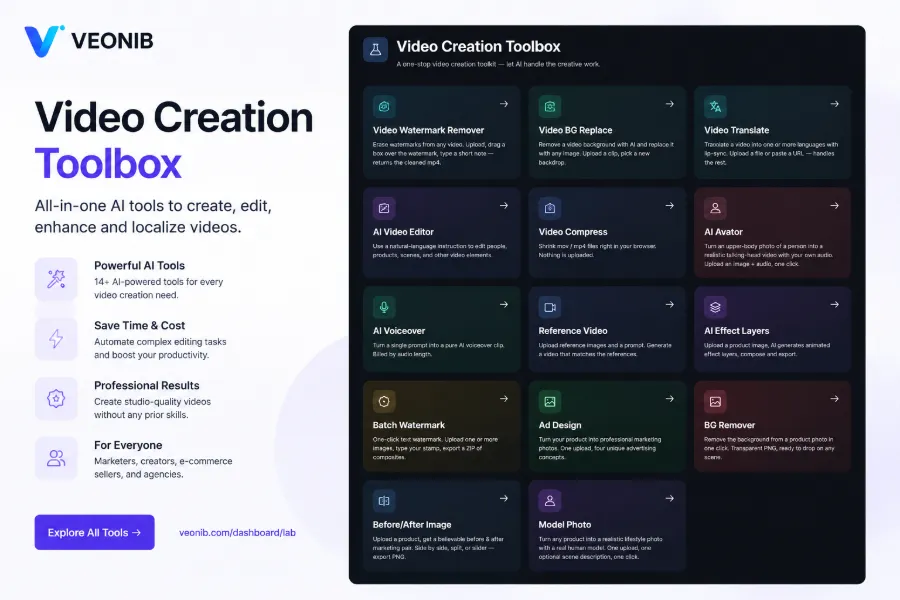
The generation process can often be completed within 60 seconds, but Shopify, Amazon, WooCommerce, and TikTok Shop have different product information and video requirements. Before publishing, each item—product name, selling points, price, subtitles, aspect ratio, language, and platform specs—must be checked. Scripts, storyboards, and export files should retain version numbers. Teams can refer to the AI Video Ad Production Guide, but they should not treat the guide as a one‑size‑fits‑all Story solution for every category.
Cross‑border projects also need to retain source assets, script versions, and platform publishing records. English, German, or Spanish versions are not just subtitle swaps; lip‑sync, speech speed, and closing information may need adjustment. When handling multiple languages, the Video Translation & Lip‑Sync Tool can be a step in the workflow. Tool information is also available on the E‑commerce Video Production Website, but platform adaptation and manual review cannot be omitted.
The final judgment is not which Story looks most “UGC,” but which one first addresses the most obvious purchase friction for the current category. Beauty first answers effect and experience, 3C first makes functionality understandable, home first makes usage scenarios imaginable, then supplemental Stories fill in trust, unboxing, or brand tone, preventing endless rework as the number of assets grows.
FAQ
Which UGC Story is most suitable for beauty products?
Beauty products usually start with Problem‑Solving or TikTok Review Story. A 15‑second video can show a usage pain point and a conclusion; 20‑30 seconds can add steps, skin feel, or usage scenarios, but actual efficacy must still be verified against compliance data.
Should 3C products do an unboxing first or a functional review?
Most 3C products should begin with a functional review unless the packaging, accessories, or gift attribute itself is a purchase driver. State the product name and purpose in the first three seconds, then use unboxing to supplement accessories, reducing the chance that viewers understand the action but not the product.
Why are home products more suitable for Lifestyle Story?
Because buying decisions for home goods depend on space, people, and actions. A 20‑second video can show a full usage process; a 30‑second version can add storage, cleaning, or installation details, which is far more helpful than a static exterior showcase for consumers to decide if it fits their home.
Can the six Stories be used simultaneously in a single video?
They can, but it’s best for a video to have one primary Story and use the others as supporting elements. Adding unboxing, review, social proof, and functional demo into a 15‑second video makes subtitle density too high, and viewers usually can’t retain the main selling point.
Do different platforms require re‑selecting the UGC Story for the same category?
A re‑check is needed, but not necessarily a complete Story swap. TikTok emphasizes quick experience and opening clash; product pages need clear functions and specs; Reels and Shorts may require adjustments in pacing, aspect ratio, subtitles, and call‑to‑action.
Share Article