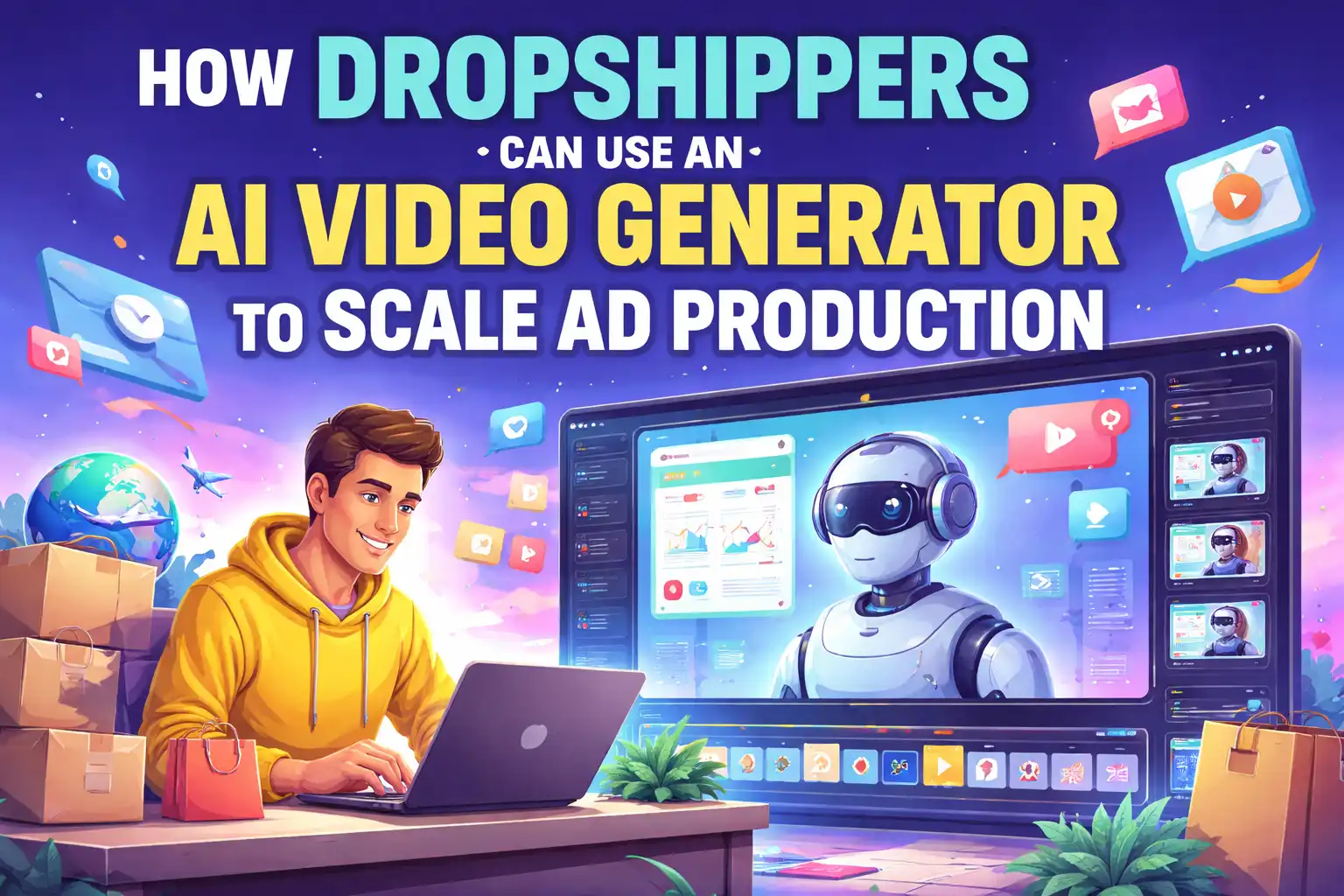
How Dropshippers Can Use an AI Video Generator to Scale Ad Production
Dropshipping is a volume game. Margins are thin, product churn is high, and a SKU that converts today could be dead next week. The difference between a winning product and a flop often comes down to how fast you can produce and test ad creative. Traditional video production—writing scripts, shooting footage, editing, adding voiceover—takes three to six hours per ad and typically costs several hundred dollars. That timeline makes sense for a brand running the same campaign for months. It makes no sense when you’re rotating through ten products a week across TikTok Shop, Facebook Ads, and Instagram Reels.
An AI video generator collapses that whole pipeline. Paste a product URL, and within sixty seconds you get hooks, scripts, storyboards, and a finished video ready to export. This isn’t a template tool that slaps text on a stock clip—it’s a full creative engine that reads the product page, understands the offer, and outputs a platform-native ad. For dropshippers operating on speed and data, that changes how quickly you can iterate.
Why Dropshipping Demands Speed Over Production Quality
The economics of dropshipping explain why manual video production is hard to justify. You’re sourcing from AliExpress or Temu, fulfilling through a third party, and competing with sellers running identical products. Profit per sale sits in a narrow band. Spending $200 to produce one video ad for a product that might not survive week two is a bad bet.
Speed becomes the lever that makes testing viable. Dropshippers need to run multiple ad variants across TikTok Shop, Facebook Ads, and Instagram Reels simultaneously. A product that works in a 15-second hook on TikTok might flop as a 30-second Facebook story. The only way to find out is to put both versions in front of audiences and let the data decide. Manual production throttles that process—you simply can’t turn around enough variants fast enough.
Traditional video production demands 3–6 hours per ad for scriptwriting, filming, editing, and exporting. AI generators produce a finished ad in under 60 seconds. That gap isn’t incremental. It’s the difference between testing five variants per product and testing fifty.
What an AI Video Generator Actually Does
To understand the workflow, it helps to walk through what happens when you drop a product URL into one of these tools. The AI parses the product page—title, description, images, price, reviews—and extracts the core selling points. It then generates hooks trained on top-performing ecommerce ads, writes a full script in 15, 30, or 60 seconds, builds a frame-by-frame storyboard, selects or synthesizes visuals, records AI voiceover in one of 30 languages, and renders the final video in 9:16, 1:1, or 16:9.
Tools like VEONIB automate this entire pipeline. You paste a Shopify, Amazon, TikTok Shop, or WooCommerce link, and the system returns a downloadable MP4 within 60–90 seconds. The output is platform-ready—no manual cropping, no timeline editing, no separate voiceover recording. It’s a single-step pipeline from URL to ad.
For dropshippers who run stores across multiple platforms, this eliminates the friction of reformatting assets for each channel. A single product URL can produce a TikTok vertical, an Instagram Reel, and a Facebook square ad in the same session. The time saved compounds quickly when you’re launching multiple products per week.
The underlying AI quality has been improving rapidly. Google’s Veo demonstrates how multimodal AI is rapidly improving video generation quality, and dedicated ecommerce tools now produce output that holds up against manually edited ads in split tests.
The cost advantage is stark; see how Google 已将 Veo 集成到 Vids 中,支持文本生成视频.
Optimizing Ad Hooks for Dropshipping Products with AI
Dropshipping products tend to fall into impulse-buy categories—gadgets, home goods, beauty tools, fitness accessories. The hook is everything. A scroll-stopping opener can double click-through rates. AI hook generators are trained on millions of top-performing ecommerce ads, which makes them especially effective at writing opening lines that trigger curiosity and urgency for these product types.
The AI analyzes the product page and outputs hooks—VEONIB’s system, for example, generates multiple variants like “This $30 gadget replaced my entire morning routine” or “Stop buying candles that don’t throw scent.” You can preview five to ten options, pick the strongest, and move on. No rewriting scripts from scratch for every variant.
Script lengths also matter for different platforms. TikTok and Instagram Reels favor 15-second ads. Facebook can handle 30 or 60 seconds. The AI generates versions at each length with corresponding storyboards, so you can test the same product with different pacing. A 15-second hook might work on TikTok but feel too rushed for YouTube Shorts. Having both ready without extra production work lets the data guide platform allocation.
One non-obvious finding: for impulse-buy products, AI-generated hooks often outperform human-written ones in controlled tests. The reason is training volume. A human writer might have written a few hundred ecommerce hooks. The AI has been trained on hundreds of thousands of real ads with known conversion outcomes. It’s more likely to hit the patterns that trigger purchase behavior.
The broader AI video industry is still evolving, and reference tools like RunwayML show the state of the art in temporal video generation. For ecommerce-specific use cases, specialized platforms have tuned their models to product-level detail, resulting in output that feels less generic than general-purpose generators.
Scaling A/B Testing Without Breaking the Bank
Once you have a working product, the goal shifts from finding a winning creative to finding the winning creative at scale. Dropshippers who use AI video tools can generate up to 100 ad variants per product per month. That volume enables a testing velocity that manual production simply cannot match.
The cost advantage is stark, as demonstrated by Google 已将 Veo 集成到 Vids 中,支持文本生成视频.
Realistic workflow looks like this: test five to ten ad variants per product in the first week. Run them on low-budget campaigns to collect early CTR and conversion data. Double down on the top two or three winners by scaling spend. Then rotate in new AI-generated variants to combat ad fatigue. One measured outcome is that dropshippers using AI video tools test 3.2x more winning ad variants compared to those relying on manual production.
But there’s a tradeoff. AI-generated ads that go out without human customization tend to feel generic. Over-reliance on raw AI output can hurt differentiation—especially when multiple dropshippers sell the same product from the same AliExpress listing. I’ve seen a case where a dropshipper ran 50 unchanged AI ads across Facebook and saw diminishing ROAS after two weeks. All the ads looked similar because they all used the same base generation parameters. The fix was to treat the AI output as a starting draft—edit the hook manually, swap in a custom image, adjust the call-to-action. Small human interventions preserved the speed benefit while restoring ad diversity.
Another observation that surprised me: the fastest dropshippers now use AI video tools to pre-test product viability before ordering any inventory. They generate a 60-second ad from an AliExpress product URL, run it as a small Facebook traffic campaign, and gauge interest from engagement and click metrics. If the ad underperforms, they never order stock. The $10 in ad spend is cheaper than committing to a bulk order that sits unsold. This turns creative production into a product validation tool, not just a marketing function.
For a deeper look at how dropshippers can run paid ads without filming anything, see our guide on how to make TikTok Shop ads without shooting any video. And if you’re evaluating the broader cost picture, our low-cost video marketing for dropshipping stores in 2026 covers budget allocation strategies that work with AI-generated creative.
FAQ
Are AI-generated videos allowed on ad platforms like TikTok and Facebook?
Yes. Every major platform accepts AI-generated video ads as long as they meet basic ad policy requirements around content and compliance. No special labeling is required for AI output. The video assets are treated the same as any other creative.
Do I need any design or video editing skills to use an AI video generator?
No. The entire workflow is URL-based. You paste a link, preview the generated content, and export. No timeline editing, no layer management, no color grading. If you can copy and paste, you can produce video ads.
How long does it take from pasting a URL to having a downloadable video?
Most tools produce a full video in 60–90 seconds. The initial generation of hooks, scripts, and storyboards takes about 30 seconds. Rendering the final MP4 takes another 30–60 seconds depending on length and resolution.
Which ecommerce platforms are supported?
Most AI video generators support Shopify, Amazon, TikTok Shop, WooCommerce, AliExpress, Temu, Etsy, and eBay. Any product URL with a structured page will work. If the page lacks enough detail, you can paste product descriptions manually.
Can I edit the script or voiceover before exporting?
Yes. You can modify any hook, scene description, or voiceover line before final rendering. The system re-renders the video to match your edits. This is the recommended workflow to avoid generic-looking ads.
Share Article