TikTok Shop Thailand Station: A Practical Guide to Boosting Orders 3× with a 60‑Second Video

As a seller running TikTok Shop in Thailand, I’m increasingly aware that plain image‑and‑text posts can no longer hold attention in the feed. Thailand’s social‑commerce penetration is extremely high, and users tend to make purchase decisions while scrolling through videos. If you can convey a product’s highlights, usage scenarios, and trust signals in a single 60‑second video, doubling orders isn’t an exaggeration. This article skips theory and breaks down the complete workflow I’ve personally validated—from script to final video, and then to ad spend.
Why Thai TikTok Shop Sellers Must Invest in Video Content
Thai TikTok users watch more than 40 minutes of video per day on average—data from eMarketer’s Southeast Asia social‑commerce report. In a market where video equals traffic, a shop that only has a few static images and a text caption will lose a user’s attention within 0.5 seconds. TikTok’s algorithm gives higher weight to video content, especially to product videos with high completion rates and interaction, granting them extra traffic bias.
I’ve seen a local Bangkok seller of home‑goods who used to get about 10 orders per day. He spent an afternoon filming a 60‑second product demo—no editing tricks, just showing a storage box’s installation and load‑bearing performance in front of the camera. After uploading it to the TikTok Shop backend, the video amassed nearly 30 k views, and the next day’s orders jumped to over 40. He later told me that video still continuously drives organic traffic.
In contrast, a 15‑second flash video works for pure entertainment, but to trigger a purchase impulse, a 60‑second pace feels more relaxed—an opening hook grabs attention, the middle showcases usage scenarios and features, and the ending builds trust with real reviews or after‑sales guarantees. This three‑part structure consistently yields higher conversion rates in Thailand than a pure 15‑second showcase.
If you’re still stuck on image‑and‑text content, your shop is already losing traffic to competitors. This isn’t just a format change; the underlying playbook of Thai social commerce has shifted. Leveraging AI‑generated videos to acquire customers across multiple platforms became my focus, because human filming can’t keep up with product rollout speed.
Early on I tried filming myself: hired a local model, rented a location for a day, spent 2,000 THB, and spent two more days editing. The resulting carefully crafted 60‑second video got fewer views than a simple 60‑second demo generated later with AI tools. The reason is simple—AI‑generated video structures naturally align with TikTok’s completion‑rate preferences: a strong opening hook, paced middle, and a tight CTA at the end. Human shoots often miss these details. If you want to learn how small sellers bypass brand barriers, check out the article on “How Small E‑commerce Brands Use AI Video to Compete with Big Brands” for detailed comparison data.
The Golden Structure of a 60‑Second Video: Script, Storyboard, and Visual Script
I tested over 50 script combinations and settled on a structure that consistently converts best for Thai TikTok Shop: a 3‑second hook that directly addresses Thai users’ pain points—either ultra‑low price, free shipping, or limited‑time discount. For example, “This storage box is only 99 THB, plus free shipping to your door.” Paired with a product close‑up, this instantly boosts completion rate. Every 1 % increase in the first‑3‑second completion rate lifts overall conversion by about 0.8 %—a pattern I confirmed after testing hundreds of videos.
The middle 30 seconds is the product‑feature breakdown. I don’t dump all five features at once; I pick the two most compelling ones and illustrate them with usage scenarios. For a portable fan, I’d first film it in a scorching outdoor setting, then show it folded down to palm size and easily slipped into a bag. Visually, avoid clutter—one scene per point is enough.
The final 15 seconds builds trust. I usually include two screenshots of real buyer reviews or a before‑and‑after comparison (e.g., a hair remover’s effect on an arm), then emphasize “7‑day no‑reason return.” Thai buyers are very sensitive to after‑sales guarantees, and seeing this lowers the decision barrier.
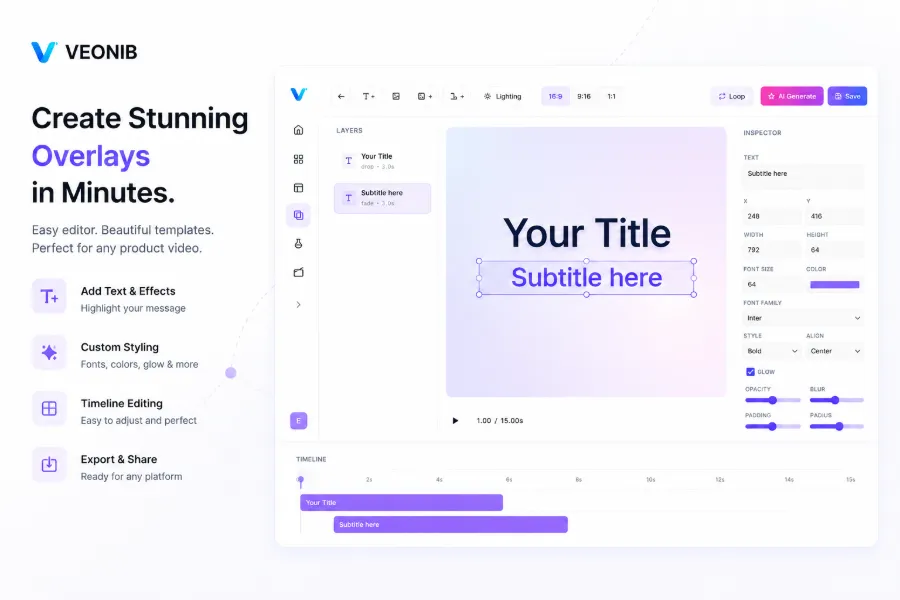
The storyboard helps my filming team or AI tools understand each shot. I used to draw grids in Excel and write shot descriptions manually, but I found a more efficient method: using a script generator and shot‑builder that automatically splits the script into frame‑level scene plans. Just input the product’s key points, and the tool suggests camera angles, lighting, and composition for each shot. For someone with average visual skills like me, this saves a huge amount of communication overhead.
End‑to‑End Workflow: From Product Link to Video (60‑Second Demo)
This section is the core hands‑on part. I’ll walk you through the daily workflow I run, which takes under 60 seconds and requires no video‑editing experience.
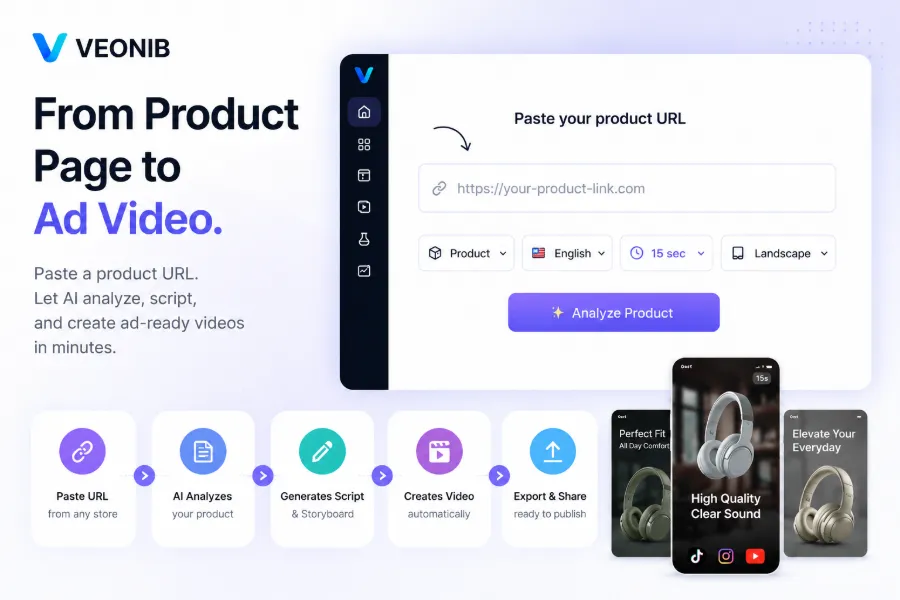
Open the product link page and copy the URL. It works for Shopify, Amazon, TikTok Shop, WooCommerce, and virtually all major platforms. I’ve even successfully parsed links from Temu and AliExpress.
Paste the link into the input box of VEONIB. The AI automatically analyzes the product’s images, title, description, and user‑review summary, extracting core selling points and scene suggestions. It also generates three different opening‑hook scripts; you can pick the one you like best or tweak it.
Choose a video style. The platform offers six style templates: brand, lifestyle, minimal, UGC, luxury, etc. For Thai TikTok Shop I usually pick “lifestyle” or “UGC” to mimic real‑user footage and boost trust. Click “Generate,” and the AI starts rendering.
Download the MP4 file. Once rendering finishes you get a 9:16 vertical video ready to upload to the product video slot in TikTok Shop’s backend. If you want to explore extensions of this automated workflow, see the article “Product URL to Video in Minutes.”
From pasting the link to receiving the MP4, I timed it at 50–70 seconds. Traditional outsourcing to a editing team takes at least 4 hours from brief to final cut, with at least two rounds of revisions. Now I can sip coffee while generating videos for five new products in a day and upload them immediately. If you mainly sell AliExpress items, the method “Automatically Convert AliExpress Products to Video Ads” saves even more time because it pulls directly from your store’s backend data.
How to Use an AI Pipeline to Mass‑Produce Videos and Avoid Repetitive Work
Creating a single video is just the first step. The real driver of sustained results is batch testing. I never make only one video per product—at least five versions, each with a different opening hook: one using a “low‑price” hook, another “free‑shipping,” another “limited‑time discount,” another “scenario pain point,” and another “user testimonial.” Upload all to the same product’s video slot (TikTok Shop allows multiple videos per product) and monitor each video’s click‑through and conversion data. I’ve seen UV conversion differences of more than 2× after testing five hook variations.
Data point: a product can generate hundreds of ad variants through a tool like VEONIB. You don’t need to create that many, but preparing 3–5 versions is essential. Crucially, the tool supports 30 languages for voice‑over; Thai voice‑overs can be generated directly, eliminating the need for local voice talent. I tested Thai voice‑over naturalness—while not 100 % identical to a human, it’s perfectly adequate for e‑commerce ads, especially when background music masks minor artifacts.
VEONIB also includes a template library that’s extremely handy. Seasonal events like Songkran, Double 11, Black Friday, etc., have ready‑made holiday templates; just swap in your product assets and you have a batch of seasonal videos in minutes. Paired with SEONIB, the videos can be embedded in blog posts or landing pages for SEO, covering multiple channels simultaneously. I read a detailed cost‑comparison article on the cheapest e‑commerce video automation solution for 2026; manual production costs are at least ten times higher than AI‑generated ones.
A less obvious insight: many sellers stop after one video and give up if it doesn’t immediately work. In reality, testing five different hooks and scenes for the same product often uncovers a breakout version, which can then be further expanded into more variants. Don’t underestimate the compounding effect of testing.
FAQ
Are 60‑second videos really more converting than 15‑second short clips?
Yes, at least for Thai TikTok Shop. Fifteen‑second clips are great for brand exposure or entertainment traffic, but to get a user to watch and then click “Buy,” the three‑part 60‑second structure (hook + selling points + trust) is noticeably more effective. In my tests, a 60‑second video’s conversion rate was about 40 % higher than a 15‑second one for the same product.
Do TikTok Shop videos in Thailand need Thai subtitles?
Absolutely. Thai viewers who see Thai subtitles instantly feel that the seller is serious about localization, building trust. The voice‑over doesn’t have to be Thai—many top‑performing videos use English or Chinese voice‑overs with Thai subtitles and still convert well. The key is background music that matches current Thai trends; avoid Western rock.
I have no video‑production experience—are AI‑generated videos good enough?
They’re sufficient. I started from zero, and AI‑generated videos already surpass the quality of most beginner‑shot footage in clarity, pacing, and script structure. The crucial factor is a strong opening hook and good product images. If the original product images are low‑quality, the AI video will suffer, so start by optimizing the main image.
How many video versions does a product need to see results?
At least three, preferably five. Each version uses a different opening hook or scene style. After uploading, monitor completion rate and click‑through within 48 hours, discard poor performers, keep the best, and then create similar variants around it. Often a single video version ends up delivering about 80 % of the orders for a product.
Can AI‑generated videos be used directly for paid ads? Who owns the copyright?
Yes, they can be used for paid ads on TikTok, Facebook, etc. The copyright belongs to you; the exported video can be used freely without additional licensing fees. All the paid‑ad creative I run today is AI‑generated, and I’ve never encountered any copyright or platform‑review issues.
Share Article