Turning Competitors' Videos into New Videos for Your Own Product: Dissection, Reconstruction, and Iteration

Marketers often scroll through Facebook Ad Library, spot a high‑performing video from a competing product in the same category, see good data and a genuine style, and their first instinct is to download it, swap the intro, add their own product, and launch. This mindset is far too common in the cross‑border e‑commerce community. Directly reusing visual assets almost always triggers the platform’s copyright complaint system: at best a single asset is taken down, at worst the entire ad account is throttled, and future review scores drop.
What can be borrowed isn’t the visual footage itself, but the “decision structure” behind it—why it opens the way it does, why certain selling points are placed up front, why a particular pacing is used for the ending. First dissect, then rebuild, and finally iterate faster than the competitor. That’s the proper way to turn someone else’s good material into your own asset.
First, Identify What to “Borrow”: The Real Value of a Competitor’s Video Is Its Decision Structure
When browsing TikTok Creative Center or Facebook Ad Library, operators see a finished video, but the reasons it gains traction are hidden beneath the visuals. A high‑performing asset usually results from several layered decisions: which audience segment the hook targets, what emotional hook is used, the order of selling points, and the final conversion closure method. These decisions form the video’s skeleton and can be observed, abstracted, and replicated.
The visual assets themselves are a different story. The real‑world footage, actors, music, and verbatim copy are tied to a specific product; swapping the product makes them ineffective, and outright copying crosses copyright lines. Most viewers decide whether to scroll away within the first three seconds, so the opening alone sets the minimum retention threshold for the whole asset—this principle holds across platforms, but the answer to “what to film in the first three seconds” must be derived from your own product and target audience.
The correct objects to dissect are the hook, script logic, shot sequence, and conversion intent—not pixel‑level visuals. Treat the competitor as a source of inspiration, not a material library; this boundary must be clear before you start.
Break Down a Competitor’s Video into a Replicable Skeleton: Script, Shots, Rhythm, and Selling Points
Dissection isn’t finished after a quick “nice” impression; it must be documented. A practical three‑step method:
- Transcribe the script segment by segment. Copy the voice‑over and subtitles verbatim, noting what each line conveys.
- Timestamp each shot and camera movement. Record when the scene changes, whether the shot is a push or pull, and what props appear.
- Summarize rhythm and information density. Count how many information points appear every five seconds and feel how the pacing alternates between whitespace and pressure.
While transcribing, label each segment with its conversion intent: grabbing attention, setting up a problem, demonstrating a selling point, or providing proof and a call‑to‑action. A single video yields only an isolated example; it’s advisable to collect 5–10 high‑performing videos of the same category and placement goal (e.g., all for TikTok or Reels) before abstracting a common skeleton. Too few samples risk treating accidental features as rules.
Below is a typical short‑form e‑commerce structure breakdown template that can be applied directly:
| Time Segment | Visuals & Camera Moves | Voice‑over & Script Purpose | Conversion Intent | Adaptation for Your Product |
|---|---|---|---|---|
| 0–3 s | Direct‑to‑face shot, quick close‑up | Pose a counter‑intuitive fact or pain point | Grab attention | Keep the pace, replace with a real pain point relevant to your product |
| 3–10 s | Expand the scene, show usage context | Introduce the problem, build immersion | Set up the problem | Rewrite with a scenario that matches your target audience |
| 10–20 s | Hand‑held shot showing product details | Stack selling points, demonstrate each one | Demonstrate selling points | Replace with your own product footage or screenshots |
| 20–30 s | Cut back to person, show price or limited‑time info | Prove effectiveness, urge action | Proof & CTA | Swap in your own discount and trust signals |
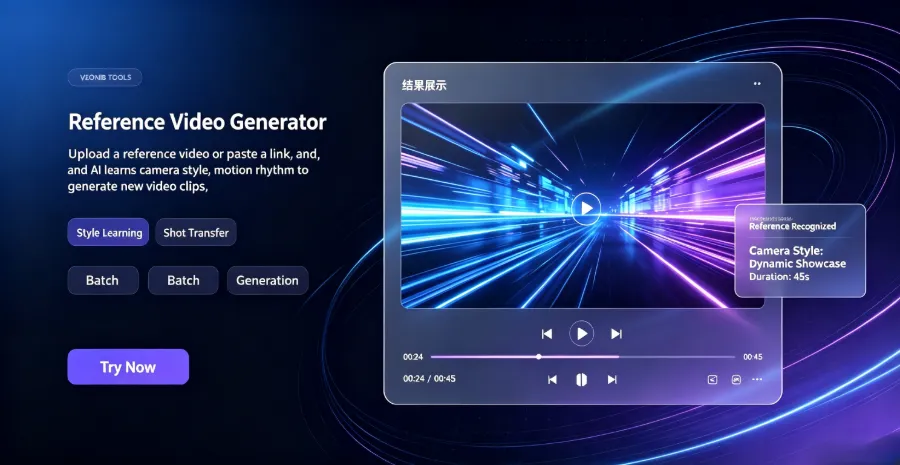
If the skeleton stays only in a document, its value is limited. After extracting common structures from multiple high‑performing videos, the next step is to turn it into a reusable asset—convert reference videos into your own brand assets. This process essentially reassembles the “extracted structure” with your own product information, rather than touching the competitor’s original footage.
Rebuild with Your Own Assets: Rewrite the Script, Reshoot the Shots, Then Match Your Product
The structure is universal; the content is proprietary. For more on the best 2026 e‑commerce AI video tools, see our Best AI Video Tools for E‑commerce Compared (2026 Edition).
Replace the shot portion with your own product footage, screenshots, or product images. Reshooting isn’t about mimicking the competitor’s camera technique; it’s about reusing the “logic that attracts viewers.” For example, if the competitor creates a product close‑up at three seconds for visual impact, find an angle of your own product that creates a similar impact rather than copying the exact composition. Keep each rebuilt asset’s script length between 15–30 seconds to match the rhythm of mainstream short‑form e‑commerce videos; too long loses retention, too short fails to convey selling points.
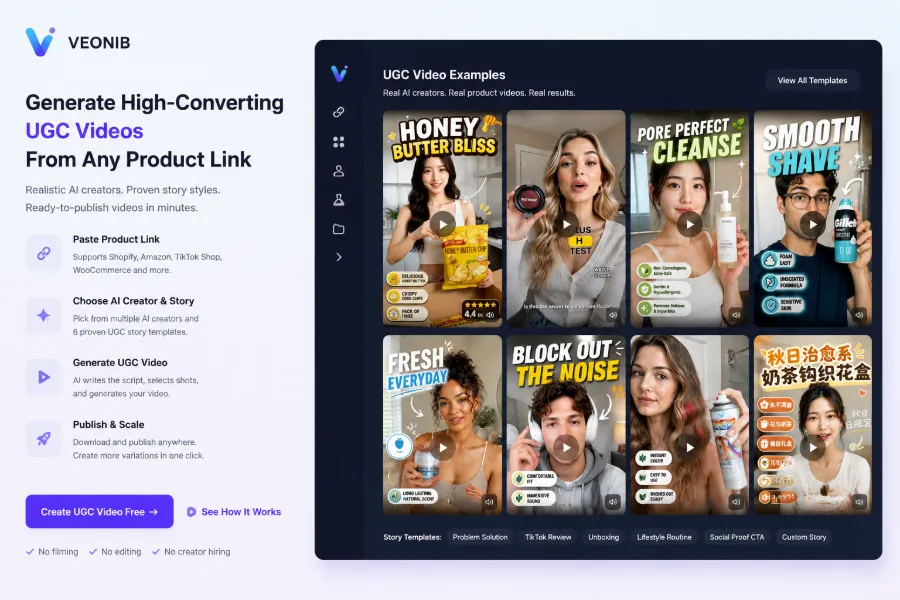
For teams lacking shooting resources, there’s a faster route: feed the product link directly into a generative workflow to produce candidate assets, skipping the filming step. Some solutions already package a workflow that turns product URLs into ad videos into reusable instructions. The core idea is to let AI parse the product page, extract selling points, and generate a script and shot plan based on a proven UGC structure. In practice, operators can give the dissected script and shot sequence to tools like VEONIB for batch generation of candidate versions, then select the few that best match their product’s tone for testing. This turns “dissection → reconstruction” from a manual task into a semi‑automated pipeline, dramatically lowering the trial‑and‑error cost per asset.
Copyright Red Lines: Structure Can Be Borrowed, Visuals and Audio Cannot Be Taken
The cost must be clear. Platforms have a mature mechanism for handling stolen assets: after a copyright holder files a complaint, the platform runs an originality check and removes the infringing material within hours, also throttling the account. Repeated violations cause review scores to drop sharply and can even lead to a ban on ad placements.
Legally, the distinction between idea and expression is also explicit. Structures, angles, and narrative formats belong to the realm of ideas and can be borrowed; visuals, verbatim copy, voice‑overs, and music are expressions protected by copyright and cannot be taken directly. The safe approach is to borrow the angle and rewrite copy and shoot around your own product. When cleaning old assets, removing watermarks is necessary, but stripping a competitor’s watermark and then using the footage is a clear violation.
Consider a cross‑border seller’s case: they downloaded a competitor’s footage, swapped in their own intro, and launched. On day three, an originality complaint led to takedown; the entire ad account’s subsequent material reviews became stricter, delaying several normally produced videos and disrupting the launch cadence. This shows that the few days saved by copying visuals are paid back with longer review cycles and increased account risk. In contrast, dissecting the structure and rebuilding with your own assets may be slower initially, but the resulting material is clean, and the account’s standing remains intact. Tools like VEONIB generate content from product‑page‑extracted original information, staying on the compliant path.
Accelerate Iteration with “Structure Reuse”: Dissection Is Not Just Output, It’s a Continuous Error‑Testing Engine
Once you codify competitor dissection into internal templates, your production rhythm transforms. What used to take weeks from concept to finished video can shrink to days, then hours, then minutes per candidate asset, dramatically expanding the testing pool. That’s the long‑term value of dissection—it’s not a one‑off output but a continuous engine for trial and error.
Winning isn’t about a single viral hit; it’s about validating multiple versions. With the same skeleton, you can swap the hook, reorder selling points, or tweak the audience script to generate several test assets. Advertising is a probability game—the larger the candidate pool, the higher the chance of discovering the next high‑performing video. When producing at scale, you must balance generation speed, realism, and platform suitability; different tools emphasize different trade‑offs, so start by comparing mainstream e‑commerce AI video tools before deciding where to invest.
An often‑overlooked point: besides high‑performing videos, “high‑view, low‑conversion” failures are also worth dissecting. They serve as excellent reverse case studies for failure attribution and pitfall avoidance—why viewers watched but didn’t buy, whether the issue lies in selling‑point order or CTA design. Dissection helps the team avoid many missteps. Expanding the dissection pool from “only hits” to “also crashes” enriches your material library substantially.
FAQ
Can I just download a competitor’s video, strip the watermark, and replace the product?
No. Removing the watermark doesn’t change the infringement. The platform’s originality check and copyright complaints will still detect it. Once reported, the asset is taken down within hours, and the account’s review score drops—making it not worth the risk.
Where’s the line between borrowing the “structure” and copying the “visuals”?
Structure includes narrative logic, pacing, and selling‑point order—ideas that can be borrowed. Visuals, verbatim copy, voice‑overs, and music are expressions protected by copyright and cannot be taken. The simple test: remove the competitor’s visuals; if the remaining skeleton can be filled with your own assets, it’s borrowing; if not, it’s copying.
If I use AI to rewrite a competitor’s script into my own version, is that infringement?
It depends on how much you change it. Simply swapping product names and a few adjectives while keeping the original sentence structure and order may still constitute infringement. The safe practice is to treat the competitor’s script as a structural reference, reorganize the language, replace specific expressions, and incorporate your own product’s genuine selling points.
How many competitor videos should I dissect before the skeleton becomes reliable?
Collect at least 5–10 high‑performing videos of the same category and placement goal before abstracting a common skeleton. Too few samples risk mistaking an accidental feature of a single video for a universal rule, causing the derived skeleton to fail when applied to another product.
Share Article