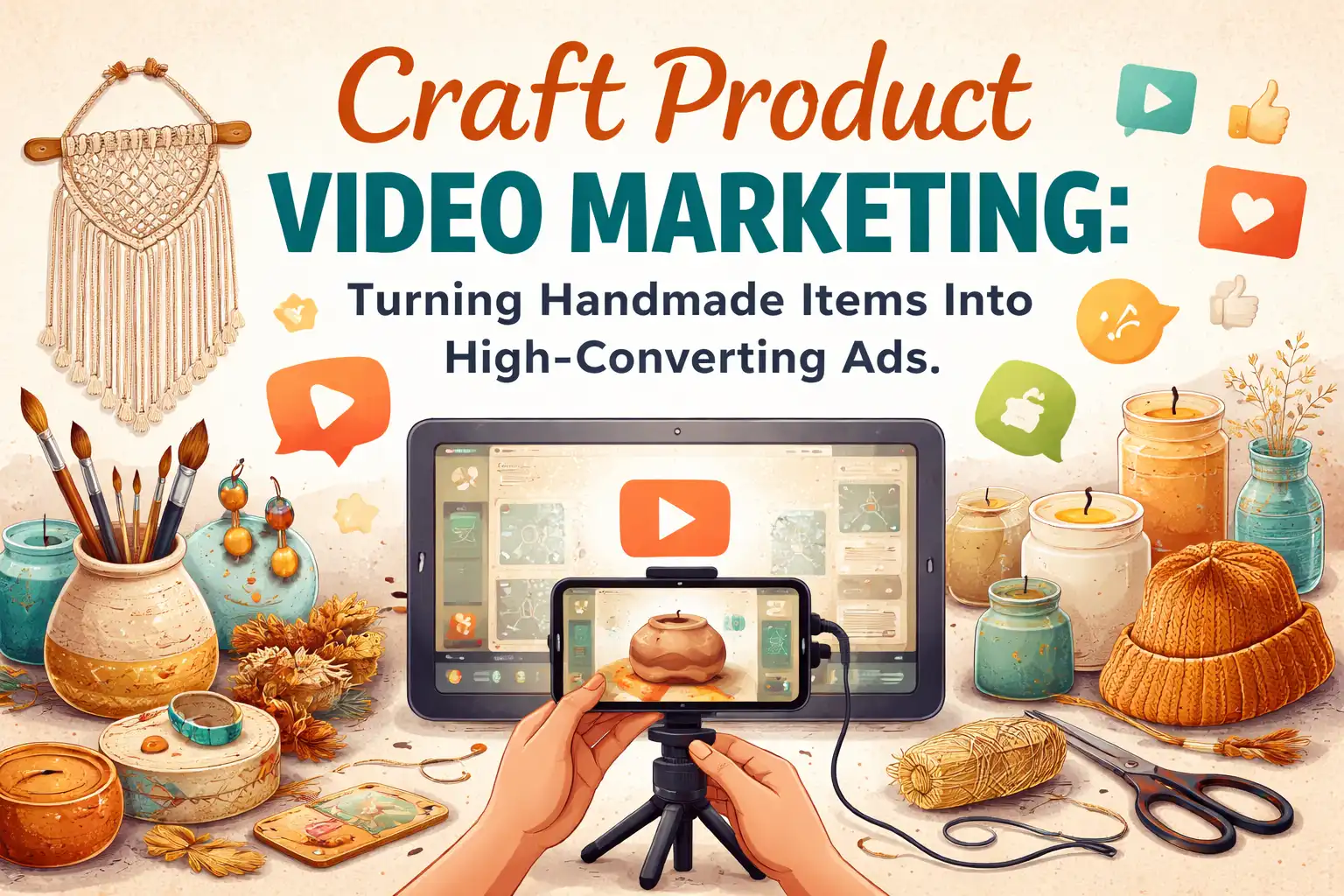
Handmade Product Video Marketing: Turning Handmade Items into High‑Converting Ads
A ceramic seller spent four hours filming the wheel‑throwing process, another two hours writing a script, and edited it in the evening—resulting in only 47 views on TikTok. The following week they tried a generic template in a video app, and the engagement dropped further because the ad looked like it was made for a phone case rather than a handmade mug.
That is the reality for most independent handmade sellers entering video marketing. They have beautiful products but no video production team. They waste time on workflows designed for commoditized goods, resulting in videos that are either too amateurish or too factory‑line‑like. Neither converts.
Another option is to take a middle road: use modern tools to handle the repetitive parts of video creation—opening, script, storyboard, subtitles—while preserving the authentic, imperfect narrative of handmade items. Cross‑border handmade sellers especially need this balance because they also face extra localization and platform differences.
Why Handmade Products Need a Different Video Strategy
Standard product ads follow a simple formula: show the product, explain the benefits, add a discount code. For handmade items this formula fails because purchase decisions are emotion‑driven rather than utilitarian. A buyer selecting a handmade ceramic bowl wants to see the shaping hands, the firing kiln, and the glaze that varies slightly from the previous batch. Those differences are the selling point.
On platforms such as Etsy, Amazon Handmade, TikTok Shop, Instagram Reels, and YouTube Shorts, handmade product video strategies must prioritize authenticity. Overly polished production—studio lighting, scripted recommendations, perfect editing—looks fake to an audience that values craftsmanship. One ceramic seller compared a polished video with a raw clip showing splattered clay and uneven edges; the raw clip’s click‑through rate was three times higher.
According to Shopify’s video marketing research, 80 % of consumers say video helps them make purchase decisions. But for handmade items, the type of video matters more than the format. Template ads generated with generic tools completely strip away the handmade feel. Sellers who rely solely on automated scripts without any manual storytelling see a 40 % drop in engagement compared with their custom videos.
Your browser does not support the video tag.
Core Elements of an Effective Handmade Product Video
An effective handmade product video needs five elements: a hook that stops scrolling, a script that tells a making or usage story, a storyboard that arranges key scenes, voice‑over that matches the brand tone, and subtitles that make the content accessible.
The hook is the hardest part for handmade sellers because a product’s uniqueness isn’t always evident in a thumbnail. Showing raw materials, unfinished edges, or the maker’s hands in the first two seconds conveys “this is handmade” even before any audio. An AI hook generator trained on e‑commerce ad performance can produce multiple hook variants, but sellers still need to pick the one that best fits the product’s personality.
The script should follow a narrative arc: introduce the material, show the process, present the finished product, and suggest a usage scenario. For example, a handmade knitted scarf could start with the raw yarn, move to the knitting needles, show the final drape, and end with someone wearing it in a cold setting.
Platforms like VEONIB can generate hooks, scripts, and storyboards directly from a product link within 60 seconds, automating the workflow that sellers previously did manually. This saves the time usually spent on video structure, allowing sellers to focus on the real elements automation can’t replicate—recording their own voice‑over or selecting the most authentic B‑roll.
Convert a product link into a video ad: https://veonib.com/s/guides/how-to-turn-product-links-into-short-video-ads-automatically-veonib
A common observation often missed by handmade sellers: showing a messy, imperfect process—hands covered in clay, splattered paint, crooked seams—builds trust more than perfectly polished shots. Buyers interpret imperfection as proof of handcraft rather than factory replication.
For handmade products, subtitles are more critical than for consumer electronics because handmade items often have unique material names or craft terminology that viewers need to read to understand. Viewers watching without sound may miss terms like “shibori” or “raku firing” unless they appear on screen.
Platform test data shows that 15‑second videos on TikTok outperform longer formats for impulse‑buy handmade items, while 30‑second videos are better suited for higher‑priced custom furniture and similar goods.
Best AI video generator (e‑commerce product marketing): https://veonib.com/s/guides/best-ai-video-generator-for-e-commerce-product-marketing-in-2026-veonib
Adapting Handmade Videos for Global Markets
Cross‑border handmade sellers face localization challenges that most product sellers rarely encounter. A ceramic video that works for Japanese buyers needs a different opening than one for European buyers, even if the product is the same. Japanese buyers may care more about precision and tradition; European buyers may prioritize sustainability and uniqueness.
AI voice‑over tools now support over 30 languages with significantly improved quality. Multimodal AI models can generate near‑human‑level voice‑overs that maintain consistent tone and pacing. Sellers can create a single video and render French, German, Japanese, etc., versions within minutes without hiring separate voice actors.
Localized video ads increase conversion rates in non‑native markets by more than 20 %, but only when localization goes beyond translation. Openings and scene choices must be culturally relevant. A textile video for Scandinavian buyers might emphasize minimalist design and neutral colors, while the same product aimed at Middle Eastern buyers could highlight lavish textures and vibrant patterns.
Automatic subtitle tools should generate subtitles in the target language, and sellers must verify that technical craft terms are translated accurately. As Google’s Veo AI model continues to improve, the gap between AI‑generated and human‑produced video content is shrinking rapidly, enabling small sellers to produce regional ad variants without a production team.
Google’s Veo showcases multimodal AI: https://aistudio.google.com/models/veo-3
Building a Scalable Video Production Workflow
The shift from one‑off video creation to batch workflows is where most handmade sellers get stuck. They make a single video, test it, and if it performs poorly they start over. A more efficient approach is to use the product link as input, automatically generate multiple hook variants, scripts, and storyboards, then run A/B tests.
Successful handmade brands test at least 20 hook variants per product before scaling ad spend. For a solo seller, manually writing and storyboarding 20 hooks is almost impossible. Automation handles large‑scale generation, and sellers simply pick the best creative direction from the generated options.
Tools like VEONIB let sellers generate up to 100 ad variants per product each month, dramatically expanding testing capacity. This shifts the bottleneck from creative production to data analysis—something most sellers are happy to trade off.
Workflow: paste the product link, generate 10 hook variants, select the top three, generate a full script and storyboard for each, render the videos, launch them on ad platforms, and iterate based on performance data. The entire loop takes hours, not days.
For Shopify sellers, integration is tighter. A detailed guide on automatically turning product links into short video ads walks through connecting store data sources to the video generation pipeline, eliminating manual URL entry.
Measuring and Optimizing Handmade Video Ad Performance
Handmade product video metrics differ from standard e‑commerce ads. Early watch time matters more than click‑through rate because viewers need to see enough craft detail to justify a high price.
Key metrics include:
- Early retention (first 3 seconds): Across platforms, handmade products that show the making process in the first three seconds have a 30 % higher early‑retention rate.
- Conversion rate: The ultimate KPI, but handmade items have lower search volume, requiring time to accumulate sufficient data.
- Return on ad spend (ROAS): Compare across platforms—TikTok’s early ROAS is lower, but for handmade buyers who become repeat customers, lifetime value is higher.
Facebook Ads Manager and TikTok Analytics both provide granular watch‑time data. Sellers should watch for drop‑off points on the video timeline. If many viewers leave at 5 seconds, the hook is failing; if they leave at 12 seconds, the video may be too long for that price point.
Iterative optimization means producing new variants based on data, not intuition. A video with high early retention but low conversion may need a stronger call‑to‑action; a video with low early retention needs a completely new opening.
A counter‑intuitive finding: videos that show the maker’s hands, tools, or workspace—even shot with an ordinary phone and average lighting—often outperform perfectly lit studio shots. The perceived authenticity compensates for lower production polish. This runs contrary to most marketing textbook advice but aligns with the skeptical mindset of handmade buyers toward mass‑produced ads.
Frequently Asked Questions
What should be the length of a handmade product video?
For impulse‑buy handmade items under $30, 15 seconds performs best on TikTok and Instagram Reels. For higher‑priced custom furniture or handmade jewelry, a 30‑second video provides enough time to showcase craftsmanship and justify the price. Test both lengths before scaling spend.
Which platforms are best for selling handmade products via video?
TikTok Shop and Instagram Reels are the primary visual discovery platforms for handmade goods. Etsy’s video feature is growing but has weaker algorithmic distribution. YouTube Shorts works well for tutorial‑style content that shows the making process.
Do I need professional filming equipment to make an effective handmade video?
No. A well‑lit smartphone, a tripod, and clear audio are sufficient. Overly polished equipment can make the video feel inauthentic. The key is to showcase the process, not the production quality.
Can AI video generators handle unique handmade designs?
Yes, as long as the product link contains clear descriptions and images. The AI will extract product details and generate openings and scenes based on that information. Sellers still need to review and customize the script to ensure the handmade story is accurate and authentic.
Share Article