GEO in Action: When ChatGPT Starts Recommending Products, Why Does Your Brand Get Chosen by AI?

Imagine—your potential customers no longer type “best smartwatch 2026” into a search engine, but instead ask ChatGPT or Perplexity the same question. A few seconds later, the AI presents a recommendation list, and your brand isn’t on it. Where is the traffic? In the AI’s answer. Industry research estimates that by 2026, over 30% of consumer searches will involve AI conversational queries. This isn’t the future; it’s happening now. If you’re still staring at keyword rankings and backlinks every day, you may have already missed a wave of traffic dividends.
Bottom line: Generative Engine Optimization (GEO) isn’t a rebranded version of traditional SEO, nor is it a black‑hat gamble—it’s a systematic set of actions that brands take to make AI “trust” their information. This article skips the fluff and breaks down exactly how GEO works in practice, and how to force your brand information into AI answers without burning money.
Why AI Recommendation Engines Are the Next “Must‑Win Battlefield” – Comparing GEO and Traditional SEO
GEO’s core goal is simple: influence the answer logic of AI tools like ChatGPT and Perplexity so that your brand becomes the AI’s top recommendation. Sounds like SEO? The difference is huge.
Traditional SEO logic: you optimize keywords, build backlinks, improve Core Web Vitals, and fight for a top‑three spot on Google’s SERP. Users see your link and click. That’s the “search results” game.
GEO logic is completely different: AI doesn’t display ten blue links for you to click. ChatGPT’s answer is a synthesized paragraph—it aggregates semantic signals from multiple data sources and generates a passage that may or may not mention your brand. If the AI doesn’t deem your information “trustworthy,” you don’t even get a mention.
Picture this: a user asks Perplexity “recommend a smartwatch suitable for morning runs.” In the SEO era, you’d just stuff your product page with keywords like “morning run,” “water‑resistant,” “heart‑rate monitor,” and you’d rank. In a GEO environment, what does ChatGPT do? It checks whether your brand website has clear structured data, whether your Amazon product description matches the website, whether TikTok video comments include real users saying “this watch is really stable while running,” and even whether your blog FAQ seriously answers those questions. If these signals conflict—e.g., the website says “water‑resistant 50 m” but a social‑media video shows someone wearing it at a pool—AI will automatically lower your weight.
Why? Because AI’s recommendation mechanism relies on “trust signals.” A single platform’s information can’t be evaluated in isolation; it needs cross‑platform corroboration. Consistent information is estimated to be cited by AI at least 2–3 times more often than inconsistent information. This means a unified, trustworthy brand data system is more important than any single‑point optimization.
In essence, GEO isn’t speculation; it’s systematic cleaning and optimization of brand information input. Think of it like a factory cleaning its production line before shipping— you don’t want to send defective products to customers, and AI doesn’t want to recommend unreliable brands to its users.
By the way, we previously compared tool choices for a similar scenario; see the practical case study VEONIB turning a classic fragrance trio link into an ad video for the actual effect of generating an ad video directly from a product link.
Where AI’s “Senses” Come From – Text Signals, Visual Signals, and User‑Behavior Signals
AI doesn’t recommend brands by intuition. Its “senses” come from three dimensions: structured text, visual signals, and user‑behavior signals.
Text signals are the foundation. Your product detail pages, blog posts, FAQs—if they use structured data (Schema.org), AI parses them more smoothly. But text alone isn’t enough—AI also cross‑checks the same text across platforms. The website says “battery life 10 days,” the Amazon page says “10 days per charge,” and a TikTok video description says “used ten days without recharging”—these three pieces line up, and AI treats “10‑day battery life” as a trustworthy signal. Conversely, any source that deviates gets flagged as “needs verification” or ignored entirely.
Visual signals are the second pillar, often overlooked. AI doesn’t just read text—it analyzes images and video. High‑quality product videos and UGC content directly boost AI’s “content confidence.” Why? Because visual content provides social‑validation “evidence”: a photo of a product in real‑world use proves the brand exists in the real world more convincingly than a specs sheet. Estimates suggest that brand pages with video content receive about a 40% higher weighting in AI’s semantic extraction than pure text‑image pages—not a trivial number.
User‑behavior signals are the third. AI correlates search trends, purchase data, review sentiment, etc., but most of that data lives with Amazon and Google. For brand marketers, the actionable levers are the first two: text and visuals.
This brings up a collaboration strategy. For text, you need a tool to calibrate and unify content; for visuals, you can use a product like VEONIB to quickly generate high‑quality videos, supplementing visual signals. Specifically, VEONIB can parse a product link and, within 60 seconds, produce a full ad video with hook, script, storyboard, voice‑over, and subtitles—mass‑producing visual signals that would be nearly impossible to do manually. Text calibration plus video rollout, both dimensions working together, allow AI to cross‑validate your brand across multiple data sources.
Practical Step 1 – Calibrate AI’s “Brain” with Text
Text‑level GEO actions aren’t flashy, but they’re easy to get wrong. The core principle is one: information consistency.
Restructure product description – Stop writing “our product is great, buy it.” AI prefers structured, comparative language. For example, instead of “perfect extraction” for a coffee machine, say “this coffee machine extracts in 30 seconds, pressure stable at 9 bar—compared with same‑price Brand A, its noise is 12 dB lower.” Comparative language and problem‑solving descriptions help AI understand where your product shines.
Use structured data – Google Search Central provides comprehensive docs on adding Schema.org markup to product pages (including rating, price, availability, brand, etc.). This is crucial because it lets AI read a JSON‑LD block directly instead of parsing the whole HTML. See the official Google Search Central documentation for implementation details.
Unify core messaging across platforms – If your brand has pages on the website, Amazon, TikTok Shop, Shopify, etc., AI will fetch all versions for cross‑checking. Core selling points must be repeated and identical—minor phrasing differences are okay, but numbers, advantages, and use‑case descriptions must stay the same. If the website says “suitable for apartments under 60 sqm,” the Amazon page cannot claim “suitable for all apartments.”
Practical tip: Cover long‑tail questions in your blog or FAQ. If you sell smartwatches, write a post titled “Smartwatch vs. Traditional Watch: Which Is Better for Running Training?” When a user asks ChatGPT “I want a smartwatch for my mom that can monitor heart rate—what’s good?” your blog content is more likely to be pulled as training material. ChatGPT doesn’t cite your URL; it cites content it has seen with high semantic relevance. The closer your blog mirrors real user phrasing, the higher the citation chance.
A brand once unified all platform copy, and three months later, ChatGPT started mentioning it in “which brand to recommend” answers—not because of keyword stuffing, but because AI saw consistent narratives across data sources.
Practical Step 2 – Build a High‑Scoring Visual Channel for AI’s “Eyes”
Once the text calibrates AI’s “brain,” you need to feed the visual channel—AI’s “eyes.” Many haven’t started this yet.
How do visual and UGC signals directly boost AI brand recommendation weight? When evaluating a brand, AI captures three visual layers: video thumbnail, video description text, and comment text. If you post 50 genuine user‑experience videos on TikTok—even if some are AI‑generated UGC‑style videos—AI treats them as “social‑validation signals.” When a user asks Perplexity “which shower gel lasts the longest,” AI leans toward brands with abundant real video content on social media rather than those with only a product image and a link.
Key insight: visual content (videos) is essentially “emotional icing.” It doesn’t solve the “who to recommend” logic—that’s handled by text signals. Video’s role is to help AI decide “whether this brand deserves discussion.” In other words, if you have only text and no video, AI may deem your brand information insufficient for recommendation. If you have only video and no text, AI will ignore you because the information isn’t unified. Both dimensions are required.
I worked with a brand seller who generated 100 UGC‑style product videos automatically and posted them on TikTok and Instagram. The result? AI still skipped the brand when answering “which brand to recommend.” Why? Because the text side of GEO was missing—website and Amazon descriptions were inconsistent, even the core price differed. AI cross‑validation saw “$29.99” in videos versus “$34.99” on the website and flagged the brand as “untrustworthy.” Visual signals can’t work alone; they must be coordinated with text GEO.
Automated bulk production of UGC‑style videos is now common. Tools like VEONIB let you paste a product link and automatically generate hook, script, storyboard, voice‑over, subtitles, and render a 15‑ to 60‑second short video—all within 60 seconds. This enables brands without video‑production capabilities to quickly flood the visual channel, implementing a “text calibration + video rollout” dual strategy.
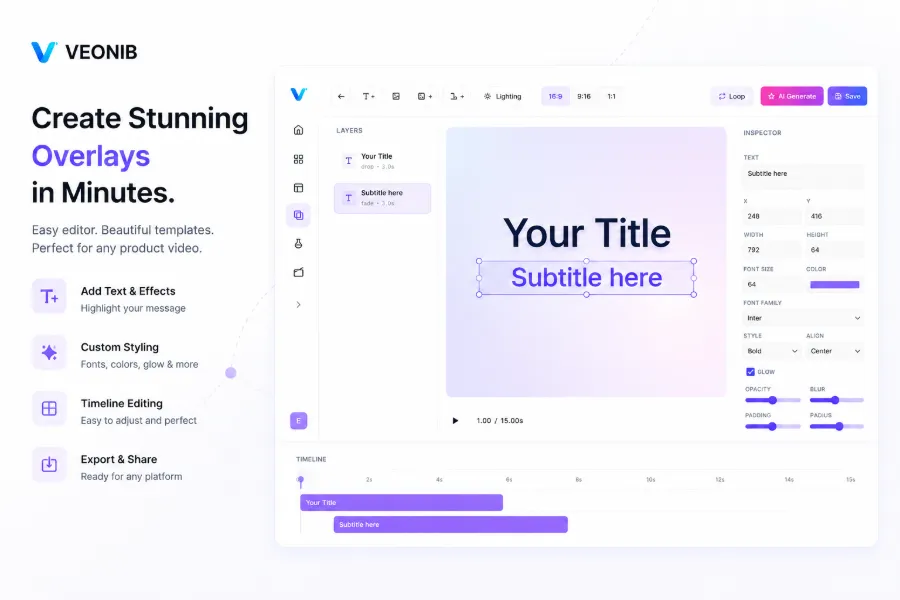
If you’re interested in a systematic overview of the AI video‑generation market, see our previous Best AI Video Tools Comparison (2026 Edition), which covers multiple mainstream tools and use cases.
The demo below shows the full conversion flow from product link to UGC‑style video:
If you’re curious, sites like Runway—an authority in AI video—are also worth checking, although their product forms differ from e‑commerce video generators.
A Pitfall to Avoid
After all this, a reminder: GEO isn’t a cure‑all. It’s not a replacement for SEO; it’s a supplement. If your brand can’t rank in traditional search engines, AI won’t suddenly start recommending you—AI’s training data heavily relies on search engine indexes. First solidify basic SEO, then optimize GEO; the order matters.
I’ve seen people treat GEO as a “quick traffic boost” and discover that AI recommendation latency is longer than search‑engine latency—after you change text, AI only reflects it after the next training cycle. That cycle can be a week or three months, completely uncontrollable.
FAQ
Q1: What is the fundamental difference between GEO and traditional SEO?
Traditional SEO targets search‑engine result page rankings, focusing on keywords and backlinks. GEO targets AI conversational recommendations, focusing on cross‑platform information consistency and semantic signals. SEO gets your link into the third spot of a search result; GEO gets your brand into a paragraph of a ChatGPT answer—completely different output formats.
Q2: I have no video‑production capability. Can I rely solely on text for GEO?
You can, but the effect will be diminished. Text signals let AI understand your brand, but without visual signals AI will consider the information insufficient. You can start with text and gradually add videos; however, skipping video entirely means you’ll miss roughly 40% of visual weighting. Brands with limited budgets should first prioritize the highest‑ROI text components.
Q3: My product is only on Amazon and the brand website has minimal information—does GEO still apply?
Yes, but it’s more challenging. When the website lacks data, AI will lean on Amazon pages and social‑media signals for cross‑validation. If your Amazon page is accurate and you have genuine user content on social media, AI can still build trust across multiple sources. However, a single‑platform approach (only Amazon) carries less weight than a “multi‑platform consistency” strategy.
Q4: How long after GEO optimization will I see results in AI answers?
There’s no fixed timeline. GPT‑4’s training data has a cutoff; if your changes don’t trigger a training update, you may not see changes for months. Real‑time AI search engines like Perplexity, however, can reference newly published structured content or videos immediately when users query. Generally, expect a range of 1 week to 3 months.
Q5: Do large models actively crawl my social‑media accounts?
Yes. Both ChatGPT and Perplexity fetch public social‑media content during training and real‑time search phases—including TikTok videos, Instagram posts, blog articles, Amazon pages, etc. Every piece of content you post on social media could become a “vote” in AI’s evaluation of your brand. That’s why GEO stresses cross‑platform consistency—any video description you post may serve as a decision factor for AI.
Share Article