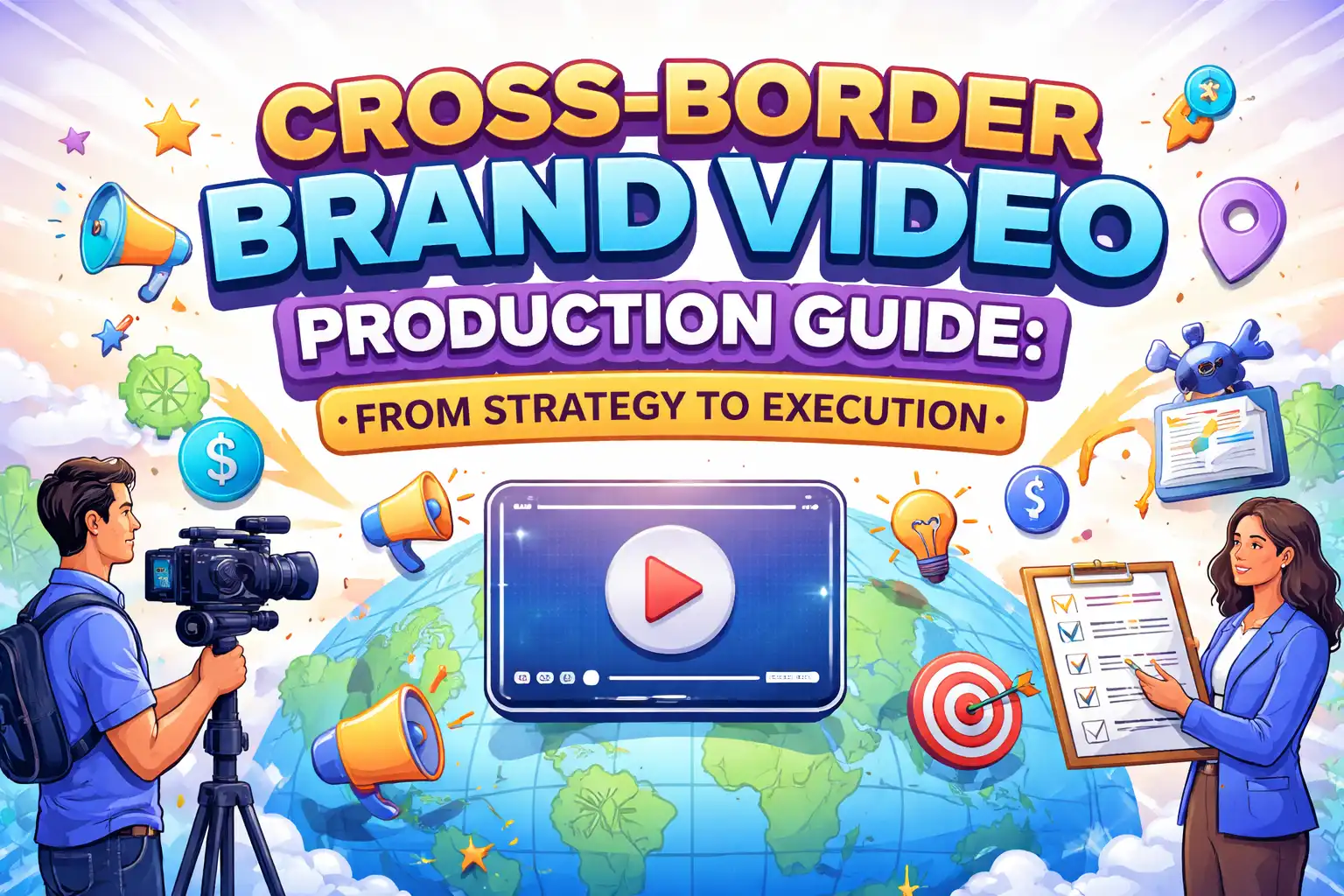
Cross‑Border Brand Video Production Guide: A Practical Roadmap from Strategy to Execution
Anyone who has worked in the Southeast Asian market has probably faced this awkward situation: you spend two months shooting a 30‑second ad, launch it in Indonesia, and discover that the hand gestures have a negative meaning locally; Thai users complain that the subtitle translation is completely unnatural. And that’s not the worst—some teams push the same set of assets to five markets, and every market ends up commenting “this ad wasn’t made for us.”
Creating videos for cross‑border brands is essentially a battle against an invisible enemy—you imagine a consumer persona in the office, but when the real users in Indonesia, Japan, or Saudi Arabia see it, it can be something entirely different. Traditional production pipelines take three to six hours per video from script to final cut; switching markets means starting over, a pace that simply can’t scale.
This article won’t talk about “how to make a brand story that moves people”—that’s the 4A agency spiel. There’s only one thing here: how to produce video assets that can land in different markets in a much shorter time.
Core Challenges of Cross‑Border Brand Videos
If your team works on one market at a time, things are much simpler. The reality, however, is that you must handle TikTok Shop, Amazon, and Instagram Reels material requests within the same week, each with different aspect ratios, languages, and cultural habits.
First pitfall: translation. Many teams cut costs by using machine translation to turn a single English script into voice‑overs for five markets. It sounds efficient, but Japanese users say it sounds like a robot is reading the script, and the Middle Eastern copy omits key polite expressions. Accurate translation does not equal effective communication—Japanese audiences favor restrained politeness, Southeast Asian users enjoy direct humor, and machine translation can’t differentiate these nuances.
Second pitfall: platform rules. TikTok requires a 9:16 vertical video with no black bars, YouTube uses a 16:9 horizontal format, and Instagram Reels has yet another size. Your team may spend time cutting one video into three versions, only to lose the product display area due to cropping—such low‑level errors are especially common during busy periods.
Third pitfall: cost vs. speed trade‑off. Traditional pipelines—script, storyboard, voice‑over, editing, export—average three to six hours for a 30‑second video. If you need to test 20 different market assets in a month, production alone consumes the operations team’s time, leaving no bandwidth for optimization.
One brand ran a classic mistake experiment: to save money, they used machine‑translated English scripts for five market voice‑overs, and Japan’s completion rate dropped by nearly 40%. Users wrote, “This company doesn’t treat us as a market at all.” Localization is more than translation; tone, pacing, and cultural details must be adapted—something machines can’t do, at least not yet.
Strategy First: Define Target Markets and Content Positioning
Many teams jump straight into writing scripts, shooting footage, and exporting versions. That’s like shooting an arrow blindfolded—you have no idea which market fits which content style.
The right approach starts with strategy. Use Google Trends or platform heatmaps to see which markets’ search volumes are rising, then tailor scripts based on each market’s video preferences. Industry research shows that localized voice‑overs in Japan can boost completion rates by about 30%. Why? Japanese consumers are highly sensitive to audio friendliness—machine‑generated voices sound noticeably electronic and instantly erode trust. The Middle Eastern market, on the other hand, values storytelling; a video with conflict and resolution performs far better than a pure product showcase.
Also keep an eye on the latest multimodal AI advances. Tools like the AI Multimodal Video Generation Progress can automatically generate storyboard drafts from product titles. They’re not 100 % ready, but they help you quickly build a script structure and save the time of writing from scratch.
The strategy stage must also resolve a core tension: brand consistency vs. localized expression. Your core brand message—“high quality, durable”—might be phrased in Japan as “meticulously detailed, solid and lasting,” and in the Middle East as “top‑tier material, attentive service.” The meaning is the same, the wording completely different. The method is to modularize content at the strategic level: hook, value point, trust element, CTA. Each module can be re‑phrased per market while the information chain stays intact.
Efficient Production Workflow: From Script to Export
Once the strategy is set, the production phase truly tests efficiency. Many teams get stuck here—script is done, but where’s the storyboard? How do you record voice‑overs? How do you adjust for each platform’s dimensions? Every step waits on people, approvals, and exports.
Now there are tools that skip those intermediate steps. For example, AI video generators like VEONIB let you paste a product link and, in seconds, generate hooks, scripts, and storyboard sketches. No need to manually write three script versions, hire voice actors for five languages, or frame‑by‑frame adjust subtitles in editing software. Drop a product link, and the system parses the title, selling points, price, then produces a set of usable hook options.
In practice, you can generate ten hook variants at the script stage, pick the two most suitable, and let the AI draft storyboards. At this point you’re not “creating” but “screening”—judging which AI‑generated direction aligns best with your brand tone. After selection, the system automatically renders voice‑over, subtitles, and BGM into the final video. Production time per video shrinks from 3‑6 hours to under 60 seconds.
One non‑obvious detail: different platforms have completely different expectations for video pacing. TikTok users scroll away if they don’t see an attraction within three seconds; YouTube viewers are willing to spend 15 seconds on background buildup. Many cross‑border brands focus too much on localized translation and ignore pacing differences—turning a long YouTube intro into a TikTok subtitle will obviously perform poorly. The correct approach is: for the same product, prepare a fast‑paced three‑second hook for TikTok, a slower‑opening story structure for YouTube, then adjust the language accordingly.
AI output still needs human review, especially for brand values and humor. Relying entirely on AI can produce “correct but boring” content—one sports brand translated “Just Do It” to “只管去做,” receiving wildly different interpretations across markets. Treat these tools as productivity amplifiers, not replacements.
After you finish writing, you can directly generate a free preview from the workflow here to see if the AI‑generated hooks and scripts match your product tone. If unsatisfied, edit and re‑render in seconds.
Cross‑Platform Deployment and Optimization
Video production is only the first step; the real challenge lies in deployment and iteration.
Platform‑specific video specs are often overlooked. TikTok’s 9:16 format cannot have black bars, or it will be demoted; Facebook’s 1:1 is common for carousel ads and product image display; YouTube Shorts follows another logic. Your team must prepare independent export versions for each platform; a one‑size‑fits‑all video won’t work. Automatic subtitles are a baseline requirement—different countries have different viewing habits. Southeast Asian users tend to watch subtitles while listening to the original audio, whereas Japanese users prefer native‑language voice‑over with Japanese subtitles.
During the launch phase, don’t run just one version. Testing five hook variants can lift conversion rates by about 20 %. The method: keep the same product and content structure, only change the hook expression in the first three seconds, run a 48‑hour test, and see which hook gets higher click‑through rates. Drop the three lowest‑performing hooks, and scale the two best‑performing ones.
Platform‑native tools are your friends. TikTok Shop Analytics shows completion‑rate distribution per video; Google Search Central tracks video exposure in search results. Connecting these channels lets you know whether a video performs better on TikTok or gains higher CTR in YouTube search.
For continuous optimization, refer to the wealth of Shopify official blog video‑marketing recommendations—especially the segmented data on how different product categories perform, which helps you fine‑tune your deployment strategy. Additionally, tools like VEONIB can quickly generate different video variants for batch testing. The iteration frequency during testing determines the eventual lift in deployment performance—a team testing 20 variants per month will see a noticeable conversion gap after three to six months compared to a team testing only five.
An often‑missed pitfall: never simply take a video made for one market, add subtitles, and push it to another market. Beyond language, colors, symbols, composition, and character clothing can be interpreted very differently across markets. If you truly lack the resources to create separate versions for each market, at least ensure core elements are neutral and non‑offensive—use neutral colors, avoid religious symbols, and steer clear of specific gestures. Then focus your effort on localizing the hook and subtitles; this alone avoids about 80 % of cultural mishaps.
FAQ
Do cross‑border brand videos need independent versions for each market?
Ideally yes, but when resources are limited you can adopt a “core material shared + hook and subtitle localized” strategy. Keep the main footage neutral, and only change the first‑second hook expression and subtitle copy per market. This reduces production cost by roughly 60 % while dramatically lowering cultural‑misfit risk.
Should multilingual voice‑overs be AI‑generated or human?
It depends on market importance and content type. For core markets (e.g., Japan, Germany, the U.S.) and high‑value brand ads, use human voice‑overs because subtle tone differences directly affect brand trust. For test assets, low‑budget markets, or UGC‑style short videos, AI voice‑overs are sufficient and cost‑negligible.
What is the optimal length for short‑form ads?
On average, 15‑30 seconds works best on TikTok and Reels, 30‑60 seconds on YouTube. A more precise rule of thumb is to consider product category—impulse items (snacks, accessories) often convert better with ultra‑short 6‑12 second videos; longer‑consideration items (home goods, electronics) benefit from 30‑45 second footage that provides more decision‑making information.
How to measure the effectiveness of cross‑border video ads?
Don’t look at views alone. Core metrics include completion rate (to assess pacing), CTR (to gauge hook effectiveness), and cost per conversion (to evaluate material quality). Each market must be evaluated separately; avoid averaging data across markets.
Are AI‑generated video copyrights clear?
Most AI video generation tools explicitly state that generated content belongs to the user and is commercial‑ready. However, verify whether the tool uses third‑party music or fonts. Before exporting, confirm that all elements have commercial licenses or use the tool’s royalty‑free asset library.
Share Article