Start a Global Small Store with $50? I Built a Cross‑Border Business with the Money of One Movie Ticket
Back then I told a friend I wanted to do cross‑border e‑commerce. He asked, “What’s the budget?” I said, “About the cost of a cup of milk tea.” He didn’t laugh, and I didn’t give up. Later I realized that if you track every cent, use Shopify’s free trial to set up a store, and generate your own assets with AI tools, $50 can actually get you started. This article isn’t a pipe‑dream; it’s a step‑by‑step record of what I actually did.
At first I wondered if that little money was too far‑fetched. Some people I know spent 20,000 yuan on courses and hired agencies, only to quit after three months with zero orders. I, however, felt that a tighter budget forces harsher decisions—you won’t spend money on useless templates, you won’t hire an editor, you won’t run meaningless ads on Facebook. Every penny forces you to find the most direct path.
My first test crashed badly. I chose a Bluetooth headset, used a free video tool to randomly generate a video, attached the Shopify link, and launched a TikTok ad. Day one spent $10 with zero conversions. Day two spent another $5, still zero. I sat in front of the computer staring at the dashboard, thinking my “$50 startup plan” would fail before it even finished. Later, on review, I realized it wasn’t the platform’s fault—the product link I chose was inherently unappealing, the data the tool scraped was poor, and the generated script was both terrible and too long, failing to capture attention. I wasted a day and half the budget. After that, I learned my lesson: every video must be previewed for free three times, confirming the script can hook viewers, before spending a dime to export.
How the $50 Breaks Down: What Exactly Did I Buy
- Shopify First‑Month Trial: Standard $1 first‑month discount, not free but almost free. I chose the basic plan, which was sufficient.
- Domain Registration: About $10 on Namecheap for a .com domain. Buying directly from Shopify’s backend costs twice as much.
- AI Video Tool: This was the most valuable expense in the whole chain. I was looking for a free yet efficient video tool and finally settled on VEONIB, which costs only $11 per month—cheaper than my dinner. It doesn’t require you to shoot footage or write a script; just drop in a product link and it automatically creates a video.
- Remaining Cash: About $28 left, which I used entirely for the smallest possible ad tests. Facebook and TikTok have a minimum daily budget of $5, enough for a first‑round validation over four or five days.
Why not buy templates? Because VEONIB comes with storyboards and scene previews, so you don’t need to spend money on Canva templates. Why not hire people? Because a 60‑second video production speed lets one person replace an entire team. Many novice sellers mistakenly think “you need a lot of startup capital,” but the biggest cost in cross‑border launches isn’t tools—it’s the psychological cost of “not daring to fail.” $50 is essentially buying an entry ticket.
Looking back, if I had spent a thousand yuan on a course, I might have stubbornly stuck with a wrong product direction because I felt “the cost was already invested.” A smaller budget forces you to test quickly and cut losses quickly. The $11 monthly VEONIB fee was far more valuable to me than those “entrepreneurial courses” costing several thousand yuan—it at least solved the very real problem of “no video assets.”
If you want to see market evaluations of such tools, check out this 2026 E‑commerce AI Video Generator Ranking, which compares several mainstream tools and their suitable use cases.
The Real Magic: Drop a Product Link, Get a Video in 60 Seconds
What surprised me most about VEONIB isn’t its low price, but that it truly feels magical—you don’t need to shoot, record, or write any copy.
The workflow is absurdly simple: find a product you want to test on AliExpress, copy its product link, paste it into VEONIB’s input box, click a button, and wait 60 seconds for a preview. It automatically generates an opening hook copy, a full script, a description for each storyboard frame, AI voice‑over, and auto subtitles. You don’t even need to see how it’s done—just preview it.
When I first used it, I was skeptical the whole time—could it really help someone who can’t edit produce a usable video? When the preview appeared, I was stunned for a couple of seconds: a ten‑second video whose cuts were smoother than my half‑day attempts with CapCut, the voice‑over had a natural English accent, and the subtitle timing matched perfectly. I did no manual work.
For why more people are abandoning traditional filming, there’s an objective analysis titled Why Product URLs May Replace Traditional Video Production for E‑commerce, whose core argument is that the efficiency gap is huge.
Output formats support 9:16 for TikTok, 1:1 for Facebook, and 16:9 for YouTube. I usually generate 5–10 different script previews in one go with VEONIB, then pick the ones that look best for export. It also supports AI voice‑over in 30 languages, so for different country markets you just select the language—no need to spend money on translators or voice actors.
Later I realized that AI video generation adds far more value than just “saving money”: a traditional video takes hours, AI can produce 10 versions in minutes, making A/B testing ten times faster and increasing product selection success rates. I once tested a kitchen gadget, spent 20 minutes creating 8 different hook video versions, and the next day two of them generated conversions—something that would have taken at least a full day in a traditional workflow.
If you’re a small brand competing for traffic against big brands, check out this article: How Small E‑commerce Stores Compete with Big Brands Using AI Videos, which discusses many practical tactics.
Testing the Market with a Few Dollars: One Video, Five Variants
The tool solved the material problem; the rest is testing. I don’t use a large budget to gamble on whether a product will be a hit; instead I validate with a “small spend, many versions” approach.
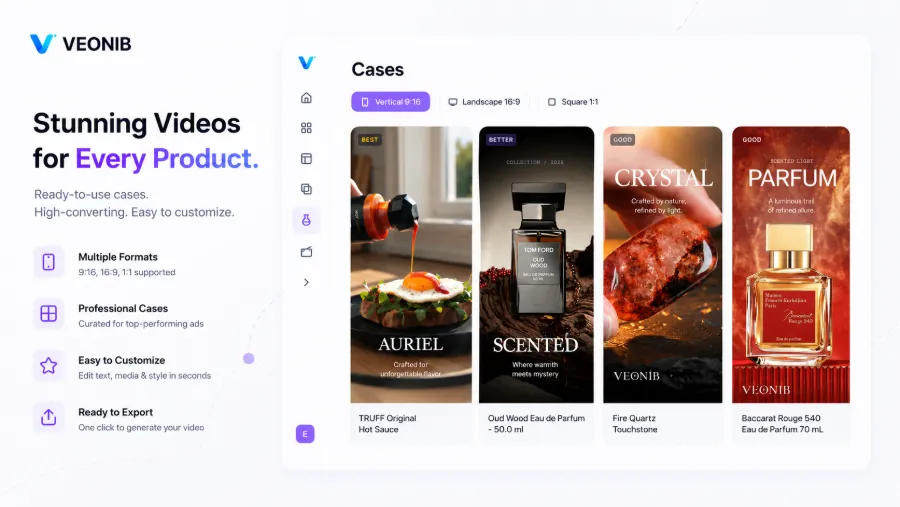
For a product, I generate at least five video versions from different angles with VEONIB. For example, selling an essential‑oil diffuser:
- Version 1: Unboxing experience, highlighting packaging quality
- Version 2: Feature demo, emphasizing quiet operation and battery life
- Version 3: User pain‑point hook, “Why the diffuser you bought is useless”
- Version 4: Scene‑based, “The happiness of having it on your office desk”
- Version 5: Comparison review, “What’s the difference between a 39‑yuan and a 399‑yuan diffuser”
I switched scripts three times, each time regenerating with VEONIB, creating a new version in a minute.
Then on TikTok Ads and Facebook Ads, I assigned each video to its own ad set with a daily budget of $5–$10. After two days I looked at the data: which version had the highest CTR, which version’s conversion rate held up. In practice, multi‑variant testing can boost conversion rates by about 30%—not luck, but simply covering different decision mindsets with variants.
The biggest advantage of this testing method is that even if all five versions flop, you only lose a few dozen dollars. If one version yields a positive ROI, you can scale it up. One product I tested this way had one out of six videos with a click‑through rate three times higher than the others, achieving an ROI of around 300%; I then scaled that video for a whole month.
If you’re a TikTok Shop seller, this no‑filming ad creation method is perfect for you. See this article: How to Make TikTok Shop Ads Without Shooting Any Video, the process is almost identical.
FAQ
Q1: Is $50 really enough to start? Are there hidden costs?
Yes, but only if you control each step. Shopify $1 for the first month, domain $10, VEONIB $11, and the remaining $28 all go to ad budget. No hidden fees, but note that Shopify charges $39/month starting the second month—you must find a direction in the first month to decide whether to continue. If you don’t achieve conversions, you can shut the store down, limiting loss to $22.
Q2: Can videos generated by the AI tool be used commercially? Do they require additional licensing?
Yes, they can be used commercially without extra licensing. The videos exported from VEONIB belong to you, with no royalty issues. I’ve run paid ads on Facebook and TikTok with these videos without any problem.
Q3: I can’t shoot or edit videos—can I still make it work?
Yes. The method described in this article is exactly a no‑shoot, no‑edit approach. You only need to copy‑paste a product link; VEONIB handles everything else—script, storyboard, voice‑over, subtitles, rendering. I didn’t even know how to use CapCut at first, yet I still generated conversions.
Q4: Is this startup method only suitable for Shopify? Can it work on other platforms?
It’s not limited to Shopify. VEONIB supports links from AliExpress, Amazon, TikTok Shop, WooCommerce, Temu, Etsy, and more. You can generate videos from any platform’s link and list the product on your own store or independent site. I used a product found on AliExpress, generated a video, and sold it on Shopify with no conflict.
Q5: If I’m not satisfied with the generated video, can I edit it?
Yes. Before export you can edit the script, hook copy, each storyboard description, voice‑over language, and style. After editing, just re‑render—no need to start over. I often tweak the opening hook to create a new version, testing which opening phrasing converts best.
Share Article