AI‑Driven Creative Localization: How Cross‑Border E‑commerce Can Quickly Adapt Ads for Multiple Markets
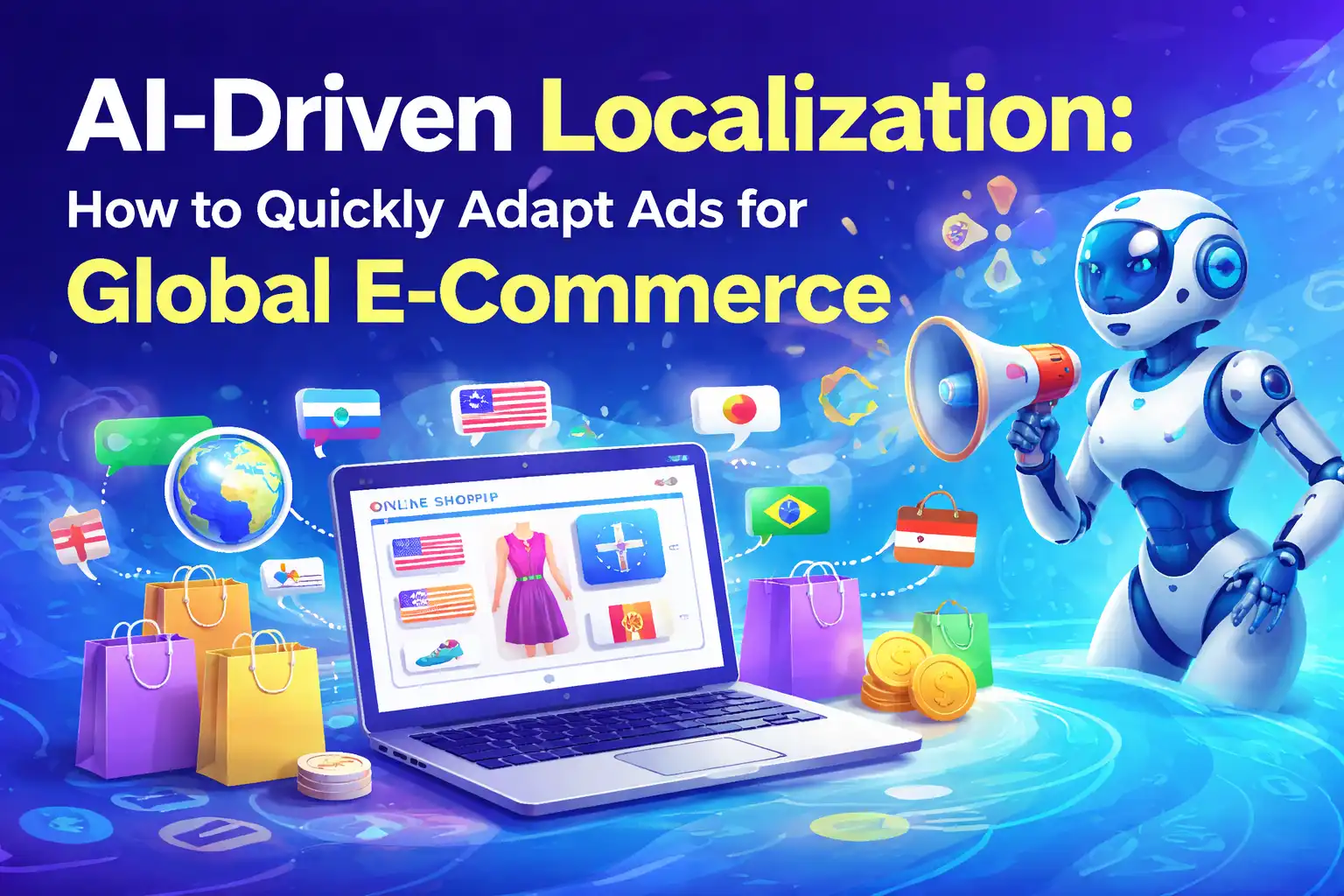
The same product link, sent to a customer in the United States and a customer in Japan, shows the same product page, the same headline, the same visual style. The real problem is that consumers in these two markets don’t perceive the product as the same thing.
U.S. users respond to “efficiency” and “time‑saving” and spend money, while Japanese users stay for “details” and “craftsmanship.” This isn’t a translation issue. The most familiar scenario for cross‑border sellers is: they spend two weeks creating five ad creatives for the U.S., get good results, then try to move them to Europe. The translation and re‑shooting take four weeks, and by the time the assets go live the hype has already faded.
Creative localization has never been an extension of translation; it is essentially a remapping of behavioral psychology onto different cultural coordinate systems. AI tools are turning this from a front‑end, non‑scalable manual task into a repeatable, iterative, testable engineering process.
Three Core Barriers to Cross‑Market Creative Localization
Let’s break down the problem. A brand entering three markets needs at least three sets of ad assets, not just three copies of copy.
1. Language layer
American humor often uses exaggerated self‑deprecation, which can make a brand seem unreliable in Germany. Japanese consumers prefer indirect expression; a literal translation of the U.S. tagline “This product changed my life” feels overly salesy. Visual symbols are even trickier: green carries religious meaning in parts of the Middle East and Southeast Asia, and using it incorrectly can damage the brand.
2. Production layer
A seller running ads on TikTok Shop, Instagram Reels, and YouTube Shorts must meet each platform’s aspect‑ratio requirements and narrative pacing—TikTok needs a hook in the first three seconds, YouTube Shorts can afford a brief lead‑in, and Instagram Reels prioritize visual polish. Manually creating a set of assets for each platform consumes at least half a day per SKU.
3. Response layer
After an ad launches, market feedback may reveal that the hook, color tone, or actor is off. Want to iterate quickly? In traditional workflows, changing a line of script means re‑shooting, re‑recording voice‑over, and re‑editing—still two to three days at best.
A survey of more than 300 cross‑border sellers found that 69 % consider asset localization the biggest bottleneck to ad performance. That figure mirrors my own observations: it’s not the product that fails, but the creative can’t keep up with channel consumption speed.
How AI Automates the Core Steps of Creative Localization
What can AI actually do? It’s more than just translating copy.
When you feed a product link into an AI tool, it first parses the product page’s selling‑point structure—specifications, use cases, target audience. Based on that, it generates multiple versions of ad scripts and visual storyboards. Previously this required a planner, copywriter, and designer working together for one to two days; now it only needs the product link as input.
Example: A seller of desktop humidifiers wants to enter the U.S. and Japan. Using a tool like VEONIB, they paste the product link and instantly receive market‑specific ad scripts and videos. To try it out, click theGenerate free preview for a trial. The U.S. version might open with “Silent operation won’t interrupt your work meetings,” while the Japanese version could say “Every detail is meticulously designed to blend into your living space.” The logic behind both lines is different, yet both derive from the same product attribute “ultra‑quiet design.”
AI also solves voice‑over and subtitle synchronization. After a script is generated, it can output voice‑overs in 30 languages with a consistent tone—no more English sounding like an energetic host while the Spanish version sounds robotic. Speech rate, pauses, and emphasis can be fine‑tuned to each market’s linguistic habits.
Another often‑underestimated feature: the AI hook generator. American consumers favor direct benefit statements; Japanese consumers prefer being moved by emotional details; Middle‑Eastern users are more sensitive to traditional family values. AI can adjust opening strategies based on existing market data. This isn’t template swapping; it’s a semantic‑aware regeneration.
Video generation is also evolving fast. Google has integrated Veo into Workspace, supporting text‑to‑video. In the future, AI will not only edit existing footage but also generate culturally appropriate visual clips directly from text descriptions. For brands that need highly customized visuals, this will be the next capability inflection point.
Key Considerations for AI‑Driven Creative Localization: Quality, Compliance, and Brand Consistency
AI localization isn’t without cost. Three recurring issues appear in practice.
1. Naturalness of voice‑over
Early AI voice‑overs sounded robotic—pronouncing each word correctly but with wrong pauses and emotional contours. Modern mainstream AI voice‑overs achieve about 82 % of human‑like naturalness in blind tests, yet they still fall short of true “human feel.” For emotionally charged categories (e.g., baby products, pets), many sellers still opt for human recordings or AI voice‑over plus manual fine‑tuning. Tools like Canva AI Video are improving speech engines, but high‑emotion scenarios still need human input.
2. Compliance risk
This is often the most expensive issue. In 2022, a fast‑fashion brand ran an AI‑translated ad in the Middle East that featured geometric patterns with religious connotations. Within 24 hours the ad was reported, the brand had to apologize publicly and pull all campaigns, disrupting its Middle‑Eastern operations for three months. AI lacks religious and political sensitivity; it can only combine text and images based on training data and cannot judge market‑specific taboos. Therefore, compliance review cannot be delegated to AI—at least not in the foreseeable future.
3. Brand consistency
Localization and brand tone naturally conflict: the more localized an asset, the more the core visual and verbal identifiers risk dilution. A classic mistake is when brands entering Japan redesign logos and packaging to suit local tastes, only to see global brand recognition drop. When AI generates localized assets, it must preserve brand colors, logo usage guidelines, and core slogans across variants. This isn a technical issue but a configuration one—you must first define which brand assets are immutable and which are flexible localization elements.
Three‑Step Workflow for Deploying AI Creative Localization
Putting AI tools to work requires a repeatable workflow, not a one‑off setup.
Step 1: Prioritize target markets
Not every market needs the same depth of localization. Rank markets by testing priority and list the specific dimensions to adjust for high‑priority markets—copy, voice‑over, visual style, compliance requirements, taboo list. This step doesn’t need AI but sets the direction for subsequent AI generation.
Step 2: Bulk generation
Use the AI tool to generate drafts for all target markets at once, including hooks, scripts, storyboards, and voice‑over previews. If possible, create multiple versions per market—e.g., direct benefit vs. storytelling for the U.S., emotional detail vs. scenario for Japan. AI’s value here is not a perfect version but a rich set of candidates for small‑scale testing.
Step 3: Human review and fine‑tuning
AI‑generated scripts may contain inaccurate slang or cultural missteps. Have local teams annotate these issues, then adjust scripts and re‑generate videos accordingly. Finally, launch the vetted assets in each market for A/B testing.
A clothing brand applied this workflow across five markets, generating 15 creative variants with AI, and saw a 40 % lift in CTA click‑through rate. When cross‑referencing with other marketing data, follow the methodology of HubSpot—track not only CTR but also per‑variant cost‑per‑click and conversion volume.
Below is a table comparing time consumption between traditional and AI‑assisted processes:
| Stage | Traditional Process Time | AI‑Assisted Time |
|---|---|---|
| Translation & copy adaptation | 8–16 hours | 2–5 minutes |
| Voice‑over recording | 4–8 hours | 1–3 minutes |
| Subtitle timing | 2–3 hours | Auto‑generated |
| Multi‑platform format adjustment | 1–2 hours | One‑click output |
These are theoretical values. In practice, manual review and compliance checks add extra time, but for pure production steps AI reduces marginal cost per market to near zero—you only bear a fixed cost for a single human review, not repeated translation, voice‑over, and editing fees.
VEONIB’s role in this workflow centers on the bulk‑generation step: input the product link, output multilingual scripts, voice‑overs, and storyboards, then have humans perform final checks and fine‑tuning before export. The core logic is to let machines do what they’re good at (combine, generate, render) and let humans do what they’re good at (judge, approve, decide).
Treat AI as a creative production tool, not a decision‑making tool. First use AI to quickly roll out assets, then let data dictate which variants deserve deeper iteration. This is the path large brands are already taking and a method small‑to‑medium sellers can replicate.
FAQ
Q1: Can AI creative localization handle dialects or slang?
Current mainstream tools work well with standard languages—American English, Central European German, standard Japanese. Coverage of regional dialects and slang (e.g., Cantonese, Osaka dialect, Bavarian German) is still limited. For dialect‑specific campaigns, generate a standard version with AI first, then have a local speaker perform a colloquial rewrite.
Q2: Are there copyright risks with AI‑generated localized ads?
If you use a reputable tool, the generated assets usually belong to you and are commercially usable. However, be aware of the training data source—if the AI was trained on copyrighted video material, the resulting footage may inadvertently infringe. Choose products that explicitly state the user owns the output content.
Q3: Is AI voice‑over expressive enough for high‑emotion products?
Blind tests show AI voice‑over reaches about 82 % of human‑like naturalness. For categories like baby care, pet products, or emotionally charged items (wedding rings, memorabilia), most sellers still prefer human recordings. A pragmatic approach is to generate several AI voice‑over options, let a human pick the most natural one, and then fine‑tune it—this cuts cost to roughly half of a fully human‑recorded solution.
Q4: Can AI automatically identify the best‑performing style for each market during multi‑market testing?
AI cannot yet auto‑determine which style works best in a given market. It can recommend strategies based on historical data (e.g., the most successful hook patterns in a market), but the final style selection must be validated through A/B testing. Generate 3–5 diverse style variants per market, run small‑scale tests, and let the data tell you the winner.
Share Article