Short Video vs Long Video: How to Choose E‑commerce Ad Length? — I Tested Three Sets of Data with the Same Product
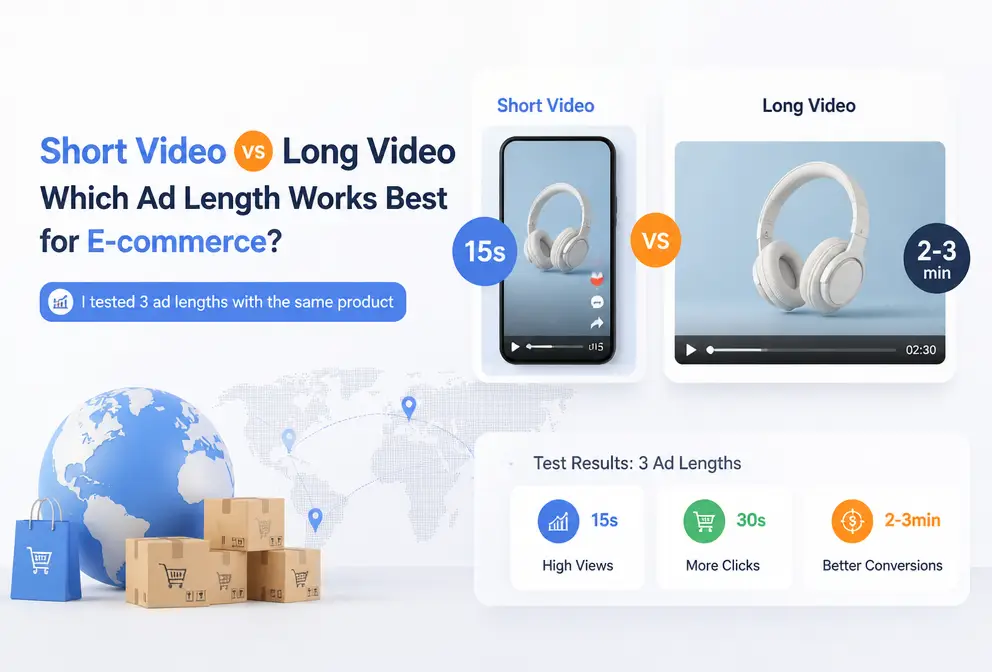
Last month I spent a week on TikTok testing three ad videos for the same Bluetooth earphones: a 15‑second quick‑cut version, a 30‑second feature demo version, and a 60‑second usage‑scenario version. After the data came in, the most surprising thing wasn’t the click‑through‑rate gap—it was that the long video’s conversion rate was almost twice that of the short video, while its completion rate was dramatically lower. This highlights a very practical issue: you can’t pick ad length by feeling alone; you must first understand users’ viewing habits on different platforms and the platforms’ recommendation mechanisms, then combine that with your own creative production capabilities to decide.
First Clarify: Ad Length Itself Isn’t the Deciding Factor; Content Density Is
Many people mistakenly think that short videos retain viewers better, so they’re more effective, while long videos are ineffective because users lack patience. In reality, after repeatedly comparing data in TikTok Ads Manager, I found that the real watershed isn’t the number of seconds, but how much effective information each second carries.
On TikTok, the average completion rate for videos under 15 seconds is more than 40 % higher than for videos over 30 seconds—this is a platform characteristic. Users swipe extremely fast; if you don’t capture attention in the first three seconds, the video will be swiped away regardless of length. However, a high completion rate does not equal a high conversion rate. My 15‑second Bluetooth earphone ad had a completion rate close to 35 % and a decent click‑through rate, but zero conversions. The post‑mortem showed that 15 seconds only allowed us to show the appearance and price, leaving no time to convey the earphones’ noise‑cancellation and battery‑life advantages.
Conversely, on Amazon Listing videos and Shopify standalone‑page landing pages, the situation is completely opposite. Users who actively search in have the patience to watch a 60‑second product demo and even want more usage details. So, to judge whether an ad length is appropriate, you must first consider the platform and user intent.
A common misconception is “the longer, the fewer people watch.” That’s not true. What actually drives users away is redundant content. A 30‑second ad that spends the first ten seconds on brand logos and effects will be swiped away by the fourth second; a 60‑second ad that continuously adds value can actually retain viewers.
| Ad Length | Suitable Product Types | Recommended Video Style | Core Goal |
|---|---|---|---|
| 15 seconds | Low‑price, impulse‑buy items | Lifestyle / UGC | Quick exposure + clicks |
| 30 seconds | Mid‑price, functional products | Brand / Minimal | Showcase + conversion |
| 60 seconds | High‑price, complex‑function products | Luxury / Studio | Trust + persuasion |
The Highlight Moments of Short Ads – 15–30 seconds Fit Which Scenarios
Short ads have a very clear structure: hook within the first 3 seconds, core selling point from 5–8 seconds, then a 2‑second CTA. This rhythm only works for high‑traffic, low‑price, short‑decision‑path products such as cosmetics, apparel, and snacks.
In my three tests, the 15‑second Bluetooth earphone ad attracted some clicks from price‑sensitive young users, but a price above $40 already requires more persuasion. The strength of short ads isn’t conversion but direction—rapidly iterating different hooks to find which selling point resonates most.
This brings up a practical pain point: many sellers are stuck because they lack editing skills and can’t quickly produce multiple short videos. In my case I now use VEONIB (https://veonib.seonib.com); just paste the product link and the AI automatically analyzes images, descriptions, and selling points, generating a 15‑ or 30‑second script and video. From URL to final clip takes about 60 seconds. This lets me easily produce 5–6 different‑hook short ads per week for A/B testing, instead of waiting three days for outsourced editing.
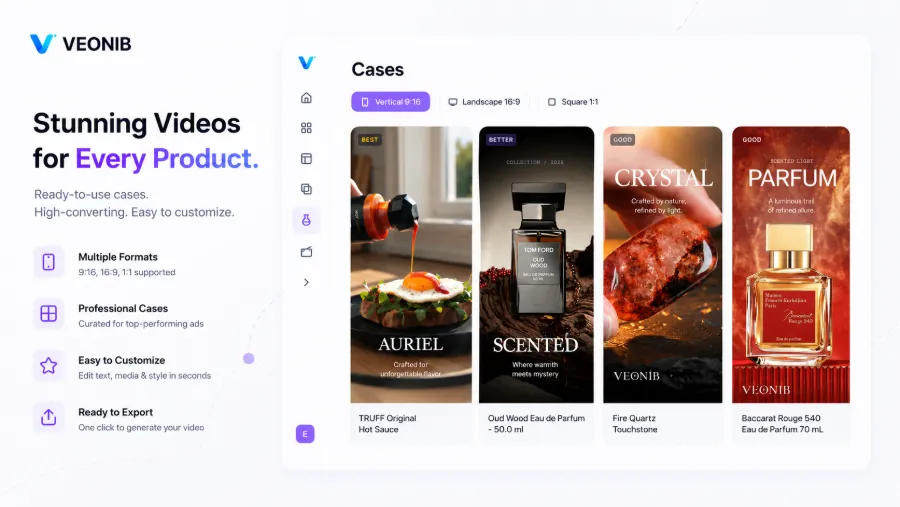
In terms of style, I recommend Lifestyle and UGC for short ads. Real‑world usage footage feels more immersive than studio product shots; users think “this isn’t an ad, someone’s actually using it.” If you already have a reference video format, you can use VEONIB’s cloning feature to turn a high‑conversion ad template into your own brand material. I once copied the structure of a viral cosmetics video and adapted it for earphones; the CTR was nearly double my original version.
The Real Value of Long Ads – 45–60 seconds as a “Trust Amplifier”
Returning to the failed test mentioned earlier. After the 15‑ and 30‑second ads produced no conversions, I created a 60‑second version: the first 5 seconds set up a relatable pain point (“can’t hear music clearly on the subway”), the next 30 seconds showed noise‑cancellation comparisons and comfort, and the final 10 seconds displayed multiple usage scenarios (commuting, fitness, office) plus a clear price anchor. This ad’s completion rate was only 12 %, but its conversion rate was four times that of the 15‑second version.
This shows that long ads aren’t meant to grab traffic, but they are excellent for conversion. High‑price products, complex 3C electronics, home goods, fitness equipment—these categories need enough information to eliminate doubts before purchase. Amazon Listing data clearly illustrate the point: products with a 60‑second video see an average 15 % lift in conversion. Users’ willingness to watch a long video on a product detail page is completely different from their behavior on TikTok.
However, producing long videos has a higher barrier. The script needs a complete narrative structure, storyboards must showcase product details and user experience, and a casual phone shoot rarely achieves persuasive power. When I made that 60‑second earphone ad, I found that VEONIB can directly select Luxury or Studio styles; the AI automatically breaks down the storyboard, planning camera angles, lighting, and composition for each shot, then generates keyframes and the video. This removes a major bottleneck for sellers without a filming team.
If you’re dealing with B2B hardware or similarly complex products, the value of a long video becomes even clearer. A product spec sheet can’t solve the problem; a 60‑second on‑site demonstration can close the deal.
How to Choose? A Simple Testing Framework to Guide Your Decision
When executing, I suggest following this framework:
Step 1: Choose the primary direction based on product price point
- Low price (< $30): prioritize 15–30 seconds, focus on exposure and clicks
- Mid price ($30–$80): a two‑pronged approach—15 seconds for hook testing, 60 seconds for trust building
- High price (> $80): emphasize 45–60 seconds, target Landing Pages and Amazon placements
Step 2: Define testing cycle and quantity
Produce at least 2 short ads + 1 long ad per week; keep each test cycle at least 2 weeks, and test a minimum of 5 versions per cycle. My first two weeks were a mistake—I switched direction after only three days, resulting in too small a sample to see real trends.
Step 3: Use AI tools to cover combinations of lengths and styles
This was the key to my later efficiency boost. Previously a 60‑second ad required at least two days from concept to final cut; now pasting a URL can generate multiple length versions in a minute, with style swaps at will. For the same Bluetooth earphones, I first ran a 15‑second UGC test to find the best‑performing hook, then ran a 60‑second Luxury version for deep conversion. AI video generation fundamentally changes the cost structure of testing in this industry.
For a deeper look at how AI tools are reshaping the overall e‑commerce marketing workflow, see the detailed industry analysis article. In short, use short ads early to test hooks, long ads to deepen brand awareness, then adjust length and style combos based on CTR, conversion rate, and completion rate feedback.
FAQ
Q1: On TikTok, which has a higher click‑through rate—15 seconds or 60 seconds?
15‑second ads usually have a higher CTR because their completion‑rate advantage is obvious; users are more likely to finish watching, and the platform gives them higher recommendation weight. However, a higher CTR does not equal a higher conversion rate; 60‑second ads, while lower in CTR, attract users with much stronger purchase intent for high‑price products.
Q2: Can the same product have both short and long versions of ads?
Highly recommended. Short versions handle exposure and hook testing; long versions handle conversion and trust building. The two versions serve different ad objectives and placement channels, and can be placed in the same ad set for comparative testing to see which combination yields the best ROI.
Q3: How should the script structure change for different ad lengths?
15 seconds: “Hook + selling point + CTA”.
30 seconds: add a usage scenario.
60 seconds: full narrative—pain‑point intro → feature breakdown → comparative proof → multi‑scenario application → price anchor → CTA. Don’t try to cram 60‑second content into 15 seconds, nor fill 60 seconds with filler just to meet length.
Q4: I have no video editing experience—can I still produce high‑conversion ads?
Absolutely. With AI video generation tools, you just paste the product link; the AI automatically analyzes product info, generates a script, plans the storyboard, and produces the video. No editing software or manual cutting required.
Q5: What video length is optimal for Amazon Listing vs. TikTok Shorts?
Amazon Listing: 45–60 seconds—users are actively searching and willing to watch a full product demo.
TikTok Shorts: 15–25 seconds—the platform algorithm rewards completion rates, and videos over 30 seconds are often swiped away.
Share Article