From “Seed Planting” to “Purchase”, Which Link in the Short‑Video E‑commerce Decision Chain Gets Stuck
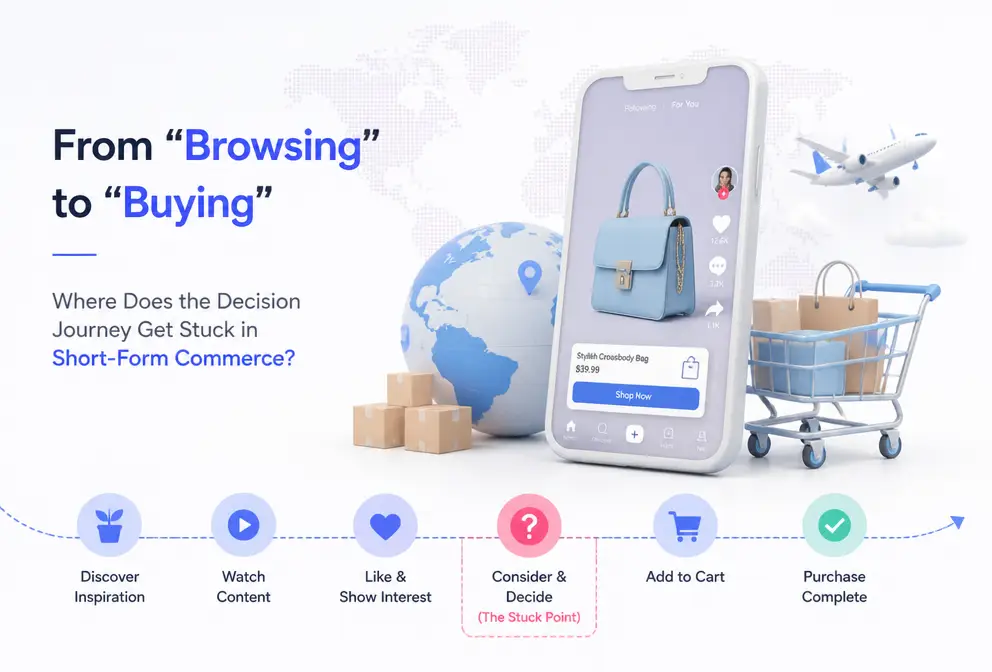
A user scrolls past a short video that sells a product and swipes away after watching; the next day they encounter the same item in their feed but still don’t click; finally a comment saying “I’ve already bought it” triggers the purchase. This scenario occurs daily on Douyin e‑commerce and TikTok Shop, yet the operations team usually only sees view counts and cannot pinpoint at which step users hesitate or drop off.
The answer is to treat short‑video e‑commerce as a decomposable decision chain. From exposure to payment, users go through at least five stages: exposure, hook, seed planting, trust, and purchase, and most people need more than three content touches before actually buying. Each stage has its own evaluation criteria and actionable optimization steps, rather than relying on “viral luck”.
Decision Chain in Short‑Video E‑commerce: What Users Experience from Exposure to Purchase
The decision chain in short‑video e‑commerce differs from traditional shelf‑based e‑commerce. Shelf e‑commerce follows a linear “search → compare → purchase” path, with users entering with a clear need; short‑video e‑commerce starts with exposure, where users passively encounter content in their feed, then go through hook filtering, seed‑planting accumulation, trust building, and finally purchase.
| Stage | User State | Content Goal | Core Metrics |
|---|---|---|---|
| Exposure (saw) | Not yet aware of need | Get the video into the target audience’s feed | Views, audience reach |
| Hook (stay) | Decide whether to continue watching | Create a reason to stay in the first 3 seconds | Completion rate, 3‑second retention |
| Seed Planting (interest) | From indifference to wanting a bit | Show usage scenarios and results | Saves, comment‑section questions |
| Trust (confidence) | Judge reliability | Provide social proof and consistent information | Repeat searches, product‑page clicks |
| Purchase (conversion) | Complete payment decision | Eliminate friction in navigation and verification | Click‑to‑conversion rate |
This chain is not a linear progression. Users repeatedly jump between the feed, search, live streams, and product pages; after seeing a video they may first search for it again, then view product reviews, leave, and return later. Building content libraries by stage (hook type, seed‑planting type, urgency type) is more effective than betting on a single viral hit, as a single video should not be expected to carry the entire conversion task.
Each short video should only fulfill one stage’s task; the team must set separate content goals and metrics for each stage, otherwise they fall into a deadlock of “lots of videos but no conversion improvement”. The adoption rate of AI video tools is high, yet content supply still cannot keep up with the pacing of ad placements. Tools can lower the production cost per video, but they do not solve the planning problem of “what content to produce for the next stage”, which is the core issue discussed in Why Most AI Video Generators Still Feel Too Complicated for E‑commerce: generation is easy, knowing what to generate is hard.
Hook Stage: The First 3 Seconds Determine Whether Users Will Enter Seed Planting
The hook’s mechanism is simple: within the first 3 seconds, use pain‑point framing, result‑first messaging, price tease, or visual conflict to make users stop scrolling. It is not responsible for selling, only for filtering—keeping the target audience and letting non‑target users swipe away. Completion and interaction rates can be monitored, but the signals closer to conversion are questions like “where to buy” or “price” in the comment section and save actions. A video with a high completion rate does not necessarily drive orders; the hook’s job is to filter purchase intent, not to please the algorithm.
Hooks must align with the product’s real selling points. Overstated promises can boost 3‑second retention but backfire during seed planting and purchase stages: users enter the product page with inflated expectations, find the item mismatched, and rarely return after leaving.
The real bottleneck for multi‑version testing is the workflow. There are four or five hook types that keep rotating; each variant requires a new script, storyboard, and edit, taking half a day per iteration. Some teams now outsource multi‑version production to tools: from a product link they directly generate scripts, storyboards, and final videos, compressing multi‑version hook testing to under a minute. The processing flow of tools like VEONIB is exactly this—paste the product link, AI completes analysis, script, storyboard, and video generation, and the team simply reviews the results to decide which version to keep.
Rapid production of multi‑version content is a prerequisite for hook testing. If material is only manually edited one by one, A/B testing stays forever on paper; turning existing product images, detail pages, and live‑stream clips into testable hook assets can follow the approach described in Generating Marketing Videos in Bulk from Any Material.
Seed‑Planting Stage: From “A Little Wanting” to “I Trust It”
Typical seed‑planting content includes unboxing, reviews, scenario demonstrations, and UGC influencer recommendations, usually 15–30 seconds long. A single touch rarely completes conversion; seed planting merely moves users from “never heard of it” to “a little wanting”.
Trust is built on three sources: authenticity—visuals and tone that closely resemble ordinary user feedback; social proof—sales numbers, reviews, comment interactions; and consistency between content and product‑page information—if the selling points don’t match, earlier seed‑planting efforts are wasted.
User behavior before purchase is typically non‑linear: see a video, search for it again, enter the product page, leave, and return. Seed planting is the cumulative result of multiple touches; saves, repeat searches, and seeing the same item again all reinforce trust. Monitoring save rates and repeat‑search data is more indicative of seed‑planting effectiveness than focusing on likes of a single video.
AI‑generated content carries trust risks at this stage. Distorted product details or false selling points are quickly exposed in the comment section, causing seed‑planting effectiveness to collapse. When using AI tools for bulk material production, content authenticity must be the top priority; the article Avoiding Product Information Hallucinations in AI Videos discusses concrete methods.
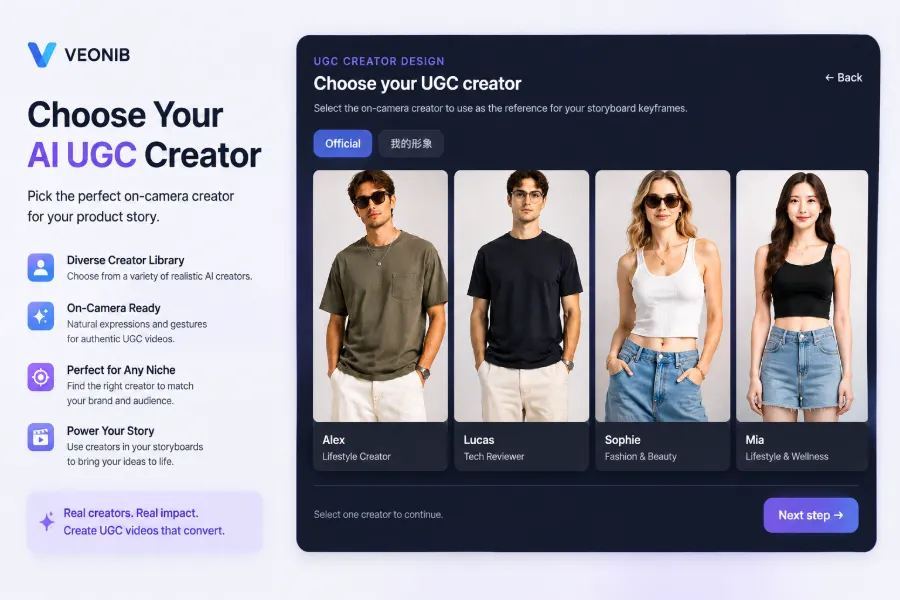
The supply bottleneck for seed‑planting content lies in teams lacking real‑person filming capabilities, making it hard to consistently produce influencer‑style material. UGC templates and AI influencer avatars alleviate part of the issue—VEONIB supports official or custom virtual characters, and with unboxing, review, and scenario script templates, small teams can maintain a update frequency with near‑zero filming cost. However, the loss of authenticity caused by virtual characters has not yet been fully solved.
Purchase Stage: Where Is the Final Conversion Friction?
From “wanting” to “paying”, friction concentrates in a few areas: overly long navigation paths; mismatched promises between the video and product page regarding price, specifications, or discounts; hesitation within the decision window due to lack of reviews or after‑sales guarantees. The click‑to‑purchase conversion rate for short‑video selling typically falls in the 1%–5% range, with most loss occurring during the information verification stage after navigation.
Key elements for closing conversion include consistency between the product card and landing page information, clear CTA and promotional tags, and reviews with after‑sales guarantees. Multi‑angle product views reduce verification costs; users can confirm appearance without scrolling through details, markedly lowering purchase concerns.
The conversion logic of short‑video product cards differs from live streams. Product cards rely on information completeness, allowing users to decide themselves; live streams rely on real‑time pressure, with hosts using limited‑time offers to push hesitation. For dropshipping stores without live‑stream staff, the effort should focus on information consistency in product‑card content.
A failure case is worth noting. One team used a “9.9‑yuan limited offer” as a hook; the click‑rate was decent, but the landing page displayed the regular‑priced product with no matching discount. Over two weeks, the click‑to‑conversion rate stayed below 1%, the material was demoted by the system, and the ad budget had to be paused. The issue was not traffic but the mismatch between the video’s promise and the product page reality—consistency checks must precede scaling.
The ongoing operation of the chain depends on whether content supply is affordable. Dropshipping stores often have dozens to hundreds of SKUs, each requiring a video. The article Low‑Cost Video Marketing Strategies for Dropshipping Stores in 2026 discusses precisely how to push per‑video production costs down to a negligible level.
Frequently Asked Questions
Q1: What’s the difference between “seed planting” in short‑video e‑commerce and regular advertising?
Traditional advertising directly promotes a product, whereas seed planting first builds interest and trust. Seed‑planting content appears as unboxing, reviews, or scenario demonstrations; users don’t order immediately after watching, but they convert faster in subsequent touches. To gauge effectiveness, look at saves, repeat searches, and intent‑question comments rather than short‑term sales.
Q2: What stages does a user typically go through from seeing a short‑video ad to completing a purchase?
Typically, users go through exposure, hook, seed planting, trust, and purchase—five stages. Exposure solves “being seen”, the hook solves “staying”, seed planting solves “wanting”, trust solves “feeling confident to buy”, and purchase solves “paying”. Most users need more than three content touches, and interspersed actions such as repeat searches, entering product pages, leaving, and returning also occur.
Q3: Why do some videos have high completion and many likes but almost no orders?
Completion rate reflects content attractiveness, not purchase intent. Questions like “where to buy” or “price” in the comment section, along with saves and repeat searches, are signals closer to conversion. When completion is high but conversion is zero, first verify that the hook’s promise matches the product page, then assess whether seed‑planting and trust stages are missing.
Q4: To improve the conversion rate from seed planting to purchase, which stage should be optimized first?
First conduct a consistency audit of the chain: the price, specifications, and discounts promised in the video must exactly match the product page. If they don’t, spend a week or two fixing consistency before checking if conversion rebounds. Once consistency is ensured, prioritize optimizing the purchase stage’s navigation path and product information completeness, as this is where the most loss occurs.
Share Article