UGC Production: Hire In‑House, Hire Influencers, or Use AI? The Cost Accounting of Three Paths

When the month‑end reconciliation came, operations stared at the material‑expense column of the report for a long time. This month we produced 96 pieces of UGC; influencer fees, re‑shoots, and urgent revisions together cost 38 % more than the budget. No one on the team slacked, the unit prices on the quotes were all reasonable, yet the books still didn’t balance. This is the real situation for many cross‑border e‑commerce teams: they need to produce dozens of assets each week, building an in‑house team means paying salaries, hiring influencers means paying per piece, and using AI raises concerns about performance. This article does not argue “which route is best”; it only looks at the economics and management—how the money is spent, where savings can be found, and which route to choose at each stage for the same output.
Bottom line: For a monthly output under 100 pieces, influencer outsourcing and AI routes have the smallest cash‑flow pressure; for over 200 pieces per month, the marginal‑cost advantage of a hybrid in‑house + AI approach starts to appear. The middle ground is the most awkward—each route has hidden losses, and picking the wrong one will result in an unexplainable expense at month‑end.
Cost‑Structure Differences Among the Three Routes
First, clarify the cost attributes. The internal recruitment route is a classic fixed‑cost structure: a full‑time short‑video director‑producer costs about ¥15 k–¥25 k per month (including salary, social insurance, equipment depreciation, and post‑production software licenses). Whether they produce 30 or 80 pieces in a month, that money must be paid. Salaries for editors and directors dominate, and once hired it’s hard to lay them off because of volume fluctuations.
The influencer route’s cost structure is the opposite—almost entirely variable. Prices per piece, revision counts, and copyright fees are all directly tied to output. A typical influencer charges $50–$200 per piece; mid‑tier influencers cost more, and MCN or agency bundles are priced separately. The upside is low pain when volume is low; the downside is hidden communication costs embedded in the unit price—script approval, scheduling, delivery reminders—time that never shows up on the quote.
The AI route sits between the two: subscription fees are fixed but much smaller; the real bulk of cost is hidden learning cost—prompt tuning, asset‑library building, style calibration—which takes considerable upfront time. Many teams underestimate this, thinking buying the tool instantly yields videos. In reality, getting AI output to a usable level usually requires a one‑ or two‑week ramp‑up. Production friction from multi‑tool collaboration is also often ignored; using separate tools for script, visuals, and voice‑over can be slower than a single outsourced piece, which is why many teams revert to influencers after trying AI.
Real Cost Estimate for 100 UGC per Month
Using 100 pieces per month as a baseline, the total monthly cost gap among the three routes is larger than imagined. First, the influencer route: assuming a median price of $80–$120 per piece for a regular influencer, 100 pieces cost $8 k–$12 k. If you go through an agency, MCN or agency bundle prices are about $1.5 k–$3 k per month, but they usually have delivery caps, and excess pieces are billed separately. This figure does not yet include re‑work—re‑work rates in influencer collaborations are typically 20 %–30 %, meaning to deliver 100 usable assets you may need to order 120–130 pieces.
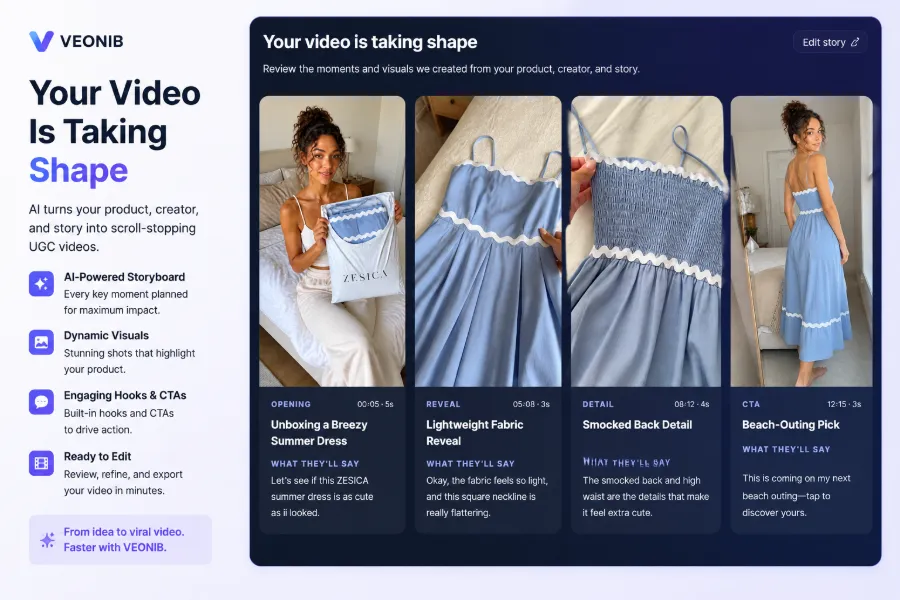
The internal recruitment route is not economical at 100 pieces per month. A director‑producer plus an editor configuration easily exceeds ¥30 k per month, and per‑person productivity may not keep up with the 100‑piece pace, often requiring external supplementation. The AI route has the lowest subscription cost, and the marginal cost of templated production is almost zero; the main expense is the initial asset‑library build and style fine‑tuning. The table below compares the key cost dimensions of the three routes side by side:
| Cost Dimension | Internal Recruitment | Influencer/Agency | AI Route |
|---|---|---|---|
| Fixed Cost (monthly) | ¥15 k–¥25 k per person | Low, almost none | Subscription fee, a few hundred yuan |
| Marginal Cost per Piece | Low (salary already paid) | $50–$200 per piece | Near zero |
| Average Delivery Cycle | 3–6 hours per piece | 3–7 days per batch | About 60 seconds per piece |
| Re‑work / Controllability | Highly controllable, internal communication | Low controllability, depends on schedule | Highly controllable, can regenerate repeatedly |
| Suitable Monthly Volume | >200 pieces | <50 pieces | Any volume, the larger the more savings |
The “cheap” unit price hides hidden losses. Influencer communication time, re‑work waiting, schedule conflicts all erode the price advantage. The AI route eliminates influencer scheduling and editing overhead, compressing the workflow to “paste link → wait for output → fine‑tune”. Tools like VEONIB automatically turn product links into storyboards and scripts, removing all intermediate human coordination. For teams that need to bulk‑expand content libraries for influencers and affiliate partners, this workflow compression often yields savings far greater than the unit‑price difference.
Pain of Scaling: Efficiency, Risk Control, and Controllability
When volume doubles, the performance gap among the three routes becomes stark. Internal recruitment is limited by headcount; you can’t just hire any time. Influencers are limited by schedules—top‑tier talent often books weeks in advance. The AI route has virtually no ceiling; generation speed only depends on the subscription tier’s quota. That’s why many teams hedge across multiple routes during peak periods.
But the real test of scaling is not efficiency—it’s controllability. A cross‑border e‑commerce team once bet on a single mid‑tier influencer for a growth phase, planning to deliver 60 core assets two weeks before a major promotion. The influencer’s schedule was delayed two weeks, cutting off supply; the team was forced to purchase additional assets at a 40 % premium, disrupting the promotion’s rollout. This case shows that controllability risk should trump price considerations—no matter how low the price, if delivery is unpredictable, the cost ledger will never balance.

Style consistency is another often‑overlooked issue. Human influencer performance varies widely; the same influencer’s content in different batches can have conversion rates that differ by a factor of two. AI output is far more stable; using the same template and avatar yields consistently controllable style. Compliance and risk control also need a separate line item: influencer content can trigger copyright or likeness disputes, leading to takedowns, compensation, and platform penalties that far exceed production fees. AI‑generated assets must contend with platform moderation that may flag synthetic content; TikTok, Reels, Shorts each have different vertical‑video length requirements, adding a layer of adaptation cost per platform. AI‑generated video takes about 60 seconds on average, whereas traditional editing takes 3–6 hours; this gap becomes a fatal delivery bottleneck during high‑volume periods. Tools like VEONIB gain a stability advantage by turning the uncontrollable “human schedule” into the controllable “machine instruction”.
Choosing a Route by Phase: A Practical Decision Framework
At the execution level, route selection should follow the stage, not personal preference.
Startup phase (monthly volume < 50 pieces): Rely on AI templates and lightweight external sourcing to keep cash outflow low. Brand tone is not yet fixed, so there’s no need to hire staff or sign long‑term influencer contracts. AI provides baseline supply; a small amount of external sourcing serves as testing, and data will guide where to double down later.
Growth phase (monthly volume 50–200 pieces): AI baseline + a few core influencers for endorsement, forming a mix. This stage should avoid betting on a single influencer—the earlier supply‑break case is a cautionary tale. Core influencers handle brand endorsement and high‑conversion pieces; AI handles bulk basic assets. Attribution of conversion has a hidden advantage here: influencer conversion attribution is often vague, making ROI tracking difficult, whereas AI assets are easy to A/B test; you can clearly see which material performs and why.
Maturity phase (monthly volume > 200 pieces): Consider building an in‑house content hub, but let AI handle the massive bulk of basic assets. When output exceeds 200 pieces per month, the marginal‑cost advantage of a hybrid in‑house + AI approach becomes significant—what looks expensive as an in‑house team becomes cheaper than continuously paying per piece to influencers. Four dimensions guide the decision: volume, budget, brand tone, and risk‑control cycle. Volume determines scale economies, budget determines cash‑flow capacity, brand tone determines the intensity of real‑person endorsement needed, and risk‑control cycle determines how much delivery uncertainty you can tolerate. Lay these four variables out, and the route choice becomes almost obvious.
FAQ
Q1: Which has lower upfront investment—hiring staff or hiring influencers?
Hiring influencers has the lower upfront cost. Hiring staff means fixed salaries, social insurance, equipment, and a continuous cash outflow; once hired, you must keep paying. Influencer payments are per piece, so cash outflow is minimal when volume is low. Low upfront cost does not mean low total cost; once monthly volume exceeds 200 pieces, cumulative per‑piece fees quickly surpass the cost of an internal team.
Q2: Can AI‑generated UGC completely replace real influencers?
Not yet. AI assets are stable for basic, test, and high‑volume supply, but brand endorsement, trust building, and niche‑community impact still benefit from real influencers. A pragmatic approach is to let AI handle volume and influencers handle quality/credibility, using a hybrid.
Q3: From what monthly volume does AI become cost‑effective?
Around 30 pieces per month it’s worth a serious evaluation. AI subscription cost is low, marginal cost is near zero, and the saved communication and re‑work time can cover the subscription fee even at modest volumes. The larger the volume, the clearer the AI cost advantage—especially beyond 100 pieces per month, where influencer unit prices become a heavy cash‑flow burden.
Q4: Can the three routes be mixed without causing style inconsistency?
Yes, but you need clear style boundaries. We recommend dividing by content type: brand endorsement and trust‑building content use real influencers; basic promotion and test content use AI; the internal team handles strategy and review. As long as scripts share a unified tone and selling‑point framework, mixing won’t cause noticeable style chaos and will balance cost, speed, and brand tone.
Share Article