$150 per video from agencies should stop: How AI automation pulls customer acquisition cost from sky‑high to ground level
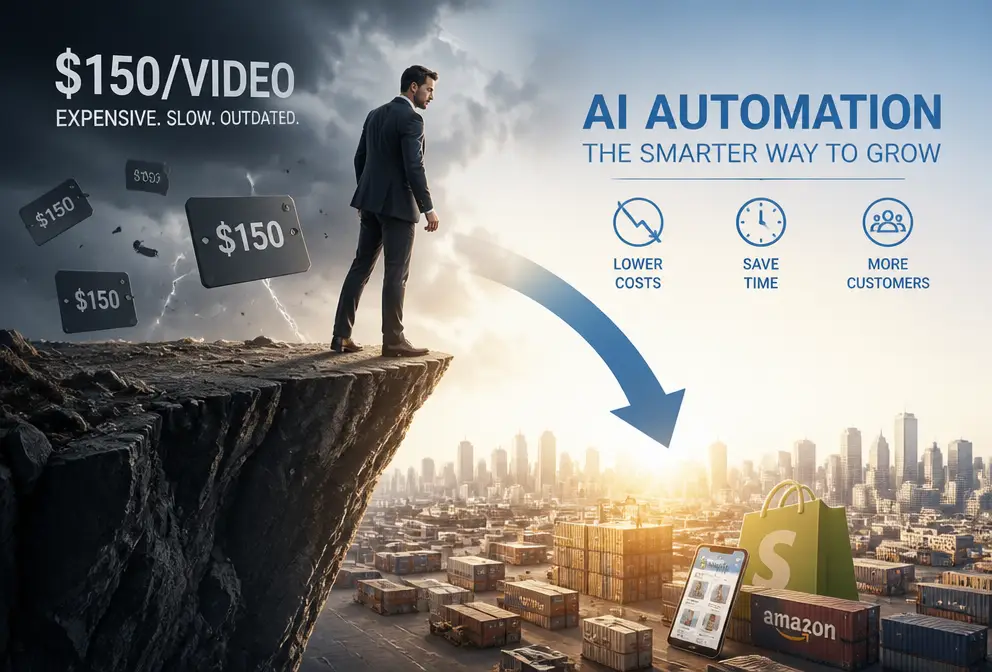
A few years ago I also believed “the more expensive, the better” – spending $150 to have an overseas influencer create a piece of content, then waiting for the sample to arrive, the schedule, the edited footage, and a month would pass. Even worse, in 2026 the creative fatigue cycle has shortened to less than two weeks; the pricey video you shot hasn’t even broken even when ROI collapses. This article isn’t urging you to abandon quality, but to do the math: why independent‑store sellers who quietly earn dollars have completely abandoned agency outsourcing and now use AI video automation to compress testing costs to $0.36 per video.
In 2023 I spent $600 on an agency to produce four videos, only to see creative fatigue hit two weeks later, with ROI dropping from 2.5 to 0.8 and the inventory nearly unsold. Since then I haven’t touched that “heavy‑asset” model again.
Why $150‑per‑video agency content is dragging down your ROI
The real cost of traditional overseas influencers or agency outsourcing is far more than the invoice you give the production team. Let’s break it down: shooting fee $150‑200, not including sample shipping – a product shipped from China to an overseas influencer costs $20‑30 in freight and duties, and sometimes you need three shipments to find the right style. Then there’s the communication and revision cycle: script emails go back and forth for three to four days, post‑shoot feedback takes another week, so a single piece of content takes on average 2‑3 weeks from order to delivery. By the time you have the final video, the launch window for the new product is already half gone.
Even more critical, the 2026 algorithm environment demands fresh content at an extreme level. According to the Shopify blog on video marketing, the effective window for the same creative idea has shrunk from 21 days in 2022 to now 10‑14 days. A $150 video that takes two weeks to produce starts eating into your budget after just a week and a half online. This means that within the effective lifespan of each piece of content, you only recoup a fraction of the cost.
I’ve seen far too many independent‑store sellers lose money this way: they bite the bullet and hire an agency, the data after two weeks looks bad, they can’t give up and keep pushing, the ad account keeps losing money, and the peak season turns into a clearance season. This model essentially tries to fight “algorithmic bulk consumption” with a “hand‑crafted” pace, which simply can’t win.
In 2026, creative fatigue accelerates: you can’t afford a two‑week production cycle
Creative fatigue isn’t about users getting bored of your ad; it’s the algorithm no longer being “excited” by the same set of creative signals. Each time you upload a new piece of content, the platform allocates a probing amount of traffic to observe interaction rates. Once the interaction rate drops from its peak, the algorithm gradually reduces exposure until the content becomes a zombie. My own account data shows that the CTR peak for the same creative usually lasts only 7‑10 days, then flattens and drops sharply around day 14.
What does this mean? If you only prepare 1‑2 videos per new product and each takes 2‑3 weeks to shoot, more than half of your launch window is wasted “waiting for content.” Last year I launched an outdoor lamp; waiting for an influencer to shoot the sample delayed the video delivery by 10 days, and a competitor’s AI‑generated batch videos captured the peak season search traffic. By the time my product went live, the peak season was already half over. That’s a classic case of a production cycle dragging down an entire quarter.
So I fully accepted the reality: no matter how polished your video is, the algorithm only cares about “freshness.” What you need is a process that can quickly generate many creative variants, not a single video that bets on a month. For multi‑platform content requirements, see the “AI Video Ads Multi‑Platform Practical Guide” (https://veonib.com/s/guides/ai-video-ads-for-amazon-shopify-tiktok-shop-and-more-veonib/index.html), which details the format and pacing requirements for different platforms.
The new testing standard in the algorithm era: find a hit with a $0.36 AI video
Since the traditional model can’t keep up, let’s change the game. My current strategy is: low‑cost test multiple creative directions, use data to identify which signal activates the algorithm, then concentrate budget to scale the winner. The core of this logic is testing efficiency – not the quality of a single video, but the “batch probability.”
Let’s do the math. A traditional agency video costs $150‑200 per piece; testing five creative directions costs $750‑$1000, not counting time. With VEONIB’s Starter plan, $11/month can generate 30 high‑definition assets, averaging only $0.36 each. 100 videos cost $36, still less than the fee to rewrite a script at an agency.
You need to understand a probability logic: a $0.36 video isn’t compared to a $150 video on quality; it wins on “batch probability” – one hit out of 100 videos can sustain you for a quarter. The last time I used this method to test a small kitchen appliance, I generated 40 different hooks and scripts; one of them achieved a 2.5× ROI on TikTok Shop, generating $8k in sales that month. The production cost of that hit video was only $0.36.
Adobe’s commercial AI video generation technology description (https://www.adobe.com/products/firefly/features/ai-video-generator.html) also notes that AI‑assisted video production is reshaping the underlying logic of creative workflows – from “meticulously polishing one piece” to “rapidly testing a batch.” Don’t underestimate this shift; it directly determines whether your ad account burns budget or makes money.
Of course, if you’re on Amazon, also check our previous guide “How AI Video Ads Boost Amazon Conversion Rates” (https://veonib.com/s/guides/how-to-increase-amazon-conversion-rate-with-ai-product-videos-veonib), which includes optimization tips for Amazon main images and A+ content.
From product link to AI video in 60 seconds: my hands‑on workflow
The first time I used Veonib I was skeptical – how could a tool replace an entire production team? I pasted a Shopify link, and after 60 seconds I was speechless.
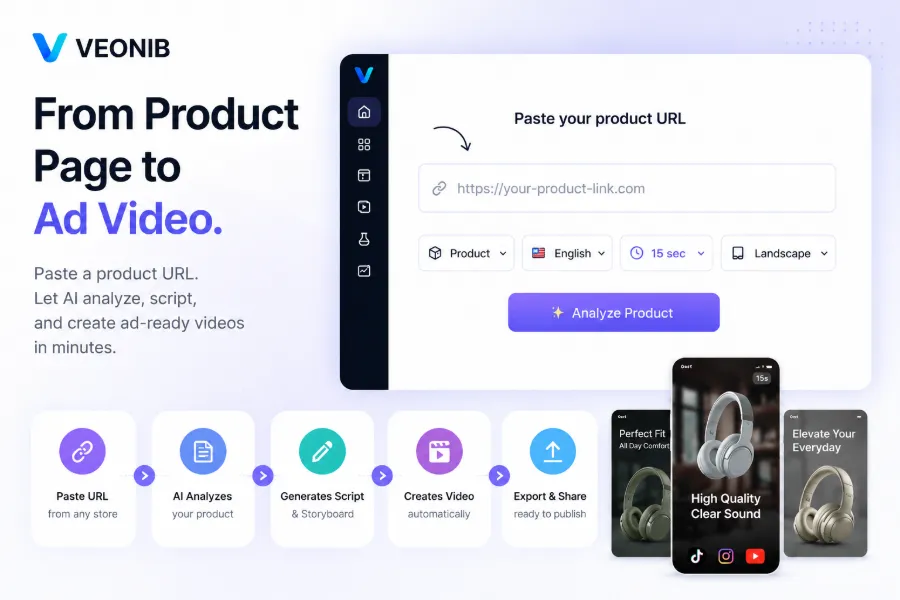
The workflow is extremely simple. Open the console, paste the product URL, and the tool automatically parses the product page’s title, description, key‑point images, etc. Then AI kicks in: it extracts core selling points, generates 3‑5 opening hooks, and pairs them with matching scripts and storyboard suggestions. You can preview each version; if you like a hook, select it, and the tool automatically renders the video.
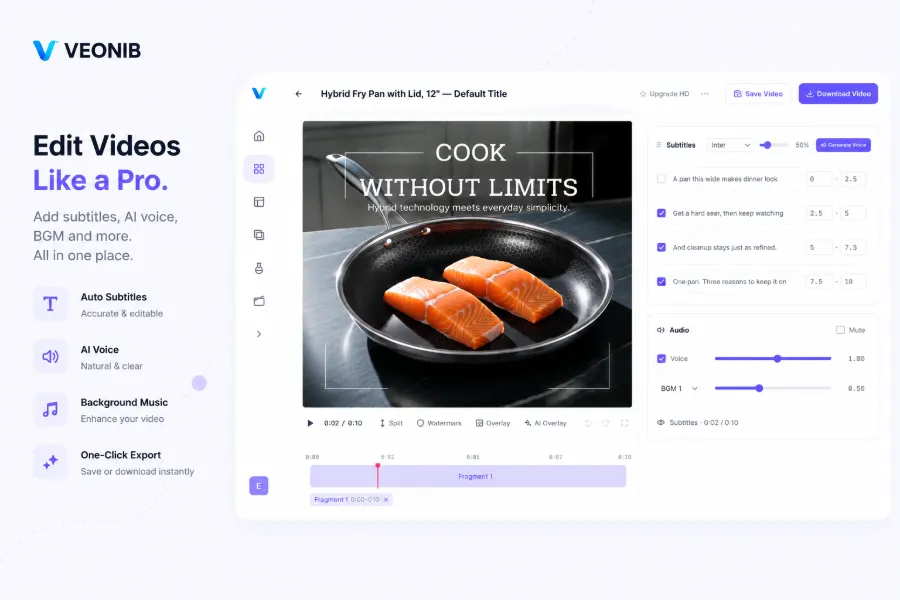
I usually fine‑tune the script manually – AI sometimes produces overly hype copy like “This gadget will change your life,” which I replace with something more specific: “This under‑$20 storage tool turned my kitchen countertop into a display.” After editing, click render, and a 1080p video (30‑60 seconds) is ready, supporting 9:16, 1:1, and 16:9 ratios. From past the link to export, it truly takes only about 60 seconds.
Compared to the old workflow: wait for the sample to reach the influencer (7 days) → wait for shooting + footage return (5 days) → wait for revisions (3 days) → wait for rendering and delivery (1 day) – a full 16 days. Now a video’s production time is enough to make a coffee and come back.
If you want a deeper dive into the AI workflow from product link to viral video, see “From Product URL to Viral Short Video AI Workflow” (https://veonib.com/s/guides/from-product-url-to-viral-video-ai-workflow-for-cross-border-sellers-veonib), which provides a more complete case breakdown.
FAQ
Q1: How long does a traditional agency take to produce one video? What’s the cost?
From requirement definition to delivery, a typical agency video takes 2‑3 weeks and costs $150‑$200, not including hidden costs such as sample shipping and communication revisions. If you need multiple script revisions or have to wait for influencer availability, the timeline can stretch beyond a month.
Q2: What does “creative fatigue” mean? Why is it worse in 2026?
Creative fatigue refers to the decline in CTR and conversion rate of an ad creative over time. In 2026 it’s more severe because algorithms place a higher weight on freshness; the excitement period for the same creative signal has dropped from 21 days in 2022 to 10‑14 days. Platforms now require a continuous stream of new assets to maintain ad efficiency.
Q3: Can AI‑generated videos match the quality of agency‑produced ones?
Visually, agency videos may have higher production values—better lighting, audio, set design. However, advertising success isn’t about “who looks better,” but about “who drives higher conversion.” AI videos based on real products can achieve comparable conversion rates as long as the hooks and copy are accurate. The key is you can test 100 versions at 1 % of the cost and find the truly effective one.
Q4: Does low‑cost testing cause the ad system to downgrade my account?
No. The ad system evaluates click‑through rate, conversion rate, and relevance—not how much you spent on the creative. A $0.36 AI video with above‑average CTR will still receive ample exposure. Conversely, a $150 video with poor script or unclear selling points will waste budget regardless of its production cost.
Q5: Do I need editing skills to use an AI video tool for the first time?
No. Tools like Veonib are designed for users with zero editing experience. You simply paste the product link, preview hooks and scripts, then export. All production steps are handled automatically by AI. If you don’t want to edit the script at all, you can just export the default AI‑generated version.
Share Article