From Product Link to Deployable Ad Creative: Bridging the Gap with One‑Step Automation

The media buying team drops a product link into the work chat at 10 a.m., demanding a 30‑second ad creative by the end of the day. The link points to a Shopify product page, where the selling points, price, and images are already displayed. Two options are on the table: paste the link into an automated pipeline and get a finished video in 60 seconds, or have a designer start by screenshotting the product page, then manually extract images and selling points, write a hook script, and proceed to timeline editing.
The gap between the two paths is not image quality but granularity of control. One‑step automation parses the product, generates the script, storyboard, and edits everything in a single action, delivering a video in 60 seconds. Manual disassembly spreads those steps into a checklist that can be inspected item by item, taking hours. The slower path retains a veto right at each stage; the faster path removes those veto rights. This gap can be compensated by human effort for a single creative, but it scales dramatically when moving to bulk production.
Manual Disassembly of a Product Link: Where It Gets Stuck
The standard manual steps are easy to list: extract product information and images, organize selling points and price, write a hook script, plan the storyboard and scenes, collect or shoot assets, edit the timeline, and finally export a 9:16 vertical video according to TikTok, Reels, and Shorts specifications. Each step alone is simple, but the dependencies between them are troublesome—without a script, storyboard and editing cannot start, so the whole chain is stretched out serially.
The toolchain is also fragmented. Screenshots of the product page are taken in a browser, image processing in another app, script writing in a document, editing in a different tool—switching between five or six interfaces for a single video. This “assembly‑line” workflow is common in the industry; some have even mapped out a typical process using five AI tools to assemble a product video, only to find that most of the time is spent on data export and waiting for exports.
The most uncontrolled part is the hook script. How to write the first three seconds? Often a draft is discarded after a rewrite. Selling points can be copied verbatim from the product page, visuals can be cobbled together from screenshots, but there is no standard answer for the hook. Industry estimates for scheduling a 30‑second ad video range from 4 to 8 hours, and it’s not unusual for revisions to push that to 1–2 days, with a large portion of the time spent on those three seconds.
One‑Step Generation Workflow: Link In, Video Out
The logic of an automated pipeline merges parsing, scripting, storyboarding, and editing into a continuous sequence: paste the product URL, the system parses the title, images, selling points, and price, generates a script, plans the storyboard and scenes, renders the video, and exports an MP4 with one click. The entire process never touches the timeline. This unified handling provides a complete breakdown of steps for generating marketing videos from any material.
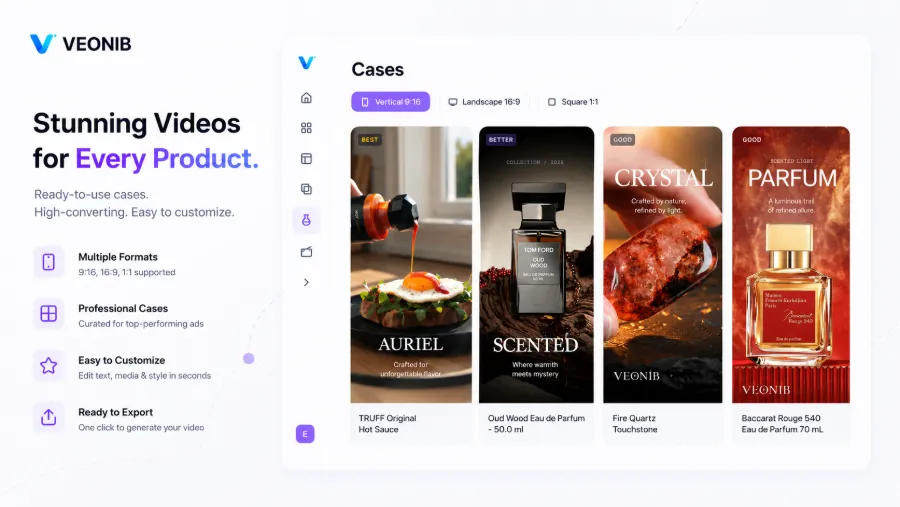
A representative pipeline tool is VEONIB. Input is a Shopify or Amazon product page link; parsing, scripting, storyboarding, and composition happen internally, and the output MP4 can be used directly for advertising and social media distribution. The key difference from manual disassembly is that URL parsing replaces manual extraction, the script and storyboard are produced in one go, and editing/compositing are compressed into a single step.
Generation speed is also repeatable. A 30‑second creative goes from link paste to MP4 export in about 60 seconds; the same link can cheaply produce 15‑, 20‑, and 30‑second versions, each generation being an independent script and storyboard.

For media buying teams, this means the unit of creativity changes. In the manual path, each video is a project that needs scheduling and progress tracking; in the automated path, each video becomes a single call, and the unit of output shifts from “one video” to “a batch of assets”.
Where the Gap Lies: Quantified Comparison of Efficiency, Cost, and Controllability
| Comparison Dimension | One‑Step Generation (Link‑to‑Output) | Manual Disassembly |
|---|---|---|
| Time per asset | ~60 seconds | 4–8 hours |
| Hook script source | System‑generated | Human‑written |
| Visual asset source | Automatic parsing of product‑page images | Product‑page screenshots, asset library, custom shoots |
| Marginal cost per asset | Near zero | Does not decrease with volume |
| Bulk scalability | Mass‑produce from the same link | Relies on human scheduling |
| Pre‑launch controllability | Fine‑tuning after generation | Intervention possible at every stage |
Cost structures differ as well. The manual path has high fixed costs: scriptwriters, designers, and editors each consume a portion of labor, and marginal cost does not drop with quantity—producing the 10th asset takes roughly the same time as the first. One‑step generation’s fixed cost is a subscription or API fee, and marginal cost approaches zero as volume grows.
This gap magnifies in bulk scenarios, not as a percentage but as an order of magnitude. With 10 assets, the manual path can be survived with overtime; at 50 assets, the total time difference between the two paths already scales by order of magnitude; at 100 assets, it equals a full‑time team working weeks versus a single night’s batch job. The baby‑care category has validated this path: the same workflow was used to mass‑produce assets for dozens of SKUs, driving per‑asset cost to a minimum.
The number of asset versions also widens the gap. Manual A/B testing requires extra scheduling; the automated path merely adds another call. The more SKUs, the clearer the advantage.
The Real Problems Appear After Bulk Production
The first issue that surfaces at scale is homogenization. Repeatedly generating from the same link leads to similar script structures and repetitive three‑second hooks. Initial performance may be good, but after two weeks the material fatigues. Platform‑specific details are also easy to overlook—subtitle safe zones, 9:16 export parameters, duration compliance—issues that rarely appear in single manual productions but explode in bulk.
Different lengths require separate management logic. A 15‑second version suits TikTok feed and exposure, a 20‑second version fits Reels discovery, and a 30‑second version is reserved for Shorts and landing pages. VEONIB‑type tools can batch‑produce multiple lengths, but as the number of versions grows, naming conventions, placement tags, and duplicate‑asset removal become daily chores.
Distribution also creates friction. A single MP4 must be adapted for TikTok, Reels, Shorts, and landing pages, each with slightly different format and subtitle requirements. Export, rename, upload, and confirm—each step repeats work. The automated pipeline removes editing but not distribution.
A more practical bottleneck is content supply for channels. Advertising platforms are just one destination; affiliate partners and influencers also need a stream of content. A common operational method is to expose the asset library as an API endpoint, letting influencers pick versions and adapt them to their channels. In this model, the generation side is no longer the bottleneck; topic selection, hook strategy, and asset‑library management become the limiting factors.
Once the asset count exceeds about 50 per month, “generation” is no longer the choke point. The system can process a week’s worth of material in an hour; the real time sink is topic judgment and hook strategy.
Scenarios Where Manual Disassembly Still Makes Sense
Automated pipelines have clear limitations: they struggle with complex product narratives, brand‑tone constraints, compliance audits that require traceable source material, and non‑standard items that need human creative judgment. Analyses of AI video generators for e‑commerce show that most tools are geared toward speed, not understanding; campaigns that need product mechanism explanations or emotional storytelling often receive scripts that stay superficial.
Manual disassembly remains superior in several scenarios: brand films, high‑price complex products, and campaigns that demand deep user insights. These projects deliver brand assets rather than a single deployable creative; scripts and visuals undergo multiple review rounds, and the automated flow cannot provide the required granularity of control.
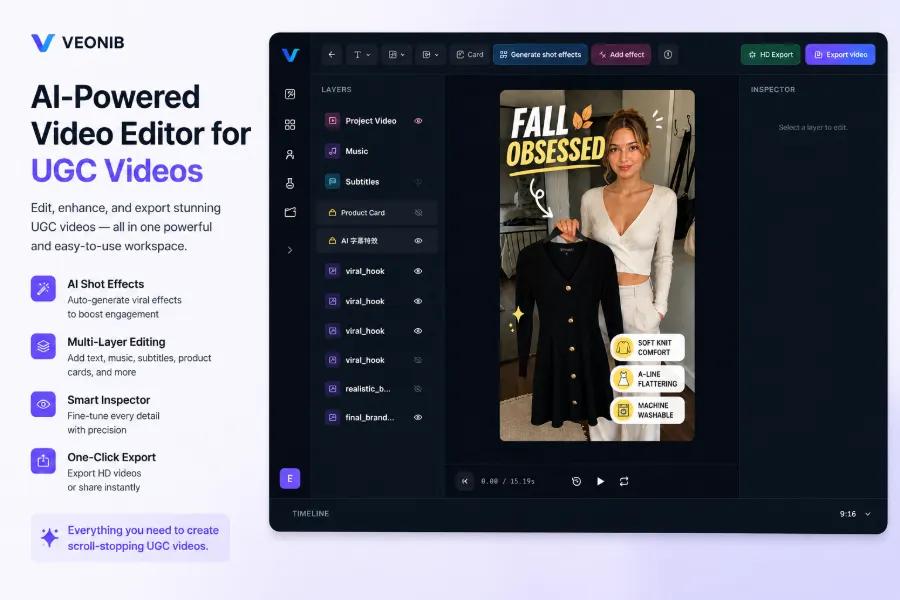
One‑step tools are not entirely inflexible. Within the AI video workflow, ten embedded tools allow multi‑layer fine‑tuning of hook segments, as well as adding subtitles and product cards. Automation does not mean abandoning adjustments; it simply moves control points from “every stage” to “key nodes”.
In practice, most teams end up using a hybrid workflow: automation produces drafts, humans handle strategic oversight and fine‑tuning, and the final video becomes an iteration starting point rather than an endpoint. I have seen a media buying team switch entirely to one‑click generation; the first two weeks saw a sharp rise in output and everyone felt the efficiency problem solved. By weeks 4‑6, click‑through rates for repeatedly generated assets from the same link began to drop. Post‑mortem revealed hook‑script homogenization and missed subtitle safe‑zone checks. They reverted to a hybrid approach: automation handles bulk drafts, humans manage hook topics and platform‑spec verification.
Being able to generate does not equal being ready for launch; being able to launch does not equal skipping review. “Speed” solves capacity, but strategic issues always remain outside capacity. The gap between the two paths is a granularity‑of‑control gap, not a quality gap—choosing a path depends on where the team is willing to spend time.
Frequently Asked Questions
Is there a big difference between videos generated directly from a product link and those produced manually?
The gap lies in creative judgment, not visual fidelity. Link‑to‑output meets material quality, subtitle, and export specifications, but the uniqueness of the hook and brand tone—areas that require human judgment—are only “usable” versions, not necessarily optimal. Treat them as drafts for iteration; the gap becomes manageable.
Can a 60‑second generated asset be deployed directly to ad platforms?
Yes, provided the specifications are verified. Before export, check the 9:16 vertical parameters, subtitle safe zone, and duration compliance; ad platforms accept the MP4 format without issue. In bulk production this step is often missed—add an automatic check or manual spot‑check in the export workflow.
When is manual disassembly still irreplaceable?
Brand films, high‑price complex products, and campaigns requiring deep user insights. These projects need multiple rounds of script and visual review, and compliance audits demand traceable source material—granularity that automated pipelines cannot provide. In a hybrid workflow, humans handle strategy while automation supplies bulk drafts.
How can we avoid hook‑script homogenization when producing assets at scale?
Separate the hook from the generation step and manage it independently. Once the asset count exceeds 50 per month, establish a hook library organized by category, selling point, and platform, with weekly human updates and retirements. The system then applies the selected hook to the storyboard and final video, rather than deciding the opening three seconds itself.
Share Article