A Single UGC Video Cost Drops to a Few Tenths of a Yuan: How AI Mass Production Rewrites the Marketing Ledger

Last year our team shot twenty UGC videos in three days to test a pair of Bluetooth earbuds. The venue, talent, and editing together cost almost eight thousand yuan. That’s about four hundred yuan per video, and after a round of ad spend only three of them were actually usable. This year, with the same budget, we produced over three hundred “grass‑planting” videos from different angles, and the cost per video fell to just a few tenths of a yuan. This isn’t a special‑effects trick; it’s an AI mass‑production tool that turns “shooting a video” from a labor‑intensive job into a parameter‑driven configuration.
First, Do the Math: Real‑Cost Comparison Between Traditional UGC and AI Mass Production
The cost structure of traditional UGC videos is actually very transparent. For a 15‑second “grass‑planting” video, venue rental averages 100–300 yuan, talent appearance fee 100–400 yuan, and post‑production editing 50–200 yuan. The baseline per video is therefore 200 yuan, and it’s normal for it to climb up to 800 yuan. The Bluetooth‑earbud assets we shot last year averaged about 380 yuan per video.
The AI mass‑production accounting is much simpler. With a monthly output of 90 videos, the subscription cost apportioned to each video is less than 0.5 yuan. No venue fee, no talent fee, no editing fee. The per‑video cost stays stable between 0.3 and 0.8 yuan. The key isn’t “free”; it’s that the marginal cost approaches zero—generating the 1st video and the 90th video costs almost the same extra amount.
| Cost Item | Traditional Method (yuan/video) | AI Mass Production (yuan/video) |
|---|---|---|
| Shooting/Venue | 100–300 | 0 |
| Talent/Appearance | 100–400 | 0 |
| Editing/Post‑production | 50–200 | 0 |
| Tool Subscription Allocation | 0 | 0.3–0.8 |
| Total per Video | 200–800 | 0.3–0.8 |
At the scale of 100 videos, the traditional method costs at least 20,000 yuan, while AI production costs under 80 yuan. This gap isn’t just “saving money”; it completely changes the scale of testing you can do. For example, using VEONIB to process a link takes less than a minute from paste to export, meaning you can finish a month’s worth of material in one afternoon. We previously compiled a detailed guide on “Creating TikTok Ads Without Shooting Any Video” here: Complete Process for Making TikTok Shop Ads Without Shooting Any Video.
From URL to Video: How AI Reshapes the UGC Production Workflow
The traditional workflow is long and fragile: product selection → script writing → talent casting → shooting → editing → publishing. Every step carries a risk of breaking the chain. Talent can’t show up at the last minute, editors can be fully booked, or the footage may not match the product’s selling points—we’ve experienced all of these.
AI video production reduces the workflow to four steps: paste the product link → AI parses the selling points → choose a template → generate with one click. VEONIB automatically extracts the product title, selling points, and price, then matches one of six Story templates. From pasting the link to exporting the video, the whole process can be completed in under 60 seconds.
Two key changes deserve emphasis: no shooting, no editing. This isn’t an incremental improvement; it turns video production from “content creation” into “content configuration.” Our former editors now spend most of their time selecting products and tweaking template parameters, and their output efficiency has actually increased. For the issue of stacking multiple tools, see the article Stop Using Five AI Tools to Make One Product Video, which makes a similar observation—shorter toolchains lead to more stable production.
The Real Threshold for Mass Production: Templates, Personas, and Authenticity
In early 2024 we tried using early‑stage AI video tools for mass production, but stiff facial expressions and lip‑sync issues caused TikTok ad completion rates to be 40 % lower than those shot with real people. That lesson taught us that the main bottleneck for AI video isn’t cost—it’s the “authenticity” threshold.
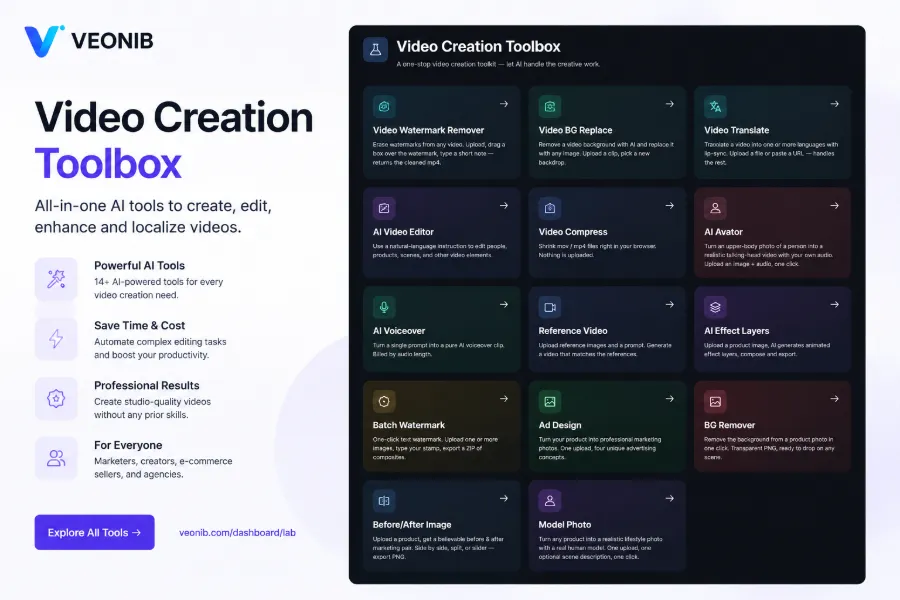
The tools have improved a lot since then. VEONIB supports three durations (15 s, 20 s, 30 s) and six built‑in Story templates: Problem‑Solving, TikTok Review, Unboxing, Lifestyle, Social Proof, and Custom. Personas can be chosen from built‑in digital humans or generated from real‑person photos. Our tests show that uploading a real‑person photo yields noticeably better results than using a built‑in digital human—completion rates differ by roughly 15 %.
Nevertheless, authenticity still has a ceiling. AI‑generated gestures can sometimes look mechanical, and background details occasionally slip. Mass production isn’t a simple “copy‑paste”; it requires template combinations and fine‑tuned parameters to maintain content diversity. In one test, the same Bluetooth earbud was rendered into five videos using different templates; the Unboxing template achieved the highest click‑through rate, while the Lifestyle template delivered the best conversion rate. If you’re comparing tools, check out the 2026 Best E‑Commerce AI Video Tools Comparison. For low‑budget tool‑stack strategies, see the article A $20‑Per‑Month AI Tool Stack for High‑Volume E‑Commerce Stores.
When Cost Is No Longer a Bottleneck: Ripple Effects on the Marketing Ledger
The most immediate impact of low‑cost production is a shift in testing strategy. Previously we could only “bet on a hit”—selecting 10–20 pieces of material each month and hoping one would perform. Now the team can increase the monthly testing pool from 10–20 to 100–200 pieces. Sample sizes for A/B tests grow dramatically, allowing us to identify high‑conversion content directions much faster.
Team roles are also evolving. Former editors now focus more on strategy analysis—reading data, adjusting templates, and optimizing selling‑point ordering. Operations staff have started handling part of the content creation because the entry barrier has dropped to “just know how to copy‑paste.” We even used VEONIB to experiment with different categories, such as turning any beverage product link into a product‑page video (see Convert Any Beverage Product URL into a Product‑Page Video in 60 Seconds), which performed better than expected.
However, there’s a hidden pitfall: when video cost falls to a few tenths of a yuan, the biggest pain point for content teams shifts from “can’t shoot” to “can’t publish.” The capacity of distribution channels becomes the new bottleneck. We once had over four hundred generated videos sitting idle because TikTok and Reels limit publishing frequency. Managing these assets—tagging, scheduling, and releasing—requires additional manpower and tooling.
Another counter‑intuitive phenomenon: users’ tolerance for “perfect videos” is decreasing. A video with obvious AI artifacts but high information density can achieve a higher conversion rate than a beautifully produced but vague‑point video. We have an AI‑generated video with noticeable lip‑sync errors that, because its selling points are crystal‑clear, outperformed contemporaneous human‑shot material by 20 %. This makes me question whether “authenticity” has been over‑estimated.
FAQ
Will AI‑generated UGC videos be flagged as low‑quality content by platforms?
Currently TikTok and Reels have no explicit downgrade for AI content, but they indirectly assess quality through completion rates and engagement metrics. Our experiments show that as long as a video’s information density is high and its selling points are clear, AI videos receive recommendation volumes comparable to human‑shot videos. The key is to avoid excessive repetition—different videos generated from the same template should vary selling‑point order and visual composition.
How to avoid excessive content duplication when producing videos at scale?
Use different Story template combinations. The same product can be rendered with Unboxing, Problem‑Solving, and Lifestyle templates, each with a distinct selling‑point order. We typically generate at least five videos per product, differentiating the hook sentence in the first three seconds.
What about copyright when generating digital‑human personas from uploaded real‑person photos?
We recommend using photos you’ve taken yourself or obtaining explicit permission from the model. If you use built‑in digital‑human avatars, copyright usually belongs to the tool provider, so check the service terms. Our team standardizes on internal staff photos to avoid any disputes.
How many distinct‑angle videos can a single product link generate?
In theory there’s no hard limit. VEONIB supports six templates, three durations, plus custom scripts and selling‑point ordering, allowing dozens of variations per link. We have generated 45 different videos from a single link, each differing in point‑point sequence and visual pacing.
Which platforms and formats do AI videos support?
Supported formats include vertical TikTok, Reels, Shorts, as well as horizontal formats for YouTube and e‑commerce platforms. Output is an MP4 file ready for direct upload. Before generation you can select the target platform, and the tool automatically adapts resolution and aspect ratio accordingly.
Share Article