A Product Video: How to Efficiently Adapt It into Advertising Materials for Multiple Countries
You have a few well‑shot product videos—clean visuals, clear selling points—but the team is stuck on one problem: you need to target Germany, Japan, and Brazil. Do you have to reshoot three times with local models, rent locations, and re‑edit, exhausting budget and time? Adding subtitles to the original footage and launching it directly raises concerns about platform review and local audience acceptance.
For more tips on efficiently producing product videos, see Stop Using 5 AI Tools to Make One Product Video.
This issue is common in cross‑border e‑commerce teams. The product video itself is fine, but it wasn’t originally created for ad placement—it may have been for a detail page or social media content. Turning it into a formal ad asset for multiple countries isn’t “re‑shooting” but follows a reusable adaptation workflow.
For authoritative industry resources, visit the AI Video Industry Authority Site.
Direct answer: You don’t need to reshoot for each country. A single generic asset can be turned into multiple launch‑ready versions through language replacement, subtitle handling, visual information cleanup, and format adaptation. The key is what to change, how to change it, and in what order.
If you need quick authorization and video generation, the SEONIB official site offers a one‑click licensing feature.
Clarify the Adaptation Goal: First Understand What “Multi‑Country Ads” Actually Require
Multi‑country ads are not just “add translated subtitles.” Deploying one video to five countries involves three layers of changes: language and subtitle format, on‑screen text and icons, and each platform’s universal placement specifications. Many people stumble at the first step, focusing only on subtitle translation and overlooking “non‑local” visual details.
Before you start, inventory the usable clips, total duration, and on‑screen elements of your video. Determine which content can be localized and which must be reshot—this judgment is more important than the translation itself. For example, spoken lines can be dubbed or subtitled, but product packaging close‑ups or ingredient tables have very limited localization space and may require reshooting.
Create a simple market list that lists target countries, platforms (TikTok, Meta Reels, YouTube Shorts), languages, and duration requirements. One spreadsheet is enough; it prevents the “blind translation” trap—translating to German only to discover the German market needs a 30‑second horizontal video while the original is a 15‑second vertical clip.
Time expectation: Adapting from a “generic version” to “multi‑country versions” typically requires at least 1–2 days of quality‑check per market, not just one hour. QC includes subtitle timing, missed on‑screen text, and audio integrity—none of which can be skipped.
Core Adaptation Steps: Localizing Language, Subtitles, and Visual Information
Turning a generic video into compliant multi‑country assets involves four steps. Each is simple, but doing them out of order causes rework.
1. Replace or add voice tracks. The same video can keep the original background music while swapping the voiceover. Many dubbing tools now preserve the original audio’s volume dynamics, so the result doesn’t sound too artificial. If the original speaker’s lip movements are clear, watch out for lip‑sync issues—mismatched lip sync can turn viewers away in some markets.
2. Handle hard‑coded subtitles. If text is burned into the footage (hard subtitles), you need to generate a clean version or overlay new localized subtitles. A common pitfall: simply stacking new subtitles over the old ones creates a chaotic visual.
3. Process on‑screen product labels, prices, and infographics. This step is often ignored. Any text that appears in a language other than the target—e.g., Chinese instructions on packaging, English price tags—must be dealt with, either by covering or replacing them with neutral, text‑free versions.
4. Export according to each platform’s safe‑zone and subtitle‑position guidelines. TikTok and Meta Reels have different bottom safe zones; misplaced subtitles will be cut off. Pay attention to horizontal vs. vertical aspect ratios; MP4 is usually the safest format.
Subtitle length must also be controlled. For multi‑country launch videos, each subtitle screen should not exceed 2 lines, and each line no more than 12 characters (visual equivalents may vary by language). Otherwise, reading on small screens becomes burdensome. German and French words tend to be longer; the same content that fits one line in Chinese may need two or three lines in German.
The table below helps teams quickly self‑audit adaptation dimensions:
| Visual Element | Single‑Language Version Handling | Multi‑Country Version Handling |
|---|---|---|
| Spoken dialogue | Keep original voice | Replace with local dubbing or add translated subtitles |
| Burned‑in subtitles | Fixed language | Remove and attach separate localized subtitle files |
| Packaging and label text | Show original packaging | Cover or replace with neutral, text‑free packaging |
| On‑screen price | Show single currency | Hide numbers, replace with graphic representation |
| Background music & songs | Any choice | Verify music licensing for target countries |
Often‑Overlooked Step: Country‑Specific Compliance “Red Zones”
Finished assets don’t automatically qualify for launch. Unreviewed material can be rejected or perform poorly. Many teams experience rejections on their first overseas campaigns, and the cause is rarely language.
Advertising restrictions vary widely across countries. For health, supplement, or skincare videos, avoid absolute claims like “cure” or “100 % effective,” which are blocked in most markets. Some countries require explicit authenticity statements for “before‑after” comparisons. Music licensing may also differ— a song usable in Country A may be muted in Country B.
A subtle but common rejection reason: a fleeting third‑party logo in the background that wasn’t fully removed. Such tiny “mistakes” are quickly caught by platform review engines and can be as damaging as prohibited wording.
In multi‑country campaigns, the most frequent rejection cause is untreated on‑screen text and icons—accounting for 30‑40 % of rejections, not the audio. Rather than maintaining multiple toolchains, embed compliance checks into the adaptation workflow by establishing a “country‑by‑country review checklist” and verify each item before launch.
Managing Asset Library and Version Iteration: Keeping Multi‑Country Ads Sustainable
Multi‑country ads are not a one‑off project. Audiences experience aesthetic fatigue from repeated ads in a single market, so assets need continual refresh. Many teams treat a “single adaptation” as the endpoint, only to discover three months later that the original project files are missing when price updates are needed—forcing a rebuild.
Create a version library for each country, retaining the no‑subtitle version, subtitle version, dubbed version, and original project files. Use a consistent naming convention, e.g., ProductName_Country_Platform_Duration_Date, to avoid confusion during collaboration. When product details change (price, discount), simply replace the affected segment without re‑generating the whole video.
Keeping at least three export variants (no‑text, dubbed, subtitled) for each original asset can dramatically reduce later modification time for subsequent launches. When bulk‑exporting multiple versions, add a watermark to prevent theft; see Protect Your Original Creative Assets.
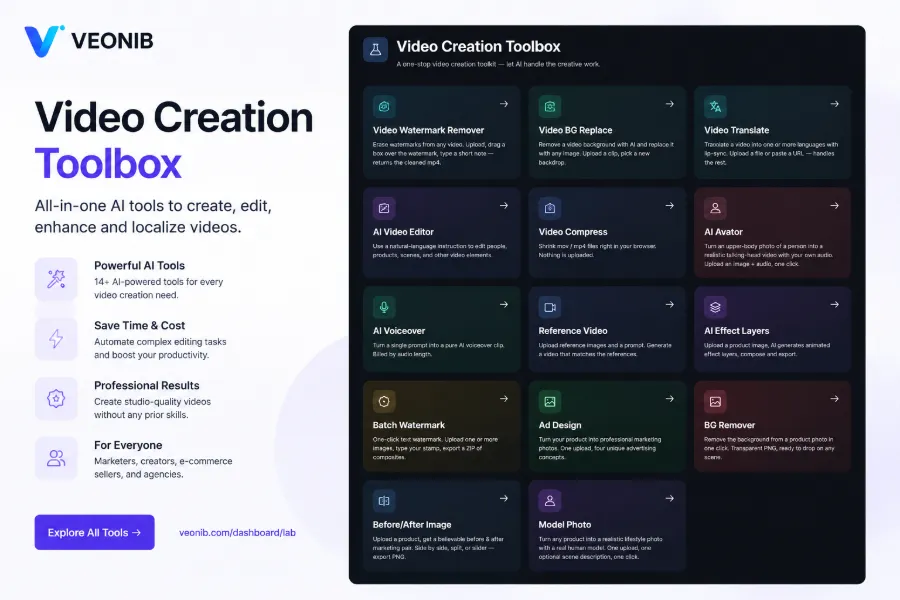
Another management approach focuses on the source. If the original asset is well‑structured and has a complete clean‑text version, multilingual export becomes far easier. Generating more localization‑friendly material at the source is explained in detail in the guide on Generating Short Ad Videos from Product Links Using AI.
In practice, when you need to export multiple market‑specific versions from the same source, tools like VEONIB preserve a unified export pipeline, reducing later update costs. It doesn’t solve creative challenges, but it compresses “product information → launch‑ready video” into a few steps, minimizing manual version chaos.
Quantify Results and Continuous Adjustment: Build a Multi‑Country Ad Tracking Mechanism
After a video is launched, data validation closes the loop. Track two metrics per country: completion rate and click‑through rate (CTR). These tell you whether localization is effective.
If a country shows high CTR but low conversion, the issue often lies in price or payment localization—viewers click but abandon because the displayed currency or payment method is unfamiliar. If completion rates are far lower than other regions, the hook’s local relevance is likely insufficient; the opening phrasing may not resonate locally.
When a country’s version has a completion rate about 15 % below the overall benchmark yet a higher CTR than other countries, the system may flag the asset as fatigued after a few campaigns. Proactively replace the localized script. Review asset tags bi‑weekly; replace and archive under‑performing country versions promptly.
If you lack a ready localized version when a replacement is needed, AI can quickly generate a new alternative. Workflows like AI Video Ads for Shopify Products – Create High‑Converting Ads in Minutes are helpful, provided the source material is clean and compliant. VEONIB’s experience with multi‑country asset management shows that complete version records and production pipelines directly affect replacement efficiency.
Pre‑launch cleanup is also crucial. Residual watermarks or extra markings not only degrade visual quality but may trigger review issues. Checking that visual elements are clean before and after launch is an often‑missed step that impacts both compliance and conversion.
FAQ
Do I need to reshoot a separate ad for each target country to be effective?
No. Using dubbing, subtitle replacement, and visual cleanup, a single generic asset can be adapted for multiple markets. Reshoots are only necessary when the visual content itself cannot be localized, such as core packaging text that cannot be covered. Typically, allocate 1–2 days of QC per market for adaptation.
How should foreign‑language speech in the original video be replaced?
Two options: replace it with a local voiceover, or keep the original audio and add translated subtitles. If the speaker’s lip movements are clear, prioritize dubbing with proper lip‑sync; if lip sync is not evident, subtitles suffice. Preserve the original background music to avoid a monotonous audio track.
Are there special restrictions for advertising pharmaceuticals or skincare products?
Yes. Most markets prohibit absolute claims like “cure” or “100 % effective.” “Before‑after” visuals often require authenticity statements. Definitions of medical terminology vary widely, so verify each target country’s ad review guidelines and, if needed, consult local compliance experts.
Should the multiple country versions be stored separately?
It’s recommended to store them separately and retain for each version the no‑subtitle, subtitle, dubbed, and original project files. Include country, platform, duration, and date in the filename for easy identification. When prices or promotions change, replace only the relevant segment rather than regenerating the entire video.
Share Article


