AI Marketing in Practice for SHEIN Suppliers: No Money Spent, No Face Shown, Yet Can Produce Viral Videos
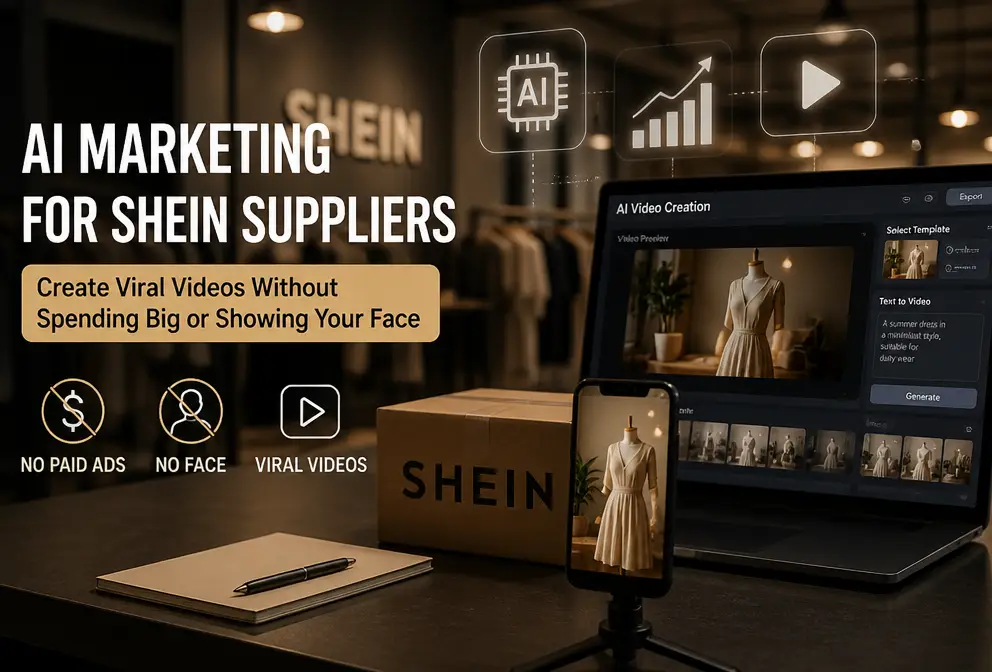
Three years in the business, I could write a memoir about the pitfalls of sourcing for SHEIN. My biggest headache has never been the production line, but every time a new product launches, other suppliers’ short videos go viral on TikTok while I can’t even produce a decent showcase video. Last year I chose a knit cardigan I thought was safe, completed pattern approval, fabric testing, and bulk inventory, but the photographer didn’t schedule the shoot until two weeks later—by then I couldn’t wait. Competitors turned the same style into a bestseller within seven days, later holding over 3,000 units in stock. That lesson forced me to find a solution within three months. Today, instead of talking about the supply chain, I’ll address the headache that everyone hates: Can AI marketing help low‑price, fast‑turnover suppliers solve the critical pain point of “where does the content come from?”
Why Do SHEIN Suppliers Lack Content? People Who Talk Without Standing in the Game Don’t Understand This
Outsiders look at SHEIN suppliers and think they’re just lounging on the platform’s profits. Those who have actually done it know that a high variety of styles, rapid new releases, thin margins, and no professional team together essentially make traditional video production impossible. SHEIN adds thousands of new items daily; if a supplier can’t produce a test video within seven days of launch, they’re basically giving up traffic. Do the math: a product’s gross margin is only a few percent, and the cost of hiring a filming team to produce a polished video can eat up the profit of several items.
Even more fatal is that when SHEIN users browse TikTok and Instagram Reels, they expect real‑world fit demonstrations, fabric movement, zipper smoothness—not ad‑style clips. These require real people, natural light, on‑location shooting. Suppliers have neither model resources nor professional short‑video planning. So the most common practice is: list the product, wait, realize there’s no traffic, list the next product, and wait again. Everyone knows they need external traffic, but no one has a ready‑made “content production line.”
The data feedback loop between TikTok and SHEIN’s backend is a black box for suppliers. You shoot a video, spend ad budget, but how long is the path to conversion on a SHEIN store? No one can calculate it precisely. One thing is certain: without a test video, you don’t even get a chance to enter that black box.
Don’t Rush Into AI—First Understand the Logic of a Viral Video
You might think, just use an AI tool and generate a video with one click? Hold on. “Fast and short” does not equal “sloppy.” SHEIN users have a low tolerance for low‑quality short videos.
On short‑video platforms, the retention rate in the first three seconds directly determines subsequent recommendation volume. Those three seconds must answer the question: “Why should I stop scrolling and look at this piece of clothing?” It’s not because you shouted “Super low price, only $9.99,” but because the first frame shows the fabric’s drape, the waist’s tightening effect, or a styling idea like “one top with three bottoms.” SHEIN users truly care about four visual selling points: fabric texture, slimming effect, size reference, and styling combos. Any video that can’t convey these within 15 seconds will have a dismal conversion rate.
That’s the biggest difference between AI marketing and traditional shooting. Traditional shooting is “creative freedom”—the director decides how to shoot, what to shoot, and how to edit. AI tools follow a “structured output” logic—you input a link, it automatically parses product information, generates hooks, scripts, storyboards, voice‑overs, and outputs a fully structured video. Adobe’s commercial AI video generation technology is already standardizing this direction, but my personal experience is that AI tools don’t replace creativity; they let suppliers produce above‑pass videos even when they have no creative ideas.
Before diving into specific tools, check out How to Deconstruct a High‑End Kitchen Appliance into a High‑Conversion Ad with VEONIB to understand the structured video generation approach. For more on Adobe’s commercial AI video technology, see Adobe’s Detailed Introduction to Commercial‑Ready AI Video and Data.
Paste the Link, Get a Video in a Minute—My Tested SHEIN Product Video Workflow
Honestly, the first time I used an AI video tool I didn’t have high expectations. After one round, I realized it truly solves the “time‑pressured” core problem.
The steps are simple. I found a recently listed summer short‑sleeve shirt in the SHEIN backend, copied its link, and opened the VEONIB interface, pasting the link. The tool automatically recognized the product name, price, and color variants, and within seconds generated a set of hook copy. I chose a UGC‑style hook: “POV: you found the only tee that doesn’t lose shape after ten washes.” This tone resonates well with SHEIN’s target audience and isn’t as stiff as a corporate ad.
I made a simple adjustment to the script. Since this short‑sleeve has six colors, I needed each color to appear in the storyboard. AI defaulted to three primary colors, so I manually added a color‑card module and filled in the remaining three colors. This required no editing skills—just drag‑and‑drop in the storyboard editor.
From pasting the link to exporting a 1080p, 15‑second video, it took me 52 seconds in testing. The AI‑selected English female voice sounded natural, with no obvious mechanical tone. Subtitles were generated automatically; I quickly checked spelling and found no errors. The only mental effort required was choosing the hook line—everything else was repetitive.
This workflow’s value for SHEIN suppliers is that you can dump an entire product list into it, batch‑generate test videos, and launch them simultaneously on TikTok, scaling up the ones that perform best. It eliminates the traditional chain of “pick a product → find a shooter → shoot → edit → launch → wait for results → flop.”
When handling SHEIN’s special requirements, such as size displays and color variants, here’s a tip: AI‑generated videos automatically pull size‑chart data from the product page, but SHEIN’s sizing system differs from Western brands. It’s best to manually annotate the script with intuitive info like “Model is 5’6” wearing size M” instead of just a centimeter chart. In my tests, versions with real visual references achieved noticeably higher click‑through rates. For platform‑specific adaptation, see the article “VEONIB AI Video Ad Generator for All E‑Commerce Platforms” for many practical cases.
Three Common Pitfalls for Beginners (and How I Bypassed Them with AI)
After generating a few hundred videos with AI, I identified three high‑risk pitfalls, each costing money and time.
Pitfall 1: AI‑generated hooks sound too “white‑American.” My first batch of videos used a standard North‑American DTC tone, which Southeast Asian TikTok users completely ignored—it felt like hearing a pitch from another world. I changed the strategy: manually rewrote the hook from “Stop buying tees that pill after one wash” to “Kalau lo mau cari kaos yang gak melar, cobain ini.” The cost of the change was low, but engagement from Southeast Asian users tripled. This shows that AI’s underlying corpus leans Western, and you can’t slack on localization.
Pitfall 2: AI’s size‑reference data is often inaccurate. This is the most frustrating. When VEONIB processes a SHEIN link, it automatically reads the size info from the product page, but many SHEIN items lack standardized model fit data. AI might fabricate a “Model is 6’0”” even though the garment’s chest measurement is only 36 inches—completely unrealistic. If I had published without manual correction, the comment section would have exploded. My current workflow: screenshot SHEIN’s size chart, paste it into the AI script’s notes, and manually annotate “This style runs small; recommend one size up.” This extra two‑minute step prevents massive returns and bad reviews.
Pitfall 3: Localization review of multilingual subtitles. A fellow supplier, eager to capture Latin American TikTok traffic, let AI auto‑generate Spanish subtitles without review. The phrase “de talla única” has a derogatory pronunciation in a certain Latin American region, leading to mockery, zero conversions, and an 8‑point rise in negative shop ratings. The lesson: any non‑English subtitles generated by AI must be checked by a native speaker for at least a minute. It sounds tedious, but it’s far cheaper than a crash.
I’ve also experienced VEONIB’s limitations. Its handling of color variants lacks flexibility—if a product page lists eight colors, AI only picks three, and you must manually add the remaining five. Its AI voice‑over sounds less natural in Spanish and Arabic than in English or Chinese—Thai voice‑overs for Southeast Asian markets feel especially stiff. If you target niche markets, it’s better to replace the AI track with a human voice‑over. However, this isn’t a major issue because SHEIN suppliers primarily serve English and Chinese markets. For more on these limitations, see the practical advice in “Low‑Budget Video Marketing for 2026 Dropshipping Stores.”
Closing Thoughts: AI Doesn’t Replace You, It Gives You the Courage to “Lose”
A month ago, among a batch of test videos run with VEONIB, three achieved click‑through rates above 12%, directly driving external traffic for a short‑sleeve and delivering an ROI more than double that of hiring a filming team. What really convinced me the path is right weren’t those three hits, but the dozens of average‑performing videos that let me afford trial‑and‑error costs.
SHEIN suppliers fear not making good videos, but making videos that don’t work and then hesitating to produce the next one. Traditional production can cost hundreds to thousands of dollars per video; a single flop can crush morale. AI reduces the marginal cost of each video to essentially zero, allowing you to produce dozens of varied videos per week, pick the best‑performing one, and treat it as a true “content strategy.”
Many peers ask, “Will AI‑generated content look too templated, obvious at a glance?” I think that question is inverted. SHEIN users scrolling TikTok care about “what does this garment actually look like on a body,” not “was this video made by AI.” If AI‑generated content genuinely showcases product selling points, even an ugly video works—ugliness can feel authentic. The real danger is not having a clear‑selling‑point video at all and waiting for a never‑scheduled shoot. For more ideas on competing with big brands on a low budget, see “How Small E‑Commerce Stores Compete with Big Brands Using AI Videos.”
Don’t get hung up on which tool to use; the key is to start and then refine. The earliest adopters have already filled their testing windows during the weeks you’re still hesitating.
FAQ
Q1: Can AI‑generated videos be used directly, or do they need another round of editing?
They can be used as‑is, but at least verify the hook copy and size information. In my experience, the AI‑generated script and voice‑over rarely need major changes, but you should manually double‑check the size chart to avoid errors like “Model is 6 ft tall but the shirt is only 36 in chest.”
Q2: SHEIN suppliers making TikTok videos, what if the templates look too similar?
Template similarity is a real issue, but the solution isn’t at the template level. The key is to change the hook copy and the angle of the product’s selling points. For the same product, today you might highlight “colorfast fabric,” tomorrow “appears 3 kg slimmer.” AI will automatically reorganize the storyboard, so visually it won’t feel like the same template. The difference lies in copy logic, not visual format.
Q3: Will posting multiple videos for the same product be considered “duplicate content”?
TikTok and Instagram Reels currently have a fairly relaxed stance on multiple videos for the same product, as long as each video’s selling point and opening hook differ. AI’s strength is generating varied angles in bulk. In my tests, posting five different‑angle videos for the same item, the best‑performing one usually captures about 80 % of the traffic, while the others serve as a long‑tail supplement.
Q4: Are AI tools friendly to “white‑label” products like SHEIN’s? Do they automatically add logos?
AI tools do not automatically add logos, and the generated videos contain no brand watermarks. SHEIN suppliers sell “white‑label” products, and lacking a proprietary logo is actually an advantage. Users see the video as genuine UGC from a real buyer, which builds trust. Overly polished brand packaging can even trigger resistance among SHEIN’s audience.
Q5: I’ve never made a video before; do I need to learn editing software to use AI?
No. The entire workflow is copy‑link → choose hook → review script → export video—four steps. The only skill you need is “knowing which hook is compelling,” which you can develop by scrolling TikTok for a few days. No need to learn Premiere or CapCut; the AI tool compresses the editing stage into a single export operation.
Share Article