How Cross‑Border E‑Commerce Sellers Can Cut Video Production Costs by 90%
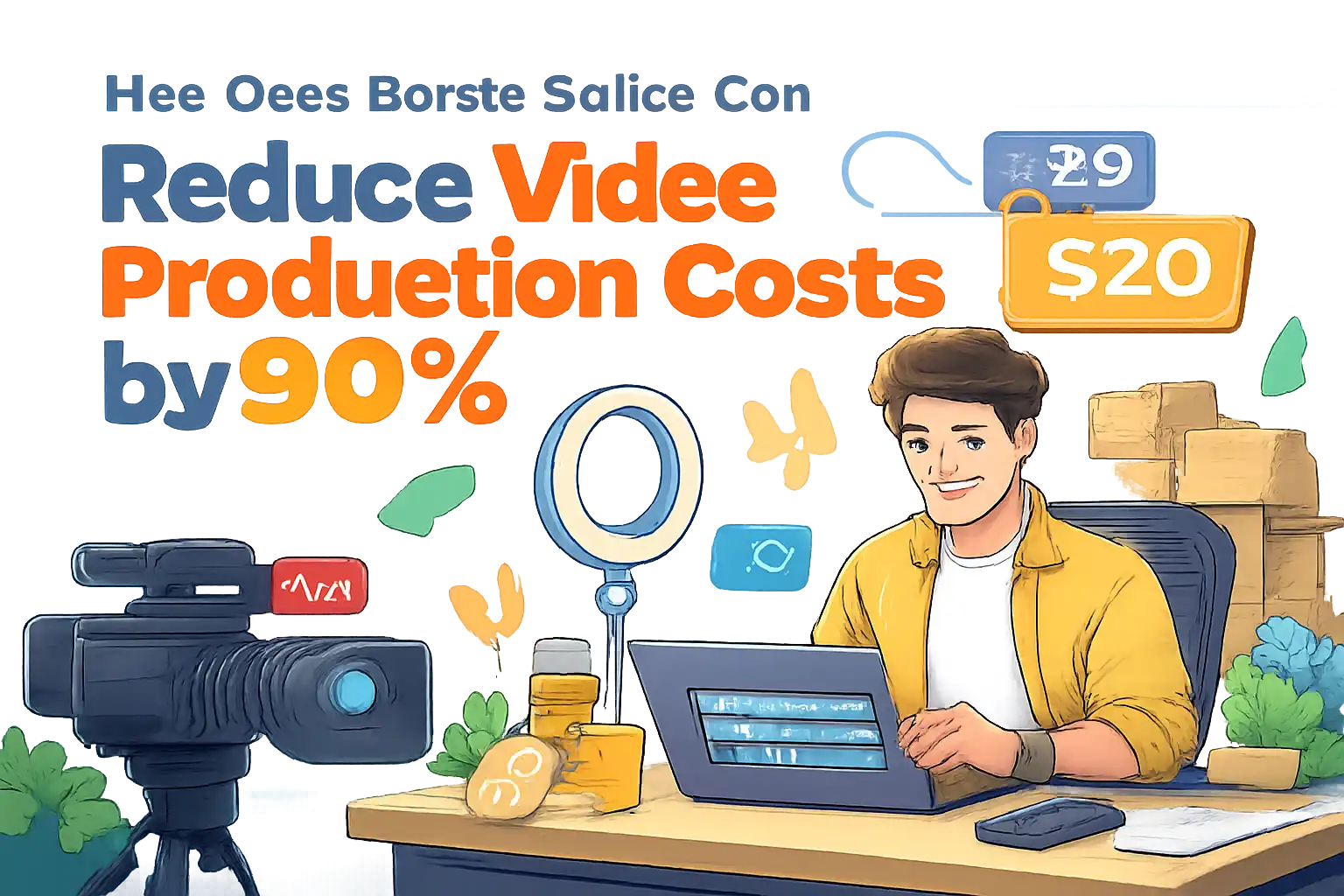
Every cross‑border e‑commerce seller has experienced this scenario: a new product needs to be listed, and you must shoot video assets for TikTok, Instagram, and Amazon. Traditional video production—from writing a script to finding voice‑over talent to editing—often costs several thousand yuan and takes three to five days. This article doesn’t discuss the hollow slogan “content is king”; instead, it breaks down a real, feasible cost‑reduction path—using AI tools to replace 80 % of the human steps in the workflow, bringing the unit cost of a video down to less than one‑tenth of its original value.
A traditional 30‑second product showcase video takes 3–6 hours to produce and costs ¥500–¥3,000, and that’s only for a single video. If your store launches five new products each week, you’ll spend tens of thousands of yuan per month on video assets alone, and multi‑platform adaptation requires different aspect ratios and versions, further driving up costs.
The Cost‑Collapse Points in Traditional Video Production
Let’s break down the full workflow of an e‑commerce product video from zero to finished product to see where money and time are actually spent.
Script ideation is the first hurdle. Writing a 15–30‑second sales script that includes a hook, pain‑point mention, product showcase, and conversion copy takes an experienced copywriter 30–60 minutes. If multiple language versions are needed, each language must be written anew.
Storyboard design follows. The traditional method translates the script into visual scenes, deciding the shot size, movement, and transition for each shot. This step usually takes 20–40 minutes unless you simply use raw product footage.
Filming or asset collection is the most expensive. Sending a photographer with lighting and equipment to a location, plus post‑shoot selection, easily costs thousands per shoot. Even using stock footage requires purchasing rights—an commercial‑use image costs a few dozen yuan, and a video that uses ten images can exceed a hundred yuan.
Voice‑over recording looks simple, but a decent voice‑over costs ¥50–¥100 per minute, not including revisions. If the client isn’t satisfied, additional recordings add extra cost.
Video editing is the biggest time sink. Dragging all assets onto a timeline, adjusting pacing, adding transitions, background music, and color grading conservatively takes 1.5–3 hours for a 30‑second video. The hidden cost here is “decision iteration”—each round of client feedback typically consumes about an hour of back‑and‑forth.
Subtitle addition and multi‑format output don’t cost much money, but they do take time. Each video must be adapted for TikTok (9:16), Instagram (1:1), and YouTube (16:9). Manual re‑exports three times, plus timeline adjustments for multilingual subtitles, add 30–60 minutes.
The table below provides a more visual comparison:
| Workflow Step | Traditional Time | Traditional Cost | AI Tool Time |
|---|---|---|---|
| Script writing | 30–60 minutes | ¥100–¥200 | 10–20 seconds |
| Storyboard design | 20–40 minutes | ¥50–¥150 | Auto‑generated, no extra time |
| Voice‑over recording | 30–60 minutes (incl. communication & revisions) | ¥50–¥200 | 10–30 seconds |
| Video editing | 90–180 minutes | ¥300–¥1,500 | 60–90 seconds rendering |
| Subtitle addition | 15–30 minutes | ¥30–¥80 | Auto‑aligned |
| Multi‑format output | 30–60 minutes | ¥50–¥150 | One‑click export of multiple ratios |
From the table, you can see that over 90 % of the time and cost in the traditional workflow are concentrated in three areas: script ideation/decision, editing, and repeated client review. Editing is expensive because it encompasses pacing control, effect addition, and final revisions; script ideation cost is essentially “revision” rather than writing—clients often want a different opening after seeing the first draft, prompting a new hook, script, voice‑over, and edit.
The Technological Turning Point in AI Video Generation – From “Can Use” to “Can Deploy”
In 2022 I tried the first batch of AI video‑generation tools. Early versions of Synthesia produced poor lip‑sync; the characters’ mouths didn’t match the audio, looking like badly timed subtitles in a dubbed movie. Pictory could auto‑edit long videos, but it often lost product details—my uploaded hand‑cream packaging color rendered as a completely different shade. That period lasted about six months; several sellers reported a noticeable rise in return rates because the product received by buyers didn’t match the appearance in the ad video. Brands largely abandoned AI solutions, believing they were only suitable for low‑quality social‑media background clips.
The real breakthrough came at the end of 2023 into early 2024. Multimodal AI technology enabled a leap in video‑generation quality. Take the latest advances in Google’s Veo series for video generation as an example. Veo 3, released in 2024, can turn a simple product description into a coherent 60‑second video, maintaining consistent material textures, lighting, and motion trajectories. This capability was unimaginable in 2022.
Even more critical is multimodal understanding. The new generation of AI doesn’t just translate text into images; it can interpret structured data on a product page—color, size, material, use case—and accurately render that information in the final video. Speech synthesis and automatic subtitle alignment have also matured over the past two years, eliminating the need for manual timing adjustments.
RunwayML’s authoritative applications in AI video generation and Google’s Veo family represent two directions of this technological curve: product‑level usability and continual technical breakthroughs. For cross‑border e‑commerce sellers, the direct result of these advances is that AI‑generated videos can now achieve conversion performance comparable to real‑life footage in ad placements, while costing an order of magnitude less.
The Secret to Cutting Costs by 90 % – From “Manual Assembly” to “One‑Click Export”
The fundamental difference between traditional video production and an end‑to‑end AI workflow isn’t simply “manual vs. machine”; it’s a re‑organization of the entire production logic.
Traditional workflow is linear: write script → find assets → record voice‑over → edit → export. Each platform requires a repeat of the whole process, and each language version adds another round of work. The hidden cost isn’t filming; it’s “decision iteration”—when a client changes the script at the final output stage, you have to start over with voice‑over and editing, consuming about two hours of the overall process.
AI tools change this structure. Using VEONIB as an example, the workflow is: paste the product link, the tool automatically parses product information, and simultaneously generates all creative assets—hook, script, storyboard, voice‑over, and scene preview. Decision points shift from “post‑production changes” to “script‑stage finalization,” which is the real reason for a 90 % time saving.
A single product link can generate a complete asset package—including hook, script, storyboard, and final rendered video—in 60 seconds, reducing creative production cost by roughly 90 %. In contrast, the traditional process takes 3–6 hours, and each additional language version requires extra time for translation and voice‑over.
The extra value from multi‑platform adaptation is also significant. One video generated once can be output in TikTok’s 9:16, Facebook’s 1:1, and YouTube’s 16:9 ratios. If you sell in both European and Southeast Asian markets, AI can generate English, Chinese, Thai, and Indonesian voice‑over versions in a single pass, eliminating the need to hire separate localization talent for each language. You can try the end‑to‑end process by clicking the free preview of VEONIB’s AI video‑generation workflow.
There’s another point most sellers overlook: video‑production costs in non‑English markets are actually much higher than in English markets. English voice‑over talent is easy to find; Spanish, German, Japanese, and Thai localization resources are scarce, and their rates are typically 2–3 times higher than English, with longer revision cycles. AI’s multilingual capability creates disproportionate premium value in this scenario, far exceeding the pure efficiency gain in English. A seller operating on Amazon’s European sites and multiple other platforms can reduce video‑production costs to 8 %–12 % of the original.
Many sellers focus on the English market, but after avoiding highly competitive markets, non‑English markets often deliver higher ad ROI—provided video quality meets standards. Sellers on Shopify, Amazon, Temu, and other platforms face the same asset‑scale pressure, and the performance gap of AI tools across these platforms is narrowing.
Practical Workflow – From Product Link to Ad Assets in 10 Minutes
Here’s a concrete example. Suppose you run a Shopify store selling smart scales, adding two new products each week, each requiring five different hook videos for testing.
Paste the product link into the AI tool. The tool parses the product page, extracts the name, main selling points, price, and specifications, then recommends 5–8 hook angles and scripts based on that data.
- “You’re not getting fat; the scale is off.” – a pain‑point hook.
- “I switched from Xiaomi’s smart scale after three months—here’s why.” – a storytelling hook.
- “My elderly parent suggested hiding the scale at home.” – a scenario hook.
At this stage you can edit the script directly. If the AI‑suggested opening doesn’t match your brand tone, change it. If the scene description is too abstract, replace it with a more concrete visual. This editing step only takes a few minutes, but its value is that it moves the final video’s decision point forward—traditionally, you and the designer would be guessing each other’s intentions, but now you can see a visual sketch of the script instantly.
After editing, choose the voice‑over language. Your primary market is English‑speaking America, but sales in Germany are also rising. Generate English first, then German; both videos render simultaneously. Average rendering time is 60–90 seconds, during which you can message the operations team to confirm other tasks.
When exporting, select 9:16 and 1:1 ratios for TikTok and Instagram respectively. The whole process—from pasting the link to downloading the finished video—takes at most 10 minutes. The traditional method would require at least three hours, plus waiting for designer drafts, voice‑over confirmations, and client review.
Google’s integration of Veo into Vids is another reference case, showing that leading industry players also recognize the necessity and feasibility of embedding AI into everyday video‑creation workflows.
FAQ
Q1: Who owns the copyright of AI‑generated videos? Can I use them for paid ads?
The video copyright belongs to you and can be used in any paid‑advertising channel, including TikTok Ads, Facebook Ads, Google Ads, and Amazon Sponsored Products. No additional royalties are required.
Q2: If the AI‑generated hook or script doesn’t match my product tone, can I edit it manually?
Yes. The script, scene description, and voice‑over text are all editable before export. After editing, the system automatically re‑renders at no extra charge.
Q3: Which e‑commerce platforms and output ratios does the tool support?
Supports product links from Shopify, Amazon, TikTok Shop, WooCommerce, Temu, AliExpress, Etsy, and eBay. Output ratios cover TikTok 9:16, Instagram Reels 9:16, YouTube Shorts 9:16, Facebook 1:1, and YouTube 16:9.
Q4: Is the quality of multilingual voice‑overs realistic? How do non‑English languages perform?
English and Chinese (including Taiwanese accent and Mandarin) have the best voice‑over quality, approaching professional standards. Major languages such as Japanese, Korean, German, French, and Spanish also achieve usable quality. Low‑resource languages (e.g., Thai, Vietnamese) have slightly less natural intonation but, combined with subtitles, fully meet ad‑placement standards.
Q5: What parts of the final product can I see in the free preview?
The free preview includes AI‑generated hooks, the full script, storyboard scene images, and voice‑over samples. You can view each hook’s conversion‑probability score and static scene visuals. After confirming satisfaction, you can pay to export the final video.
Share Article