BFCM Peak Season Advertising Costs Surge, How AI Bulk Video Production Can Minimize the Cost per Asset
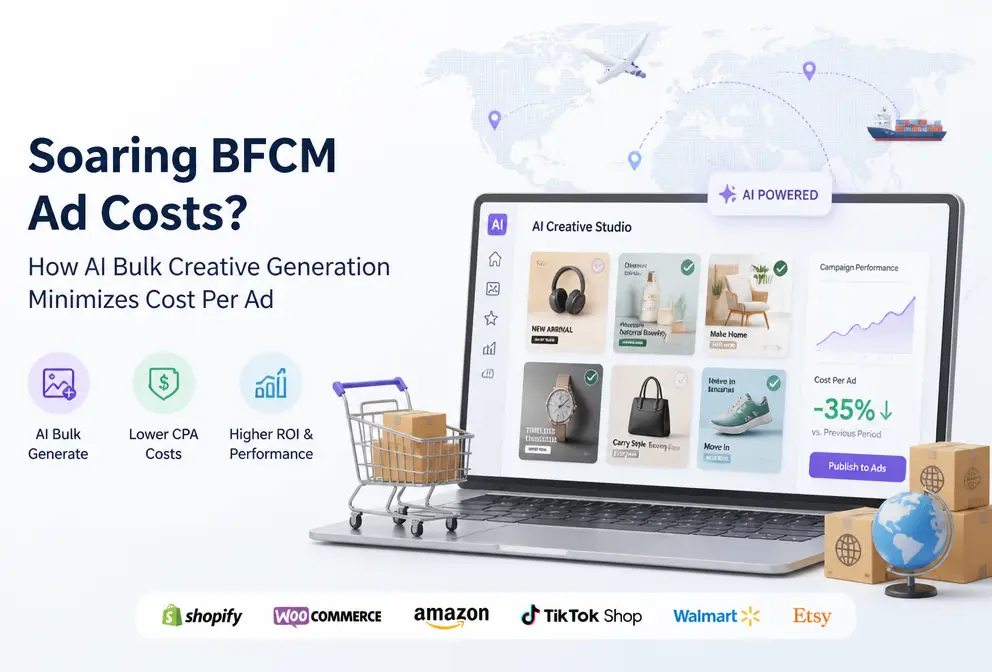
The big‑sale window hasn’t officially opened yet, but CPMs in the ad backend have already started to rise—this is a common experience for many cross‑border e‑commerce teams in Q4. Outsourced video production has long lead times, high per‑asset quotes, and the consumption rate of assets is getting faster, putting pressure on both cost and supply. Treat AI bulk video production as a cost‑structure problem: first calculate the true cost of a single asset, then see how batch production can dilute it, and finally discuss what will sustain ROAS when the volume of assets increases.
Conclusion first: The bidding cost during the peak season can’t be controlled; what can be controlled is how much it costs to produce each effective asset. By switching asset production from per‑item outsourcing pricing to a subscription‑based bulk amortization model, the per‑asset cost can be driven close to zero—provided that testing discipline keeps up; otherwise, bulk production will simply amplify waste.
The Underlying Logic Behind Rising Advertising Costs in the BFCM Peak Season
During BFCM, advertising costs rise directly because inventory is tight. The window from Black Friday to Cyber Monday is only a few days, and all brands compete for volume, making the bidding environment on Meta and TikTok far more intense than usual. Industry observations show that Q4 CPMs are typically 20%–40% higher than the annual average, so the same budget buys noticeably fewer impressions.
What’s often overlooked is the fatigue‑induced price increase on assets. After a single asset is served at high frequency for a few weeks, its CTR continuously declines, and the platform needs more impressions to generate a click, indirectly pushing costs up. This is the “asset fatigue tax”—not caused by the bidding environment but by the supply of assets not keeping pace with consumption.
The promotional window is short, so asset iteration time is compressed; teams can only rely on old assets or pay extra for rush orders. It’s important to clarify a premise: bidding cost cannot be controlled; what can be controlled is “how much it costs to generate each effective asset.” The rest of the accounting is based on this premise.
The Real Cost of a Single Asset: Calculate First, Then Reduce
First, look at traditional outsourcing. A 15–30‑second ad video from a freelancer or small team usually costs $500–$2,000, with a delivery time of 3–7 days. That’s only the first version; script revisions, visual tweaks, and subtitle re‑work all require new scheduling, and rush fees apply during the peak season.
Internal teams aren’t necessarily cheaper. Editing time eats into operational bandwidth; a person producing two or three assets a day is considered efficient, but reshoots and supplementary shoots are unpredictable. A larger hidden cost lies in version management: the same video must be produced in 9:16, 1:1, and 16:9 formats, plus 15‑second and 30‑second lengths, and any update to promotional information requires a full redo.
Thus, total cost = per‑asset price × monthly asset demand. The real issue isn’t “how much per asset,” but “how many assets are needed each month.” A detailed subscription breakdown of the three production methods can be found in the Mainstream AI Video Generator Pricing Comparison. Below is a simplified table of the baseline numbers:
| Production Method | Per‑Asset Cost | Delivery Time | Scalability |
|---|---|---|---|
| Traditional Outsourcing Team | $500–$2,000 | 3–7 days | Weak; cost rises with volume |
| Internal Editing Staff | Monthly salary amortized, high time cost | 1–2 days | Constrained by human capacity |
| AI Bulk Generation | Subscription‑based, marginal cost near zero | Minutes | Strong; output limited only by quota |
Switching the metric: effective‑asset cost = total production cost ÷ number of winning assets produced, not total cost ÷ total assets. The larger the asset pool, the lower the cost after spreading it across winners, and ROAS improvement comes from this denominator.
AI Bulk Video Production Workflow: From Product Link to Deployable Asset

The core pipeline of AI bulk video production is simpler than most people think. Paste a product link, the system automatically parses the product title, main image, selling points, and price, generates a script and storyboard, then outputs the video. One link can simultaneously produce multiple versions: different lengths, different styles (Brand, Lifestyle, UGC, Studio, Luxury, Minimal), and different platform specs (TikTok, Reels, Shorts), all at once.
Take tools like VEONIB as an example: after entering a product link, the backend automatically performs product analysis, script writing, storyboard planning, and video generation, compressing the production time from hours to under 60 seconds per asset. Under a subscription model, the cost structure is: a fixed monthly fee for a quota of dozens to hundreds of assets, with marginal cost per asset approaching zero.
In the industry context, AI video generation technology is already quite mature; visual quality and camera logic have passed the threshold for ad placement. After generation, a single click exports an MP4 that can be uploaded directly to ad platforms, supporting Shopify, Amazon, WooCommerce, TikTok Shop, and others.
For the full path from product page to deployable ad, see Generating TikTok and Instagram Ad Assets from Product Pages. Exported assets go straight into the ad manager.
When Asset Volume Increases, How to Keep ROAS Stable
When the number of assets rises, the real lever is testing speed. The more candidates you have, the sooner you can identify winning assets and concentrate budget on them. Bulk production not only offsets production fees but also mitigates the peak‑season asset fatigue tax—providing substitutes when primary assets decay. That’s the value of batch tools like VEONIB.
However, more assets don’t automatically mean better ROAS. One team produced and launched over 200 highly similar assets in the two weeks before BFCM; the account’s frequency spiked, CTR and ROAS both dropped within two weeks, and they were forced to pause, then re‑segment assets.
The correct approach is structured testing: small‑budget, phased rollouts, quickly eliminate assets based on CTR and ROAS, then scale the winners. Typically, about 20% of assets generate 80% of spend, and the purpose of testing is to find that 20% as fast as possible. Using the “one‑click generate UGC assets from product link” feature (link) ensures a steady supply of candidates; the elimination mechanism is built on the ad side.
Visual continuity between the asset and the landing page is also often ignored; a broken visual after click leads to drop‑off on the landing page. Ensure seamless handoff before launch – see Seamless Connection Between Ad Assets and Landing Pages.
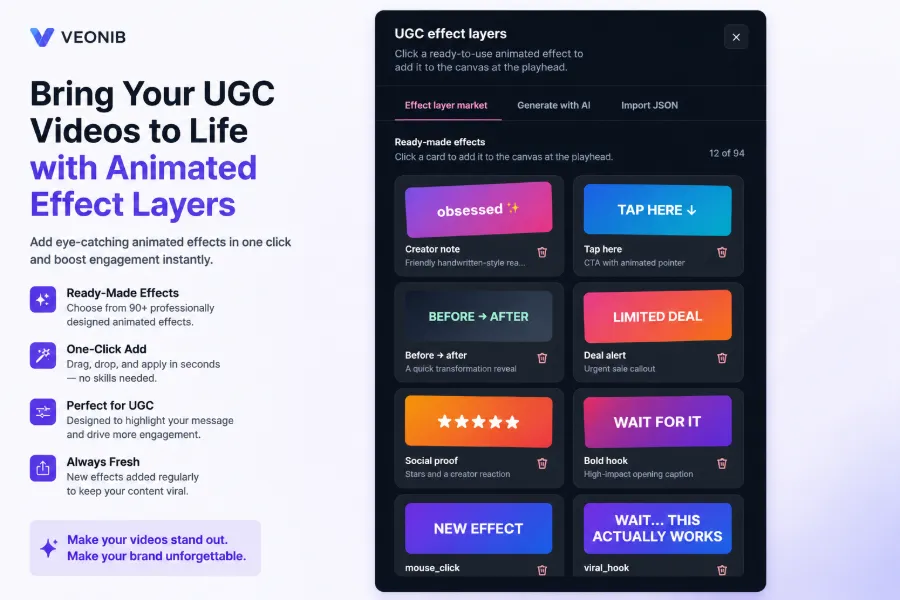
Peak‑season assets also need to handle reusable promotional elements. Hook, promotional tags, CTA, and social proof can be applied as layers once, and bulk‑produced assets automatically overlay the promotion information, saving the effort of editing subtitles one by one.
Another approach is to split a high‑traffic piece of content into multiple ad assets. The concept of turning one high‑traffic blog post into 30 monetizable short videos applies here as well: a validated selling point can be broken into different hooks and lengths for testing, amplifying the output of a single piece of content.
FAQ
BFCM peak‑season advertising costs are rising—can we completely avoid them?
No. Bidding costs are determined by market supply and demand; missing BFCM means for up the year’s largest traffic window. What you can control is asset production cost and asset efficiency: with the same budget, a slightly higher CTR translates into a lower actual acquisition cost.
If AI‑generated bulk assets are deployed directly, will platforms limit their delivery?
Normal delivery won’t be limited. Platforms restrict violating content, low‑quality plagiarism, and overly repetitive assets—not AI generation per se. However, you must control the degree of homogeneity; a large batch of highly similar assets deployed simultaneously may be flagged as duplicate content.
If the per‑asset cost is reduced, will ROAS automatically improve?
Not necessarily. Asset cost is only part of the equation; ROAS depends on testing speed and the efficiency of identifying winners. Low‑cost bulk production solves the supply side, while the ad side’s elimination and scaling mechanisms determine the final return.
Can operators without editing experience use AI bulk video production?
Yes. The entire workflow avoids any editing software: paste the product link, generate script and storyboard, export MP4—three steps. What operators need to add is judgment on ad performance—knowing which assets to discard and which to amplify.
Share Article