Practical Method for Turning a Viral Video Idea into Multiple High‑Conversion Ad Assets

A TikTok short video achieved a good click‑through rate, and the team wants to scale the success. The most common approach is to repeatedly boost the same asset, but within a week the CTR drops, CPM rises, and the cost per conversion more than doubles. The problem isn’t the creative itself; it’s the “single‑asset” strategy that violates the basic rules of ad placement.
Creative fatigue isn’t mystic—it’s the result of platform and audience dynamics. The real bottleneck isn’t a lack of new ideas; it’s how to systematically break a validated concept into controllable, testable, and measurable multiple variants. This deconstruction logic can be applied directly without waiting for inspiration.
Why a Single Viral Asset Can’t Be Re‑used Indefinitely
First, understand how decay occurs. TikTok, Reels, and Meta’s algorithms push the same asset to similar audiences. When that audience repeatedly sees the same content, CTR and conversion rates naturally decline. The asset itself isn’t getting worse; the audience’s attention threshold has risen. Industry consensus is that a creative’s effective window within a given audience typically shrinks by weeks—some fatigue in three days, others last two weeks. This isn’t absolute, but it serves as a scheduling reference.
Another often‑overlooked issue is how platforms judge duplicate content. Submitting the same asset in different formats repeatedly can cause some platforms to lower its distribution weight or flag it as low‑quality. This affects the account’s overall traffic allocation, not just a single asset’s exposure.
Thus the core logic is: decompose the “concept,” not copy the “file.” An asset works because of its underlying concept—a hook that captures attention, a clear selling point, a scenario that creates immersion. Copying the file yields the same decay curve; deconstructing the concept creates multiple independent starting points. The trend from manual to AI‑automated e‑commerce content creation is essentially solving this capacity problem—when manual production can’t keep up with high‑frequency testing, teams must rely on systematic deconstruction to sustain asset supply.
The “Reusable Skeleton” of a Viral Creative
When you receive a well‑performing asset, don’t immediately mimic its surface form. Break the original asset into its structural components: how the hook opens, how the product’s selling points are presented, how usage scenarios or trust signals are laid out, and how the CTA ends. After deconstruction you’ll have a storyboard and script framework—this is the reusable part.
Distinguish two types of elements during deconstruction. One type is the immutable conversion drivers—core product selling points, target audience pain points, final conversion appeal. These are the skeleton and must stay unchanged. The other type is the replaceable variables—opening style, narrative angle, on‑camera format, background music, pacing. These are the flesh that can be swapped.
For example, a 20‑second UGC video with a good ROAS can be broken down as: the first 3 seconds use a pain‑point question to grab attention, the next 10 seconds show product usage, and the final 7 seconds present a before‑and‑after comparison with a purchase prompt. Once the skeleton is extracted, you can keep the “pain‑point question → usage demo → effect comparison → purchase prompt” story flow and only replace the opening question and the middle scenario. Typical video lengths range from 15 to 30 seconds; the skeleton must adapt to different placements—TikTok feed favors a fast‑paced 15‑second cut, while Reels and Meta can accommodate a fuller 30‑second version.
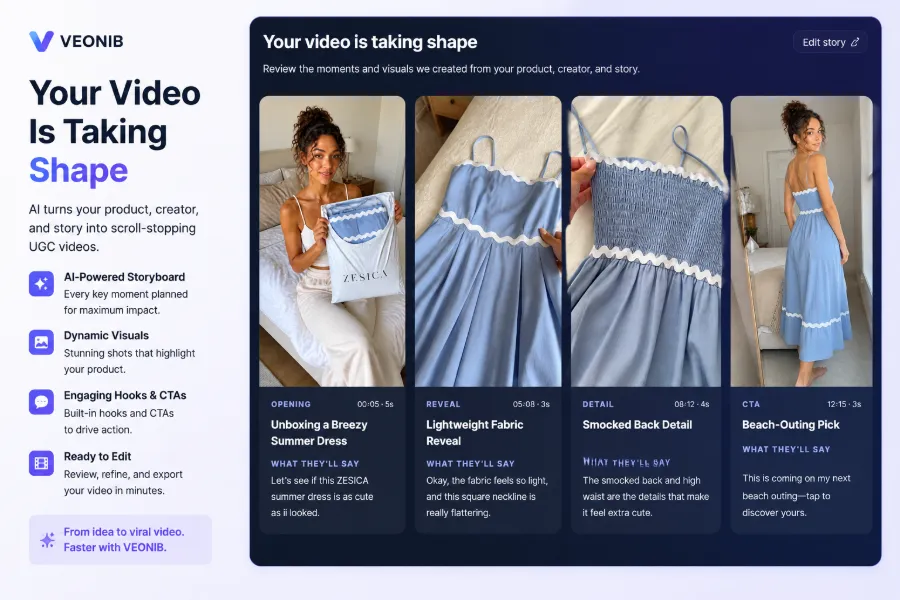
After turning a video into a storyboard and script framework, the remaining work is bulk filling. This can be done manually or with tools that reduce repetitive work—e.g., VEONIB automatically parses product pages and extracts angles, saving the manual information‑splitting step. Tools are accelerators; the deconstruction mindset and judgment criteria still need to be mastered. For a full case study on turning a single product into multiple high‑conversion ads, see Turning a Single Product into High‑Conversion Ads: A Complete Post‑Mortem.
The Future of Ecommerce Content Creation: From Manual Production to AI Automation details the evolution of content production and provides a macro perspective for our deconstruction approach.
Use a Combination Matrix to Mass‑Produce Variants Instead of Re‑writing Scripts One by One
Once the skeleton is set, the correct way to mass‑produce is to perform “single‑variable replacements” within the same skeleton, not to rewrite each script from scratch. Change only one dimension at a time while keeping everything else constant; this gives the test results attribution value. If you change hook, story type, and on‑camera format simultaneously, you won’t know which variable drove the outcome.
From a single product description you can generate six UGC story types: problem‑solving, TikTok Review, unboxing, lifestyle, social proof, and custom. These six types can be produced in parallel; a preview asset for each usually takes under 60 seconds to generate. The bottleneck lies in how you organize these variants, not in generation speed.
You can organize the de variant dimensions using the following matrix:
| Variable Dimension | Adjustable Content | Selection Principle When Splitting Variants | Example Variant Form |
|---|---|---|---|
| Hook (opening) | Suspense / Pain‑point amplification / Direct result | Change only one opening style at a time, keep the rest | Suspense: “What surprised me about this product is…” |
| Story type | Unboxing / Review / Daily routine | Match different audience decision paths | Unboxing vs. One‑week‑later review |
| Length & aspect ratio | 15 s / 30 s / 9:16 | Short length grabs attention; longer length fully explains selling points | 15 s fast‑paced vs. 30 s full scene |
| On‑camera format | Real person / Digital avatar / No person | Choose based on product trust level | Real‑person on‑camera vs. Pure product showcase |
The benefit of this matrix is that each row is an independent test dimension. You can fix story type and length while testing three different hooks; after that round, lock in the best hook and test different story types. Tools like VEONIB can directly generate multiple hooks and script templates, saving you from manually building the matrix, but the testing logic still needs your design. If you don’t want on‑camera appearances, see Methods to Continuously Produce TikTok Ad Assets Without Shooting Video for alternative approaches.
The open‑source code at veonib’s GitHub helps teams quickly set up custom video generation pipelines.
A common mistake is trying to change every dimension at once, thinking “more variants = better.” Changing multiple dimensions simultaneously under the same concept turns the results into a tangled mess—you won’t know whether the hook, length, or on‑camera format caused the effect. Maintaining comparability is more important than sheer variant count.
Use Delivery Data to Prune, Keeping Only the Truly Effective Variants
After variants enter the scaling phase, the challenge is elimination logic, not scaling speed. A typical convergence rhythm: start with a small budget testing many variants simultaneously, monitor CTR, completion rate, and cost per conversion, then eliminate the weakest half each round, concentrating budget on the top 2–3 winners. The first round can test 6–8 variants; after two or three days, drop the worst half, then converge further in the second round.
A often‑overlooked risk during bulk scaling is that the assets gradually drift away from the product’s true selling points. Constantly swapping variables on the same skeleton can lead to “freshness” at the expense of factual accuracy—exaggerating effects, fabricating usage scenarios, or replacing real selling points with nonexistent features. Scaling must preserve information truthfulness; otherwise, short‑term volume gains may be followed by higher return rates and negative reviews. For detailed guidance on preventing content distortion across multiple versions, see How to Prevent Multi‑Version Assets from Becoming Inaccurate, which emphasizes keeping each variant faithful to the product page.
Another reality to accept: even the winning variants will eventually fatigue. Creative fatigue is normal, not an anomaly. Therefore the whole process must be cyclical—winning variants continue to run while you deconstruct them again to create new skeletons for the next round of variants. This “second‑level deconstruction and recombination” capability is what teams truly need to build.
In practice, budget allocation should follow the convergence rhythm. Early testing budgets are spread thin; individual asset budgets should stay low to avoid runaway costs. In the convergence phase, concentrate budget on the winning variants while reserving a small portion for testing new ones, preventing a situation where all assets become fatigued simultaneously and no material is left to run.
Hijacking AI Carousels — How Emerging Brands Outrank 8‑Figure Competitors in ChatGPT Search further discusses creative strategies in search‑traffic competition and provides practical examples for the matrix approach discussed here.
FAQ
How many variants should be derived from a single viral idea in the first round?
Aim for 6–8 variants. Too few won’t reveal differences; too many spread the budget thin and lengthen the test cycle. Change only one variable per variant, run for two–three days, then prune based on data, converging to 3–5 for the next round.
Which elements must stay unchanged when creating variants, and which can be freely altered?
Core product selling points, target audience pain points, and conversion appeal must stay unchanged—they’re the conversion foundation. Hook opening, story type, on‑camera format, and length/aspect ratio can be swapped. The rule of thumb: if a change would affect the factual accuracy of product information, don’t change it.
Will running many variants simultaneously cannibalize each other’s traffic and waste budget?
There will be some internal competition, but it’s a necessary cost of testing. The key is to control each variant’s budget and test duration, avoiding indefinite parallel runs. Eliminate in rounds, quickly concentrate budget on the top 2–3 performers, and internal competition naturally diminishes.
Will repeatedly submitting similar content cause the platform to label it low‑quality?
Possibly. Re‑submitting the same asset can be recognized and its distribution weight reduced. However, different variants under the same concept—different hooks, visuals, narratives—are usually not flagged as duplicates. The crucial point is that variants have substantive differences, not just a new thumbnail.
After a variant’s performance decays, what’s the next step?
Don’t try to rescue it by increasing budget. The correct approach is to deconstruct the winning variants again, retain effective hooks and selling‑point structures, replace the fatigued elements, and launch a new batch of variants. Creative fatigue is normal; turning “deconstruct → test → eliminate → deconstruct” into a loop sustains a steady supply of assets.
Share Article


