From Social Media Buzz to E‑Commerce Purchase: How to Bridge the Broken Conversion Funnel
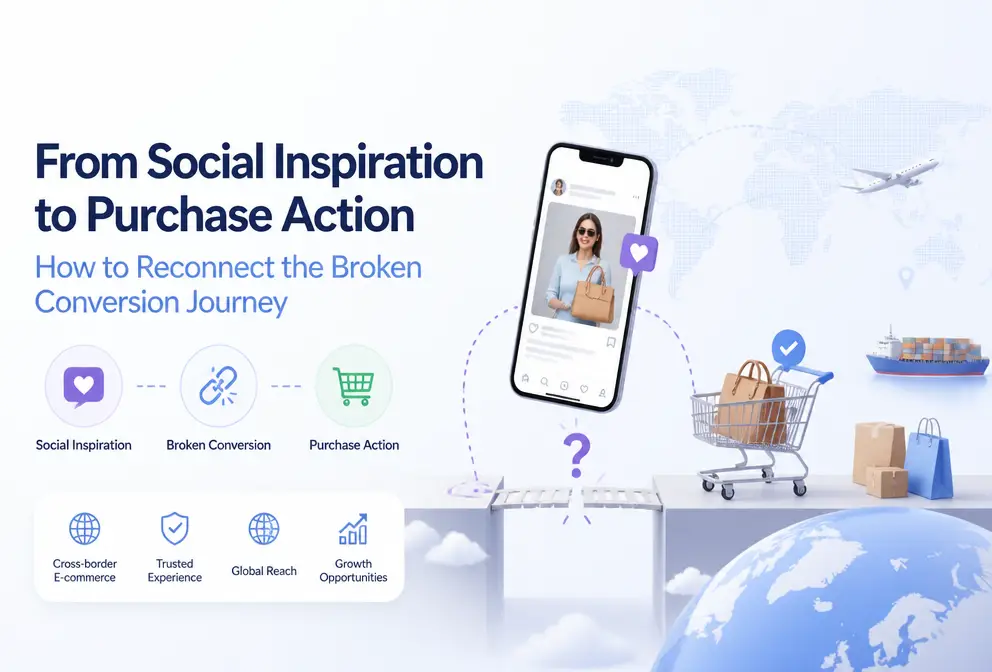
Ads on TikTok and Instagram Reels have decent click‑through rates, and users are indeed drawn in by the “hook” to the product page, but the final sales are dismal. This isn’t an isolated case; it’s a common pain point for cross‑border sellers. Advertising budgets are being spent, traffic is coming in, but orders aren’t keeping up.
The problem isn’t at the “discovery” end but at the invisible conversion gap between “discovery” and “purchase.” Users don’t lack the desire to buy; the path from buzz to purchase is broken. This article addresses exactly how to reconnect that broken conversion chain.
First, a quick answer: the average click‑through rate for social media ads is about 1%, while the average conversion rate in e‑commerce is roughly 2%–3%—note that these are two different stages, with a ten‑fold gap between clicks and purchases. When users land on a product page, most are in a “browsing” mindset rather than a “buying” one. Whether the page can capture that curiosity directly determines whether they’ll convert or bounce.
First, understand where the break occurs between social media “discovery” and e‑commerce “purchase”
The content logic on social platforms is “discovery”—users scroll to a video, get intrigued by the visuals or copy, and click to learn more. The logic on an e‑commerce page is “purchase”—users need to quickly decide if the product is worth buying. The mental states are completely different; any semantic gap between traffic acquisition and page reception will cause conversion to stall mid‑way.
A real case from a cross‑border e‑commerce team: they ran ads on TikTok with click‑through rates exceeding 1.5%, which looked great. However, the landing‑page bounce rate was 80%, and after two weeks the ad budget was exhausted with almost no orders. A post‑mortem revealed that the ad emphasized “fashionable looks,” while the product page’s above‑the‑fold content focused on “material specifications.” Users were attracted by the “good looks” but were met with “specs,” and the information gap destroyed purchase intent.
The full funnel from ad exposure to final purchase is roughly: ad click → page load → information receipt → trust building → final conversion. The most fragile segment is the transition from “information receipt” to “trust building.” Users decide within seconds whether to stay or leave.
| Funnel Stage | Typical User State | Common Reasons for Drop‑off | Remedies |
|---|---|---|---|
| Ad exposure & click | Curiosity, intrigued | Hook doesn’t match actual content | Align messaging |
| Product page landing | Quick scan, eager judgment | Slow load, cluttered info | Simplify page layout |
| Trust assessment | Skeptical, hesitant | Lack of real‑world usage and reviews | Add UGC and detailed showcases |
Three typical symptoms of a broken funnel and what users are actually hesitating about
High bounce rate after click. The ad creative and the above‑the‑fold content on the landing page are completely misaligned. Users are drawn in by a “hook” but see a different narrative, making bounce almost inevitable. This mismatch often happens when different people handle creative production and page maintenance, each speaking their own language.
Lack of authenticity. Many cross‑border shoppers consult at least 3–5 different sources before ordering; official descriptions alone are insufficient. Users habitually search for third‑party reviews and real‑world usage feedback. If the product page only contains brand‑authored copy without authentic usage scenarios, trust never forms.

- Monotonous content format. Static images and cold product descriptions can’t provide the persuasive power needed for purchase decisions. Users need to see the product in real contexts, usage processes, and detailed presentations—things static pictures can’t deliver. A notable observation is that after leaving social media, users don’t jump straight to a purchase decision; they first enter an “information verification” stage, where third‑party reviews and real usage scenarios outweigh brand statements. This is why more sellers are generating bulk UGC assets from product pages—authentic influencer content has a far larger impact on trust assessment than imagined.
Turn the “hook” into a “staircase”: use content to hold every second after the click
To capture social media traffic, a simple eye‑catching “hook” isn’t enough; it must be upgraded to a “content staircase” that continuously persuades. The first five seconds after landing on the page carry huge decision weight; consistency between the ad and the above‑the‑fold content directly influences dwell time.
Here’s how, step by step:
- Ensure strict consistency between ad creative and the above‑the‑fold content on the landing page. Whatever selling point the ad emphasizes, the landing page should highlight the same point, avoiding the “I clicked the wrong thing” feeling.
- Place UGC‑style videos as social proof at the top of the product page. When users arrive, the first thing they see should be real‑world usage, which is far more persuasive than any text.
- Break product details into a series of consecutive frames instead of a single image. A full usage walkthrough, unboxing, lifestyle scenes convey far more information than a static picture.
These content production paths can be derived directly from the product link into scripts and storyboards. For a discussion on generating ad videos from product URLs, see this post. In practice, bulk‑generating TikTok and Instagram ads from product pages dramatically shortens the alignment cycle between creative and page information.
Fixing the conversion funnel isn’t just about redesigning the landing page; it’s also about embedding enough detail into the ad creative itself, treating “buzz content” as “persuasive content.” That way, every step from click to stay is supported by content.
Use automation to smooth the middle segment
Manually producing platform‑specific assets one by one is costly and scaling is a barrier for many teams. Traditional video editing can take hours to days per script, while the cadence of ad updates is faster, leading to repeated funnel breaks.
An automated production workflow that takes a product link as the sole input is changing that. The system parses product info, selling points, and price, automatically generates scripts and storyboards, and outputs videos ready for social media and product pages. URL‑based automation can compress the creation of a single asset to a few dozen seconds, and reusing the same baseline across platforms becomes feasible.
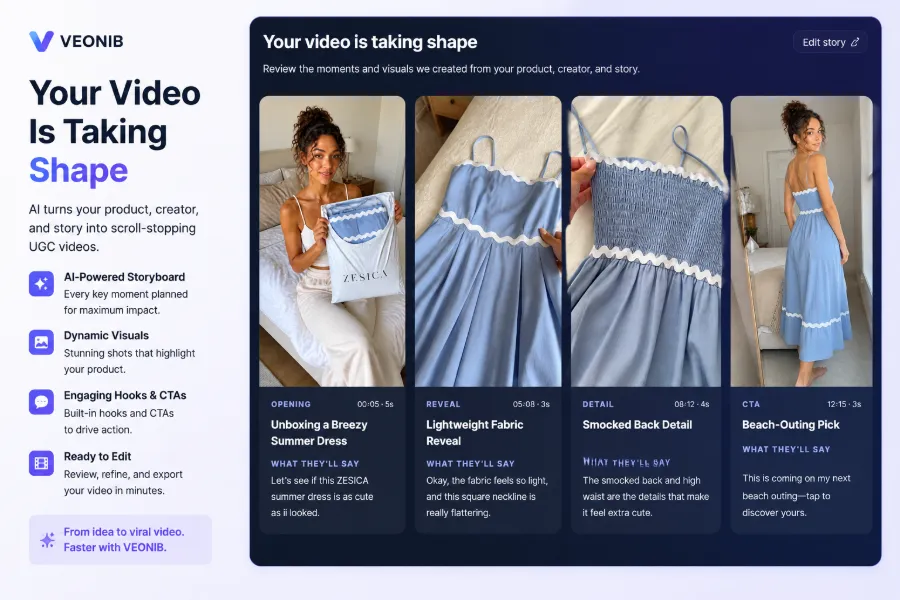
These tools show clear gains in production speed. For example, VEONIB integrates product link parsing, script generation, storyboard planning, and video rendering into a single pipeline, supporting multiple video styles (brand, lifestyle, minimalistic, etc.). The exported MP4 can be deployed immediately. For teams with high volume and frequent updates, this solves a production bottleneck rather than a marketing‑design problem. Compared with mainstream AI video generators, the long‑term operating cost of such a solution is evident. Check real user feedback on G2 for reliability rather than relying on marketing pages.
Keep an eye on these metrics to keep the funnel healthy
Building the funnel is just the start; long‑term operation requires monitoring four key metrics: ad click‑through rate, landing‑page bounce rate, add‑to‑cart rate, and final purchase conversion rate. Together they pinpoint where the funnel is breaking.
- High click‑through but high bounce → inconsistency between creative and page.
- Normal bounce but low add‑to‑cart → weak persuasion on the product page.
- High add‑to‑cart but low purchase conversion → issues in checkout or shipping fees.
With full attribution tracking, you can usually locate the most severe loss point within two weeks. Meta Pixel and TikTok Pixel are basic requirements; without attribution data, all optimization is blind.
Once the funnel stabilizes, consider expanding verified assets into multiple languages and markets to extend their lifespan. Translating proven assets into other languages is a low‑cost way to reuse content. Also, linking SEO blog content to generate video assets lets the same material add value across channels.
The funnel requires continuous iteration, not a one‑off build. Content performance decay, shifting user preferences, and platform rule changes all affect results. Tools like VEONIB are valuable because when assets need updating, you can quickly regenerate them from existing product data without starting from scratch, keeping iteration costs under control. Regularly review metrics, replace ineffective assets, and test new content formats to keep the conversion funnel thriving.
FAQ
Q1: Social media traffic click‑through is high, but order rates stay low—why?
A high click‑through rate only shows the ad captured attention; it doesn’t mean users are ready to decide. Most users enter an “information verification” stage after clicking. If the product page lacks authentic usage scenarios and third‑party reviews, trust never builds, and orders can’t happen. Check that the ad and landing‑page above‑the‑fold information match and that the page provides enough persuasive content.
Q2: How can I tell if my ad creative and landing page are misaligned?
Compare the selling points emphasized in the ad with the information shown above the fold on the landing page. If they don’t point to the same purchase reason, there’s a mismatch. Another indicator is bounce rate—if click‑through is normal but bounce stays above 70% for a long period, it’s likely a creative‑page information gap. You can also have someone unfamiliar with the ad open the product page and ask if they can state the core selling point.
Q3: Small sellers have limited budgets and can’t produce professional videos—how to fill the content gap?
Professional equipment isn’t required; UGC‑style phone videos often feel more authentic. AI tools can generate video assets directly from product links, automatically producing scripts and storyboards at a fraction of outsourcing costs. The key is authenticity and information density, not high‑resolution production.
Q4: My assets have been running for a while and performance is dropping—should I tweak the ad first or replace the content?
Let the data guide you. If click‑through rates are falling, the creative’s appeal is waning; if click‑through stays steady but conversion drops, the page or trust building is the issue. Typically, creative fatigue drives click‑through decline, so start by refreshing the creative before adjusting bids or audience targeting.
Share Article