What Is an AI Product Video Generator? – From Link to Video in One Minute
As a seller who has run a cross‑border independent store for three years, the most painful part for me used to be product videos Virtual AI Fashion Models. To shoot a 30‑second short video you need to contact a photographer, prepare props, do post‑production editing, add subtitles, and add music—just the communication alone takes a kettle‑full of effort. Outsourcing to an editor starts at ¥800 and you have to wait three days. Then I saw a post on a forum about an AI product video generator that claimed you could just paste a link and get a finished video automatically. My first reaction was: “Is this thing reliable? I’ll try it for free.” The result: from copying the link to downloading the first finished product, it really took only a minute. The footage, music, voice‑over, and subtitles were all there. Of course, after using it I found it’s not as perfect as the hype, but it does solve a part of the pain. In this article I’ll share the pitfalls I’ve hit and actual comparisons to explain what it is, what it can do, and where it still falls short.
What Is an AI Product Video Generator? – Core Principles and Workflow
Essentially, these tools are an automated video pipeline Studio‑Grade AI Commercial Photography. You just paste the product page link, the AI crawls the page for images, titles, descriptions, and selling points, then automatically analyzes the content, creates a script and storyboard, and finally renders a complete video. You never touch any editing software, and you don’t even have to type anything.
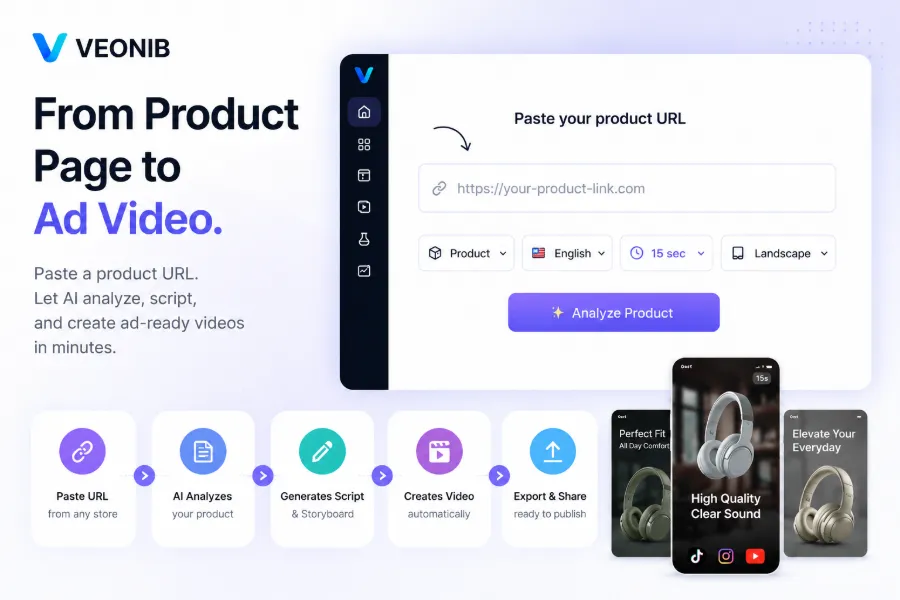
For example, the recent tool I tried, VEONIB, is a typical AI product video generator. Its process is straightforward: paste link → AI analyzes product info → automatically generates script and storyboard → renders and exports. The claimed average generation time is 60 seconds; in my tests it ranged from 60 to 90 seconds. Compared with traditional video production, it’s like ordering takeout versus growing your own vegetables and cooking from scratch. Traditional production needs a shooting crew, editors, voice‑over talent, and takes days; AI generation is fully automated and measured in seconds.
One thing to note is that the quality of the output largely depends on the quality of the link you provide. I once used a vague main‑image link, and the resulting video looked noticeably poor—AI had no high‑resolution material, so it just enlarged a blurry picture. When the link information is incomplete, the script can also contain absurd errors. VEONIB offers an internal guide on eliminating AI video “hallucinations,” explaining how to avoid inaccurate information. From a broader perspective, the article “How AI Is Transforming E‑commerce Marketing” also points out that these tools lower the barrier to video creation but cannot fully replace human judgment.
What Can an AI Product Video Generator Do? – Core Features and Use Cases
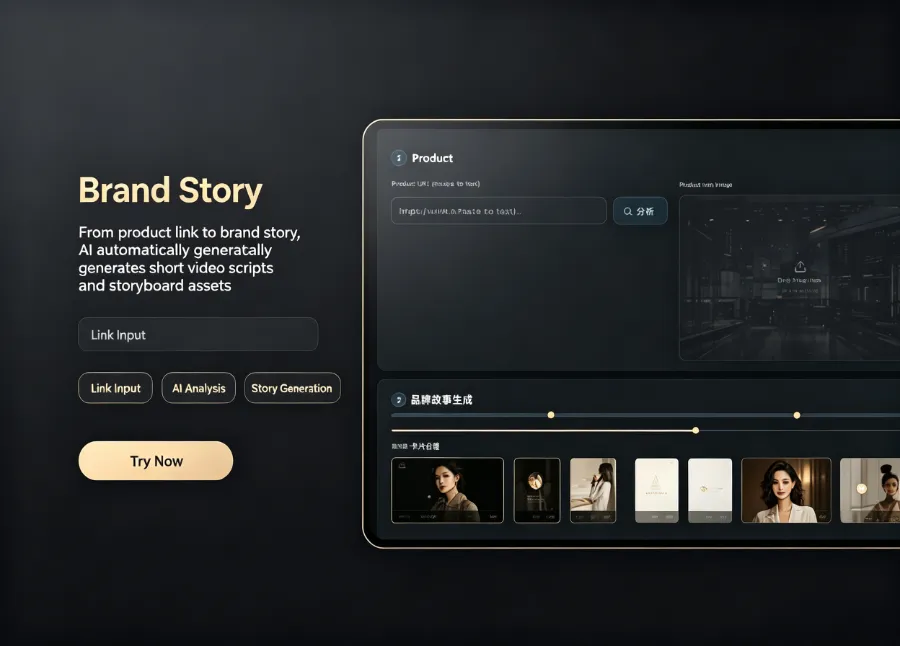
Honestly, I was amazed by the feature list when I first started. VEONIB can generate several types of videos: standard product showcase videos, brand story videos, vertical social‑media videos, ad‑placement videos, and Amazon listing videos. Each has its own template and pacing.
The most useful feature is multilingual voice‑over. I had a $60 Bluetooth earphone; using the same product link, VEONIB produced English, German, and Japanese versions, which I pushed to US and European markets for ads. Traditionally, each language would cost at least ¥500 for a voice actor and take at least a day. AI generation is almost zero extra cost and done in minutes.
Another pleasant surprise is aspect‑ratio adaptation. Choose TikTok for 9:16, YouTube Shorts for 9:16, Facebook for 1:1—one script automatically fits multiple platform dimensions without manual cropping. You can also generate dozens of different versions at once for A/B testing to find the highest‑converting material. For a team’s promotion cadence, VEONIB’s content integration capability is valuable; you can link SEO content with video, see the VEONIB‑SEONIB integration guide for details.
However, many overlook a subtle point: although generation is ten times faster than manual editing, output quality heavily relies on the completeness of the link’s information. If the product description is only a couple of lines without size, material, or key selling points, the AI‑generated script will be empty and full of filler. You’ll end up with a “pretty but useless” video.
AI Product Video Generator vs. Traditional Production: Speed, Cost, and Quality Comparison
I have two SKUs on hand—one with an AI‑generated video, the other shot by an outsourced team. Here’s a quick side‑by‑side comparison:
| Dimension | Traditional Production | AI Generation |
|---|---|---|
| Time | 2–5 days (including communication, shooting, editing, revisions) | 60 seconds generation, 5 minutes for tweaks and export |
| Cost | $500–$5,000 (photographer, model, editor, voice‑over) | Almost zero (preview free, export pay‑per‑use) |
| Quality | Strong realism, high controllability, fits brand tone | AI‑style visuals, limited scene realism |
| Creative Control | Very high—every shot can be adjusted repeatedly | Low—only script and voice‑over can be changed, no frame‑by‑frame edits |
| Revision Flexibility | Requires reshoots or re‑editing, costly | One‑click regeneration, multiple iterations possible |
Honestly, AI‑generated videos can’t match the realism of real footage. Especially when a model is involved, the natural eye contact and lighting transitions are still beyond AI’s reach. But AI wins on speed and cost, making it perfect for rapid scaling scenarios. For example, when a new product launches, you can first use AI to create a basic product video for the listing, then later shoot high‑quality material if the style proves promising. That was a very practical strategy I used in early testing.
Also, many assume AI videos can be used directly for ads; I fell into that trap. If you don’t adjust the script and pacing to each platform’s style—e.g., TikTok needs a hook in the first three seconds, YouTube Shorts needs a faster narrative—conversion rates can be lower than a static image. So AI generation isn’t the endpoint; manual fine‑tuning is essential.
Virtual AI model photo generation tools complement visual content creation and can be combined for a full product visual solution. VEONIB’s product page on Product Hunt contains many real user reviews that help assess its practicality. VEONIB on Product Hunt
Common Misconceptions and Tips When Using an AI Product Video Generator
The biggest pitfall I hit with AI video generators was inaccurate information.
Once I generated a video for a light‑blue hoodie, and the script said “This hoodie is made of deep‑blue fabric.” I copied it straight into an ad, and a customer immediately asked in the chat, “Did you send the wrong picture?” I watched the video three times before realizing the voice‑over and visuals didn’t match. Upon checking, I found the AI had misread the hexadecimal color code from the link’s tag as “deep blue.” This mistake cost me about $50 in ad spend and damaged brand trust.
Since then I’ve adopted a habit: after each video is generated, manually review the script for key information—color, size, price, material. AI hallucinations are real; it doesn’t inherently know that “light blue” and “deep blue” are different. VEONIB has a dedicated context‑engineering process to reduce hallucinations, but I still recommend a visual script check.
The second misconception is using the default script as‑is. My first generated script read like a product manual: “This product uses XX technology, dimensions are XX, suitable for XX scenarios.” Viewers skimmed past it within a few seconds. The correct approach is to edit the AI‑generated script, adding user pain points, usage scenarios, and emotional hooks. Brand tone must be controlled by you; AI only provides raw material and cannot replace your brand understanding.
The third misconception is thinking that having AI eliminates the need for a professional team. For flagship products or brand‑image videos, I still outsource to professional editors. AI is best for daily new arrivals, product testing, and rapid social‑media content—high volume, not high quality.
FAQ
Q1: What input does an AI product video generator need? Just a product link?
Yes, the core input is a product URL. The tool automatically extracts images, titles, descriptions, price, etc. If the page content is poor (blurry images, sparse description), the output will suffer. Make sure the product page is complete before pasting the link.
Q2: Can the generated video be used directly for commercial ads? Is the quality sufficient?
It can be used directly, but you should manually verify key information and adjust script pacing. For testing, social‑media daily content, AI videos are sufficient; for core brand ads or major campaign assets, supplement with real footage or professional editing.
Q3: Which e‑commerce platforms are supported?
Most major platforms are supported: Shopify, Amazon, WooCommerce, TikTok Shop, Temu, AliExpress, Etsy, eBay, etc. As long as the page structure is standard, the AI can parse it. A few highly customized independent sites may fail, requiring manual data entry.
Q4: Is there a fee to generate videos? Is there a free trial?
Most tools offer a free preview—you can see the script, storyboard, and a video sample. Exporting a high‑resolution, watermark‑free video requires payment. VEONIB lets you generate a preview without a credit card; export is billed per video.
Q5: Who owns the copyright of the generated video?
Usually the user owns it. The videos you create inside the tool can be freely used for commercial ads, social media, and e‑commerce platforms without additional licensing. Still, check the specific tool’s terms before use.
Share Article