No Models, No Filming Crew: How to Mass‑Produce TikTok UGC? One Person Is a Whole Content Team
At 2 a.m., I stared blankly at the TikTok dashboard. The shop had just launched three new items, the account had been silent for four days, and my phone was full of dozens of videos that were shot and then deleted. No models, no studio, no filming crew— not even someone to hold a fill light. This isn’t a special case; it’s the daily reality for the overwhelming majority of solo sellers.
For the past six months I’ve been testing the same question: can one person consistently mass‑produce TikTok UGC content? The answer is yes, but only if you change your way of working. In a traditional filming workflow, you need to find a model, rent a location, set up lighting, edit—each video starts with at least two hours of human labor. After I started replacing the filming stage with AI tools, the average time from product selection to video export dropped from two hours to 60 seconds. This article skips theory and focuses on the pitfalls I hit and the final workflow that works.
Why TikTok UGC Content Is Critical for Small Sellers
TikTok users have an almost exact preference for “authenticity.” When a brand’s official ad appears in the feed, users stay on average less than three seconds—they instantly recognize it as an ad and scroll away. UGC‑style videos are different: an ordinary person unboxes, complains, or recommends a product in front of the camera, and viewers stay for 15 seconds or more.
The data doesn’t lie. Industry stats show that UGC‑style videos on TikTok have about a 40 % higher average engagement rate than brand ads. The conversion gap is even clearer: in my own shop’s A/B test, the same product’s brand‑ad video had a click‑through conversion rate of around 1.2 %, while the UGC‑style video achieved over 2.8 %. This isn’t a quality issue; it’s a trust issue—users trust a “regular‑person‑looking” recommendation more than a carefully packaged ad.
But solo sellers hit a dead end: they lack people, equipment, and time. Outsourcing to an MCN costs 300–800 CNY per UGC video; updating 20 videos a month is a fixed expense of over 10 000 CNY. Hiring part‑time models, plus location and shooting time, also doesn’t drop below 200 CNY per video. It’s not a budget problem; it’s an efficiency problem—every minute you spend on content production is taken from product selection, operations, and customer service.
I tried outsourcing, I tried asking friends to help shoot, and I eventually gave up. It wasn’t the results; it was the pace. TikTok content needs high‑frequency updates, and the communication overhead of outsourcing is too high—by the time the partner delivers the video, the trend has already passed.
No Real Models? Solve the “Human” Problem with AI Personas
The biggest bottleneck in traditional UGC filming is the “person.” You need a real person on camera, a location, lighting, and at least two shoots to get the right feel. Solo sellers simply can’t shoulder that cost.
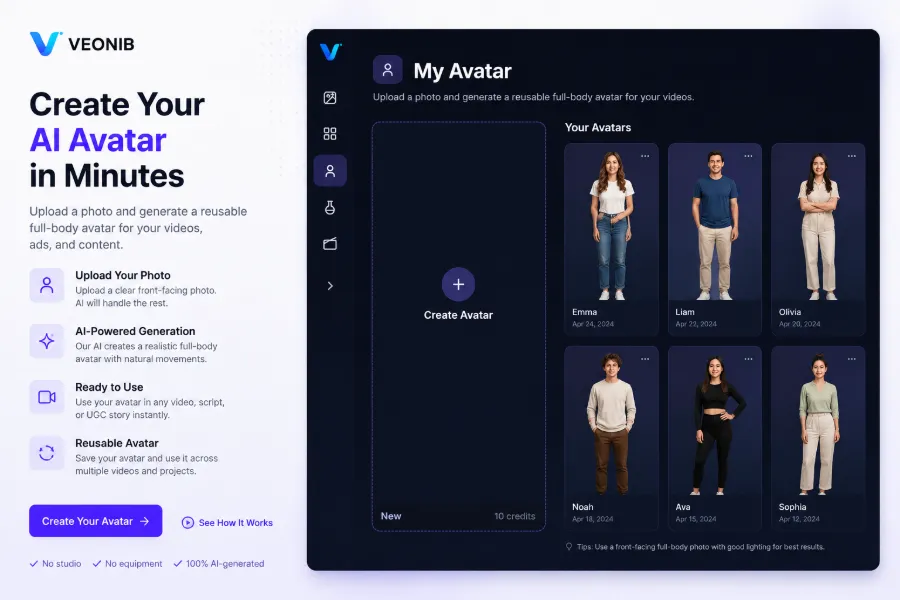
My first encounter with VEONIB was driven by a very specific problem: I had a beauty product to promote but couldn’t find a suitable real person to shoot a “try‑on” video. The traditional solution was to find a user on Xiaohongshu for a collaboration, which took at least a week back and forth. VEONIB’s solution was to upload a photo, generate an AI digital avatar, and then use that avatar to shoot the video.
During the first test I didn’t have high expectations. In 2023, AI characters’ lip‑sync, facial expressions, and movements still looked stiff. The actual result surprised me—AI characters moved almost as fluidly as a real person, and lip‑sync accuracy at normal speaking speed was virtually indistinguishable. More importantly, the whole process from photo upload to rendering took under 30 seconds.
What does that speed mean? It means you can generate a UGC video with a character on camera within five minutes of selecting a product. No need to book a model, wait for a schedule, or re‑shoot repeatedly. If you don’t like the result, just swap the avatar and regenerate—zero cost.
My current setup includes three built‑in AI personas, each matched to a product category: a young female for beauty and lifestyle, a gender‑neutral avatar for tech and tools, and a mature male for home and utility products. The match between the persona and brand tone determines the first‑impression trust factor.
Six Story Templates: Making Bulk UGC Production Simple
With a persona in place, the next question is structure. UGC videos don’t go viral by random filming; they must follow TikTok’s viewing habits—grab attention in the first three seconds, showcase the product or scene in the middle, and end with a call to action.
VEONIB includes six story templates: Problem‑Solution, TikTok Review, Unboxing, Lifestyle, Social Proof, and Custom. Each template follows a different narrative logic.
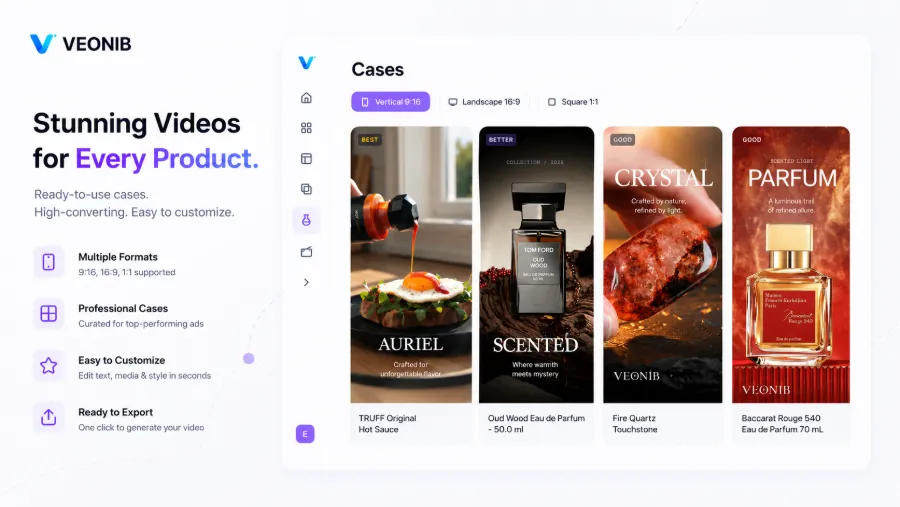
For example, I sell a portable coffee maker. The Problem‑Solution template narrates “Running late in the morning? This machine makes coffee in 30 seconds”—directly hitting the pain point. The TikTok Review template says “Two weeks of use, here’s the real feeling”—emphasizing authenticity. The Unboxing template fits a product launch: “From the box to the first cup, a complete record”—satisfying user curiosity.
The biggest value of templates is efficiency, not creativity. After selecting a template, the average time from concept to export drops from two hours to 60 seconds. AI automatically parses the product link for title, selling points, price, and specs, then fills those into the template. No script writing, no storyboard—just pick a template and wait for the video.
One pitfall I hit: using the default template leads to content homogenization. In early 2024 I released a dozen videos generated with the same template; the backend showed a noticeable drop in completion rate after the third week. The issue wasn’t the template itself but the lack of visual differentiation. I later adjusted the strategy: each template is paired with a different persona, background scene, and opening line. The structure stays similar, but the visuals are completely distinct.
For a concrete example, see VEONIB’s product‑link‑to‑ad video workflow, which demonstrates the conversion from a product URL to a full video. For affiliate marketers and creators who need a steady stream of content, this template system provides “unlimited content material for affiliates and influencers” (link).
One Person Equals One Team: End‑to‑End Optimization from Selection to Publication
The core issue for solo sellers isn’t a lack of tools; it’s a lack of smooth processes. It took me two months to get the workflow working, and now it looks roughly like this:
After selecting a product, paste the product link into VEONIB; AI parses the product info. Choose a template and persona, tweak a few parameters—opening copy tone, background music style, video length (15 / 20 / 30 seconds). Click generate, and after 60 seconds you have an MP4 file. Upload directly to TikTok, set title and tags, and publish.
The entire process takes less than three minutes. In a traditional shoot, those three minutes wouldn’t even finish lighting.
With this automated workflow, a solo creator can consistently produce 15–20 UGC videos per week. That output would require at least a three‑person team under a conventional filming model. For a deeper look at how AI can automate the entire marketing video pipeline, see AI‑Automated Marketing Video Pipeline.
I must be honest: AI‑generated UGC initially lacks a certain authenticity. In a 2024 test, a default‑template video received comments like “This looks too AI.” The issue lay in the avatar’s micro‑expressions and the randomness of the background—AI‑generated scenes were too “clean,” losing the roughness typical of UGC.
The fix is to manually adjust two parameters: first, add natural head nods and blink frequency to the avatar; second, vary the background—avoid a plain color every time, and switch to real indoor or outdoor settings. VEONIB’s AI Video Ad Generator lets you fine‑tune these after generation; it adds a couple of minutes but makes a noticeable difference.
Another issue to watch is content diversity. The biggest trap of template production is making every video look like it came from the same template. My current approach: each week I use four different templates, each paired with two different personas, and three to four distinct background scenes. Thus, 15 videos may share a structure but look visually unique.
FAQ
Q1: Without real models, do AI‑generated avatars look fake?
AI avatar technology in 2024 has improved dramatically; lip‑sync and facial motion look almost flawless at normal viewing distances. If you zoom in full‑screen, you may still notice subtle unnaturalness—like slightly low blink rates. For 15‑30 second short videos, this gap hardly affects the viewing experience.
Q2: I’m a solo creator updating TikTok daily—won’t templates cause repetition?
Yes, if you stick to a single template. The solution is to rotate three to four templates, each paired with different avatars and backgrounds. Even with daily updates, users will see visually distinct content in their feed.
Q3: Can AI accurately extract information from product links, or do I need to edit manually?
Most of the time AI correctly extracts title, price, specs, and key selling points. Occasionally, details like material, size, or usage scenarios are missed. It’s advisable to review the script once and manually add any missing points; this takes no more than 30 seconds.
Q4: How long does it take to generate a 15‑second UGC video?
From past the product link to exporting the MP4, the average is 60 seconds. Including template selection and avatar tweaks, the whole process finishes within two to three minutes. Compared with the two‑hour start‑up of traditional filming, this efficiency is the key for solo sellers to stay fresh.
Q5: Can these videos be used directly for TikTok Shop live‑selling?
Yes. VEONIB outputs standard MP4 files with resolution optimized for TikTok’s vertical format. You can upload them directly to TikTok Shop product pages or feed ads. In my shop, 80 % of the selling videos are produced with this workflow, and conversion metrics are comparable to those of videos shot with real people.
Share Article