Skincare Product Video Marketing: From Content Strategy to AI Automation Implementation
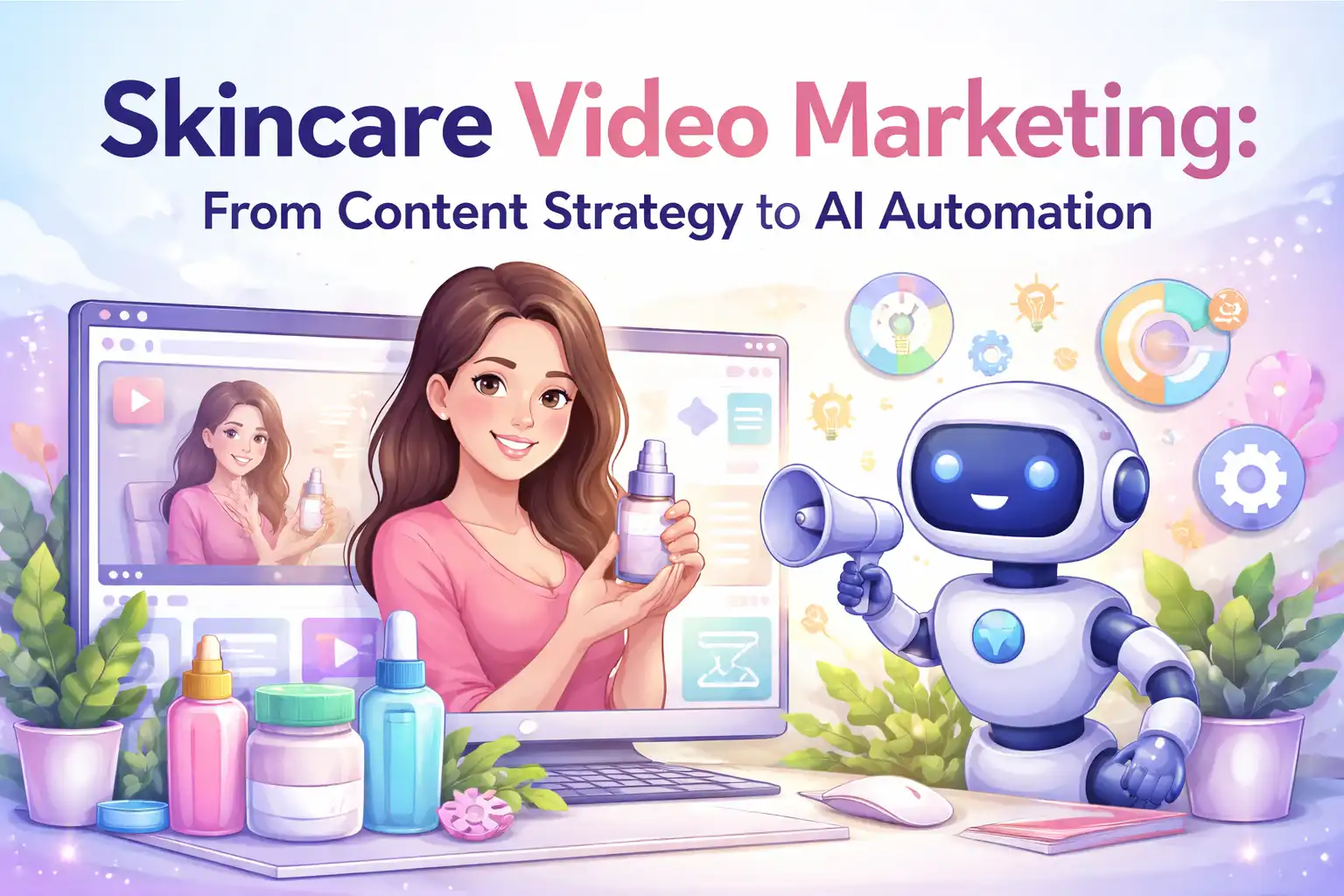
Skincare products are one of the most competitive categories in video advertising. Users need to see texture, absorption speed, and on‑skin effect, while traditional production workflows often get stuck at script, storyboard, and voice‑over stages, preventing brands from keeping up with the rapid update cycles across multiple platforms. A high‑quality skincare video ad typically takes 3–5 days to produce—by the time the script is finished, the storyboard approved, and the voice‑over recorded, the product’s buzz may already have faded. This article focuses on the unique scenarios of skincare, breaks down high‑conversion content models, and explores how AI tools can compress the “product‑to‑advertisable video” chain into minutes, allowing teams to refocus on creative iteration.
Core Challenges and Current Trends in Skincare Video Marketing
The conversion logic of skincare video ads differs fundamentally from other categories. Users must build trust before purchasing, and that trust comes from visual authenticity—whether the texture looks even, whether it feels sticky after application, and whether absorption truly matches the claim. A blurry color clip or an overly beautified filter can cause consumers to skip the video and switch to a competitor.
At the same time, platform algorithms are intensifying this content pressure. TikTok Shop, Instagram Reels, and YouTube Shorts increasingly favor a native feel. If a brand simply trims a traditional ad and uploads it, completion rates drop dramatically. Short‑form videos need a “creator vibe”—slightly rough footage, a realistic background, and a complete demonstration—making them more likely to receive recommendation traffic.
A bigger contradiction lies between the demand for bulk content and production costs. A skincare brand in peak season may need to test 5–8 ad variants simultaneously, covering different ingredients, usage scenarios, and audiences. In traditional workflows, each variant requires a new script, shoot, or edit, causing costs to balloon. Industry data shows that a single brand must post more than 10 videos per month on TikTok to maintain a stable traffic curve—almost impossible for small teams.
Shopify’s official blog explicitly notes that the ROI of e‑commerce brands on short video is positively correlated with the number of assets—more tests, higher win rates. But this presumes the team can produce those assets quickly.
Maturing AI video generation technology is reshaping this competitive landscape. Over the past two years, multimodal models have dramatically improved video generation quality, evolving from simple image animations to understanding core product selling points and automatically structuring narratives. This means skincare brands no longer need a full production pipeline for each product; they can automate repetitive work with AI tools.
Google Veo multimodal video generation model demonstrates how AI can jump from textual understanding straight to scene rendering—a capability especially suited to skincare, where products often have clear, structured descriptions and standardized usage procedures, making it easier for AI to extract key information and convert it into visual storytelling.
Four High‑Conversion Content Models for Skincare Videos
Not every video model warrants investment. Based on platform and product characteristics, skincare video content can be grouped into four proven high‑conversion models, each triggering different algorithmic preferences and user psychology.
Unboxing/Package‑Opening Content is one of the easiest to deliver results. Users naturally trust “first‑hand authenticity.” When a skincare brand launches a new product, showing only product images and text often yields lower conversion than a video where someone opens the box, tears off the seal, and unscrews the lid—creating an immediate mental cue that the product is being used. The key element is a genuine packaging environment, not a perfect studio display—closer to real user behavior yields better performance.
Tutorial‑Style Content has significantly higher completion rates on TikTok than pure product showcase. Users stay for the core driver: “I want to see the effect on my own face.” A 10‑second clip of serum application, paired with real skin texture, is more persuasive than any benefit copy. This content doesn’t need complex transitions or effects but must clearly show the progression “before → during → after.” Hyaluronic acid products are especially suited for this model—wetness before absorption and dryness after are visual selling points.
Ingredient/Benefit Analysis Content focuses on education. Ingredients like niacinamide, vitamin C, and retinol already have consumer awareness; brands need to translate the “mechanism of action” into visual language users can understand. For example, using animation or overlay footage to show how a molecule penetrates the skin surface, accompanied by concise copy like “Why this serum is worth the price.” This type of content usually has the lowest bounce rate because it provides decision‑making information rather than emotional impulse.
UGC/Hybrid Testimonial Content is the ultimate social proof aggregator. Brands extract highlight clips from real user feedback and stitch them together with beat‑matched editing to create a “everyone’s using it” trust chain. This format shines on Instagram Reels—platform algorithms favor real‑person footage, and hybrid editing naturally builds product awareness quickly. The challenge lies in copyright clearance and material quality control, but the payoff is typically worth it.
Each model’s first‑3‑second decision point differs. The unboxing model needs to showcase the product in the first frame; the tutorial model needs an intuitive before‑after visual; ingredient analysis works best with a question hook—“Do you know the most expensive ingredient in a cleanser?”; UGC hybrids start with a user’s line. While testing AI video generation preview at VEONIB, teams can experiment with different hooks to see their impact on completion rates before scaling up.
From Script to Final Cut—Rebuilding Skincare Video Production with AI
Traditional skincare video production bottlenecks revolve around a few steps: script writing requires repeated hook refinement; storyboard design needs hand‑drawing or reference images; multilingual voice‑overs demand studios or outsourcing; platform‑specific aspect‑ratio rendering needs manual cropping and adjustment. The entire process from concept to asset delivery typically consumes 3–6 hours of professional labor.
A concrete workflow: a skincare brand needs a TikTok ad for a serum containing niacinamide and a new ingredient. The traditional approach writes two script versions, the ops team picks one, a designer creates a storyboard from reference images, then shoots or animates, followed by editing, color grading, music, and subtitles. This spans 3–5 days, and if the ad underperforms, rework costs multiply.
AI tools are reshaping this chain. The operation can be compressed into four steps: 1) paste the product link into the AI tool; 2) the AI automatically parses the product title, description, images, reviews, etc., generating multiple hook variants and a full script; 3) preview each frame’s visual description via storyboard preview; 4) select voice‑over language and style, then export videos in various aspect ratios with a single click.
Traditional production takes 3–6 hours, while AI tools like VEONIB can output an initial version with multiple hook variants in 60 seconds. This means an ops team can generate a week’s worth of ad assets within an hour, freeing energy for creative iteration and data analysis. One computer plus a product link can accomplish work that previously required an entire team.
Your browser does not support the video tag.
However, a critical failure case is worth mentioning. In 2024, a skincare brand tried to rely entirely on AI‑generated generic assets for Instagram, overlooking visual authenticity of ingredient texture. The AI‑generated footage showed the serum’s texture as overly smooth, deviating from the real product’s flowiness, leading to comments questioning the ad: “It looks too perfect, not like the real product.” The ad was flagged for potentially misleading content, directly hurting performance.
This lesson shows that AI outputs still need human visual‑authenticity review. Skincare users are highly sensitive to “does it look real.” Teams should retain at least one genuine texture close‑up—whether shot on a phone or a professional camera—and embed it into the AI‑generated narrative. AI handles structure, hooks, and efficiency, but skincare must preserve authentic skin texture and product feel. Do not hand everything over to mechanical generation.
Multi‑Platform Adaptation and Bulk Testing—Boosting Skincare Ad Success Rates
Material specs and user expectations differ across platforms far beyond most sellers’ predictions. TikTok requires 9:16 vertical, with a compelling hook or contrast within the first 3 seconds; Instagram Reels also uses 9:16 but tolerates less visual perfection, making composition and color grading directly affect completion rates; YouTube Shorts favor educational content, so ingredient‑analysis videos get more recommendation than pure showcases; Facebook and traditional YouTube ads need 1:1 or 16:9 horizontal versions, with a slower pacing.
If a brand prepares only one set of assets per skincare product and replicates it across all platforms, adaptation issues are likely. For example, a tutorial video that performs well on TikTok may be too slow at the start for Instagram, causing users to swipe past within the first 3 seconds.
Bulk testing is the only viable solution. Research shows that testing more than five ad variants for a single product can increase ROI by roughly 30‑40%. These variants must cover different hooks, script lengths, and closing CTAs, and be tweaked for each platform’s characteristics.
Sellers can use VEONIB to generate 10+ 9:16 videos with different hooks for the same serum, then test them simultaneously on TikTok. Ops staff no longer need to write each script or shoot each clip—just input the product link, and the AI parses ingredients, benefits, and usage scenarios, creates multiple hook directions and narrative structures, and exports with one click. Testing cycles shrink from weeks to days, dramatically accelerating ROI iteration.
Note that “golden 3‑second” hooks differ dramatically across platforms. TikTok prefers suspense and contrast—e.g., “Three months later, still half a bottle left” or “Season‑change breakout emergency diary”; Instagram favors aesthetics and mood—e.g., a morning sunlit close‑up of a lotion bottle with soft music; YouTube Shorts favor direct education and result promises. Applying the same hook across all platforms wastes testing budget. AI’s multi‑hook generation capability solves this pain point, giving each platform a tailored opening.
FAQ
Do skincare video ads require professional cameras or lighting?
No. Users’ trust in skincare videos comes more from authentic usage scenes than polished visuals. A smartphone‑captured texture demo in natural light often converts better than studio footage. Professional gear can raise the quality floor but isn’t essential.
Can AI‑generated video ads guarantee sufficient visual detail (e.g., texture demonstration)?
AI can generate scene descriptions and visual previews, but skincare texture, absorption speed, and real skin texture still need real‑footage supplementation. It’s recommended to embed at least one authentic product close‑up within the AI‑generated narrative to avoid user accusations of “over‑filtered.” AI handles efficiency; authenticity requires human oversight.
Can small sellers without a video team use AI for video marketing?
Yes. One of AI tools’ core values is lowering the production barrier. Small sellers don’t need designers, photographers, or voice actors—just a product link and basic operational judgment. The typical workflow is paste the link, choose hook direction, confirm script, and export video, all doable by a single person. Unsatisfactory initial versions can be iterated repeatedly, with costs mainly in final rendering and export.
How many video variants should a single skincare product have for testing?
Industry practice suggests starting with at least 3–5 variants; if budget allows, aim for 8–10+. Variants should cover different hook directions, script lengths, and closing CTAs. The best‑performing variants can be refined further, while poor performers are dropped. The key is simultaneous testing to eliminate time‑based confounding factors—testing, not sequential rollout.
Share Article