After TikTok Shop US GMV Doubles, Why Sellers Whose Video Content Can’t Keep Up Are Falling Behind

Some sellers have already increased their ad budgets, product listings, and promotion pacing, but their asset libraries are still stuck with a few old videos. Products receive new exposure opportunities every day, yet there aren’t enough video versions to test different selling points, so they end up repeatedly using the same asset. By the time click‑through rates drop and comments dwindle, the team realizes the problem isn’t necessarily the product selection or the budget, but that the content supply hasn’t kept pace with transaction growth.
After TikTok Shop US GMV doubles, sellers need to simultaneously expand the quantity, angles, and testing frequency of video assets. Video is not just an ad attachment; it also drives product discovery, builds trust, validates selling points, and bridges conversion. If a newly launched product goes several days without its first video, or if all selling points are crammed into a single asset, the growth window may already be gone.
This is the “content gap” that cross‑border teams often encounter: the product has entered the sales system, but the content has not yet formed a production system that can sustain continuous testing. Video‑first e‑commerce is not about shifting all budget to short‑form video ads; it’s about making video the main gateway from product being seen to being purchased.
After GMV Growth, What Sellers Really Lack Is Not Traffic but Content Supply
The doubling of GMV in TikTok Shop’s US region amplifies both product exposure opportunities and content competition. When more products are pushed into recommendation feeds, influencer content, and short‑form video ads, consumers see not an isolated product but multiple sellers vying for attention around similar needs. Product detail pages remain important, but many users first understand the usage scenario in a video before deciding whether to visit the detail page.
“Having a product to sell” and “having enough videos for continuous testing” are two different growth conditions. The former requires inventory, pricing, fulfillment, and a ready product page; the latter also requires creating different hooks, scenarios, creator personas, and CTAs around the product’s selling points. Once seller growth accelerates, the second condition usually surfaces the problem first.
The content gap manifests concretely: product launch speed outpaces video production, the same asset is used repeatedly, and different selling points such as waterproofness, portability, and time‑saving lack corresponding video versions. On the surface it looks like a shortage of videos, but more often the issue is the lack of a mapping between product selling points, user scenarios, and testing hypotheses.
Therefore, video‑first e‑commerce is more of an operational arrangement than a standalone ad format. Video helps users discover the product, UGC or TikTok Review reduces unfamiliarity, and the product detail page fills in specifications, price, and after‑sales information. When transaction volume doubles, content demand doesn’t just increase by a factor of two because competing sellers also increase, and material fatigue appears faster.
Content Gaps Usually Occur in the Production Process, Not in Creative Inspiration
A product video starts from the product link and typically goes through information gathering, selling‑point extraction, scriptwriting, storyboarding, shooting or generation, editing, version export, and publishing testing. The most common bottleneck in manual production isn’t the editing software, but scattered asset files on cloud drives, inconsistent product specifications across pages, scripts that no longer match the visuals after revisions, and the need to re‑export MP4s in different sizes.
A typical failure flow looks like this: a product enters the TikTok Shop US sales stage on Monday morning, the operations team schedules a promotion that day, the ad team prepares the budget, but the video must wait for photography assets, script confirmation, and editing slots. After a few hours there is no finished video; the next day subtitles are still being revised. By the time the video is finally released, the first‑round promotion and influencer traffic window have already closed. The team later rearranges testing, but can only judge whether the product is worth further investment based on delayed data.
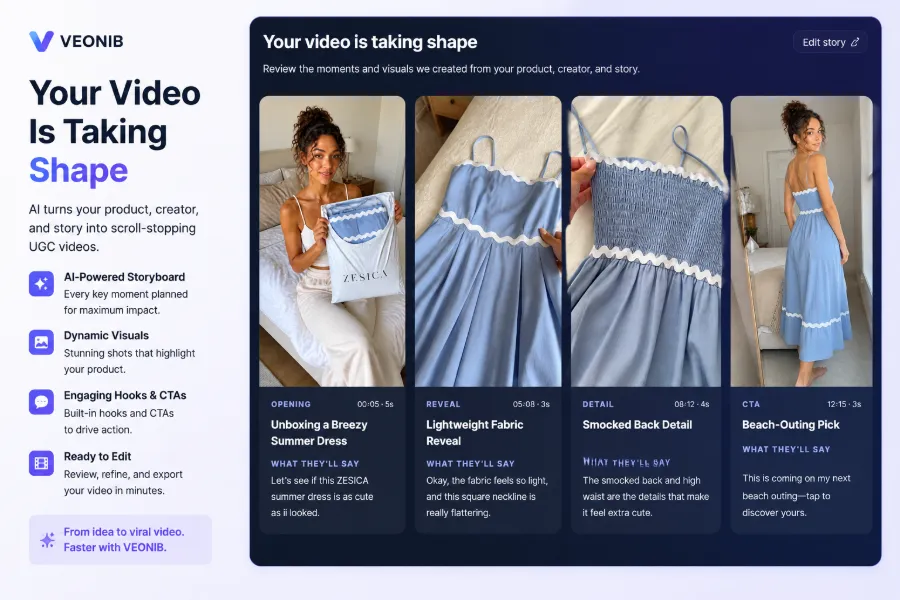
VEONIB steps in precisely at the node where the product link is parsed for images, description, specifications, and selling points, then generates scripts and storyboards. Its page claims that videos are usually generated within 60 seconds, about ten times faster than traditional editing; this is a description of the tool’s workflow, not a guarantee of exposure, clicks, or conversions on TikTok Shop.

But automatic generation does not mean you can skip review. Product price, capacity, color, target audience, and functional claims must be cross‑checked against the original product page, especially AI‑inferred material or usage effects. The team once had a script that turned “foldable” into “auto‑storage,” and the visuals reinforced the mistake with a similar animation; it wasn’t taken down until someone pointed it out in the comments. To reduce such issues, operators separately verify fact errors in product videos rather than just checking whether the footage looks nice.
After speeding up content production, new frictions appear: too many versions, unclear responsibilities for naming, archiving, and selecting the first‑release version, and no record of which hook has already been tested. If these steps lack fixed rules, the tool merely swaps waiting for editing time for waiting for decision time.
Sellers Who Can’t Keep Up With Growth Often Lack a Testable Video Matrix

It’s hard for a single video to cover all user motivations for the same product. Some users want to know what problem it solves, others care about unboxing feel, some need to see real‑world usage, and others are only sensitive to limited‑time discounts or social proof. A video matrix isn’t about copying the same ad ten times; it’s about giving each motivation its own verifiable content version.
Sellers can split assets along the following dimensions:
- Change the hook and user problem first, then alter the scenario, creator persona, video length, and CTA, finally recording the selling point and test result for each version.
A 15‑second version is suitable for quickly validating a single selling point, a 20‑second version can add usage steps or details, and a 30‑second version is better for a full narrative. The three lengths have no fixed superiority; actual results depend on product complexity, traffic source, creator expression, and comment feedback. For a product that needs installation instructions, 15 seconds may only generate interest; for a visually striking accessory, 30 seconds could actually slow down the first‑round validation.
VEONIB can be placed within this production workflow to quickly generate different UGC story templates, but operators still need to decide which versions are worth filming and which merely swap out the on. For angles such as problem solving, TikTok Review, unboxing, lifestyle, and social proof, you can refer to the six UGC video templates, but the number of templates does not equal the number of valid hypotheses.
Product‑link‑driven video production is shortening the distance from product information to ad assets. The “product‑link‑to‑video” workflow (https://telegra.ph/Product-URL-to-Video-in-Minutes-A-Smarter-Way-to-Create-Ecommerce-Ads-07-11) is suitable for addressing early‑stage asset gaps. It solves the problem of “having a testable version first,” not of completing influencer relationships, comment operations, or platform rule judgments for the seller.
A video matrix helps seller growth by enabling faster discovery of effective selling points, reducing fatigue from a single asset, and synchronizing product launches with content releases. A high click‑through rate for one version doesn’t mean it fits all audiences; a low conversion rate may simply be due to price information appearing too late. If a team only watches the final GMV, it’s easy to mix up creative issues, landing‑page problems, and inventory issues.
From “Make More Videos” to “Make Content Production Keep Up With Product Operations”
Content operations can advance in a modest yet executable sequence: first verify product facts, then break down scripts by selling points, build multiple storyboard versions, and finally schedule publishing, testing, and post‑mortems. Product launches, inventory changes, promotion milestones, and ad testing cycles should reside in a single calendar, not be maintained by separate teams.
Determining whether the content gap is shrinking shouldn’t rely solely on the number of videos generated. More useful metrics include the number of publishable assets, the time from product launch to the first video, coverage of different selling points, and asset reuse rate. If a product still lacks a first video 24 hours after launch, or 80 % of ad spend concentrates on a single old asset, faster production speed hasn’t solved the operational problem.
Product‑link‑driven video production also reshapes team responsibilities. Related e‑commerce product video generation tools can reduce repetitive script and storyboard work, but creator judgment, comment feedback, user trust, and platform compliance still cannot be replaced by generation speed. Teams still need to link asset versions, ad groups, audiences, and inventory status; otherwise, post‑mortems will only show an isolated view count.
The limits of automation are also clear. The claim of a 100 % AI‑generated workflow without video‑editing experience describes the production process, not content quality or sales outcome metrics. Operators must still verify price and specification accuracy, ensure no unsubstantiated efficacy claims, confirm that voice‑over matches the visuals, and check compliance with TikTok Shop’s ad and product rules. When needed, teams can embed built‑in tools into the operational workflow rather than creating a separate isolated system.
After a product goes live, the release time of the first video, test coverage of different selling points, and asset reuse rate should be reviewed weekly. If the number of generated assets rises but version selection and data analysis start queuing, the bottleneck has shifted from editing to decision‑making. Competition in TikTok Shop’s US market ultimately isn’t just about sellers battling for GMV; it’s also about content production systems competing for testing speed, user trust, and continuous iteration capability.
FAQ
Why does TikTok Shop US GMV growth directly amplify sellers’ content gaps?
Because larger transaction volume brings more product exposure, competitive comparison, and asset‑testing demand. If a product’s first video is released only hours or days after launch, the initial promotion and influencer traffic window may already be missed.
What is a “content gap” in e‑commerce operations?
A content gap is the disconnect between the rhythm of product operations and the supply of video content. It manifests not only as a shortage of videos but also as a lack of corresponding asset versions for different selling points, user scenarios, and testing hypotheses.
How should sellers design multiple distinct videos for the same product?
First split user motivations, then separately change the hook, scenario, creator persona, length, and CTA. A product should be tested from several angles—problem solving, unboxing, lifestyle, or social proof—rather than repeatedly publishing the same ad.
How should 15‑second, 20‑second, and 30‑second videos be coordinated in testing?
15 seconds is good for quickly validating a single selling point, 20 seconds for adding supplemental information, and 30 seconds for a full demonstration. The first round can generate all three lengths; after 3–7 days of data observation, budget can be concentrated on the version that best fits the product and audience.
After AI‑generated product videos, what still needs manual review by sellers?
They must verify product price, specifications, color, functionality, and efficacy claims, and ensure that visuals, subtitles, and voice‑overs are consistent. Before publishing, a platform compliance review is also required, especially to prevent AI from turning inferred image information into explicit product promises.
Share Article