60 Seconds from Product Link to Marketing Video: How VEONIB is Reshaping 2026 DTC Ad Production
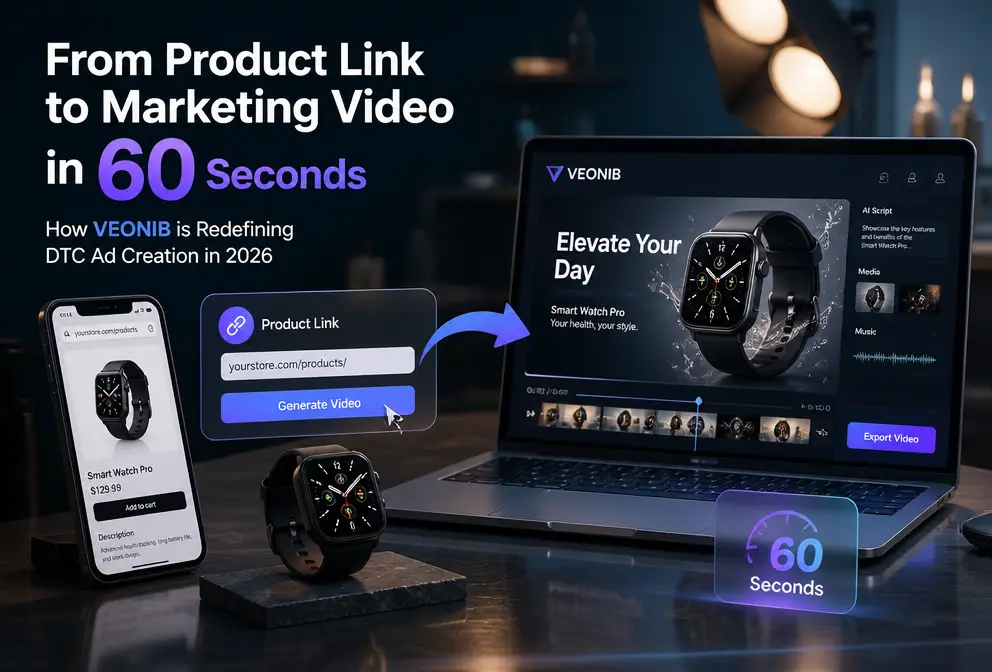
At the beginning of 2026, while organizing the ad asset library for TikTok Shop, I discovered an awkward fact: the four videos the team spent three days producing last week each fell short of their budget before completing their average view count. Worse, competitors upload dozens of assets daily, while we can’t even meet the creative quota for A/B testing. This isn’t an isolated case. DTC brands are being swallowed by a hunger for content—TikTok Shop, Instagram Reels, and YouTube Shorts consume massive amounts of ad material every day, creating an ever‑widening efficiency gap between the traditionally day‑long production cycles and the hourly pacing of ad delivery. A new workflow is filling this gap: drop a product link in, and 60 seconds later you have a video ready to launch. It isn’t perfect, but it does change the rhythm of ad production.
The Efficiency Gap in 2026 DTC Ad Production
The 2026 DTC marketing landscape is dominated by short‑form video platforms. Brands must maintain high‑frequency updates on TikTok Shop, Instagram Reels, and YouTube Shorts, each with its own aspect‑ratio, hook rhythm, and length requirements. Previously, a 15‑second ad took 3–5 days from concept to export, and adapting it to multiple platform formats added another 2–3 hours of manual cropping and subtitle adjustments. Most teams also run Shopify or Amazon stores, making it impossible to devote that much time to every SKU.
A hidden problem is that A/B testing is cost‑blocked. Creating a single ad takes days, leaving no room to test five versions. The result is often “bet on one piece of creative to go all the way,” which either blows up or goes silent. Some teams tried generic AI video generators, but the output was either too rough or the workflow was so complex it required a dedicated specialist—just as an industry analysis noted, most AI video generators remain too complicated for e‑commerce, with learning costs offsetting speed gains. When ad testing shifts from “two weeks” to “two hours,” the real missing piece isn’t creative; it’s a pipeline that quickly translates product information into advertising language.
Deconstructing the 60‑Second Workflow: Four Key Steps from URL to Ad Video
You receive a new product link—say, a smart desk lamp on a Shopify store. Previously you had to write a script, gather assets, edit, voice‑over, subtitle, and so on. Now the process is compressed into four automated steps. First, paste the product link; the system automatically parses the title, selling points, and review content, generating multiple hook variants—these opening copy lines are trained on high‑conversion e‑commerce ads and include both “POV” immersion and direct loss‑comparison tones. Second, AI creates a full script of 15, 30, or 60 seconds based on product attributes and automatically breaks it into frame‑by‑frame storyboards with scene descriptions. Third, a voice‑over and subtitle module selects one of 30 languages and applies automatically styled captions. Finally, a single click renders a 9:16, 1:1, or 16:9 video file, completing the entire process within 60 seconds.
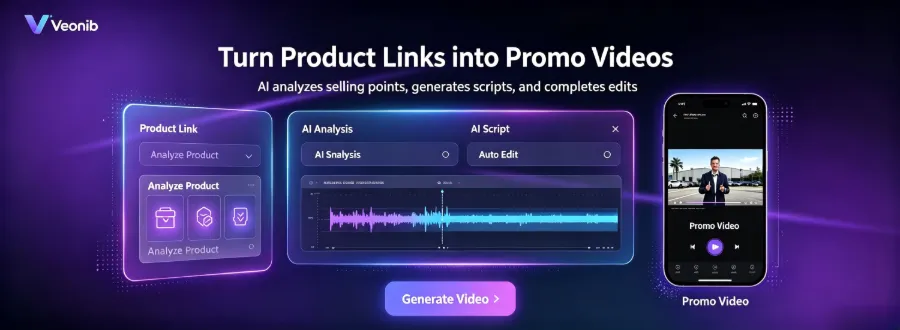
One representative of this workflow is VEONIB, which automates the entire pipeline from URL parsing to video export in under 60 seconds. Official data shows a ~90 % cost reduction and a ten‑fold speed increase. What truly interests me isn’t the numbers but its cross‑platform compatibility—links from Shopify, Amazon, TikTok Shop, and WooCommerce can all be parsed directly without uploading separate product assets. This means a single link can generate versions for multiple channels simultaneously, eliminating repeated manual adjustments.
For more details on VEONIB’s implementation for a health‑monitoring cat litter ad, read How VEONIB’s Video Pipeline Rendered a Health-Monitoring Cat Litter Ad That Sells the Invisible.
If you’re interested in the specific steps, check out the detailed guide that breaks the same workflow into finer operational instructions.
For a quick way to generate short‑form ad videos, see How to Turn Product Links into Short Video Ads Automatically.
Real‑World Example: 60‑Second Conversion from Pet Supplies to Health‑Monitoring Ad
A noteworthy case is PrettyLitter, a functional product that monitors pet health through changes in cat litter color. The biggest advertising challenge for such products is “selling an invisible function”: users can’t intuitively perceive the value of “health monitoring,” so traditional ads require extensive narration and demonstration footage. Using VEONIB, the team entered PrettyLitter’s Amazon product link, and AI generated three ad variants from different angles: one focusing on “saving money” by avoiding emergency vet bills; one emphasizing “peace of mind” for owners traveling abroad; and one taking a review‑style approach, simulating a real user’s surprised reaction. Each variant had its own script, storyboard, and voice‑over, all produced in under 60 seconds.
This case reveals an interesting pattern: for functional DTC products, AI outperforms creative teams at rapidly generating “different selling‑point entry” variants because its script generation is based on product parsing rather than human inspiration fatigue. The three variants can be tested simultaneously; the hook with the highest CTR wins. If you have a well‑performing reference video, you can also clone the winning ad format, reusing the successful structure for a new product and further shrinking the time from concept to launch.
The Trade‑offs of 60‑Second Ads: When to Use Them and When to Be Cautious
Speed never comes for free. I saw a concrete example: a health‑supplement brand generated a batch of 60‑second ads with AI, only to find the post‑launch CTR 12 % lower than their previous in‑house assets. The post‑mortem showed the script was overly generic—applicable to any supplement—and lacked brand uniqueness. This is a typical sacrifice of automation: AI‑generated hooks and scripts tend to “play it safe” on emotional storytelling and brand tone, which is especially problematic for luxury goods and high‑emotion products (e.g., maternity, pet end‑of‑life care).
That doesn’t mean the 60‑second workflow is useless; it just has clear boundaries. The comparison below clarifies the differences between the two approaches:
| Dimension | Traditional Production | AI 60‑Second Workflow |
|---|---|---|
| Production Time | 3–5 days | 60 seconds |
| Cost | Thousands of dollars (including labor) | ~90 % reduction |
| Creative Control | Fully controllable, can fine‑tune emotional details | Script and storyboard editable, but deep narrative limited |
| Ideal Use Cases | Brand films, high‑emotion ads, luxury products | Rapid testing, viral hit creation, routine content updates |
Another less obvious observation: the 60‑second workflow changes the rhythm of A/B testing. Traditional teams “test three versions per week” already feel diligent; with automation you can “test ten versions per day.” This high‑frequency testing subtly accelerates the learning efficiency of delivery algorithms—algorithms find high‑conversion combos faster, lowering CPA. However, the influx of low‑cost assets can also increase content homogenization on platforms. The solution isn’t to abandon the tool but to scale “micro‑creative differentiation”: change hooks, backgrounds, scene descriptions, so dozens of assets each carry slight variations and compete, rather than relying on a single big production to win.
FAQ
Do I need design or video‑editing experience to use these AI tools?
No. The core operation is simply pasting a product link, then selecting from the system‑generated scripts and storyboards. You can edit text or swap scenes before export, but all basic work is done by AI, so zero design background is sufficient.
Can the generated videos be used directly for paid ad placements (e.g., Facebook, TikTok)?
Yes. Exported videos are standard MP4 files in 9:16, 1:1, or 16:9 ratios, ready to upload to ad management platforms. After purchase, the videos belong to you, with no watermarks or copyright restrictions.
Can I edit the script or change the voice‑over language before export?
Yes. Any hook, scene description, or voice‑over can be rewritten in the preview interface, and re‑rendering will update the video. AI voice‑over supports 30 languages, including Chinese, English, Japanese, Korean, etc.
Which e‑commerce platforms’ product links does the tool support?
Links from Shopify, Amazon, TikTok Shop, WooCommerce, Temu, AliExpress, Etsy, eBay, and other major platforms can be parsed. The system automatically extracts product titles, selling points, and review content to generate ad ideas.
Share Article