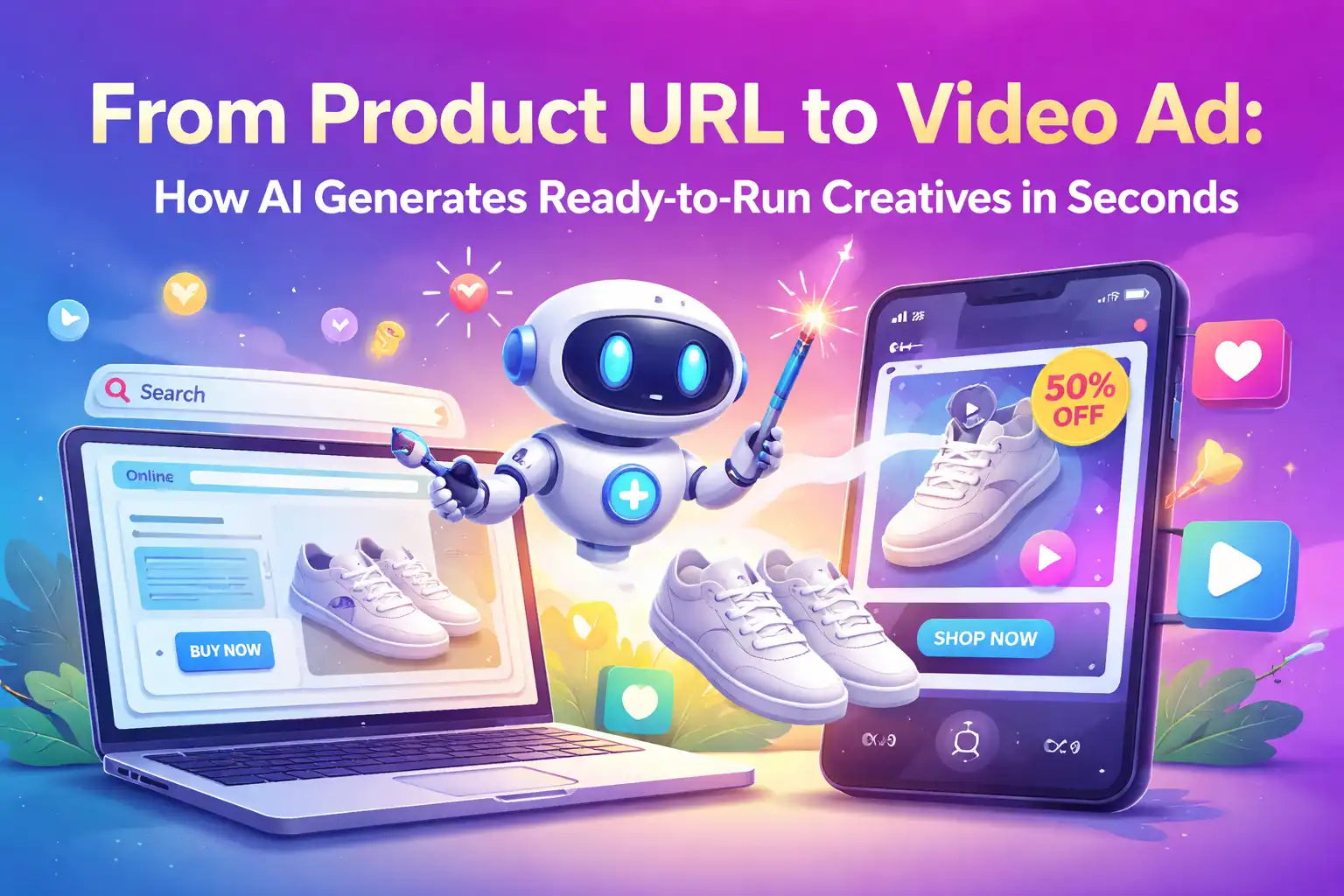
From Product URL to Video Ad: How AI Generates Ready-to-Run Creatives in Seconds
Tuesday afternoon. Product launch is tomorrow morning. The product page is live on Shopify, but there’s no video ad. Hiring an editor means a 48-hour minimum turnaround. Opening CapCut or Premiere Pro requires hours of manual scripting, asset hunting, and rendering. For most ecommerce sellers, this bottleneck between launch and creative production means missed revenue.
A product URL to video generator is an AI tool that accepts a standard ecommerce product link and automatically produces a finished, platform-ready video advertisement. It parses the product page, generates hooks and a script, builds a storyboard, adds synchronized voiceover and subtitles, and renders the final file in under one minute. The technology replaces what used to be a multi-person, multi-day workflow with a single paste action. Here is how it actually works, why sellers are adopting it, and where the tradeoffs still live.
How a Product URL to Video Generator Works
The process is deceptively simple on the surface. A user pastes a standard product URL from platforms like Shopify or Amazon into the generator. Behind the scenes, the AI scrapes and analyzes the product title, key images, bullet points, and description. It identifies the core selling points and the likely target audience based on the language and imagery used on the page.
From that analysis, the system generates multiple hooks — opening lines designed to stop a viewer from scrolling within the first two seconds. These are drawn from patterns found in high-performing ecommerce ad libraries. A full script is then written for the chosen duration. The system automatically matches scenes to the script, pulling from a library of stock footage or generating visuals aligned with the product description.
A platform like VEONIB automates this entire process by reading the product page and generating a complete ad asset in a single pass. It then overlays AI-generated voiceover in a selected language, syncs auto-styled subtitles, and renders the video in the standard 9:16 aspect ratio used by TikTok and Instagram Reels. The entire pipeline, from paste to preview, finishes in under 60 seconds. Models like those demonstrated by how multimodal AI is rapidly improving video generation quality make this parsing and visual coherence possible. For sellers using specific ecosystems, resources like AI Video Ads for Shopify Products provide platform-specific workflows that integrate directly with store catalogs.
Why Sellers Are Switching to URL-Based Video Creation
The adoption is driven by concrete operational advantages, not hype. Speed is the most obvious one — what took a freelancer a full day now happens during a coffee break. But the cost difference is what gets management’s attention. By eliminating scriptwriters, voiceover artists, and video editors from the early testing phase, creative production costs drop by roughly 90% compared to the traditional agency or freelance workflow.
This cost efficiency unlocks a new testing cadence. Instead of betting the entire production budget on a single creative angle, sellers can generate five, ten, or twenty variants from the same product URL. A/B testing becomes a practical daily activity rather than a monthly expense. A tool like VEONIB can produce dozens of variants from a single URL, letting sellers test different hooks and scenes without committing significant production budget. This directly combats ad fatigue, which typically sets in after an audience sees the same creative three to four times in a retargeting window.
DTC brands and cross-border sellers benefit even more. Localization — translating scripts and recording voiceovers in multiple languages — is a notorious bottleneck. URL-based generators often include voice support for 30 or more languages, effectively solving the localization bottleneck with a single click during the export step. According to HubSpot’s video marketing research, video ads consistently outperform static images in conversion rates, creating a strong incentive to produce more video content faster. For smaller stores, this levels the playing field, as explained in how small e-commerce stores compete with big brands using AI videos.
Comparing the Traditional Workflow vs. the URL-to-Video Approach
The operational difference is not incremental — it represents a completely different production model. The table below breaks down each stage of both workflows.
| Workflow Stage | Traditional (Manual) | URL-to-Video Generator |
|---|---|---|
| Script Generation | ChatGPT or copywriter (30-60 min) | AI-generated in seconds |
| Storyboard & Visuals | DALL·E / stock footage + manual layout (1-2 hrs) | Auto-matched scenes from product data |
| Voiceover & Subtitles | Studio recording or freelancer (1-3 hrs) | AI voiceover, 30+ languages, auto-subtitles |
| Editing & Rendering | Premiere Pro / CapCut / DaVinci Resolve (2-4 hrs) | Auto-rendered in 60-90 seconds |
| Total Time | 3–6 hours | Under 60 seconds |
| Estimated Cost | $200 – $1,000+ per ad | Negligible (subscription model) |
The tradeoff, however, is creative control. A manual workflow gives a brand complete authority over every pixel, transition, and tone of voice. Automated generators sometimes produce generic visuals or mismatched scenes that a human editor would catch immediately — a product described as sleek and metallic might get paired with a warm lifestyle shot that dilutes the intended aesthetic. For brand-polished hero assets, the manual route still makes sense. But for rapid testing, product launches, and volume publishing, the URL-to-video model is functionally superior. This comparison between tooling approaches is covered in more detail in the breakdown of Veonib vs CapCut AI.
What to Look for in a Product Video Generator
Not all tools are equal. When evaluating a generator, ecommerce teams should consider platform compatibility — the tool must work with Shopify, Amazon, TikTok Shop, and WooCommerce. Output format support is critical: 9:16 for Shorts and Reels, 1:1 for Facebook, and 16:9 for YouTube channels.
Language support matters for international sellers. Tools that offer voiceover in 30 languages with automatic subtitle rendering handle localization better than those that require manual dubbing. The availability of a free preview — generating hooks, scripts, and storyboard visuals before committing to an export — lowers the risk of wasting credits on unusable outputs. Commercial rights must be clearly granted for paid ad campaigns. And specifications like supporting up to 100 ad variants per product per month determine whether the tool can actually support scaling efforts. Platforms that bundle these features provide a strong foundation, which is why the VEONIB: AI Video Ads Generator for E-commerce Brands page outlines these capabilities in detail.
FAQ
What is a product URL to video generator? It is an AI tool that takes an ecommerce product link and automatically creates a complete video ad, including script, storyboard, voiceover, subtitles, and a final rendered file ready for upload.
How long does it take to generate a video from a URL? Most tools generate a preview of hooks and scenes within seconds. The final video render typically completes in 60 to 90 seconds, depending on the resolution and length selected.
Can I edit the script or scenes before exporting? Yes. The best tools let you rewrite any hook, scene description, or voiceover line before triggering the final render. The video regenerates to match the edited inputs.
Do I own the commercial rights to the generated videos? Reputable platforms grant full commercial ownership upon export. The videos can be used across paid ad campaigns, organic social posts, websites, and any other commercial channel.
Which ecommerce platforms are supported for URL input? Most generators support Shopify, Amazon, TikTok Shop, WooCommerce, Temu, AliExpress, and Etsy. The tool reads the product page structure from the provided link regardless of the underlying platform.
Share Article