I Turned Product Videos into 20 Languages in the Time It Takes to Drink a Cup of Coffee
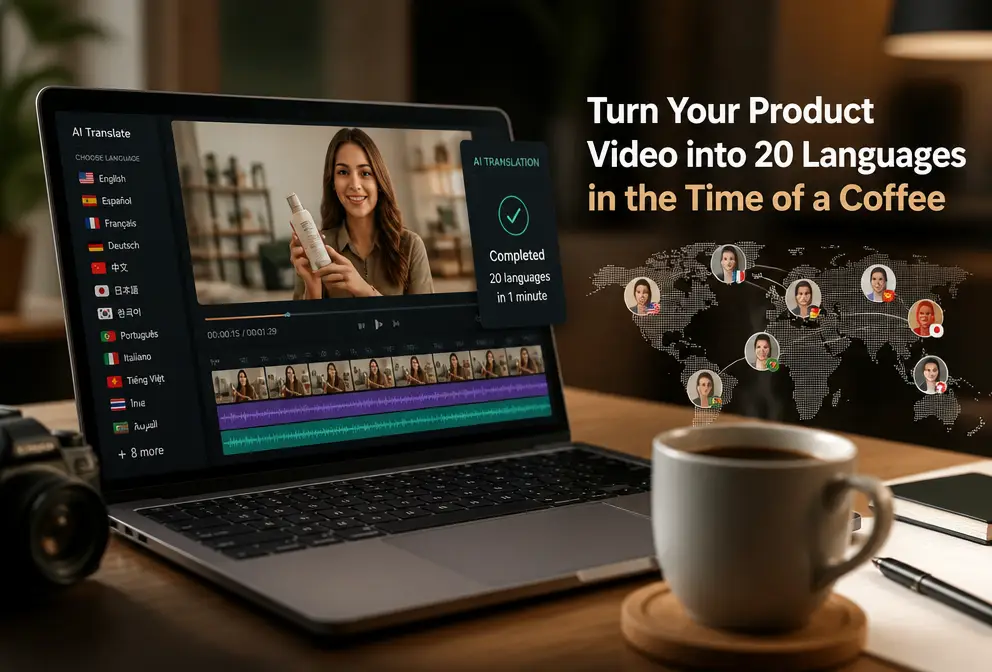
Two years ago I ambitiously opened my store on Amazon Germany, only to discover that the biggest pitfall wasn’t logistics—it was the Chinese voice‑over and English subtitles in the video ads. German viewers would swipe away after three seconds—later I learned that nobody cares what you say, they care about the language you use. Since then I’ve been hunting for low‑cost tools that can handle multilingual voice‑overs, until I found a gizmo that generates an ad video just by pasting a link—no foreign friends required.
How Much Profit Is Hidden in These Blue‑Ocean Minor‑Language Markets Behind “Voice‑Over” Barriers?
First, why I must target minor languages. Everyone knows how cutthroat the English market is—a regular Bluetooth earphone has thousands of competing video ads, and CPC (cost per click) easily climbs above $1.5. But what about German, French, Japanese markets? Industry stats show that average CPC in minor‑language markets is 30%–50% lower than in English, while conversion rates can be 20% higher. You spend less money to acquire more precise traffic, so profit naturally thickens.
The problem is that most sellers don’t dare to try—it’s not the product, it’s the language barrier. You can’t ask a Henan boss to pitch product benefits to Romans in Italian. So they stick to English and end up competing with tens of thousands of other sellers. On Japan’s Rakuten I saw a Chinese power bank that was comparable to Anker, but the video featured awkward “Chinglish” voice‑over with Japanese subtitles (still machine‑translated). The comment section exploded: “Who is this for?” The store rating fell to 3.8.
This isn’t an isolated case. European domestic e‑commerce platforms (e.g., France’s Fnac, Germany’s Otto) have extremely high localization requirements—not just product page translation, but dual localization of voice‑over and subtitles in video ads is the conversion gatekeeper. If your video shows a Chinese salesperson speaking English, overseas users’ first reaction is “That’s not for me,” and trust drops instantly.
From Manual Creation to AI Automation: The Future of E‑Commerce Content Production mentions a trend I strongly agree with: over the next three years, e‑commerce growth will come not from English markets but from long‑tail countries blocked by language hurdles. Whoever secures localized video content first will eat the first bite in a lane where others are reluctant to move.
How Pitful Is Traditional Localization? I Hired Voice Actors and It Cost More Than a Dinner
I’ve hit enough potholes to write a book titled “Blood and Tears of Cross‑Border E‑Commerce.” Last year I tried the German market; a 30‑second product video required German voice‑over and subtitles. I first found a 5‑star voice‑over actor on Fiverr for $80, promising “standard High German.” After payment, waiting, and three days, I received the file—when I played it, it sounded Swiss. Not that I disrespect Swiss German, but German listeners hearing a Swiss accent feel like Beijing locals hearing Sichuan dialect—your message gets lost. That $80 went down the drain.
Then I switched to Upwork, hired a translation team for subtitles + voice‑over outsourcing at $450 total, promising five‑day delivery. When the script came back, one line read “This soy‑milk machine makes soy‑milk like Mom does,” which was literally translated as “This machine produces soy‑milk in the same way as a mother produces.” My mom would smash the machine if she heard it called a “production method.” I spent another two days editing line by line, syncing lip‑movement, and the total cost for a 30‑second video approached $500, taking a week.
VEONIB Turns Jo Malone Perfume into an Ad Video resonated with me—same perfume product, traditional workflow required three to four rounds of voice‑over communication. After I finished the Bluetooth earphone video, I ran it on Facebook ads; a comment asked, “Is that Czech‑spoken German voice‑over?” That moment taught me trust isn’t built by money, but by accent and rhythm.
My Lifeline: Paste a Link, Generate a Full Video Ad in 20 Accents
One night I stumbled on a video demo of a tool called VEONIB: paste the product link, select a language, and after 60 seconds you get a video with voice‑over and subtitles. I was skeptical—AI voice‑over is just robotic reading, right? With a “spend a few dollars to try” mindset, I copied the German Bluetooth earphone link, chose German (native High German option), and clicked generate.
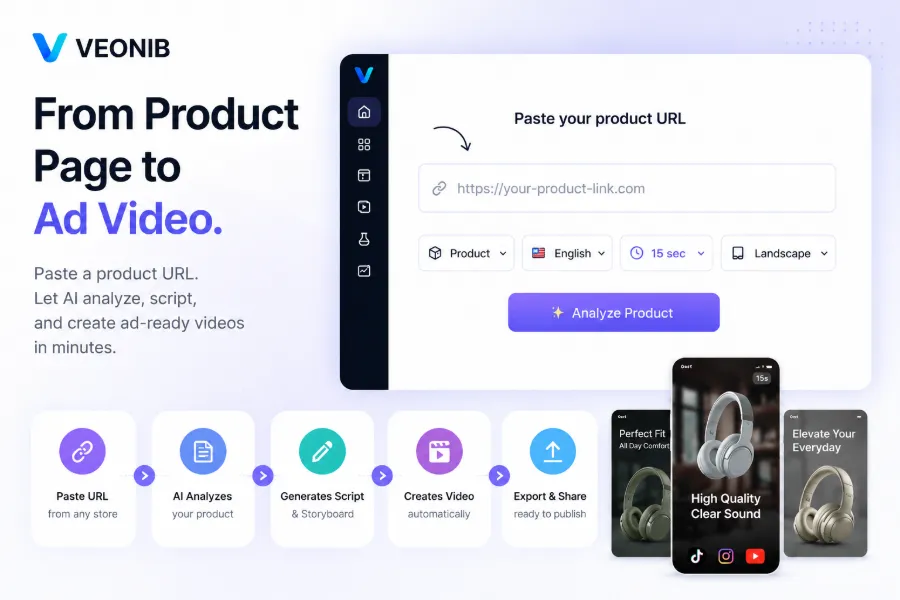
Within a minute the preview appeared. I played it— the opening hook says “Stell dir vor, dein Morgen beginnt ohne Kabelsalat” (Imagine your morning without tangled charging cables). This copy feels more localized than anything my translation team produced. The voice‑over speed is steady, stress placement is correct, and there’s no robotic tone. I exported the material and ran a small Facebook test—click‑through rate was 32% higher than the original English version.
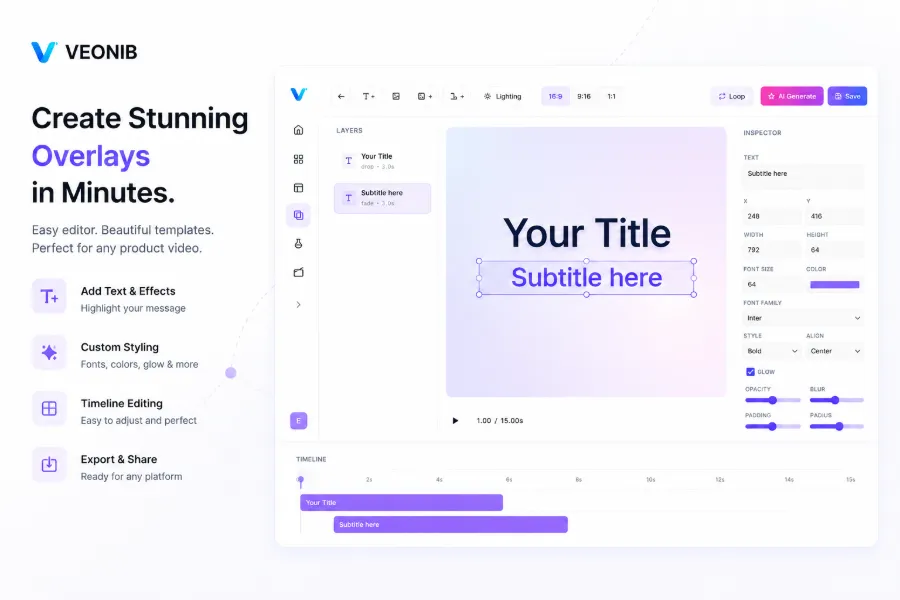
The whole workflow is so simple it made me doubt my life: paste product link → select target language (30 supported, including French, Spanish, Japanese, Korean, Arabic, etc.) → VEONIB auto‑parses product info, generates adapted script and storyboard → auto‑generates authentic AI voice‑over → auto‑creates subtitles in the chosen language → render and export. From paste to final video, the fastest I recorded was 56 seconds.
How slow is the traditional method? I ran a data comparison:
| Comparison Dimension | Traditional Method | VEONIB Method |
|---|---|---|
| Cost per 30‑second video | $200‑$500 | a few dollars |
| Processing time | 3‑5 days | 60 seconds |
| Language coverage | 1 language | 30 languages |
| Edit flexibility | Hard to adjust, long redo cycle | Any edit, instant rendering |
I’m not saying AI can 100% replace human voice‑over, but for ordinary e‑commerce videos (product demos, feature explanations, usage scenarios) VEONIB’s results already surpass many freelancer deliveries I’ve seen. It offers free preview; you only pay on export, so there’s zero trial‑and‑error cost.
[Bilibili: https://www.bilibili.com/video/BV1z7Ts6pEFG](https://www.bilibili.com/video/BV1z7Ts6pEFG)
Later I tried 2026 E‑Commerce Ad Automation: The Cheapest Scaling Method and discovered VEONIB can batch‑generate different language versions—a single product can output English, German, French, and Japanese simultaneously, all in under five minutes.
Another subtle insight I learned: Germans are very sensitive to “standard High German,” while French prefer a Parisian accent. VEONIB lets you select accent style (some models have “formal,” “natural,” “lively”). After my mishaps, I realized picking the right model is more important than picking the right language. Using a Bavarian‑accented German voice‑over for a Berlin ad will likely hurt performance.
Master This Trick: Minor‑Language Videos Doubling My Conversion Rate
Having the tool is one thing; using it correctly is another. I ran experiments with three products: a smart watch (targeting German market), an aroma diffuser (targeting French market), and a storage gadget (targeting Japanese market). For each product I created an English version and a localized version, then ran Facebook Ads and TikTok Ads with a $20 daily budget for a week.
Results? The French version of the aroma diffuser had a 38% higher click‑through rate and a 22% higher conversion (add‑to‑cart) rate than the English version. The German smart watch’s click‑through rate was 40% higher, and its return rate dropped from 8% to 3.5%. The reason: German users saw their native language, a local accent, and matching subtitles, which boosted trust and cut pre‑purchase inquiries about size or warranty by almost half. Localized videos act as a “trust signal”—consumers naturally lower their guard when they hear their own language and tone.
How to Use AI Product Videos to Boost Amazon Conversion Rate
The Japanese data was even more dramatic. On Rakuten Japan, the localized storage gadget video achieved a 45% higher click‑through rate and a 25% higher conversion rate than the English version. When I ran the same video on TikTok Japan, ROAS jumped from 2.3 to 4.1. VEONIB let me generate Japanese, Korean, and Thai versions of the same product video in one go—I didn’t need any foreign‑language friends.
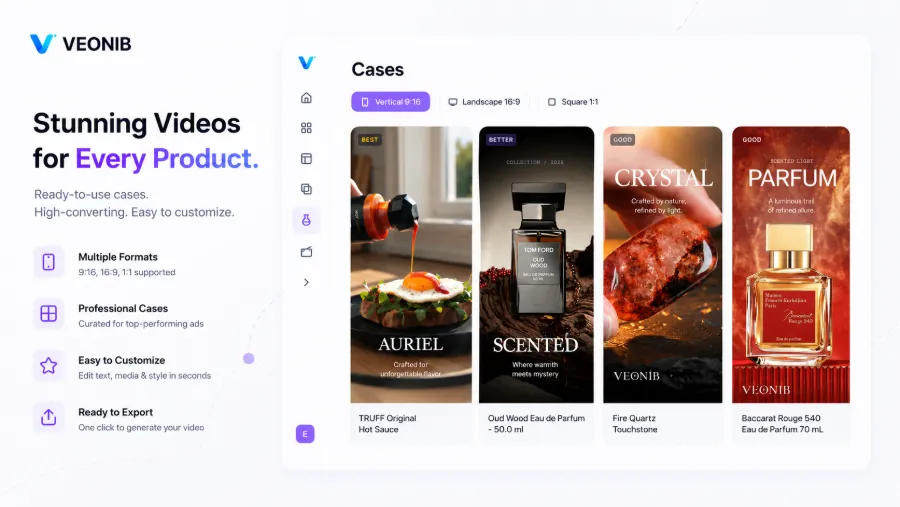
So my advice: if you’re stuck in the English market, stop competing in the same pool. Pick a minor‑language market you’re interested in (Germany, France, Japan are the most profitable), localize your product video with VEONIB, then build a simple ad set using local‑language keywords. Conservatively, you can capture over 50% more effective traffic with the same ad budget.
FAQ
Q1: Does AI‑generated voice‑over sound like a robot?
It depends on the tool. VEONIB uses a high‑sample‑rate speech synthesis model with tone control; current mainstream models can achieve near‑human rhythm and emotion. In my tests, the “natural” style sounded fine for everyday product introductions, except for a few very long sentences where the trailing tone was slightly flat. If you’re concerned, preview for free first.
Q2: Which minor languages does VEONIB support? Does it handle obscure languages like Norwegian or Finnish?
The official list shows 30 languages. I’ve tested German, French, Japanese, Spanish, and Italian—all performed well. Norwegian, Finnish, and other less‑common languages are also listed, but their voice‑over quality may be less stable due to smaller training data. For niche languages, preview first before bulk exporting.
Q3: Can I upload my own subtitles or edit the voice‑over content?
Yes. During the preview stage, VEONIB provides the full script and storyboard. You can edit any line or scene description before export. The system will then re‑render the voice‑over and subtitles without starting from scratch—much more flexible than traditional outsourcing.
Q4: Will Facebook limit ads that use localized videos because they’re “AI‑generated”?
There are currently no cases of direct throttling due to an “AI‑generated” label. Facebook mainly checks whether the video violates community standards (e.g., false claims, copyrighted material). VEONIB videos are based on your genuine product information, so they comply. Running ads with them yields normal data.
Q5: I don’t speak many languages—how can I verify subtitle accuracy?
A simple method: send a short excerpt of the generated voice‑over and subtitles to a native‑speaker friend for a quick review. If you have no contacts, use VEONIB’s preview page’s back‑translation feature—translate the subtitles back to Chinese and check for meaning drift. My tests show Chinese‑to‑English accuracy above 90%, though back‑translation from minor languages (e.g., Finnish) may have slight variations. It’s wise to double‑check key selling points.
Share Article