The depth of product information parsing is the watershed for script quality when pasting the same link to generate a video
Two operators take the same product link and paste it into two different “link‑to‑video” tools. One returns a script with a hook, ordered selling points, and storyboard instructions; the other simply replaces the product name in a template, leaving about 70 % of the sentences reusable with another link. From the UI both look like “paste → generate → export,” but the gap appears after the link is fetched.
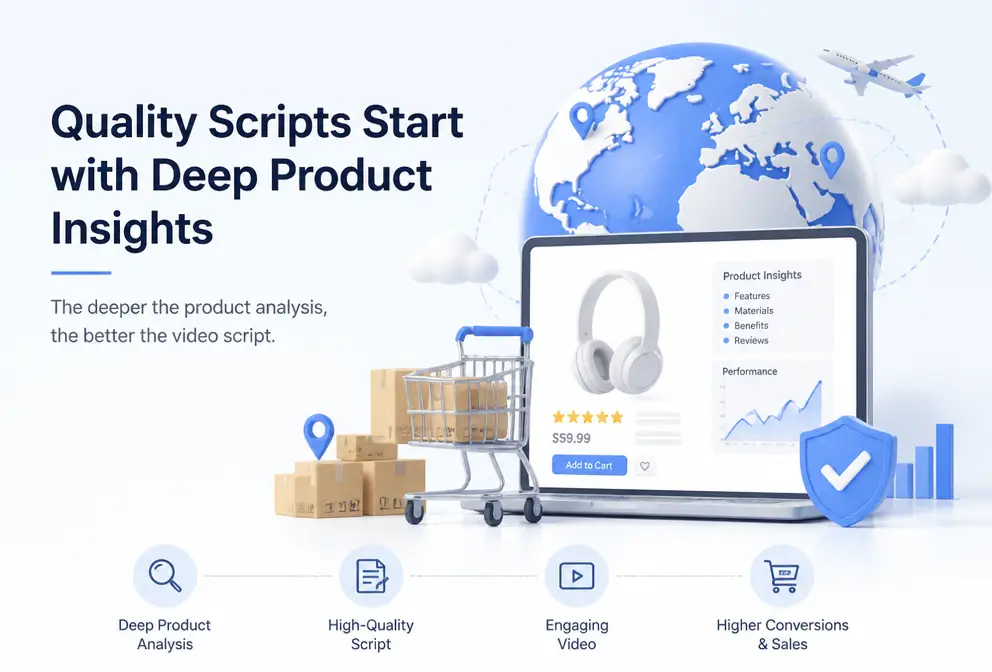
The script quality of “paste‑link‑to‑video” does not depend on the number of templates, but on how deeply the tool understands the product: fetching extracts fields, while parsing decides which information deserves to go into the hook, selling points, and storyboard. Most tools stop at fetching, which is the source of the “template‑like” feeling.
I have seen this scenario more than once. To fill the gap in script quality, operators usually shuttle material back and forth among script, storyboard, and voice‑over tools. The problem is not a lack of tools, but that most tools stop at the “understand product” step.
The truth about “paste‑link‑to‑video”: most tools only fetch, they don’t parse
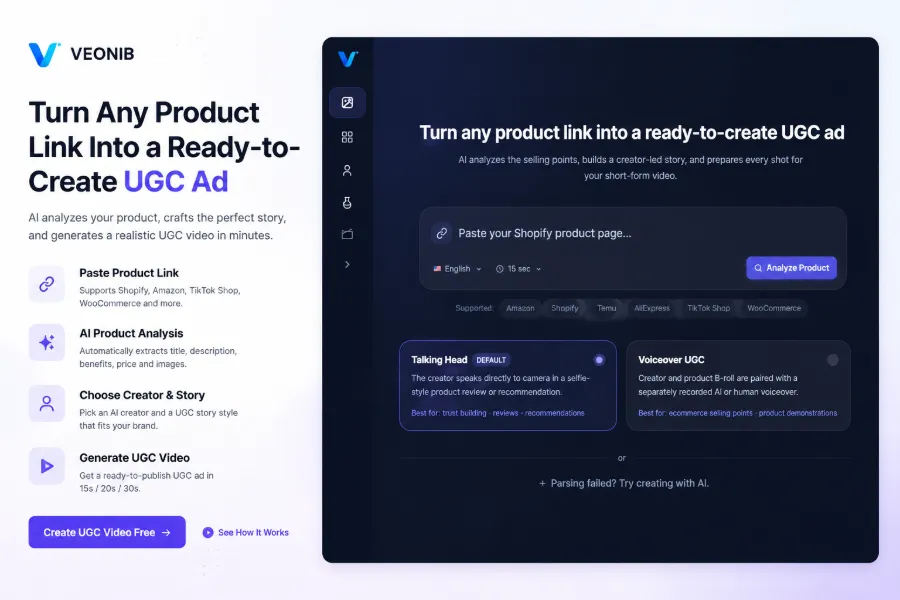
If we break “link‑to‑video” apart, the pipeline is fixed: fetch URL → extract fields → apply template → render video. Whether the link comes from Shopify or Amazon, the middle two steps determine what the script looks like.
Fetching solves “getting the fields”; parsing solves “understanding the product.” The former is done when the title, main image, and price are stored; the latter must decide core selling points, target audience, and which information belongs in the first three seconds. Most tools consider the job finished after the former.
A large number of tools on the market stop at extracting two or three fields: title, main image, price, occasionally a detail description. The script is generated from a template, with the product name inserted into a fixed sentence. About 70 % of the sentences in the generated script can be reused verbatim for another product. Someone documented this stitching process in a post titled “Use Five Tools to Assemble One Product Video.” The issue isn’t the number of tools, but that none of them deeply understand the product.
Operators bear the cost. When a script is vague, they have to add selling points themselves; when a storyboard lacks a basis, they have to decide the shots themselves. To cobble together a usable piece of material, they typically bounce between three or four tools. The workflow shouldn’t be limited by a single link format; the idea of “creating marketing videos from any material” and parsing depth are two sides of the same coin.
Most tools stop at “fetching,” which is the main source of the template‑like feeling.
What deep parsing extracts: from product information to hook, script, and storyboard
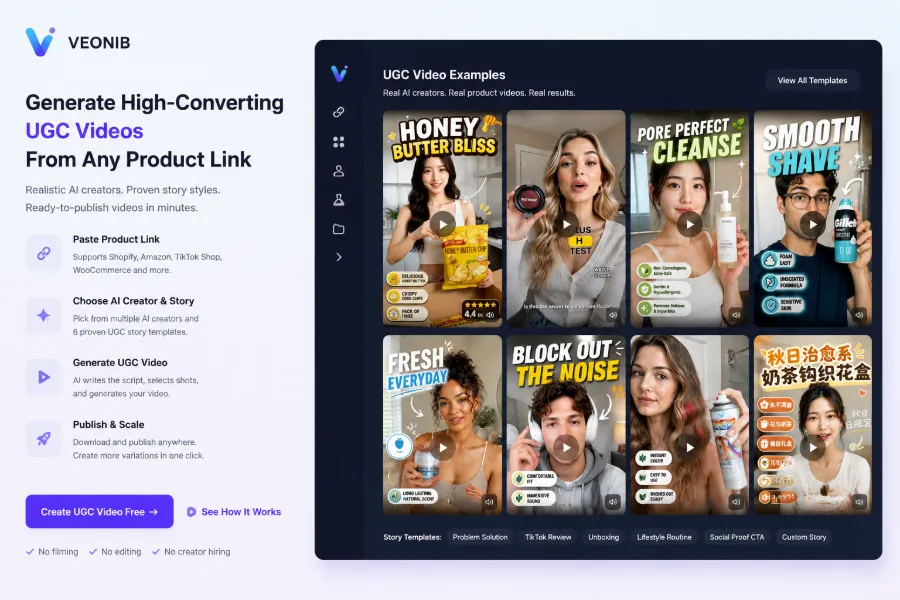
Deep parsing extracts more than just title and price. A complete pipeline covers main image, detail images, functional description, selling points, usage scenarios, target audience, price anchor points, and even high‑frequency words from reviews. In terms of coverage, deep parsing typically draws from 6–8 categories of information sources, while shallow parsing only covers 2–3.
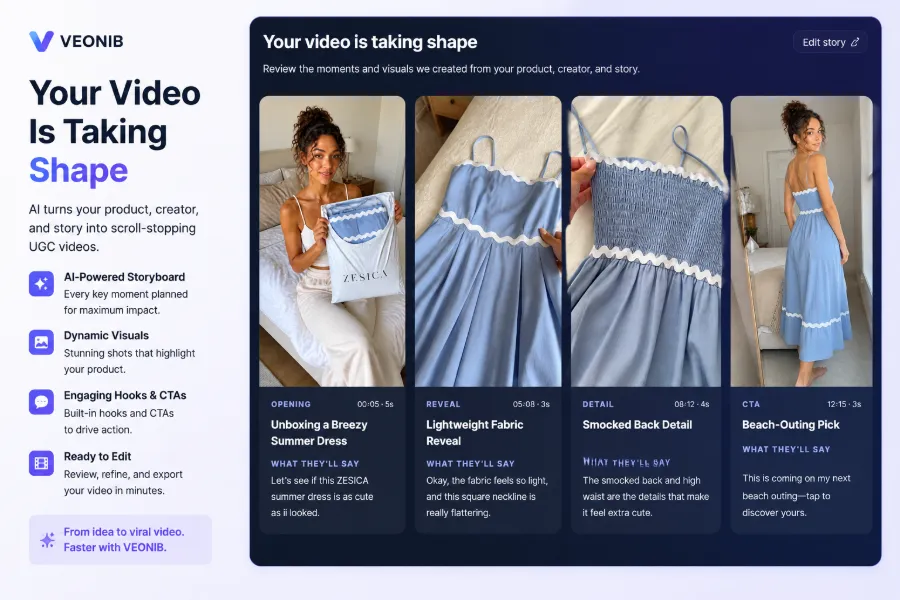
These pieces of information must be mapped onto script components to count. Take the pipeline of VEONIB as an example: after the link is entered, a product analysis is performed, and the output is not a block of text but intermediate artifacts—hook, script, storyboard, and shot list. The parsing result first determines the hook, then the script structure and storyboard, and finally the camera movement, lighting, and composition for each shot.
Parsing granularity directly determines whether a storyboard can be realized. A shot that needs to show “the accessories on the desk when unboxing” requires identifying objects from the detail images; a shot that demonstrates “before‑and‑after differences” needs to extract functional features from the description. Without these fields, the storyboard collapses into a generic product image carousel.
For different categories, the parsing trade‑offs differ. In the case of baby‑care products, the workflow in “Baby‑care product link to video process” shows that age suitability, material safety, and usage frequency are more worth writing into the script than price. Such choices reveal whether parsing is designed for the category.
| Comparison Dimension | Shallow Parsing (most tools) | Deep Parsing |
|---|---|---|
| Information Sources | Title, main image, price | Main image, detail images, description, selling points, scenarios, audience, price anchor, review keywords |
| Hook Copy | Template sentence with product name swapped | Incremental information distilled from specific selling points or scenarios |
| Selling‑point Presentation | Fixed order list | Sorted by purchase motivation |
| Storyboard Planning | Generic material carousel | Each shot has rationale for camera movement, lighting, composition |
| CTA Logic | Generic “Buy Now” | Combines price anchor and target audience |
One often‑overlooked point: parsing is not a one‑off action. Mature pipelines retain intermediate outputs such as scripts and storyboards, allowing edits before final rendering. This is both evidence of parsing depth and the basis for later fine‑tuning.
How parsing depth translates to script quality: the chain from hook to CTA
The transmission chain is simple: concrete information → hook with incremental info → selling points ordered by purchase motivation → storyboard with rationale for each shot → CTA combined with price and audience. If any link in the chain collapses, the script reverts to a template.
Take two products from a baby‑care store: baby wipes and a baby food processor. With shallow parsing, both hooks are “Must‑see for moms,” selling points are listed by title keywords, and the storyboard is a generic product image plus scenario carousel. With deep parsing, the wipes’ hook starts with “Red‑butt baby relief,” selling points are ordered “safe material – alcohol‑free – portable pack”; the processor’s hook addresses “What to do when adding baby foods for the first time,” the storyboard adds close‑ups of ingredients, and the CTA emphasizes the price anchor, highlighting cost savings from a single purchase. Scripts generated from deep parsing contain three times as many specific nouns about ingredients, specifications, and applicable scenarios as shallow scripts.
Structurally, you can borrow the pattern of high‑performing assets—clone high‑conversion ad video formats—to solve the skeleton problem; but the skeleton is only the structure. The density of information filled into it still depends on parsing.
One team, eager to launch a new product, used a shallow‑parsing tool to batch‑generate 30 videos. Two weeks later, a review showed that the hooks were almost identical, the first three seconds suffered heavy drop‑off, and the platform flagged the material as low‑quality duplicate, driving up cost per impression. Most ad platforms use the first‑three‑second completion rate as a weighting factor for scaling; highly repetitive assets receive almost no distribution at this stage. The cost of insufficient parsing depth is not bland copy but ineffective delivery.
Another often‑overlooked point: parsing depth directly determines whether different products in the same store can be differentiated. With shallow parsing, ten products from the same shop generate essentially the same video, making deduplication meaningless; deep parsing at least varies scenes, selling‑point order, and visual composition.
Evaluating a “link‑to‑video” tool: a 30‑minute comparative test
To judge parsing depth, a single comparative test is enough. Use the same product link and target audience, generate scripts in 2–3 tools, and the whole process takes about 30 minutes.
Score on four criteria: hook specificity (does the first three seconds contain information that only applies to this product?), selling‑point ordering logic (does the order follow purchase motivation or just title keywords?), storyboard rationale (can each shot be explained), and CTA relevance (does it incorporate price anchor and audience traits).
A hidden signal beyond the four items: whether the tool is willing to expose intermediate outputs like scripts and storyboards for editing. The deeper the parsing, the more likely the tool will reveal these artifacts. Black‑box tools usually only give the final video; tools that parse deeply tend to lay out the script and storyboard first.
In one comparative test I observed a detail: VEONIB’s parsing result is first presented as a script and storyboard, allowing per‑segment edits before rendering. The parsing process is laid out for the user rather than hidden behind a “generate” button.
Parsing depth also affects downstream steps. In multilingual campaigns, the concrete information in the script determines translation quality; combined with video translation and lip‑sync, a single asset can be reused across markets.
SEO‑content‑linked video generation also relies on consistent information. In the workflow described in “SEO‑content‑linked video generation process”, the article and video share the same set of product information; any detail lost during parsing becomes a gap in every subsequent stage.
A 30‑minute test cannot reveal everything. Parsing depth isn’t always “the deeper, the better.” For simple products with a single ingredient, overly deep parsing can make the script bloated. A more reasonable standard is alignment: information dimensions should match category characteristics, the hook should add incremental info, and the storyboard should have a rationale.
FAQ
How does product‑information parsing differ from ordinary web scraping?
Scraping simply pulls fields from a URL—title, main image, price—and calls it done. Parsing goes a step further, deciding which information deserves to be written into the hook, ordered as selling points, and placed into the storyboard. In practice, shallow parsing usually extracts 2–3 field types, while deep parsing covers 6–8 sources.
What typical problems appear in scripts when parsing depth is insufficient?
The most typical issue is script genericness: you can replace the product name and the script still works for another product. Manifestations include a hook with no incremental information, selling points listed by title keywords, and a storyboard reduced to a generic image carousel. Such assets suffer high drop‑off in the first three seconds and are often flagged by platforms as low‑quality duplicates.
How can I quickly assess the parsing capability of a “link‑to‑video” tool?
Generate a script from a single product link and focus on three points: does the hook contain information that only applies to this product? Are the selling points ordered by purchase motivation? Does the tool expose the script and storyboard as editable intermediate outputs? A full comparative test takes about 30 minutes; scoring on the four dimensions above will reveal the gap.
Is deeper parsing always better?
Not necessarily. For simple products with a single ingredient, overly deep parsing can make the script overly verbose, diluting the hook. A more reasonable judgment is “alignment”—the information dimensions should match the category’s characteristics, not merely the sheer number of sources. Simple products need only a few targeted fields; complex products benefit from a full multi‑dimensional parsing.
Share Article