The More “Polished” AI Ad Videos, the Lower the Click‑Through Rate? Why Advertisers in 2026 Are Shifting to “Rough” Creative

At the end of last year, a DTC seller of small home appliances approached me to review his ad performance data. He kept polishing AI‑generated ad videos—brighter lighting, smoother transitions, more standard voice‑overs, unified brand‑color subtitles—creating three versions and running them for a week. The CTR dropped from 0.8 % to 0.5 %. When he reverted to the original handheld footage with noisy ambient sound and a slightly accented voice‑over, the CTR rose back to 1.1 %.
This case is not an outlier. In 2026, more and more advertisers discover that the more “perfect” an AI ad video is, the worse its click‑through rate becomes. The so‑called “anti‑polish” (lo‑fi creative) is not a downgrade in aesthetics; it is a material‑strategy shift forced by platform algorithms and user behavior. This article unpacks the underlying mechanisms and shows how to scale‑copy this “rough” feel.
The “More Perfect, Fewer Clicks” Paradox of Polished AI Ad Creative
First, what did that seller actually do? He followed a standard “polish” checklist: frame‑by‑frame lighting adjustments for clearer images, added transition effects for smoother segment flow, overlaid subtitles in a uniform font, and applied the same brand CI color palette to all assets. Each individual step is fine, but together they made the material feel overly “advertising‑y”.
In short‑form video, users’ ad‑defense mechanisms are more sensitive than in the image‑text era. E‑commerce ad videos usually achieve a CTR of about 0.5 %–1 %, and users decide within the first three seconds whether to skip. Polished material’s problem is that it is instantly recognized as “this is an ad”. The cleaner the picture, the smoother the transitions, the more standard the voice‑over, the more likely users will swipe away within three seconds.
A psychological mechanism lies behind this: polished material naturally triggers a defensive mindset. When a video looks high‑budget, users subconsciously think “they’re spending a lot to get me to buy,” rather than “someone is sharing a genuinely useful product.” Data from TikTok and Meta ad back‑ends point to the same conclusion—completion rate matters more than visual quality in determining a material’s fate.
When the seller reviewed his results, he said, “I spent three weeks making the material look like a brand ad, and users saw through it in three seconds.” This is not an isolated case; it reflects the 2026 trend of declining CTRs, where over‑polished creative combined with user fatigue. Correlation is not absolute causation, but the direction is clear.
Three Underlying Logics of Anti‑Polish: Authenticity, Social Proof, and Algorithm Preference
Why are rough‑feel materials more effective? Three fundamental logics explain it.
Logic 1 – Authenticity Premium. Slight handheld shake, background ambient noise, pauses in the voice‑over—these “flaws” make the material feel like a real person sharing rather than an ad. Users trust “real people who have used it” far more than “brand self‑promotion”. Rough‑feel material essentially leverages this trust.
Logic 2 – Social Proof. UGC inherently carries the psychological cue “others are using it”. When a video looks like it was filmed by an ordinary user, it suggests “this isn’t an ad, it’s genuine feedback,” lowering the decision threshold. That’s why unboxing, review, and lifestyle‑scene assets usually convert better than pure product showcases.
Logic 3 – Algorithm Preference. Platforms apply stricter originality checks to “over‑polished, template‑like” content. Rough material, with its irregular visuals and non‑standard structure, is more likely to be classified as original and receive a more natural initial traffic allocation. This effect is especially pronounced on TikTok and Shorts.
Anti‑polish does not mean abandoning quality. The “roughness” is about texture, not logic—hooks, selling points, and CTA structures must remain intact; only the outer presentation should look more like a real‑person shoot. If the content logic itself is sloppy, the platform will flag it as low‑quality and with it no traffic.
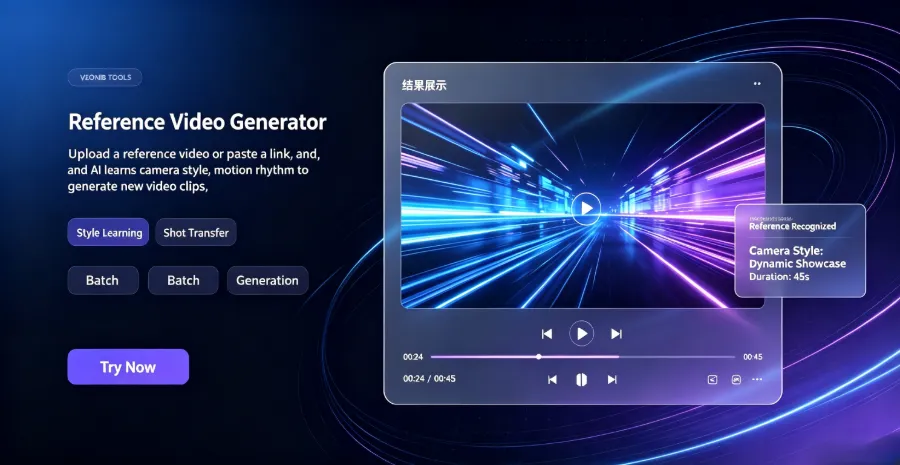
In practice, controlling the “rough” style is most effective by referencing real material. Upload a few UGC videos you like as style guides, and let the AI generate matching assets instead of letting it free‑form. This “reference‑driven” approach is more controllable than pure prompt engineering. The impact of rough material on conversion rates has already been validated in cross‑border e‑commerce, such as using AI videos to boost Amazon conversion rates with the same logic.
Turning “Rough” into Production Capacity: Using AI Workflows to Mass‑Produce UGC Material
Manually shooting rough material is easy; scaling it is hard. A media team may need to test dozens of assets each week, and phone filming plus manual editing can’t keep up. That’s why 2026’s direction is “let AI batch‑generate authentic‑looking material,” not “let AI generate perfect material.”
The core shift is removing manual editing and prompt‑engineering burdens. The mainstream approach now is to paste a product link; the system automatically parses selling points and price, then outputs a script, storyboard, and final video. A single asset takes about 60 seconds to generate, requiring no editing expertise. This automated pipeline has already been proven in the practice of AI‑automated end‑to‑end ad video production pipelines, where the entire chain from copy to video can be handed over to a tool.
When capacity is insufficient, tools like VEONIB solve the “product link → final video” workflow—paste a link, auto‑parse product info, generate script and storyboard, output videos of various lengths. Subscription tiers can produce up to 30/90/240 assets per month, enough to support “weekly volume testing” needs.

Multiple lengths (15 s/20 s/30 s) and multiple character avatars are configured to fit different platforms and ad placements. TikTok’s 15‑second assets and Shopify landing‑page 30‑second assets have completely different pacing and structure. The choice of avatar also directly affects the “roughness” level—select UGC or lifestyle‑style templates paired with a realistic human avatar rather than an overly perfect render, and the resulting material feels like a “real person sharing”.
A key point: “roughness” must be manually controlled. AI‑generated material defaults to polish and requires active selection of “rougher” options at the template and avatar level. Templates themselves are the style‑control mechanism; six high‑conversion UGC video templates cover problem‑solving, unboxing, lifestyle, and other scenarios—just apply as needed.
Material Testing Matrix: When to Be “Rough” and When to Be “Polished”
Anti‑polish is not a universal formula. Tailoring material strategy to the campaign stage and product category is more reliable than a blanket “all rough” approach.
- Cold‑start testing (new product launch): Rough‑feel UGC / real‑person on‑camera is priority. The goal is low‑cost material production and rapid hypothesis validation; rough assets cover the most selling‑point assumptions cheaply.
- Brand‑building phase: Polished studio or lifestyle material is used to lift brand premium, but it must be layered with genuine evidence—pure ambience without detail won’t convert.
- High‑price, high‑decision‑cost items: Combine “real‑person review” (rough) with polished showcase; they complement each other.
- Influencer “seed” matrix: Emphasize UGC real‑person, unboxing, and social‑proof for mass reuse.
| Campaign Scenario | Recommended Material Style | Key Metrics | Common Risk of Over‑Polish |
|---|---|---|---|
| Cold‑start testing (new product) | Rough‑feel UGC / real‑person | 3‑second completion rate, CTR | Over‑polish leads to high bids, distorted feedback |
| Brand‑building | Polished studio / lifestyle | Recall rate, brand‑term searches | Only ambience, lacking real evidence |
| High‑price single item | Live review + polished showcase | Conversion rate, add‑to‑cart rate | Pure ambience without detail can’t support decision |
| Influencer seed matrix | UGC real‑person / unboxing / social proof | Interaction rate, comments | Material homogenization dilutes authenticity |
Maintain at least 20 assets in the testing matrix each week, rotating them. Eliminate based on both 3‑second completion rate and CTR. Different tools vary widely in supporting material matrices; a horizontal comparison of 2026 e‑commerce AI video tools can guide selection.
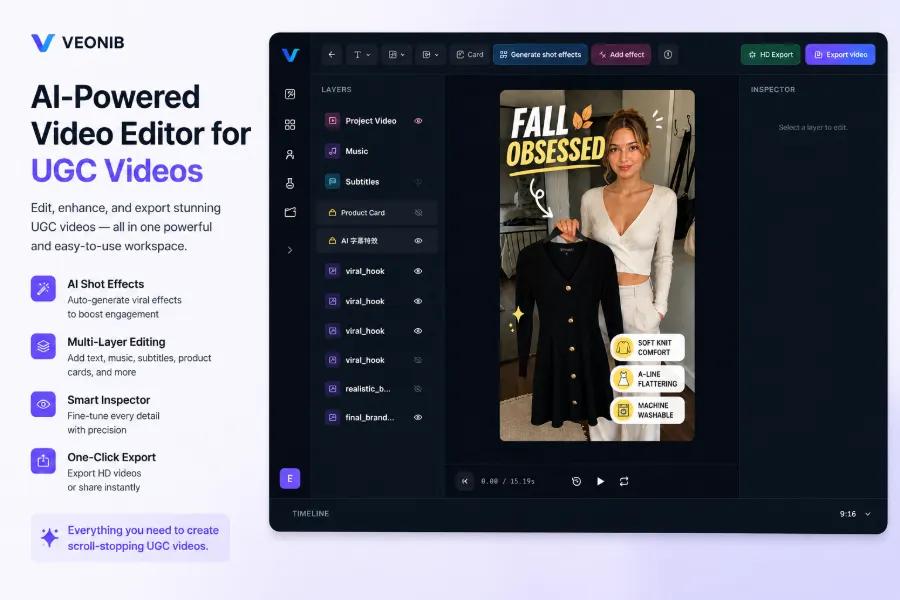
After a material reaches a stable phase, you can lightly polish and reuse parts of it. VEONIB’s multi‑layer editor supports subtitle tweaks, product‑card insertion, and smart effect generation—suitable for industrial‑level processing while preserving the core roughness. Remember, polishing should serve reuse, not transform rough material back into a polished style, otherwise you lose its original effect.
Polished assets can also be synced to on‑site content for secondary distribution. Official AI‑video sync integrations provide a ready‑made path to reuse ad material in blogs or product pages, extending asset lifespan.
FAQ
Will “rough” material look cheap and damage brand image?
The “roughness” is about texture, not quality. As long as hooks, selling points, and CTA structures are intact, rough material conveys authenticity rather than cheapness. Polished assets for brand‑building and rough assets for cold‑start can coexist without replacing each other.
Is anti‑polish suitable for all categories? What about high‑price products?
High‑price products aren’t suited to pure rough material because users need more detail to decide. Use a combination of “real‑person review + polished showcase”—rough assets build trust, polished assets display details; they complement each other.
Will AI‑generated videos become too rough and be flagged as low‑quality by platforms?
There is a risk. Roughness is a matter of texture, not logic—if the content structure is chaotic, the platform will deem it low‑quality. Control this by choosing UGC templates and realistic human avatars rather than letting AI run wild. Referencing real material yields more controllable results than relying solely on default outputs.
How to decide whether to keep an asset or replace it immediately?
Use the dual metric of 3‑second completion rate and CTR. If, after three days, the 3‑second completion rate is below 20 % and CTR is below the category average, replace it outright. If the completion rate is acceptable but CTR is low, the issue may lie in the selling‑point expression; tweak the script and retest before deciding.
Share Article