One Person Holds Up a “Talent Team”: Building a Virtual UGC Matrix

At the start of the month, when I opened the content schedule, the ad account had already chased for three rounds of new assets, and the several influencer collaboration groups on WeChat were silent. Asking each one, the reply was almost always the same: “The next slot is only next month.” This isn’t a matter of execution. The real constraints a solo e‑commerce operator face are: high influencer fees, long lead times, and uncontrollable assets, while the ad account’s demand for UGC material is continuous, stable, and scheduled consumption. Operators of Shopify independent sites or TikTok Shop should be familiar with this gap.
A virtual UGC matrix redefines UGC from “finding people to produce” to “operating with a matrix structure”: multiple accounts, multiple personas, templated content, and an automated pipeline, allowing one person to sustain a team‑level output. Success isn’t judged by whether the content looks like a real person, but by content scale and repeatability. An individual piece can be mediocre, but the supply must be uninterrupted.
Why One Person Needs a “Virtual Influencer Team”
First, do a time accounting. The traditional influencer UGC workflow is: find an influencer, negotiate price, wait for schedule, ship samples, wait for script, wait for final cut, then rework. A single cycle usually takes weeks, and it’s not unusual for a big promotion to stretch to two or three weeks. Ad accounts consume assets daily; the lifespan of a high‑volume piece is often only a few days. Demand is a continuous function, supply is discrete points, and the gap sits right there.
What a virtual UGC matrix does is simulate a continuous output of an influencer team using multiple accounts, multiple personas, and templated content. Its structural advantage lies not in the quality of a single piece but in content scale: bulk testing, rapid iteration, multi‑platform distribution—things real influencer collaborations can’t provide. With an influencer, changing a script takes two days; in a matrix, changing a template affects all subsequent content.
A mature toolchain is the prerequisite for this to work. The automated workflow from product link to script, storyboard, and final video has compressed a single video’s production cycle from weeks to minutes. The article From product URL to e‑commerce ad in minutes – a smarter way to create e‑commerce ads documents the practical use of such tools. Maintaining a dozen accounts daily is now a scheduling issue rather than an impossibility.
How to Build a Virtual UGC Matrix: Accounts, Personas, and Content Templates
In terms of account architecture, the matrix splits accounts by category or selling point, not by “person.” Unboxing accounts, review accounts, lifestyle accounts each have their own role. A persona combines four elements: nickname, avatar, bio, and tone; each account corresponds to a single vertical content positioning.
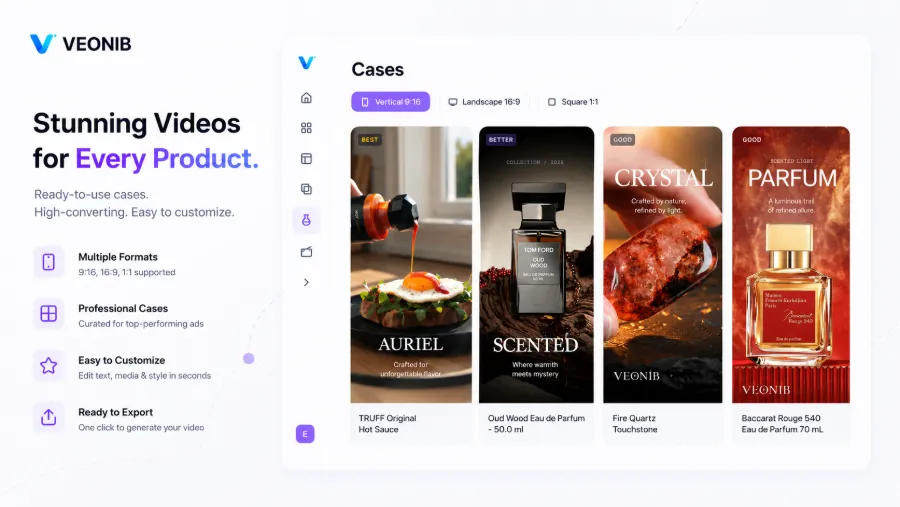
The content template layer is the matrix’s “show schedule.” Six story templates—Problem Solving, TikTok Review, Unboxing, Lifestyle, Social Proof, Custom—cover the main narrative structures of discovery content. To reuse high‑volume assets, simply clone the narrative template of a high‑volume ad and rebuild the structure from the reference video.
The purpose of templating is to reduce decision cost: each piece goes from “what to shoot today” to “which template to apply today.” In my tool setup, I use VEONIB for a single task: select a template, paste the product link, and wait for the final video. The account persona is the content skin applied to the skeleton; the stability of output depends on whether the template structure matches the account’s vertical positioning.
The trust mechanisms and suitable categories differ greatly among the six templates; refer to this table when choosing:
| Template Type | Core Trust Mechanism | Suitable Categories | Single‑Operator Notes |
|---|---|---|---|
| Unboxing | Physical verification | Electronics, cosmetics | High material reuse; ensure differentiation |
| TikTok Review | Usage evaluation | Home, personal care | Tone must be consistent |
| Problem Solving | Scenario immersion | Kitchen, tools | Hook determines completion rate |
| Lifestyle | Ambient discovery | Apparel, accessories | Rhythm relies on editing |
| Social Proof | Herd effect | Health supplements, courses | Cite data cautiously |
The matrix doesn’t need to start large. Begin with 3–5 accounts; each account produces 7–15 vertical pieces per week, yielding a pool of hundreds of assets after a month.
From Product Link to Final Video: A One‑Person Batch Production Pipeline
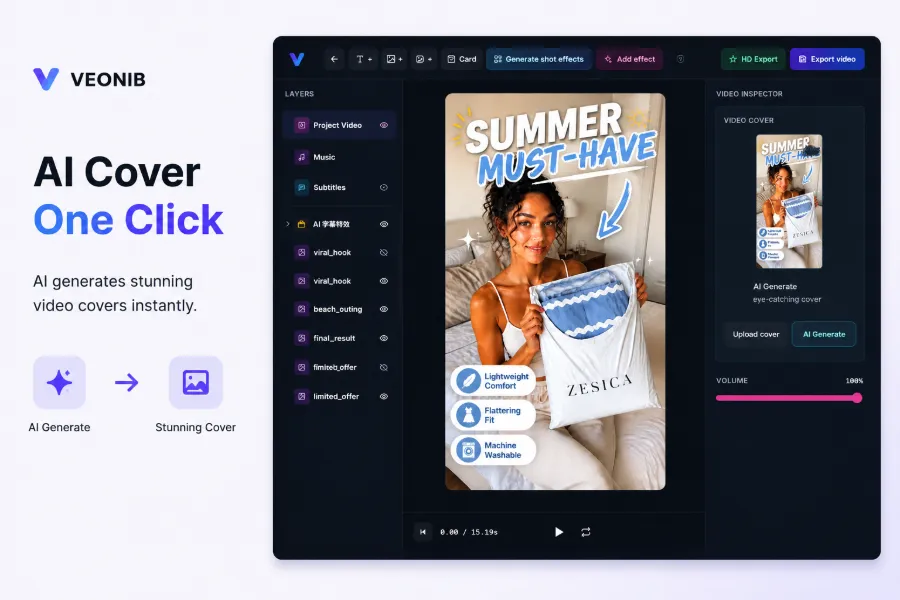
When you break a single video down, there are five production steps: product link, selling‑point analysis, script, storyboard, final video export. For a solo operator to sustain production, all five steps must be repeatable, not improvised each time.
First import the product link; the system automatically parses the title, selling points, and price. Then, based on the selling points, it generates the script and storyboard. Finally, export the MP4. This one‑click product link to UGC video workflow compresses the work of an editor, photographer, and copywriter onto a single line.
The key to batch production is importing multiple product links at once and generating three length versions—15 s, 20 s, 30 s—for each link, tailored to TikTok, Reels, and Shorts respectively. The same product gets a separate video on each platform, dramatically increasing material utilization.
When batch importing, I usually compile the week’s products into a spreadsheet and feed it to the tool in one go. VEONIB’s batch import saves the time of repeatedly pasting links; the saved effort should be spent on hooks: cover, hook copy, and CTA are the lifeblood of click‑through rates. The most common pitfall in batch production is reusing the same set of hooks across different accounts.
For quality control, verify each selling point’s accuracy to avoid reusing the same material verbatim. A single video takes about 60 seconds to generate, roughly ten times faster than traditional editing. The baseline cadence is one video per account per day.
Multi‑Account Publishing Rhythm, Asset Management, and Risk Boundaries
In publishing rhythm, staggering is fundamental. Four or five accounts posting simultaneously creates a content fingerprint. Re‑editing to match each platform’s style is equally important: TikTok values the first two seconds of the hook, Reels emphasizes watch‑through, Shorts focus on information density. The same video, edited separately for each platform, survives better than a plain cross‑post.
Asset management is the foundation of the matrix’s operation. Final videos are archived by product, account, and date; after watermark removal they are stored. Rules for cross‑account reuse are set: the same product material can appear on different accounts, but the cover, hook, and editing rhythm must be redone. After a while you realize the real bottleneck isn’t generation speed but asset archiving and reuse. For distribution, SEONIB’s video management and distribution capabilities provide a unified way to pull videos from all accounts.
What truly kills a matrix is insufficient differentiation. After 2–4 weeks of batch production, homogeneous accounts are gradually flagged by platforms, causing a noticeable drop in reach and a rapid decline in the marginal returns of early content investment. The most typical case I’ve seen: four accounts using the same template for three weeks; in week two, two accounts’ view counts halved, and the remaining accounts dropped as well in week three.
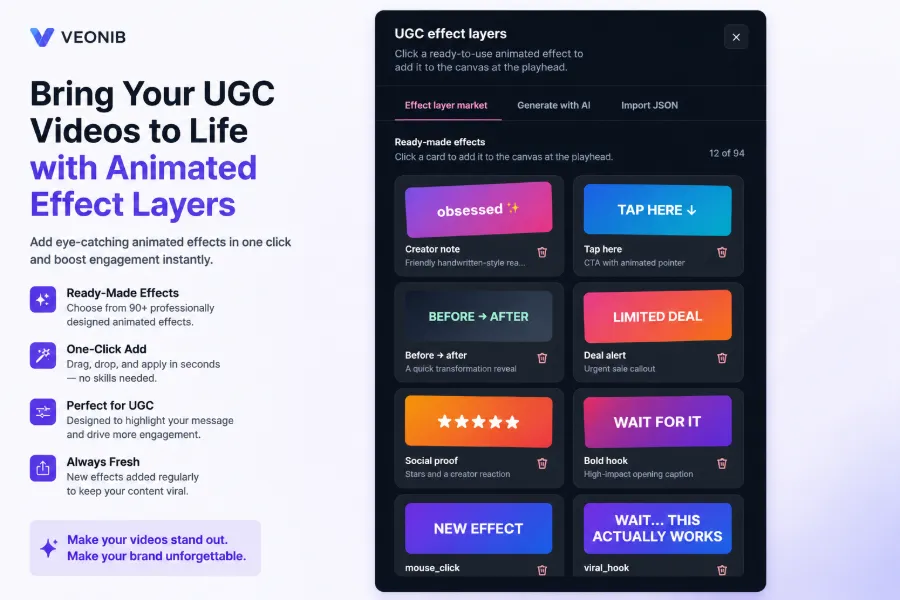
The remedy is differentiated re‑editing. Change the cover, modify the hook, add different motion‑graphics layers and CTA cues; the same product appears completely different across accounts. After re‑editing, traffic typically recovers within about a week.
Risk boundaries must be defined in advance. Matrix accounts should not masquerade as real people or fabricate usage experiences; avoid false discovery claims—Amazon is especially strict about fake reviews. Platforms are tightening rules on AI‑generated content; designing accounts around a “discovery narrative angle” rather than a fabricated persona makes it easier to pass review and survive long‑term.
The extent to which a matrix can succeed depends on how much time the operator invests in asset archiving and differentiation. Generation is only the first stage of the pipeline; organizing, re‑editing, and staggered publishing are the daily tasks that truly consume effort.
FAQ
Q1: How many accounts does a solo operator need to start a virtual UGC matrix?
Starting with three accounts is realistic. One account can’t sustain testing efficiency, and more than five become hard to manage in terms of asset output and differentiated re‑editing. Three accounts cover three narrative angles, producing 20–30 pieces per week, enough to feed a set of ad accounts.
Q2: How many pieces per day constitute a matrix‑level volume?
One piece per account per day, or 3–4 pieces total across the matrix, is a stable benchmark. At 60 seconds per piece, daily publishing isn’t the production bottleneck; archiving and differentiation consume the real daily time. Below ten pieces per week, batch testing loses its purpose.
Q3: Can platforms detect AI‑generated UGC? Will it be throttled or result in account bans?
Yes, and they detect it faster than most people expect. Homogeneous batch content is usually suppressed within 2–4 weeks; it may not lead to a ban, but traffic drop is almost inevitable. The response is to re‑edit per platform, stagger publishing, and limit the density of a single template’s usage.
Q4: Do the accounts in a virtual matrix need to masquerade as real influencers?
Not recommended. The purpose of an account is to provide a narrative angle, not to impersonate a non‑existent person. The cost of disputes from a fabricated identity far outweighs any benefit; designing accounts around a discovery narrative angle makes it easier to pass review and survive long‑term.
Share Article