Malaysian Shopee Sellers: One Product Link Becomes a TikTok Viral Video in 60 Seconds
Shopee sellers in Malaysia have all felt that split feeling—handling hundreds or thousands of orders during the day, then spending two to three hours in the evening editing a video for a new product. The traffic dividend of TikTok Shop is right there, I can see it, but the barrier to video production keeps people out. A 15‑second short video that can convert customers, from sourcing material to adding subtitles and adjusting aspect ratios, takes half a day to do manually. The more realistic problem is that even if you bite the bullet and produce three to five videos, you still have dozens of SKUs waiting to be listed, and video production simply can’t cover them. This isn’t a tool issue; it’s a structural problem of a traditional workflow that isn’t scalable.
How big is TikTok’s opportunity in Malaysian e‑commerce?
There are now over 350,000 active sellers on Malaysia’s Shopee platform, with annual order volume approaching 700 million. What does that number mean? It means that for any product you sell, there are at least a few hundred competitors selling the same thing. In today’s fiercely competitive main‑image environment, TikTok Shop’s growth curve in Southeast Asia is rewriting the rules.
TikTok Shop’s GMV in Malaysia has multiplied several times over the past two years, and video content is replacing static images as the core driver of conversion. I’ve seen some early‑adopter sellers whose single‑product video views exceed hundreds of thousands within 48 hours, directly boosting their Shopee shop’s search ranking. The problem is that most sellers still use the most primitive method to make videos—downloading supplier assets, manual editing, repeated adjustments—making it impossible to meet the platform’s demand for content volume.
That’s the biggest paradox: videos can drive conversion, but manual production efficiency limits how many products you can cover. If you don’t make videos, you’ll be left behind by those willing to invest.
The old way: From supplier assets to editing software, a video takes an entire afternoon
My most typical workflow used to be: download a product asset package from 1688 or the supplier’s cloud drive, use Format Factory to remove watermarks, drag it into CapCut to trim length, then manually add subtitles, find background music, and adjust to a 9:16 ratio. If you’re lucky, a product video could be barely finished in two hours. If you’re unlucky—say the supplier’s assets have inconsistent resolution, subtitle timing is off, or leftover watermarks cause TikTok’s review to reject the video—the whole afternoon is wasted.
The most frustrating experience was when I spent three days making five pet‑product videos, only to have them all rejected by TikTok’s ad review because of watermark issues. The ad budget was already running, but the assets couldn’t be uploaded; the rejection notice made me realize the model was unsustainable.
Traditional manual production of a single e‑commerce video takes 2–4 hours on average, not counting repeated revisions and review rejections. Most small sellers can’t afford a professional video team, and individual sellers can’t possibly edit an original video for every SKU. Trying to do A/B testing on TikTok this way is simply unrealistic. If you’re facing similar problems, check out this AI Video Ad Bulk Generation Guide; it helped me rethink the efficiency limits of video production.
The new way: Hand the product link to AI, and get a TikTok video in 60 seconds
The most obvious change is that the workflow has been completely compressed. It used to be “download‑edit‑export” in three steps; now it’s “paste‑wait‑export”.
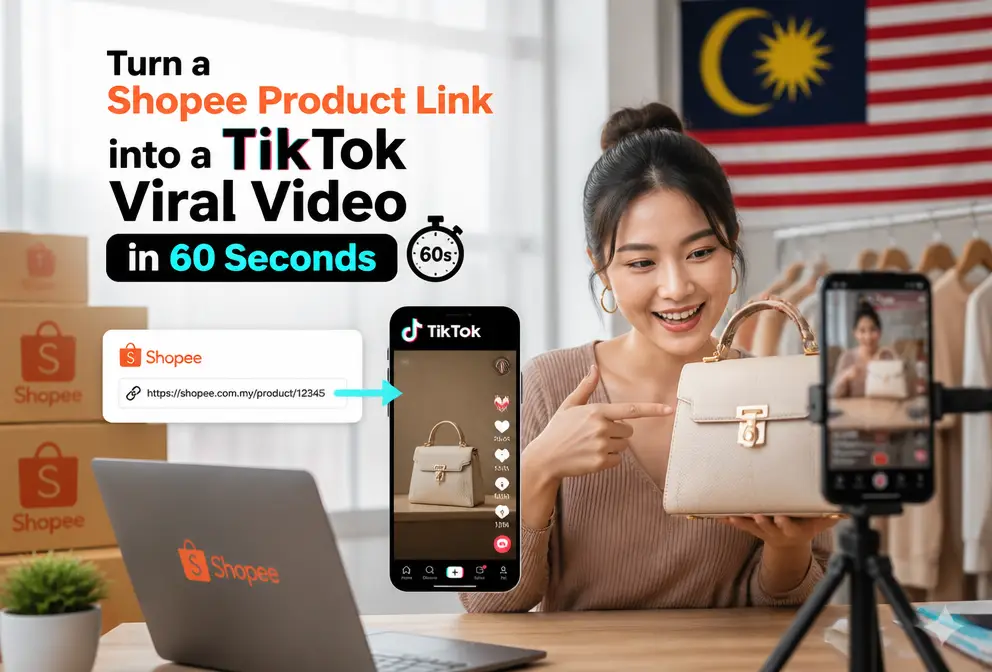
I simply paste the Shopee product page link, and let the AI handle everything else—it automatically extracts product images, text descriptions, feature points, and price information. The AI generates a script, creative hook, and storyboard, then renders a video ready for publishing. No video editing experience or software learning required.
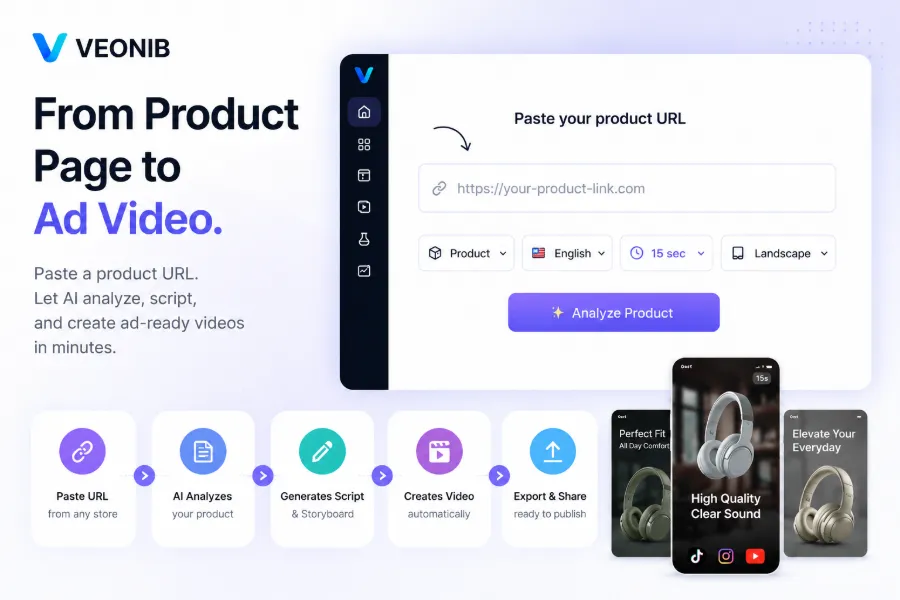
When I first tried VEONIB, generating a TikTok video for a pet product took less than 60 seconds. Psychologically, the change is massive—what used to consume all your energy now comes from a single link.
The whole process is ten times faster than manual work. What’s more useful is that it doesn’t require me to learn any prompt‑engineering tricks. Some AI video tools need you to write a screen‑full of description to generate barely usable content, but this tool works with just a link. You can compare it to Why Most AI Video Generators Are Still Too Complicated for E‑commerce to see why a simple workflow matters to sellers.
From “product video” to “brand story” — Two forms of AI video
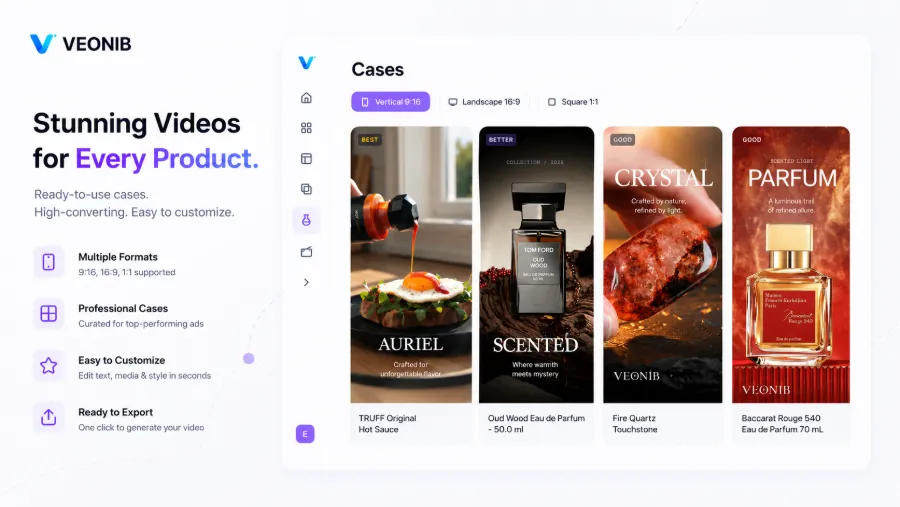
The same product link can be switched between different video styles. One is a product video that directly showcases features, material, and usage scenarios—suitable for product detail pages or TikTok shop windows to drive conversion. The other is a brand‑story video that packages product selling points into a 30‑ or 60‑second short story—better for TikTok ads aimed at acquisition.
AI can switch video styles with a single click—lifestyle, premium luxury, UGC, minimalist—each automatically adjusting script, voice‑over, and visual feel. This is hugely helpful for A/B testing; a single product link can generate dozens of video variants, each tested to see which creative gains more traction.
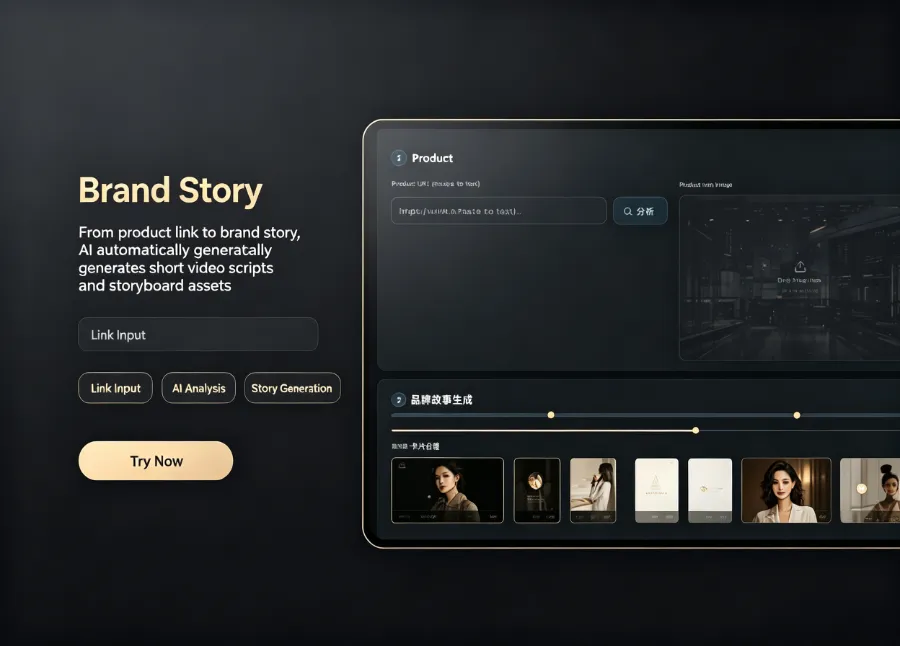
I later noticed a pattern: the real limiter for sellers isn’t tools or budget, but the psychological resistance to scaling manual production. When faced with dozens of SKUs, the thought of editing each one manually makes you give up. But when you can just paste a link and get a video, you’re more likely to think about which products deserve A/B testing. For low‑cost tiered strategies, see this Low‑Cost Video Marketing Strategy.
From “one video” to “full‑funnel advertising” — AI truly scales sellers
The biggest bottleneck for sellers used to be the inability to produce videos in bulk. You couldn’t generate five versions for 20 SKUs in three days to test material competitiveness. AI breaks that barrier: a single product link can generate countless video variants, covering TikTok, Facebook, Instagram, and more simultaneously.
Videos can be output in 9:16, 1:1, and 16:9 ratios, suitable for TikTok Shop, Facebook Ads, and Amazon listings. You don’t need to re‑edit for each platform. If your assets include watermarked supplier material, AI’s generation process naturally avoids the issue—it only extracts visual information from the product itself, leaving no elements that could be rejected by reviewers. For details, see Supplier Footage Watermark Removal & Review‑Pass Strategy.
Creative production cost drops by about 90%, and testing efficiency improves tenfold. Video quality isn’t the key; the number of SKUs covered by video is the hidden threshold for conversion—how many products you cover determines how many potential customers you can reach on the platform. To turn this capability into a truly scalable ad strategy, I strongly recommend reading AI Automated Advertising Scaling Method, which outlines a complete workflow from a single video to full‑funnel advertising.
This direction is the future trend. To understand why the whole industry is moving toward “one link generates video,” see The Future of AI Video Starts with a Product URL.
FAQ
Do I need to shoot my own footage to generate AI videos?
No. AI extracts product images and description directly from your product link; you don’t need to shoot anything, fetch supplier assets, or worry about watermarks.
Which e‑commerce platforms are AI videos suitable for?
Supported platforms include TikTok Shop, Shopify, Amazon, Facebook Ads, Instagram Reels, YouTube Shorts, etc. Videos automatically adapt to 9:16, 1:1, and 16:9 ratios.
How long does it take to generate a video?
On average, about 60 seconds to generate a complete finished video. From past the link to downloading the video file, the whole process never exceeds three minutes.
Can it generate different language versions?
Yes. It supports AI voice‑over and automatic subtitles in 30 languages, suitable for multi‑country market promotion.
What format are the exported videos?
Standard MP4 format, ready to upload directly to TikTok, Facebook, Shopify, and other platforms without transcoding.
Share Article