Built‑in Characters, Custom Characters, and Real‑Person Photos: How to Choose for E‑commerce UGC Videos

When cross‑border sellers mass‑produce TikTok Shop, Amazon, or Shopify ad videos for the same product, the part that most often requires repeated rework isn’t subtitles or transitions—it’s the character. Built‑in characters, custom digital avatars, and uploaded real‑person photos may look like mere style differences, but they each serve a distinct operational goal: product‑testing speed, long‑term brand consistency, and real‑person trust.
A quick rule of thumb: use built‑in characters while a new product’s selling points are still being validated; switch to a custom character for continuous publishing and establishing a fixed brand persona; and upload a real‑person photo when the product relies on endorsement by the founder, an expert, or authentic experience. The three options can be phased, you don’t need to lock in a single choice before the first ad goes live.
Start with the Operational Goal, Not the Appearance

Built‑in characters are ready‑made assets that let you quickly turn a product link, selling points, and script into the first batch of UGC ads. A custom character requires you to create a reusable digital persona, focusing on consistent appearance, tone, and on‑camera style. Uploading a real‑person photo brings an actual person into the video, which works best for founder appearances, expert‑type products, or content that needs a clear personal endorsement.
In practice, production speed, brand consistency, realism, and trust often pull against each other. Built‑in characters let you swap openings and selling points fast, but the character’s recognizability is limited; custom characters support ongoing brand video management but incur maintenance costs; real‑person photos give the strongest relational feel, yet require licensing, high‑quality assets, and clear usage boundaries.
15‑second, 20‑second, and 30‑second videos shouldn’t be seen as just three export options. 15 s is good for testing a single selling point, 20 s can add a problem‑solving scenario, and 30 s suits unboxing, experience walkthroughs, or fuller social proof. The character choice should serve the campaign task, not just “the most eye‑catching” role. Sellers without shooting capabilities can also follow the guide Create TikTok Shop Ads Without Shooting Any Video.
| Option | Best‑Fit Scenario | Main Advantages | Main Limitations | Key Metrics |
|---|---|---|---|---|
| Built‑in character | New product testing, quick script swaps | Fast production, low cost, no actors needed | Limited character continuity | Click‑through rate, first‑3‑second retention |
| Custom character | Long‑term account, product series | Stable look and tone | Time‑consuming to build and maintain | Asset reuse rate, brand search |
| Real‑person photo | Founder, expert, experience endorsement | Strong relational and trust feel | High licensing and compliance requirements | Completion rate, comment quality |
The same product can first be tested with a built‑in character for three selling points, then migrate the stable scripts to a custom avatar or real‑person footage. This sacrifices a bit of early uniformity but avoids locking an unvalidated product direction to an expensive persona.
Built‑in Characters: Validate Product and Script First
Built‑in characters work well for new‑product testing and for quickly trying multiple content directions for a single product. Sellers don’t need to prepare actor footage, nor do they have to reshoot when swapping the opening. After the product link is parsed, a checkable ad video can usually be generated within 60 seconds. This time frame is meant to let the team produce many versions quickly, not to guarantee any specific ad performance.
During testing, the product’s selling points should be fixed while the character is a variable. A solid workflow is to start with a problem‑solving template, then test TikTok Review, unboxing, and lifestyle scenarios, swapping the first‑3‑second opening, subtitle style, and call‑to‑action each time. If both character and script change simultaneously, any fluctuation in conversion or CTR becomes impossible to attribute.
A hidden benefit of built‑in characters is that they let sellers surface script issues faster. For products that can’t directly showcase results—e.g., health‑monitoring cat litter—the visuals can’t rely solely on “before‑and‑after” comparisons; they need to weave narrative through lifestyle scenes, problem‑solving, and social proof. The Health‑Monitoring Cat Litter Ad Example is better for studying narrative structure than copying the character’s look.
However, built‑in characters are not a substitute for long‑term brand identity. Across several rounds of assets, a character’s expression, speech rhythm, or on‑camera presence may vary, and viewers may not remember the role. They reduce first‑round testing cost, not the maintenance cost of a brand persona.
Custom Characters: Incorporate Character Consistency into Ongoing Production
Custom characters are ideal for teams that need to publish brand videos continuously, especially those with product series, a fixed account, and a clear audience. Once the avatar’s appearance, speaking style, clothing, and video pacing are standardized, asset archiving becomes easier and viewers can more readily associate different products with the same brand persona.
Before creating a custom avatar, the team must define the audience, product category, language tone, and on‑camera role. Simply aiming for “looks like the brand” isn’t enough: a Lifestyle style may suit home‑goods and beauty, a Studio style fits electronics that emphasize structure and function, and a Luxury style demands restrained lighting, composition, and subtitles. The character choice will, script expression; custom avatars are better for continuous storytelling rather than daily drastic personality shifts.
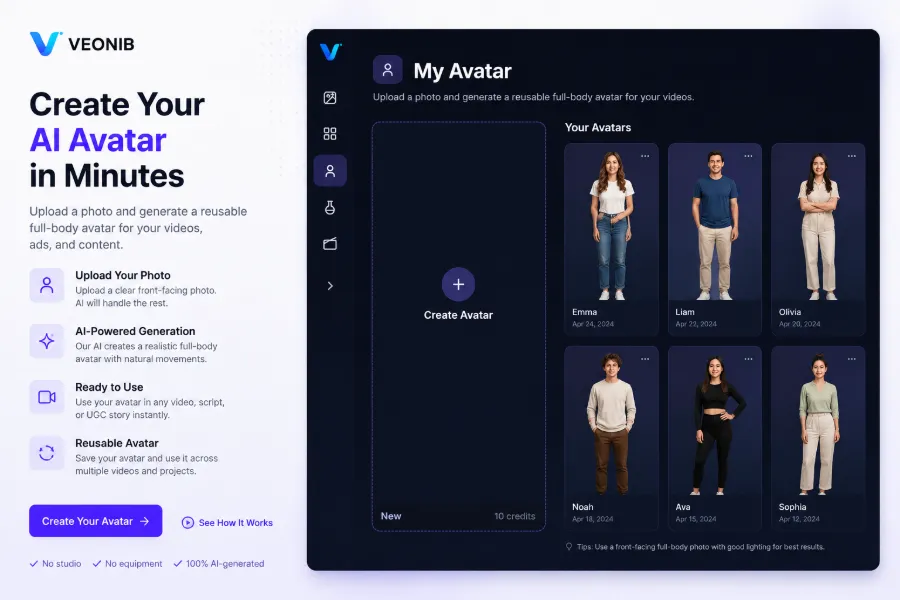
Production scale also influences whether maintaining a custom avatar is worthwhile. A team producing 30 AI ad videos per month might still rely on built‑in characters for most testing; at 90 or 240 videos per month, a fixed character and story templates help reduce repetitive setup. For a discussion on scaling content from product to traffic, see E‑commerce Marketing Evolution.
A common misconception: custom avatars increase recognizability, not automatically real‑person credibility. Even if a digital avatar looks identical every time, it may still lack authentic experience, personal background, and specific usage details. If a brand changes target market, tone, or positioning, the avatar may need to be adjusted, and previously created subtitles, scenes, and templates won’t be fully reusable at zero cost.
Real‑Person Photos: When Trust Is the Selling Point
Real‑person photos are suitable for founder appearances, expert‑type products, personal brands, and UGC content that needs authentic experience endorsement. Unboxing, usage experience, problem‑solving, and social‑proof scripts gain extra context from the person’s identity. Viewers see a specific individual rather than a generic on‑screen role.
The real‑person approach requires clear licensing and consistent standards for photo clarity, subject pose, clothing, and on‑camera boundaries. Large angle differences can cause mismatched facial proportions, hairstyles, or age appearances in generated results; if a founder only licenses ad usage but not long‑term social‑media publishing, cross‑platform reuse will be blocked later.
The difference between real‑person photos and custom digital avatars isn’t about “more real.” Real‑person photos emphasize genuine relationships and identity credibility; custom avatars emphasize reusable content and control. The former suits “how I use this product” stories; the latter fits a series of brand videos with a unified narrative.
When publishing across platforms, check TikTok, Amazon, and Shopify material requirements separately. Especially for synthetic content, ad labels, and character licensing, you can’t assume that an MP4 approved on one platform will pass on another. Dimensions, subtitle safe zones, and listing video specs often differ; incorporate platform rules into the production workflow when reviewing Multi‑Platform AI Ad Video Adaptation.
Real‑person footage can be split by length: 15 s retains a single selling point, 20 s adds a reaction, 30 s accommodates an unboxing or trust proof. Longer isn’t always more persuasive; if the person merely repeats product specs, a 30‑second video may waste the viewer’s attention early on.
Integrate All Three Options into a Single Publishing Workflow
Cross‑border sellers can follow this sequence instead of repeatedly picking characters from a library:
- Define the campaign goal first, then choose the character option; next, decide the story template, video length, platform, and primary test metric.
- In the testing phase, start with a built‑in character; once the selling points and script direction stabilize, migrate to a custom avatar or real‑person footage.
- Before publishing, checklist product info, price, subtitles, character actions, aspect ratio, MP4 export, and platform specifications.
In practice, platforms like VEONIB that parse product links into images, descriptions, and selling points, then generate scripts and storyboards, can compress “find assets → write script → plan shots” into one step. Fast link parsing doesn’t mean the ad is ready to go live. When price, inventory, promotion, or title changes, old videos may retain outdated content, so manual review becomes the main task.
Generating a video from a product link usually takes under 60 seconds, but manual review, platform upload, and version archiving must be accounted for separately. Teams should at least log the character option, script version, platform, publish date, and associated product link; otherwise, when an Amazon Listing or Shopify page changes price, operators will have to open multiple files and compare manually.
When producing at scale, asset version management can cause more chaos than generation speed. The workflow for uploading once and generating multiple creatives can follow Four Types of Ad Creative Production, but each version should still be labeled with character, script, and platform—avoid generic names like “final version” or “final version 2”.
Some sellers built a custom avatar during the testing phase, spending the first two weeks on avatar design, clothing, and asset maintenance. After several campaign rounds, they realized the real need was a script direction change: they shifted from emphasizing visual display to problem‑solving, which required re‑working character actions, subtitles, and video versions, extending the testing cycle by days. The failure wasn’t due to poor custom‑avatar quality, but because brand consistency was prioritized over selling‑point validation.
Batch production also brings cost and tool‑stack trade‑offs; teams can compare different options against a Monthly $20 Tool Stack on a single internal process sheet. Low cost doesn’t equal low maintenance; the real metrics to track are rework frequency, review time, and synchronization scope after assets become outdated.
FAQ
When testing a new product, which character type should be prioritized?
New‑product testing usually starts with built‑in characters. Test openings, selling points, and script direction within the first 1–2 weeks, then decide whether to migrate a stable version to a custom avatar or real‑person footage.
What’s the main difference between custom characters and uploaded real‑person photos?
Custom characters address long‑term brand persona and content consistency; real‑person photos serve identity relationships and authentic experience endorsement. The former is built for reuse, the latter requires more licensing, photo quality, and usage‑boundary management.
Before creating a UGC video with a real‑person photo, what licensing and asset issues must be checked?
Confirm that the person authorizes ad, social‑media, and cross‑platform use; verify photo clarity, angle, clothing, and subject pose. Keep a record of the license; otherwise, a takedown request weeks after publishing could affect multiple ad versions.
Can the same product switch character types at different stages?
Yes, this is a common operational practice. Use a built‑in character during testing, then switch to a custom avatar or real‑person photo once the selling points stabilize. As long as the script, product info, and version records stay clear, test results remain valid.
How do the three character options adapt to TikTok Shop, Amazon, and Shopify?
TikTok Shop favors quick short openings and conversational style; Amazon Listings prioritize clear product‑function display; Shopify ads can align character and narrative with the brand page’s style. Each platform requires separate checks for length, aspect ratio, subtitles, and ad compliance—don’t publish the same unedited file across all three.
Share Article