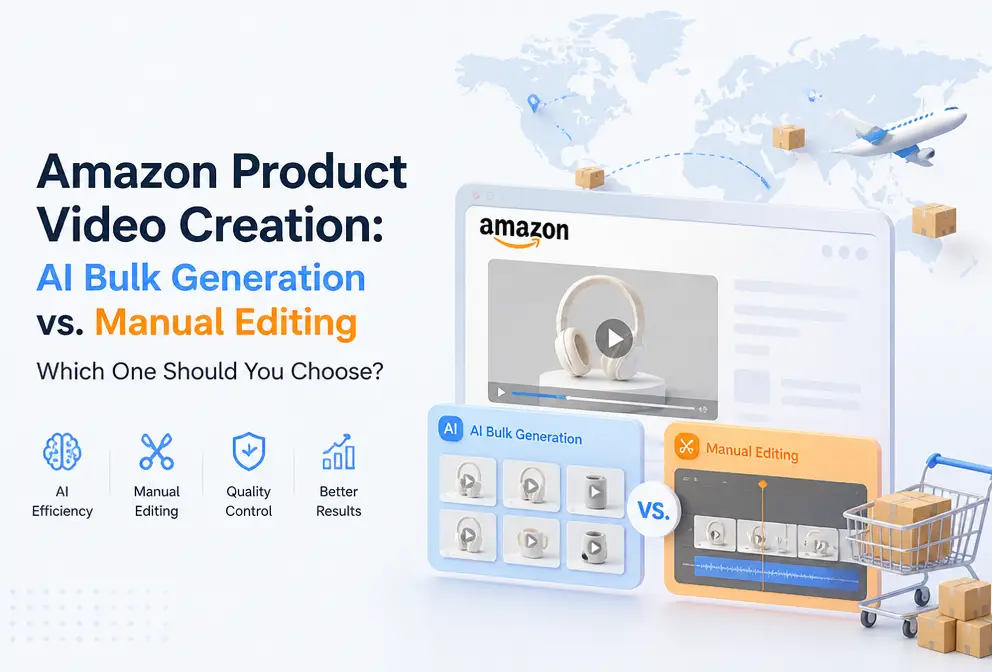
Amazon Product Video Production: AI Batch Generation vs. Manual Editing – Which Should You Choose?
On the night before a new product goes live, the main image video slot is still empty. The seller opens Jianying, pulls up a few casually filmed clips from the phone, and begins the long manual process of creating a 30‑second video: selecting clips, matching rhythm, adding subtitles, adding music, then exporting to the MP4 format required by Amazon. After a night’s work, the result barely watches, but the resolution, length, or aspect ratio always fails to meet the standards, forcing a re‑export. The next morning, the listing still has no video.
This scenario repeats daily in cross‑border seller groups. This article does not list feature checklists; instead, it puts the time, money, skill barrier, and long‑term consistency of manual editing versus AI batch generation side by side, helping teams of different sizes decide. Neither path is absolutely superior; each fits a different product‑launch rhythm.
The Real Cost of Manually Editing an Amazon Product Video
The manual workflow looks simple, but it’s all time. For a 15–30‑second product video, the full steps are: filming material, rough cut, music, subtitles, color grading, and exporting to Amazon specifications. With ample material, it usually takes 2–6 hours from start to listing; insufficient material requires reshooting, doubling the time.
Breaking it down makes the cost clearer. Rough cutting can be done in half an hour; music selection and beat‑matching are the biggest time sinks—changing the BGM three times or re‑doing the rhythm is normal. Subtitles and color grading each take about half an hour; finally, exporting often reveals that Amazon’s main image video slot requires specific encoding and resolution, necessitating another adjustment. A single video takes 2–6 hours for a skilled editor, and a novice takes more than twice that.
Hidden costs are often overlooked. Professional versions of editing software like Jianying, Premiere, or CapCut cost a few hundred to over a thousand yuan per year; outsourcing to freelancers usually costs $60–$150 per video, with extra fees for each revision. The communication overhead of repeated revisions can be more draining than the editing itself. When new products launch frequently, the manual model inevitably collapses—teams releasing more than ten items a month see labor costs multiply, leading to weekly overtime by the third month and a steady decline in video quality.
Manual costs are not one‑off; they compound month after month as new listings are added. The per‑video cost differences between the two approaches can be referenced in the 2026 AI Video Generator Pricing Comparison. With a monthly subscription, the per‑video cost can drop to a fraction of manual outsourcing.
How AI Video Tools Fit Into Amazon Product Material
AI video tools follow a completely different workflow from manual editing. Starting from a product link, the seller pastes the Amazon product page URL into the tool; the AI automatically reads images, description, and selling points, then generates a script, storyboard, and scene‑by‑scene plan, finally exporting an MP4 with one click. The whole process takes about 60 seconds and requires no editing knowledge.
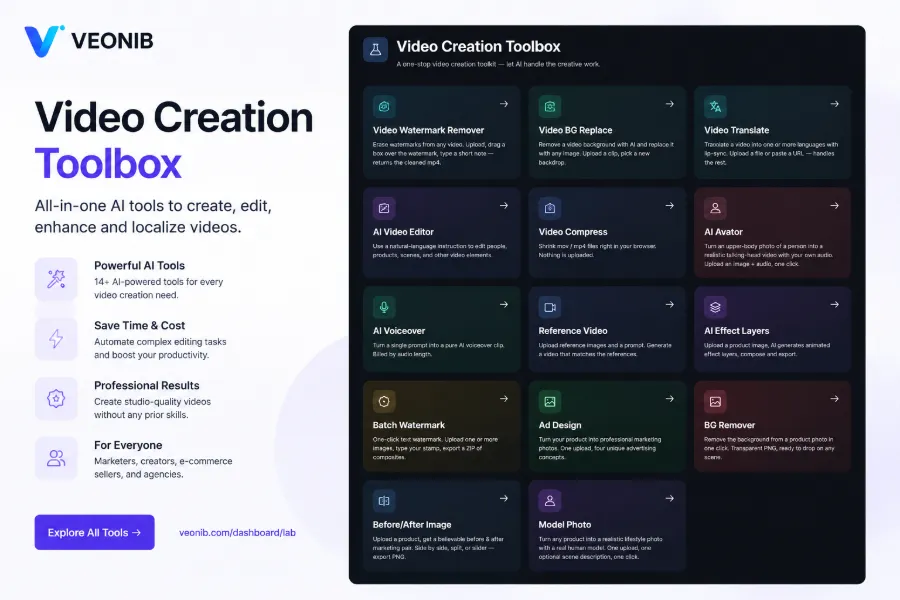
These tools offer template libraries designed specifically for e‑commerce scenarios, with ready‑made styles such as brand, lifestyle, UGC, and minimalistic. For small sellers lacking professional filming equipment, this solves the material scarcity problem—no studio, no models; the product link itself supplies all inputs. End‑to‑end generation averages about 60 seconds, roughly ten times faster than traditional editing, a speed advantage that becomes especially noticeable at scale.
Specific workflow: after pasting the link, the tool automatically analyzes the product title, selling points, and price, generating multiple hook scripts and storyboards. The seller selects a style and the video is generated. Automatic resizing for TikTok, Reels, and Shorts eliminates the most tedious format‑adjustment step of manual editing. The industry discussion on this trend is extensive; see How AI Is Reshaping E‑commerce Marketing for a deep dive. Tools like VEONIB essentially turn a product link directly into a finished video, with no need to understand timelines or keyframes.
Beyond Efficiency, Quality and Consistency Are the True Deal‑Breakers
Speed is only a surface difference; the real watershed lies in product quality and long‑term consistency. Manual editing wins on authentic material and fine‑grained control, but video quality heavily depends on the editor’s mood that day, leading to large variability—one video may be perfect when the editor is focused, another may be unsatisfactory even after overnight revisions. AI generation is stable and rhythmically uniform, but human review is still needed to ensure product details and copy are accurate.
An often‑overlooked mechanism: almost all e‑commerce platforms default to silent playback, so the visual information in the first three seconds determines retention. This makes visual storytelling a hard requirement for both workflows. Many sellers focus on narration and ignore whether the silent visuals can independently convey the selling points. Manual editors must deliberately design visual rhythm; AI‑generated videos must be checked to ensure the scene plan covers key selling points.
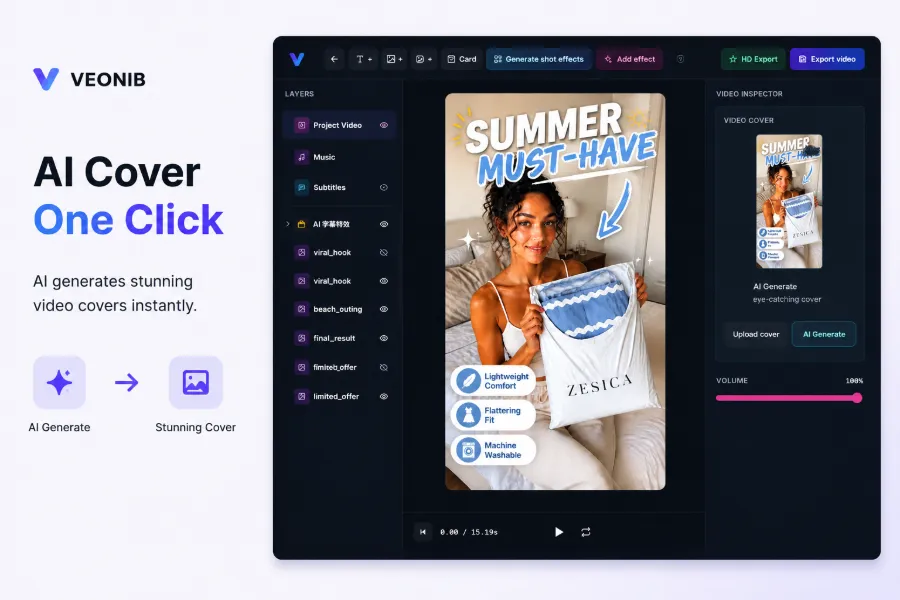
Another less obvious point: beyond per‑video speed, brand‑style consistency across multiple videos is the real pain point for scaling sellers. Manual editing varies per video, so the same product’s videos across batches can look completely different; a unified storyboard template guarantees visual stability, which is crucial for teams handling many SKUs. AI video tools (using VEONIB as an example) excel here because each generation follows the same storyboard logic, preventing brand drift. Technical details can be found in the VEONIB video generator open‑source project page.
| Comparison Dimension | AI Video Tool | Manual Editing |
|---|---|---|
| Time per video | ~60 seconds | 2–6 hours |
| Cost per video | Subscription‑based amortization | $60–$150 outsourced |
| Skill barrier | No editing background required | Requires proficiency with editing software |
| Batch production | Parallel generation of many videos | One‑by‑one, human bottleneck |
| Style consistency | Unified storyboard template | Depends on editor’s state |
| Ideal seller type | High‑frequency launches, scaling teams | Single product, emphasis on material authenticity |
Choosing Based on Team Size and Launch Rhythm
The decision framework isn’t complex. Sellers with a single product and a focus on authentic material can stick with manual editing—refining one video to satisfaction yields a good ROI. Teams launching many products per month and relying on ad‑driven volume benefit from batch generation; manual methods can’t sustain beyond three months at scale. A hybrid approach works for many: core items get manual polishing, while high‑volume items use AI as a base.
A real example: a seller releasing ten new items per month persisted with manual editing. By the third month, weekly overtime was required, video quality declined, and a main‑image video received negative feedback for inaccurate product details. By the fifth month, they abandoned the manual route and switched processes. This timeline shows that manual methods fail not because of speed but due to unsustainability at scale. For teams releasing more than ten items per month, labor costs double mathematically—not a matter of attitude.
Conversion rate is another consideration. Video boosts Amazon listing conversion when the content is accurate and the visuals are clear. Any workflow must include a review step to avoid distorted material that later triggers post‑sale complaints—especially for AI‑generated content, where product details (color, size, function) must be verified against the actual item. See AI Product Video Solutions for Improving Amazon Conversion Rates.
At scale, automation is unavoidable. Each additional manual video adds labor cost, while batch generation’s marginal cost approaches zero. For teams testing product concepts via ad material, the Most Cost‑Effective Way to Scale Automated E‑commerce Video Ads is worth a look. Finally, start at your own pace—no need to buy the top tier immediately. Begin by manually polishing core items, then use tools for high‑volume items, and increase budget after the workflow is proven.
FAQ
What is the optimal length for an Amazon product video?
15–30 seconds is the mainstream range. The first three seconds must capture attention because the platform defaults to silent playback, making visual information more important than narration. Videos longer than 60 seconds see a noticeable drop in completion rate unless they showcase complex, durable products.
How much time does it take to manually produce a product video?
A skilled editor spends 2–6 hours; a novice usually needs 8 hours or more. This includes rough cut, music, subtitles, color grading, and export, but not filming. If additional footage is required, time can double.
Can a seller with no editing background create videos themselves?
Yes, but the learning curve is steep. Tools like Jianying or CapCut are easy to start with, yet reaching a quality suitable for listing typically requires 2–4 weeks of learning and practice. AI tools need no editing background; pasting the product link generates a finished video.
What format and content restrictions does Amazon impose on product videos?
Amazon’s main image video slot requires MP4 format, with a recommended resolution of at least 1280×720 and a length of under 60 seconds. Content must not contain pricing, promotional information, contact details, or calls to purchase off‑site. The product display must be truthful and accurate, without misleading descriptions.
Share Article