AI-Driven Localized Video Advertising: How Cross‑Border Sellers Can Adapt to Global Markets at Low Cost
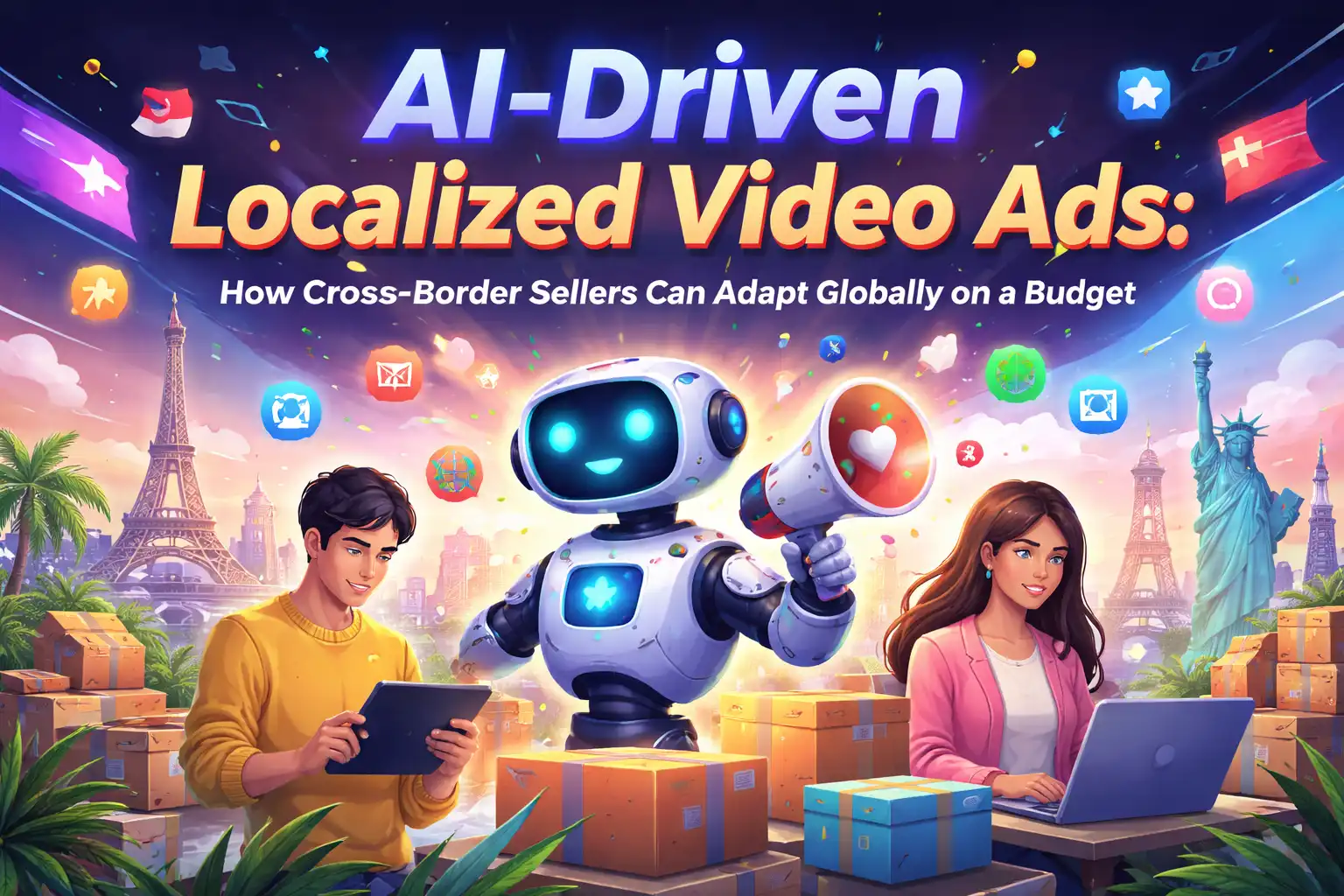
When you run ads on TikTok Shop or Amazon, you’re not facing a uniform mass audience; you’re dealing with consumers who speak different languages, eat different breakfasts, and were raised on different cultural memes. Using a single ad asset that tries to “eat” every market usually results in dismally low conversion rates—this is the norm I’ve observed after working with dozens of cross‑border sellers over the past two years. Localization isn’t just about translating subtitles; it means redesigning hooks, tweaking product value propositions, and sometimes creating entirely new storyboards for a specific market. The emergence of AI is making this once time‑ and cost‑intensive workflow affordable. In short, an AI‑localized video ad can cover the language and cultural preferences of multiple markets within minutes, at a cost that is only one‑fifth to one‑tenth of traditional outsourcing. Low‑cost video marketing 2026
Why AI Is the Key to Video‑Localized Advertising
The traditional video‑ad localization process is structurally painful. You have to find separate translators, voice‑over artists, and editors for each market; a 15‑second ad typically takes 3–6 hours from script to final product. If you’re targeting five markets simultaneously, communication overhead alone consumes half a day. Even worse, you rarely dare to test multiple versions across markets at the same time—time and budget simply don’t allow it. This situation only began to change when multimodal AI video models entered commercial use. Google’s latest multimodal AI video generation model, Veo, demonstrates text‑to‑video generation, but the most practical scenario is generating multiple language versions of hooks and scripts directly from a product URL. Google Veo multimodal video generation
AI changes the workflow logic in a simple way: one input, many outputs. Starting from a single product link, the tool automatically parses product attributes, selling points, and target audiences, then generates distinct hooks, storyboards, and voice‑overs for each target market. For example, a Bluetooth headset might emphasize noise‑cancelling commuting for Japan, while highlighting audio precision specs for Germany—the script structure differs completely, yet the underlying product and assets are reusable. Converting AliExpress products into video ads ( Turn AliExpress products into video ads ) follows this logic, saving sellers the time of producing separate ads for each market.
We can feel the difference with a few numbers:
| Comparison Dimension | Traditional Method | AI‑Assisted Method |
|---|---|---|
| Time to produce a single localized ad | 3–6 hours | < 1 minute |
| Number of markets covered simultaneously | 1–2 | 5–10 |
| Monthly version testing volume | 10–20 ads | 100+ ads |
This scalability is especially critical for sellers who operate stores on TikTok Shop, Amazon, Shopify, and Temu at the same time. When your product must appeal to consumers in Indonesia, Brazil, Germany, and Mexico simultaneously, AI is not just an accelerator—it’s the only tool that can achieve such coverage at a reasonable cost.
Core Workflow for AI‑Localized Video Ads
After understanding what AI can do, let’s break down the concrete steps. The workflow starts with a product URL and ends with a set of multilingual videos, requiring virtually no manual material editing.
Paste the product link. Whether you’re on Shopify, Amazon, or AliExpress, the AI tool automatically extracts the product page’s title, description, images, and high‑frequency words from reviews. The AI Hook Generator then creates 3–5 hooks tailored to different market styles—e.g., a “local influencer is using it” social proof hook for Southeast Asia, and a direct‑comparison pain‑point hook for North America. This takes about 20 seconds.
Generate script and storyboard. After selecting a hook, the AI Script Generator adjusts the narrative logic for the target market. The same product may have a script centered on ritual for Japanese consumers, but on technical parameters for German consumers. VEONIB then automatically builds a storyboard, adjusting scene order based on language differences—e.g., when showcasing kitchenware, Asian markets prioritize multi‑family usage, while North America shows single‑apartment scenes first.
Multilingual voice‑over and subtitles. AI supports 30 languages and can match various tones: enthusiastic, professional, friendly. Automatic subtitles adjust display speed according to language length—an often‑overlooked detail: German subtitles are typically >30 % longer than English. If you reuse English timing, a 15‑second ad becomes unreadable. AI’s subtitle feature can compress or extend display time per language, but sellers must still control dialogue volume during script creation and avoid stuffing every word.
Export videos in multiple ratios. One rendering produces 9:16 (TikTok/Reels), 1:1 (Facebook), and 16:9 (YouTube Shorts) formats as MP4 files. A single product can yield 100 AI‑generated ad variants covering multiple markets and script combinations. If you run Create high‑converting Shopify video ads on Shopify, this bulk‑production capability plugs directly into the “Create high‑conversion AI video ads for Shopify products” workflow, generating multi‑market versions whenever you launch new items.
Practical Tips for Cross‑Border Sellers Implementing AI‑Localized Ads
AI speeds up generation, but the final cultural review still requires native eyes. In 2024, a Shenzhen‑based 3C seller deployed AI‑generated North‑American ad assets to Southeast Asia, showing a white male using the product in a private office. Southeast Asian consumers, however, more commonly encounter shared apartments or family common areas. The ad’s ROI dropped by 60 %. The lesson: AI can produce language and visuals, but only locals can judge whether a scene feels familiar to the target audience.
Key considerations when rolling out:
Cultural Sensitivity – AI‑generated hooks may carry ambiguous meanings in certain markets. For example, “lazy cooking” is humorous in North America but can be perceived negatively in Japan. Have at least one native speaker read the script before launch. VEONIB allows free editing of hooks and scripts before export; this feature is essential, not decorative.
Platform Format Adaptation – Different platforms have subtle differences in aspect‑ratio and length requirements. 9:16 for TikTok/Reels, 1:1 for Facebook, 16:9 for YouTube. AI can batch‑convert, but you still need to adjust hook pacing per platform—TikTok’s first three seconds must grab attention, whereas Facebook’s 1:1 format tolerates a slightly longer lead‑in. Canva’s AI video generation ( VEONIB AI video ads generator ) also supports ratio changes, but it leans toward design templates and lacks e‑commerce‑focused multilingual script generation.
Localization ≠ Translation – Product selling points have different priorities across markets. For skincare, “whitening” is less accepted in North America and should shift to “brightening and evening skin tone,” while it can be used directly in Southeast Asia. AI may not automatically discern these subtle differences; you must manually set selling‑point priorities before script generation. Below is an overview of localization differences by platform:
| Platform | Recommended Aspect Ratio | Typical Ad Length | Key Localization Differences |
|---|---|---|---|
| TikTok Shop | 9:16 | 15–30 seconds | Hooks must tie into local trending topics; subtitle speed must match language |
| Amazon | 16:9 / 1:1 | 15–60 seconds | Emphasize product specs and authentic reviews; avoid exaggerated promises |
| Shopify | 1:1 / 9:16 | 15–30 seconds | Brand storytelling; multiple angles of usage scenarios |
| AliExpress | 9:16 | 15–30 seconds | Highlight cost‑performance and fast delivery; visuals should be bold and direct |
A/B Testing and Iteration – Before entering a new market, test at least 3–5 localized versions to see which hook and narrative yields the highest click‑through rate. AI can quickly generate many variants, but reserve a 48‑72 hour testing window. Don’t expect the first version to be optimal—localization is an iterative optimization process, not a one‑off translation.
Common Misconceptions About Localized Video Ads
I’ve repeatedly seen three pitfalls in sellers’ real‑world operations. Avoiding them early saves a lot of trial‑and‑error cost.
Misconception 1: AI‑generated ads need no human intervention and can be launched as‑is. This is the most dangerous belief. The 2026 low‑cost video marketing guide notes that AI tools work best as creative starting points, not final drafts. I’ve seen an outdoor‑lighting seller launch an AI‑generated “midnight party” hook in the Middle East—local consumers never host outdoor parties at midnight. AI doesn’t know cultural taboos; it only learns patterns from data. Always perform a manual quick check before export.
Misconception 2: Localization is just translating subtitles. Subtitle translation is the shallowest layer of localization. True localization adjusts visual logic, reorders selling points, and often redesigns hooks. For instance, a coffee machine ad in Japan might showcase a morning ritual, while in Germany it demonstrates precise extraction parameters—completely different scripts. Swapping subtitles alone makes the audience feel “this is for another market,” not “this is made for me.”
Misconception 3: Every market needs completely independent ad assets. Producing ten completely separate ads for ten markets is unrealistic and unnecessary. A better approach is to use the same core footage (product demo, usage scenes) and only replace hooks, voice‑overs, and selling‑point order. AI’s storyboard builder can retain core scenes while swapping the first three seconds of the hook and the final CTA. About 40 % of cross‑border sellers who first adopt AI tools skip the secondary cultural review of localized content—this statistic shows that most people bypass the most critical quality‑control step.
Balancing automation efficiency with human quality checks – Recommended practice: let AI generate five different localized versions, then have a native speaker from the target market pick and fine‑tune the best one. This retains AI speed while embedding human judgment. For technical specifications on multilingual content, consult Google Search Central’s best practices for multilingual pages and videos to understand how search engines interpret them.
FAQ
Q1: Can AI‑localized video ads truly match the quality of native ads?
They can reach 70‑80 % parity. For 15‑30‑second short videos, AI‑generated hooks and voice‑overs often make it hard for average consumers to tell if the ad was AI‑made. However, for long ads requiring strong brand tone or cultural humor, the gap remains noticeable. Use AI for testing and bulk production, and reserve budget for manual polishing of the top‑performing versions.
Q2: Which cross‑border e‑commerce platforms benefit most from AI video localization?
TikTok Shop, Amazon, Shopify, AliExpress, and Temu all see good results. TikTok Shop’s reliance on short video makes AI a natural fit; Amazon benefits from product images and review‑driven script optimization; Shopify suits brands with multi‑market store configurations.
Q3: Are copyright and commercial usage rights guaranteed for AI‑generated video ads?
Most professional AI tools (e.g., VEONIB) explicitly grant full commercial usage rights upon export, allowing you to use the video on any paid or organic channel without additional royalties. However, verify the service terms to ensure they don’t include clauses like “training data may reuse your material.” Some free tools do not grant full copyright.
Q4: If an AI‑generated localized hook isn’t suitable, can I still edit it?
Yes. Nearly all AI ad‑generation platforms let you edit scripts, hooks, and scene descriptions before export. After editing, the system re‑renders the video. It’s advisable to preview multiple AI‑suggested versions first, then manually fine‑tune.
Q5: How much cost savings does AI localization provide compared with traditional outsourced translation and production?
Traditional 15‑second localized ads (voice‑over + subtitles + editing) cost roughly $200‑$500 and take 3‑6 hours. AI tools typically charge $10‑$30 per export, with rendering time under a minute. At scale, cost reductions can exceed 90 %, though you should still allocate budget for human cultural review.
Share Article