2026 AI E‑Commerce Video Tools Ranking Worth Investing In

In the past two years, cross‑border e‑commerce sellers have found themselves in an increasingly awkward position when it comes to advertising assets. Demand for video assets on channels such as TikTok Shop, Amazon Listing videos, Shopify stores, Reels, Shorts, etc., has doubled, yet the traditional outsourced production cycle for a single ad video typically takes 3–5 days and costs anywhere from a few hundred to over a thousand dollars. Small and medium sellers cannot afford that time nor that cost, let alone produce dozens of assets each month to test performance.
By 2026, the question is no longer “whether to use AI tools,” but “which tool to choose without falling into a trap.” The market is flooded with AI tools that claim to make e‑commerce videos, but only a few truly fit the e‑commerce workflow. This article starts from real‑world use cases, builds an evaluation framework, and then reviews the tools worth watching, helping you spend your money wisely.
A single ad video traditionally takes 3–5 days to outsource, while AI tools can compress the cycle to under 60 seconds. This gap determines whether small sellers can keep up with the platform’s material consumption pace.
Why E‑Commerce Video Production Must Shift to AI Tools in 2026
First, a set of real data. In 2026, TikTok Shop and Amazon algorithms are increasingly favoring video content; the impact of Amazon Listing videos on conversion rates no longer needs proof, and Shopify product pages are using videos more often instead of static images. UGC ads are taking a larger share of social commerce placements because users’ trust in polished brand ads is declining while their acceptance of authentic content rises.
Traditional workflows suffer from overly long chains. A video must go through script writing, model shooting or asset sourcing, editing, voice‑over, subtitles, platform size adaptation—any step can become a bottleneck. Outsourcing a video for 3–5 days is normal; during peak season, a week‑long wait is not uncommon. Sellers who need to test multiple products and angles simply cannot keep up.
The value of AI video tools is not that their output matches professional teams, but that they shrink the production cycle from “days” to “minutes.” Sellers can then focus more on material strategy and testing rather than on production. This is the core reason the decision shifts from “whether to use” to “which one to use.”
Five Core Evaluation Dimensions for AI E‑Commerce Video Tools in 2026
Tool selection should not be based solely on feature lists in marketing materials. More features do not equal suitability for e‑commerce; many tools excel at generic video generation but falter in e‑commerce contexts. Below is a quantifiable evaluation framework with five dimensions, each with specific checkpoints.
| Evaluation Dimension | Core Checkpoints | Meaning for E‑Commerce Sellers |
|---|---|---|
| Generation Speed | Time from input to finished video per clip | Determines whether you can keep up with material testing cadence |
| Video Quality & Style Diversity | Availability of UGC, Lifestyle, Studio, etc., styles | Affects ad performance across different platforms |
| Platform Compatibility | Support for MP4 export, multi‑size output | Determines whether the video can be used directly on TikTok, Amazon, Shopify |
| Operational Barrier | Need for editing, scripting, storyboard experience | Determines whether the team can actually use it |
| Cost Structure | Monthly subscription fee and video quota | Determines whether long‑term investment is sustainable |
Among these, operational barrier is the most easily overlooked. Many tools are powerful but require users to write scripts, storyboard, and tweak parameters—learning costs that cause non‑editors to abandon them. Another often‑underestimated factor is cost structure; some tools charge per video, and expenses can spiral during bulk testing.
One‑by‑One Review of AI E‑Commerce Video Tools Worth Watching in 2026
Current mainstream AI video tools fall into two categories. The first is generic video generators such as Pictory, InVideo, which excel at turning text or assets into video but require manual script and storyboard editing for e‑commerce, taking 2–10 minutes per video with a complex workflow. The second is digital humans like Synthesia, HeyGen, suited for talking‑head content but limited for product showcases and UGC‑style e‑commerce videos.
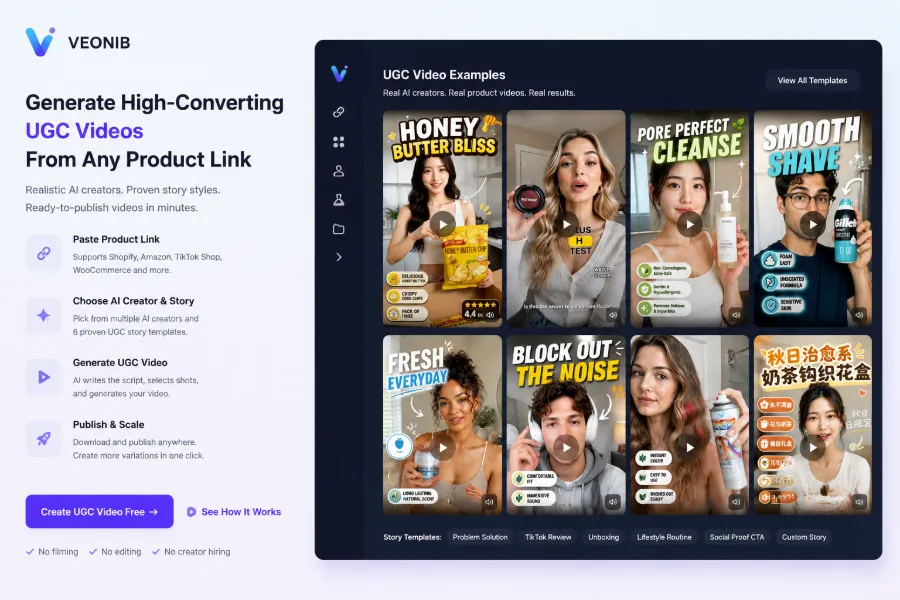
These tools share a common problem: they treat e‑commerce videos as ordinary videos, ignoring product information extraction, selling‑point distillation, and platform‑specific requirements. After receiving a generic video, sellers often still need to edit scripts, adjust dimensions, add subtitles—so the workload isn’t reduced much. This explains why many AI video generators still feel complex for e‑commerce, a sentiment echoed in seller communities.
The truly worth‑watching tools are those designed from the e‑commerce workflow perspective. Their core isn’t the generation quality but the degree of automation—how much manual intervention they eliminate.
From Product Link to Finished Video: How Automated Workflows Transform E‑Commerce Video Production
Traditional multi‑tool pipelines require at least five coordinated tools: script generator, editing software, voice‑over, subtitle, size‑adaptation—each step must be handled manually, with repeated exporting/importing and a high error rate. Automated workflows compress everything into one step: paste the product link, AI parses product data, generates script and storyboard, and outputs the final video.
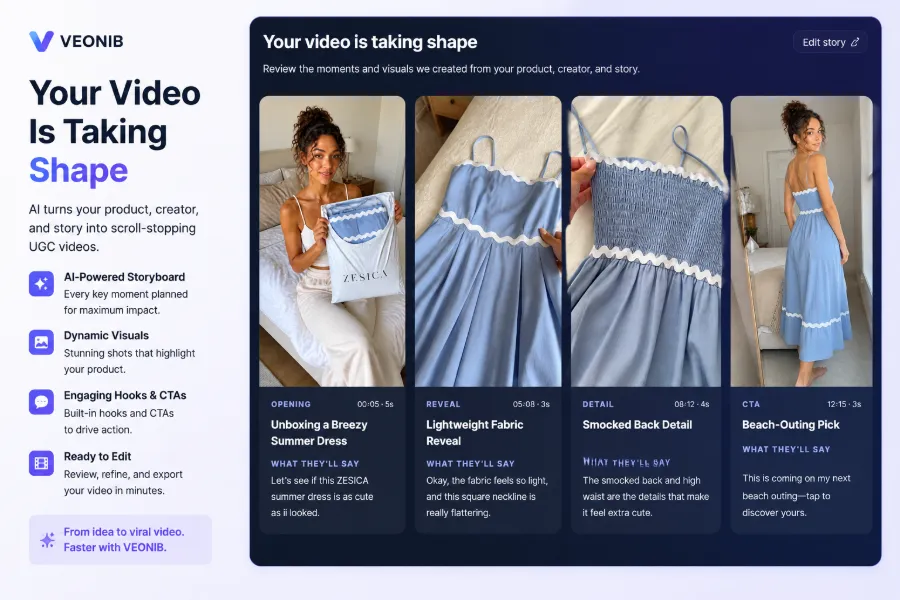
The technical principle is simple. AI reads the product page’s images, title, description, and selling points, automatically creates a marketing‑focused script and storyboard, then matches appropriate video styles and scenes. For example, with VEONIB, paste a Shopify or Amazon product link and AI completes product analysis, script writing, storyboard planning, and video generation—all within 60 seconds, outputting an MP4 ready for ad placement. This “product‑URL‑to‑video” workflow is becoming the new paradigm for e‑commerce video production, as described in “One Product URL Starts the AI Video Future.”
UGC‑style videos shine under this workflow. On TikTok and Reels, UGC videos often achieve better organic reach than polished brand ads, yet many sellers stick to “high‑end” aesthetics and miss this traffic boost. Automated tools enable bulk production of UGC videos, allowing sellers to quickly test different story templates and creator personas to find the best expression for their product. For concrete conversion data on Amazon, see “How AI Product Videos Boost Amazon Conversion Rates.”
How Small Sellers and Brand Teams Choose the Right Tool Based on Budget
Different scales have vastly different needs. Small sellers typically need 30–90 videos per month, with a budget of $10–$50. Brand teams or agencies may need hundreds of videos monthly, demanding greater style diversity and bulk generation capacity.
When selecting, first calculate your volume and budget, then match them to the tool’s tiered pricing. Most mainstream AI video tools offer subscription plans—Starter, Growth, Agency—with free trials. Small sellers can start with the entry tier; there’s no need to pay for advanced features they won’t use. VEONIB’s three tiers—Starter, Growth, Agency—correspond to different production stages, allowing you to choose as needed.

A common pitfall: in 2025 a seller heavily invested in a feature‑rich AI video tool, only to abandon it after a week because the workflow was too complex, reverting to outsourcing. Tool selection must match the team’s actual execution capability, not just a checklist of features. Even the most powerful tool is wasteful if the team can’t use it.
Tools are just the starting point; material strategy drives conversion. The same tool can generate stable ROI for some and nothing for others, depending on product selling‑point understanding and platform algorithm mastery. Small teams can leverage AI tools to compete with big brands on material volume, but only after solid product positioning and audience analysis—see “How Small E‑Commerce Stores Compete with Big Brands Using AI Videos.” If you only have static product images, you can also use dynamic animation overlays to turn them into video ads—see “Dynamic Animation Overlays Transform Static Product Images Into High‑Converting Video Ads.”
Frequently Asked Questions
How do AI‑generated e‑commerce videos perform on TikTok and Amazon?
Performance depends on material strategy, not the tool itself. UGC‑style videos usually outperform polished brand ads in organic reach on TikTok, while Amazon Listing videos have a clear positive impact on conversion rates. Start by bulk‑generating various styles with AI, test on a small budget, then scale up.
Can someone with no video‑editing experience quickly start using these AI tools?
Yes. Highly automated tools only require pasting a product link; AI handles script, storyboard, and generation with no editing experience needed. Generic tools often demand manual script and storyboard editing, raising the learning curve. Prioritize operational barrier when evaluating.
Can the assets generated by AI video tools be used directly for paid ad campaigns?
Most tools output MP4 files that can be uploaded straight to TikTok Ads, Meta Ads, etc. Just ensure you respect each platform’s size and length specifications; choose the appropriate preset during generation to avoid later adjustments.
How do I adapt video dimensions and lengths for different platforms?
TikTok and Reels favor 9:16 vertical format, 15–30 seconds long. Amazon Listing videos usually require 16:9 horizontal format, 30–60 seconds long. Mainstream AI tools support multi‑size output; simply select the platform preset when generating.
What is the typical monthly subscription cost for AI video tools?
Entry‑level plans cost $10–$20 per month for around 30 videos; mid‑tier plans are $20–$50 for roughly 90 videos; enterprise plans start above $50, supporting bulk generation and team collaboration. Most tools offer free trials—test first, then subscribe.
Share Article