Why a Docs Tool Is Suddenly Every Cross-Border Seller’s Problem
Let me be blunt: if you’re running a serious cross-border operation, your documentation is already a revenue leak, and you don’t even know it. I’m not talking about your product manuals or your supplier spec sheets. I’m talking about the documentation that powers your internal automations, your customer support knowledge base, your onboarding flows for new virtual assistants in Manila or Shenzhen, and the API references that your logistics and marketplace integrations depend on. Every time an agent — human or software — has to guess what a field means, or can’t find the right endpoint, or has to ask a colleague for the “real” version of a process, you’re burning margin. The launch of Blume this week, an open-source docs framework that positions itself as “AI-ready,” sounds like a developer tool for SaaS startups. But look closer, and it’s a warning shot for anyone whose business runs on fragmented, stale, and machine-unfriendly documentation. The cross-border seller who ignores this is the one who’ll be manually reconciling spreadsheets while competitors let AI agents run their returns and replenishment flows.
The Documentation Debt That Sinks Global Operations
Here’s the reality of our industry: most cross-border sellers treat documentation as an afterthought, a chore to be completed after the real work is done. Your Shopify store has a help center that’s a graveyard of outdated policies. Your Amazon Seller Central account has internal SOPs that live in a shared Google Doc with thirty versions. Your fulfillment partner in Poland has an API reference that was last updated when the EU VAT rules changed — twice ago. This is the documentation debt that compounds quietly until it becomes a crisis.
The problem isn’t that we lack tools. It’s that the tools we have were built for a world where documentation was read by humans, on screens, in a browser. That world is ending. The readers are increasingly not humans at all — they’re AI agents, automation scripts, and machine-learning models that need to parse your content, extract meaning, and execute actions. And they are ruthlessly unforgiving of ambiguity.
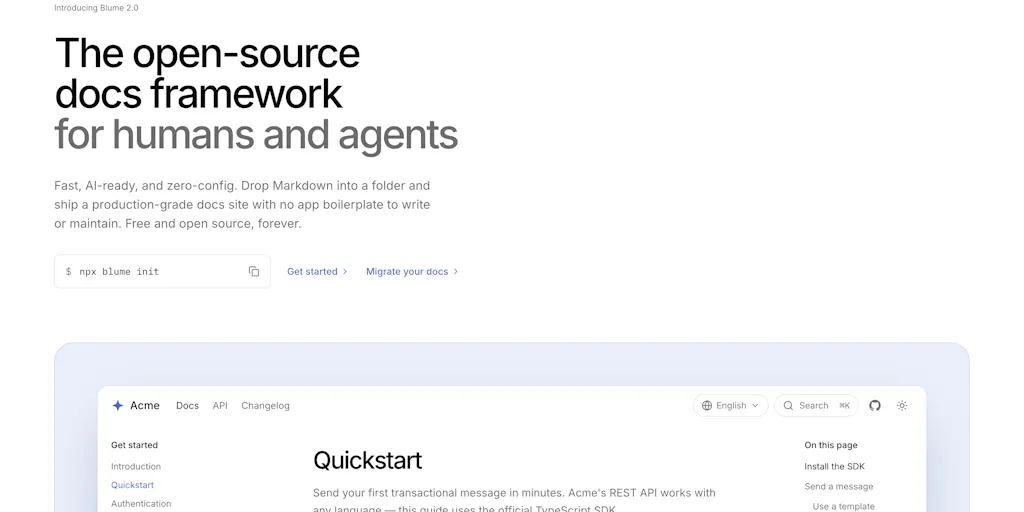
This is where Blume enters the picture. It’s a docs framework created by Hayden Bleasel, the maker behind Ultracite, and it’s positioned as an open-source alternative to Mintlify and Fumadocs. The pitch is “fast, AI-ready, and zero-config.” But the deeper story, buried in the Product Hunt comments, is the one that matters for us: the maker explicitly lists what “AI-ready” means — generating llms.txt, serving raw markdown via negotiation headers, exposing MCP servers, and structuring content for agent readability.
Let me translate that into cross-border terms. When your customer support agent in Cebu needs to know the return policy for a customer in Germany, they don’t want to click through five pages of a help center. They want an AI assistant that can pull the exact policy, in the right language, and cite the source. When your automated replenishment system needs to check whether a supplier’s API has changed its authentication flow, it needs a machine-readable spec that’s always current. The tools that make this possible aren’t nice-to-haves anymore — they’re the difference between an operation that scales and one that chokes on its own complexity.
Why Your Knowledge Base Is Already Obsolete
The uncomfortable truth is that most existing documentation platforms — the ones you’ve probably paid for or are considering — were designed for human eyeballs and keyword search. They generate beautiful, interactive docs that look great in a browser demo. But they’re fundamentally static. When an AI assistant tries to read them, it’s scraping HTML, dealing with JavaScript-rendered content, and trying to infer structure from visual layout. It’s like asking someone to read a book by photocopying the spine.
Blume’s approach is different. Instead of optimizing for human browsing first, it optimizes for machine readability from the ground up. The llms.txt file is a standard that tells AI crawlers where to find the important content. The raw markdown via content negotiation means an agent can request the source rather than the rendered HTML. MCP servers (Model Context Protocol) let AI models interact with the docs as a structured data source, not just a blob of text. This is the direction every serious operator should be thinking about, even if they never touch a line of code.
What Blume Actually Solves (and What It Doesn’t)
Let’s get specific about the problems this tool addresses, because there’s a real gap here that incumbents haven’t closed.
First, the staleness problem. One of the best exchanges in the Product Hunt comments is between a user named Gal Dayan and the maker. Dayan asks the sharp question: “The actual pain point for me has always been staleness — docs drifting from the real API surface over time. Does Blume do anything to flag that drift, or is it purely a generation/theming layer on top of whatever markdown you feed it?” Bleasel’s answer is honest: “As for staleness, we have a few things to help here e.g. translations but hoping we can work on bridging the gap between product and docs more going forward, perhaps with skills.” That’s an admission that the tool doesn’t solve the root cause — it’s still a layer on top of your markdown, not a system that verifies accuracy against your actual product or processes.
Second, the AI-readability problem. The maker’s response to Farrukh Ahmed about how “AI-ready” is achieved is worth quoting: “There’s a ton of different ways — llms.txt, *.md, agent readability, MCP servers.” This is genuinely useful. Most docs tools haven’t even started thinking about this. The AI configuration page they link to is a roadmap for anyone who wants to make their content consumable by agents.
But here’s where my judgment comes in: this is a framework for building documentation sites, not a solution for your existing mess. If you’re a cross-border seller, you don’t have a team of developers to migrate your help center, your internal SOPs, and your API references into a new framework. You need something that works with what you already have. Blume is a tool for teams that are starting fresh or are willing to invest in a rebuild. For the rest of us, it’s a signal of what’s coming, not a plug-and-play fix.
Where the Math Breaks
Let’s do the cost-benefit analysis that most sellers skip. Migrating your documentation to a new framework like Blume means either learning the system yourself or hiring a developer. The tool is open-source, so the licensing cost is zero — but the labor cost is real. You need to convert your existing content to markdown, set up the build pipeline, and maintain it. For a small team running a Shopify store with a few products, this is overkill. The ROI only makes sense if you have a substantial operation: multiple marketplaces, a private label with complex specs, or a logistics network with many touchpoints.
The other part of the math that doesn’t add up yet is the AI-readiness payoff. The user Farrukh Ahmed asks a great follow-up: “We put llms.txt on our site a while back, and it’s hard to gauge from out here whether assistants lean on it reliably or if uptake’s still patchy model to model. Have you spotted any real signal either way?” The maker doesn’t give a direct answer, which tells me the ecosystem is still immature. You can build the most AI-friendly docs in the world, but if the AI assistants your customers or your team use don’t reliably read them, the investment hasn’t paid off yet.
What Cross-Border Sellers Can Borrow Right Now
Even if you never adopt Blume, there are three principles from this launch you can apply to your operation this week.
Principle one: Stop writing for humans first. When you update your return policy, your shipping guide, or your product spec sheet, ask yourself: “If an AI agent had to answer a customer question using this document, could it?” That means using plain language, consistent headings, and avoiding jargon. It means structuring your content so the answer to a common question is in the first paragraph, not buried on page three.
Principle two: Expose your content as data, not just pages. The llms.txt concept is trivial to implement — it’s just a text file that points to your key content. You can add one to your site or your help center without any framework. Similarly, serving markdown versions of your key pages is something most platforms can do with a plugin or a small script. You don’t need to rebuild your docs; you just need to make them accessible in a format machines can parse.
Principle three: Treat documentation as a product, not a chore. The best operators I know treat their SOPs and help content as living assets that get updated when processes change, not as static files that get reviewed once a year. This is the cultural shift that matters more than any tool. Blume’s honest admission about staleness should be a wake-up call: no tool will fix your docs if your team doesn’t own the process.
Why Amazon Sellers Should Care More Than Shopify Ones
If you’re a Shopify-focused DTC operator, your docs problem is smaller. Your store is self-contained, your integrations are limited, and your team is likely small. You can get away with a mediocre help center and a few Google Docs.
Amazon sellers have a different problem. You’re operating inside a machine that is itself an AI — the A9 search algorithm, the buy box logic, the inventory forecasting. Your documentation is not just for your team; it’s for Amazon’s systems, for your prep centers, for your freight forwarders. If your listing content, your FBA inbound specs, or your product data feeds are inconsistent, you don’t get a gentle warning — you get suppressed listings, stranded inventory, and suspension risk. The stakes are higher, so the need for machine-readable, consistent documentation is more urgent.
Moreover, Amazon sellers are increasingly using AI tools for listing optimization, repricing, and customer service. These tools need to read your data and your policies. If your documentation is a mess, the AI tools you’re paying for will produce garbage outputs. Blume and tools like it are a reminder that the quality of your AI stack is only as good as the data you feed it.
Where My Judgment Says It Falls Short
I’ve been generous with Blume’s potential, so let me be equally clear about its limits.
First, it’s a developer tool with a markdown-first workflow. The cross-border seller who’s running their business from Seller Central and a spreadsheet is not the target user. The learning curve is real, and the maintenance burden is non-trivial. If you don’t have a developer on your team or on retainer, this is not for you — yet.
Second, the AI-readiness features are forward-looking but unproven. The maker’s answers in the comments are honest about the ecosystem’s immaturity. There’s no evidence yet that AI assistants reliably use llms.txt or MCP servers in a way that drives real business outcomes. You’d be investing in infrastructure for a future that may or may not arrive in the form you expect.
Third, the staleness problem is acknowledged but not solved. Blume is a theming and generation layer. It doesn’t check whether your docs match your actual API surface or your actual product specs. That’s a problem that lives one layer up, in your CI/CD pipeline and your content review processes. No framework can fix a broken process.
Finally, the competitive landscape is crowded. Mintlify and Fumadocs are established players with their own strengths. Blume’s open-source nature is a differentiator, but it also means you’re responsible for your own hosting, security, and maintenance. For a small team, that’s a hidden cost that the “zero-config” pitch glosses over.
What I’d Watch / Test Next
Here’s what I’d do this week, no matter what stack you’re running.
First, audit your critical documentation for AI readability. Take your top five customer-facing help articles and your top three internal SOPs. Copy the text into a plain text file and ask an AI assistant — ChatGPT, Claude, whatever you use — to answer a specific question using only that text. If it can’t find the answer quickly, your docs aren’t AI-ready.
Second, add an llms.txt file to your site or help center. It takes ten minutes and costs nothing. Point it at your key content pages. This is the cheapest insurance you can buy against being invisible to the next generation of AI search and assistants.
Third, test Blume on a non-critical project. If you have a developer, spin up a small docs site for one of your internal processes — your returns flow, your supplier onboarding, your listing optimization checklist. See if the AI-readiness features actually make a difference in how your team or your tools interact with the content. The source code is on GitHub, so there’s no cost to experiment.
Finally, watch the MCP and llms.txt ecosystem closely over the next six months. The adoption signal will come from the big platforms — Shopify, Amazon, Klaviyo, the logistics providers. If they start exposing MCP servers and structured content, you’ll know the future is here, and you’ll want to be ready. If they stay silent, you’ve lost nothing but a little time.
The launch of Blume is a small event in the grand scheme of cross-border commerce. But it’s a useful reminder that the next competitive advantage won’t come from a better product or a cheaper price. It’ll come from having an operation that machines can understand. Start making yours legible today.