The Real Lesson From a Recipe App: Why Cross-Border Sellers Should Study “Mise” Thinking Before Their Next Q4 Build
Most product launches I skim on Product Hunt are noise. But every so often a small utility ships with an operating logic that maps cleanly onto the messy, multi-warehouse, multi-channel reality that cross-border sellers live in every day. That is exactly what happened with Robot Recipes, a cooking utility that quietly accumulated a small but telling launch history — a base app in August 2023, a Recipe Generator in February 2024, and a Weekly Recipes digest on December 1st, 2025. The maker, Andrew Tye, framed the newest feature — “Mise” — around a problem that sounds nothing like e-commerce and yet sounds exactly like it: getting multiple parallel workstreams to finish at the same time, with one shared prep list and step-by-step timing. If you run a Shopify store, an Amazon Seller Central account, or a TikTok Shop catalog, you already own that problem in a dozen different forms.
I am going to treat this launch as a case study in operational sequencing — not because I think you should download a recipe app, but because the design decisions inside it are the same decisions you face when you decide how to orchestrate SKU launches, restock cycles, ad campaigns, and returns. There is a real, borrowable framework here. There is also a real ceiling, and I want to be honest about it.
What “Mise” Actually Solves — and Why It’s a Sourcing Problem in Disguise
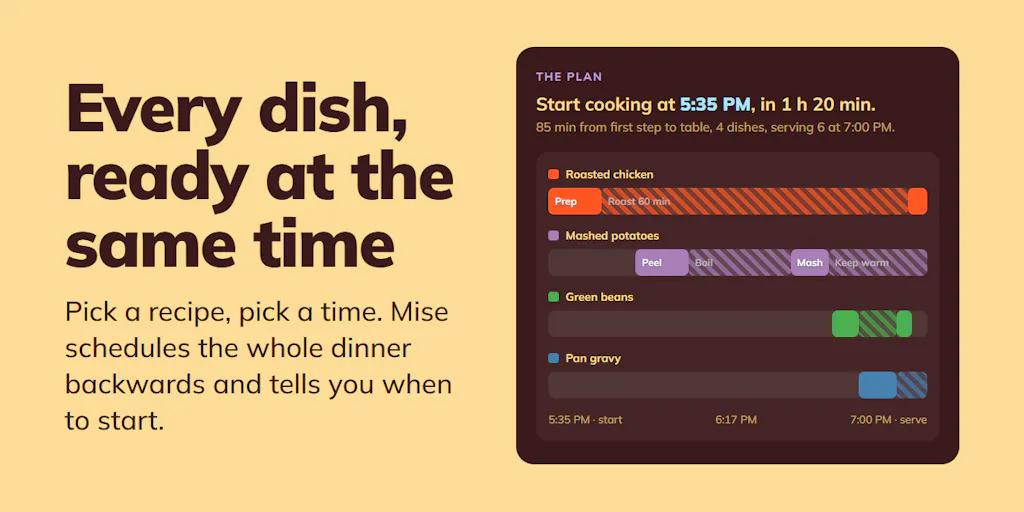
Andrew Tye’s own launch note is unusually candid about the pain: “one of the things that frustrates me about cooking is trying to get everything ready at the right time. Doing it with one dish is hard enough, but for meals with multiple dishes I’ve pretty much expected that things won’t be ready at the same time.” That is the entire thesis of Mise. You pick the dishes, set a meal time and serving count, and the product produces “a start time, a single shopping list, and step by step instructions with start times.”
Strip out the food and you have a launch orchestration engine. A cross-border seller running a five-SKU drop on Shopify with a parallel TikTok Shop push and a replenishment order into a 3PL is doing exactly this math — except most of us do it in a Google Sheet with hand-typed lead times and a prayer. The insight Mise encodes is that the hard part isn’t any single task. It is the dependency graph between tasks, and the fact that humans are terrible at backward-scheduling from a fixed deadline.
The other thing Mise gets right — and this is where the sourcing parallel gets sharp — is the shopping list consolidation. One list, derived from multiple recipes, deduplicated. If you have ever tried to reconcile a purchase order across three suppliers for a single bundle listing, you know how much margin leaks in that reconciliation. The maker also claims “thousands of recipes to choose from, or you can generate new ones on-demand,” and admits plainly that “it is not always 100% perfect, but I think you’ll find it better than guessing or use paper notes.” That sentence is the most honest thing on the page and the most useful for anyone evaluating AI tooling in their own stack.
Why Amazon sellers should care more than Shopify ones
A Shopify-only operator can often brute-force a launch with a good VA and a Notion board. An Amazon FBA seller cannot, because the constraint set is harder and less forgiving. You are working backward from a container ETA, a Helium 10 keyword window, a review-velocity target, and a PPC budget that has to be paced against inventory depth. If the listing goes live before the inventory is at the fulfillment center, you burn your launch window. If it goes live too late, you miss the ranking surge. That is a Mise problem with money attached. The same logic applies to restock timing: your reorder point, your supplier lead time, your freight forwarder’s schedule, and your ad spend ramp all have to converge on a date, and none of them naturally want to.
This is why I keep telling operators that the highest-leverage AI tools in 2026 will not be copy generators. They will be sequencers. Copy is cheap now. Coordination is still expensive.
How It Differs From the Incumbents — and Where the Comparison Gets Uncomfortable
The obvious comparison set is Paprika, Whisk, Mealime, and the recipe layer inside Samsung Food. Most of these are excellent at recipe storage, scaling, and grocery list export. Almost none of them do backward-scheduled multi-dish timing well, because it is genuinely hard and the payoff is invisible until the moment it works. The closest analog in the broader tooling world is not a recipe app at all — it is Notion templates or Airtable bases with dependency fields, which is what most sellers actually use today.
So the differentiator is narrow but real: Mise is a timing engine, not a content library. That is a meaningful product decision, and it is the one I would copy.
Where the math breaks
Here is the part the launch page does not resolve, and it matters for anyone thinking about building or buying a sequencer. The maker says the output is “not always 100% perfect.” In cooking, that is fine — you eat a slightly cold side dish. In cross-border e-commerce, a 10% sequencing error on a container arrival means either a stockout on a hero SKU or a storage fee bill that eats the launch margin. The tolerance for error is orders of magnitude tighter, which means any sequencer you adopt for your business has to be auditable. You need to see why it picked a date, not just trust the date.
Andrew Brodsky raised a related question in the reviews: are the recipes AI-generated or scraped, and if scraped, can users see the source and a star rating? That is the same provenance question every seller should be asking of any AI tool that touches their supply chain. If an AI tells you to reorder 400 units on March 3rd, you need to know whether that number came from your actual sales velocity or from a hallucinated average. The launch page does not answer the provenance question, and I am flagging that as a gap rather than pretending it is solved.
The filter gap nobody has closed
Julien Zmiro asked in the reviews whether you can filter recipes by ingredients — “Tomatoes + basil + red onion.” That is a faceted search problem, and it is the exact problem sellers face when they try to filter a supplier catalog by MOQ, lead time, certification, and landed cost simultaneously. Almost no sourcing tool does this well. Most give you keyword search and call it a day. If you are evaluating a sourcing platform this quarter, put “can I filter by four constraints at once, not one” on your scorecard. It will eliminate 80% of the market immediately.
What Cross-Border Sellers Can Actually Borrow From This
Three things, and I want to be specific rather than inspirational.
First: build a backward-scheduled launch calendar, not a forward checklist. Mise starts from the meal time and works backward. Most seller launch plans start from “when the product is ready” and work forward, which is why launches slip. Flip it. Pick your target listing-live date, then derive every upstream deadline — photography, packaging, freight booking, inspection, PO issuance — from that date. The moment you do this, you discover which dependencies are actually binding. Usually it is not the supplier. It is the inspection window or the freight cutoff.
Second: consolidate your shopping lists. If you are running three suppliers and two 3PLs, you almost certainly have three purchase order formats and two receiving workflows. The margin leak is in the reconciliation, not the unit cost. This is exactly the problem Klaviyo solved for email — one source of truth for a fragmented channel — and it is unfashionable but true that the same consolidation logic applies to procurement.
Third: accept imperfect sequencing and instrument it. The maker’s honesty about imperfection is the right posture. Do not wait for a perfect AI planner. Build a rough sequencer, run it, and log where it was wrong. After two quarters you will have a proprietary dataset of your own lead-time variance, which is worth more than any off-the-shelf tool.
A note on the multi-channel version of this problem
If you sell on Etsy, eBay, Temu, and SHEIN simultaneously, the sequencing problem compounds because each marketplace has its own listing latency, its own review-velocity curve, and its own penalty for stockouts. A Mise-style planner for multi-channel launches does not exist in a mature form. Whoever builds it will have a real business.
Where My Judgment Says This Falls Short
I want to be direct about the limits of the analogy, because I think over-extending it would be lazy.
Mise is a consumer cooking app with a small review base — 4.5 stars based on 2 reviews, per the launch page — and a launch cadence that spans 2023 to 2025. It is not an enterprise orchestration platform, and it does not pretend to be. The “thousands of recipes” claim is unverified in the source, the AI-versus-scraped provenance question is unresolved, and the print view that Brodsky requested is a nice-to-have that speaks to a consumer use case, not a B2B one.
The deeper limitation is that cooking has soft deadlines and e-commerce has hard ones. A recipe app can tolerate a five-minute drift. A cross-border seller cannot tolerate a five-day drift on a container. So the borrowable part is the mental model — backward scheduling, consolidated lists, honest imperfection — not the product itself. Anyone who reads this launch and thinks “I should install a recipe app to run my Amazon business” has missed the point. Anyone who reads it and thinks “I should rebuild my launch calendar as a dependency graph” has got it exactly right.
The uncomfortable question for tool builders
If you are building in this space, here is the test: can your sequencer explain itself? Not just output a date, but show the chain of assumptions behind it. Because in cross-border, the operator is the one who eats the storage fee when the model is wrong. Tools that cannot be audited will not survive contact with a real P&L.
What I’d Watch / Test Next
This week, before you buy anything, do three things. First, pull your last three product launches and reconstruct them as backward-scheduled timelines — target live date at the top, every upstream dependency below it. You will find at least one binding constraint you have been ignoring. Second, take your current open purchase orders across all suppliers and force them into a single consolidated list with a shared format. The reconciliation pain you feel doing this manually is the exact pain a sequencer should remove. Third, pick one AI tool already in your stack and ask it the provenance question: where did this number come from? If it cannot answer, demote it.
Then watch Robot Recipes and its Weekly Recipes cadence as a cheap proxy for how consumer-grade sequencing tools evolve. The moment one of them ships an auditable dependency graph, the cross-border version is six months behind it. I would rather be early to that than late.


