The Voice Router Is the New Logistics Layer: Why Cross-Border Sellers Should Care About Speko
Every cross-border operator I know has a dirty secret buried in their tech stack: a spreadsheet that decides which tools get used. Not a strategy document, not a quarterly review — a literal Google Sheet, or a Notion page, or a Slack thread where someone pasted a list of vendors and wrote “don’t touch this one, it broke last quarter.” We do this for payment gateways, for logistics providers, for email service providers. We benchmark, we swap, we pray. And then a new model, a new provider, a new “AI-powered” widget launches, and the whole calculus shifts again. For most of us, the cost of testing is so high that we just run outdated tools and pretend we’re current. That’s not a tech problem. That’s an operational problem. And it’s the exact problem Speko is trying to solve for voice AI — a corner of the stack that’s about to become as important to cross-border commerce as shipping labels.
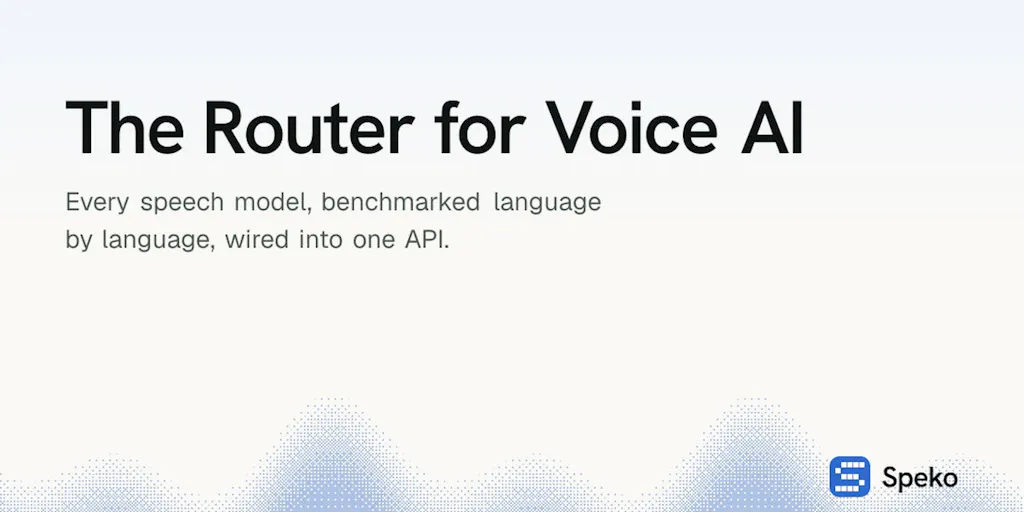
Here’s the thesis: if you sell across borders, you already know that customer support, product discovery, and even checkout are becoming voice-first in key markets. The question isn’t whether you’ll need voice AI. It’s whether you’ll have a system for choosing the right voice AI when the landscape changes weekly. Speko is a router for voice models — speech-to-text, LLM, and text-to-speech — that picks the best provider for your specific use case and language, based on public benchmarks rather than vendor marketing. For a cross-border seller, that’s not a nice-to-have. That’s the difference between a support bot that handles a German returns request gracefully and one that sends a customer to a dead end because the speech recognition model was trained on American English and nothing else.
The Problem Speko Actually Solves: The Benchmarking Tax
Let me be blunt about what most cross-border sellers are doing with voice AI right now: nothing, or worse, paying for a single vendor and hoping for the best. If you’re running a Shopify store with a customer service chatbot, you’re probably using whatever the app store recommended — maybe Zendesk, maybe Intercom, maybe a custom integration with OpenAI’s API. And it works, sort of, for English. But the moment a customer in France speaks into their phone, or a buyer in Japan types a question in Japanese and expects a voice response, the whole thing falls apart. The models that work for English don’t work for Danish. The ones that handle Spanish well might butcher Portuguese. And the vendor you chose six months ago might have been overtaken by a new model that’s 20% better on your exact use case — but you’ll never know, because testing it would require a full R&D cycle.
That’s the “benchmarking tax.” It’s the hidden cost of running any AI-dependent operation in a market where the underlying models change weekly. Bek Abdik, the founder of Speko, lived this pain firsthand. Before launching Speko, he was CTO at a startup building voice AI apps, and he described the process in the Product Hunt launch: his team had to support 10+ languages, and their “testing” process was a Google Sheet with 15 audio links sent to native speakers to score. If a new model was good, they’d swap. But every week, something new came out — even in English — and the cost of testing was so high that most teams just ran outdated models. Swapping always looked like an R&D project, so nobody did it.
Cross-border sellers should recognize this pattern immediately. It’s the same reason you don’t switch freight forwarders every time a new one launches, even when the new one is cheaper. The switching cost — the testing, the integration, the risk of downtime — outweighs the benefit. So you stay with the incumbent. And the incumbent, knowing you’re locked in, has no incentive to improve. That’s the trap. Speko’s answer is to make the swap itself the product. You don’t choose a model. You choose a use case and a language, and Speko routes you to the best provider at that moment, measured on public benchmarks rather than vendor marketing. The company doesn’t train or sell models itself, which is precisely how it keeps the rankings impartial. That’s a meaningful distinction in a market where every vendor claims to be the best.
Why Amazon sellers should care more than Shopify ones
Here’s a hot take: Amazon sellers should be paying more attention to this than Shopify operators. Not because Shopify stores don’t need voice AI — they do — but because Amazon’s ecosystem is already voice-heavy in ways you might not realize. Amazon Alexa is a voice interface, and Amazon has been pushing voice shopping for years. If you’re an FBA seller, your customers are already asking Alexa to reorder products. The question is whether your product listings, your customer service responses, and your post-purchase communications are optimized for voice search and voice interaction. A router like Speko doesn’t directly solve that — it’s not a listing optimization tool — but it does solve the underlying problem: how do you choose the right voice tech when Amazon’s own tools are just one option among many?
The Shopify angle is different. Shopify is a platform that encourages third-party apps, and the app ecosystem is already crowded with AI customer service tools. But most of those tools are single-vendor. You pick one, you integrate it, you’re stuck. Speko’s approach — routing to the best provider based on use case and language — is a fundamentally different architecture. It’s not a tool you install. It’s a layer you build on top of. For a Shopify store selling to five European markets, that’s potentially huge. But the immediate pain is more acute on Amazon, where voice is already part of the customer journey and the cost of a bad voice interaction is a lost sale or a negative review.
How Speko Differs From the Incumbents: Not an OpenRouter Clone
The obvious comparison is OpenRouter, which does for LLMs what Speko is trying to do for voice. But that comparison misses something important. An LLM request is a batch operation — you send a prompt, you get a response. A voice agent is a live duplex session. Audio flows in, audio flows out, and the model has to handle real-time conversation. That’s a different technical challenge, and it’s why Speko positions itself as its own product rather than just another API aggregator.
The founder’s framing on Hacker News — which he referenced in the Product Hunt launch — is useful here. A “router” hides three questions: what gets picked (a model, a provider, or the whole stack), where it lives (an external hop or inside your session), and when it decides (session start or mid-call). Speko’s answer is that routing is decided before the session starts, and then audio flows directly to the provider — no extra hop in the audio path. That’s a meaningful technical choice. It means lower latency, which matters for voice, and it means Speko isn’t a middleman in the audio stream. It’s a decision-maker at the front end.
Compare that to the alternatives. If you’re building a voice agent today, you’re probably choosing between Google Cloud Speech-to-Text, Amazon Transcribe, AssemblyAI, or Deepgram. Each has strengths. Google is strong on language coverage, Amazon is strong on integration with AWS services, AssemblyAI and Deepgram are strong on accuracy and speed. But choosing one means committing to its weaknesses too. Speko’s pitch is that you don’t have to choose. You define your use case and language, and Speko routes you to the best option at that moment.
There’s also a question of whether this approach actually works in practice. One commenter on the Product Hunt page, Natalia Iankovych, asked about the advantages compared to Google’s open-source libraries and alternatives, and specifically about less commonly supported languages like Swedish or Danish. That’s a fair challenge. The whole value proposition depends on Speko’s benchmarks being comprehensive enough to cover the long tail of languages that cross-border sellers actually need. If Speko’s benchmarks only cover English, Spanish, and German, then it’s not solving the problem for a seller targeting the Nordics. The founder didn’t answer that specific question in the launch thread, so it’s an open question. But the fact that the question was asked — and that the founder’s response was to point to the public benchmarks — suggests the team is aware of the gap.
Where the math breaks
Here’s where my skepticism kicks in. Speko’s model is essentially a benchmarking service plus a routing layer. The benchmarking part is valuable — public, impartial benchmarks are genuinely useful in a market where every vendor claims to be the best. But the routing part is only as good as the benchmarks, and the benchmarks are only as good as the test set. If you’re testing on a fixed set of audio clips, you’re measuring performance on those clips, not on the real-world diversity of your customers’ accents, background noise, and speaking styles. That’s a fundamental limitation of any benchmarking approach, and it’s not clear how Speko addresses it.
The other issue is pricing. The Product Hunt launch doesn’t disclose pricing, and the founder’s comments don’t mention it either. That’s not necessarily a red flag — many products launch without public pricing — but it does make it harder to evaluate the value proposition. Is Speko charging per session? Per minute of audio? A flat subscription? The answer matters for cross-border sellers, who are already sensitive to per-unit costs. If Speko’s routing fee eats into the margin on a low-priced product, it’s not worth it. If it’s a flat monthly fee that replaces the cost of testing multiple vendors, it could be a no-brainer. Without pricing, I can’t make that call.
There’s also the question of what happens when Speko makes a mistake. If it routes a customer’s voice query to a model that fails, who’s responsible? The model provider? Speko? The seller? In a cross-border context, where you’re already dealing with different consumer protection laws and data privacy regulations, that’s not a trivial question. The launch page doesn’t address it, and the founder’s comments don’t either. I’d want to see a clear SLA and a clear liability framework before I’d route my customer interactions through a third-party decision-maker.
What Cross-Border Sellers Can Borrow From Speko (Even If You Never Use It)
Here’s the part of this essay that’s not really about Speko at all. The deeper lesson — and the reason I’m writing about a voice AI router for an audience of cross-border sellers — is the mindset behind it. Speko is built on a simple insight: the cost of switching is the real tax, and the way to eliminate it is to make switching itself a product. That’s a lesson that applies far beyond voice AI.
Think about your own stack. How many tools are you running because you chose them once and never revisited the choice? Your Klaviyo account for email marketing. Your Helium 10 subscription for Amazon keyword research. Your ShipStation integration for fulfillment. Each of these was probably the right choice when you made it. But the market changes. New tools launch. Pricing shifts. Competitors emerge. And you stay with the incumbent because switching is an R&D project — just like swapping a voice model was for Bek Abdik’s team.
The Speko approach suggests a better way: build a system for evaluating your tools on a regular cadence, with public or at least objective benchmarks, and make the switch when the data says so. That doesn’t mean switching every week — that’s chaos. It means having a process for testing, a framework for comparison, and the willingness to move when the evidence is clear. For cross-border sellers, that’s especially important because the stakes are higher. A tool that works for US domestic sales might not work for EU sales, where data privacy regulations are stricter and payment methods are different. A tool that’s fine for English-speaking customers might fail for Japanese-speaking ones.
There’s also a specific lesson here for anyone building a voice AI customer service operation. Whether you use Speko or not, the principle is sound: don’t lock yourself into a single vendor for a fast-moving technology. Build your architecture so that you can swap the underlying model without rebuilding the whole system. That’s an architectural choice, not a vendor choice. And it’s one that will pay off repeatedly as the voice AI landscape continues to evolve.
The tooling takeaway: run your own benchmarks
If you’re not ready to commit to a router like Speko — and given the open questions about pricing and language coverage, I understand the hesitation — you can still borrow the core idea. Start running your own benchmarks. Pick a set of test scenarios that reflect your actual customer interactions. Record them. Test them against the top two or three providers in your space. Score them. Keep the results in a spreadsheet. Re-run the benchmark every quarter. That’s not an R&D project. That’s an operational discipline. And it’s the thing that will save you from running outdated tools because the cost of testing feels too high.
For cross-border sellers, the test scenarios should include multiple languages and dialects. If you sell to Germany, test German. If you sell to Brazil, test Brazilian Portuguese. If you sell to Japan, test Japanese. The models that win on English might lose on Japanese, and the models that win on Japanese might lose on German. That’s the whole point of Speko’s approach, and it’s a point you can adopt without using Speko at all.
Where Speko Falls Short: My Honest Judgment
Let me be clear about my reservations. First, the language coverage question is real. The Product Hunt comments include a specific question about Swedish and Danish, and the founder didn’t answer it directly. For a cross-border seller targeting the Nordics, that’s a dealbreaker if the answer is “not covered.” The value proposition of a router is that it handles the long tail of languages, but if the benchmarks don’t cover the long tail, the router is just a fancy way to choose between English and Spanish.
Second, the lack of pricing transparency is a problem for a cross-border audience. We’re used to per-unit economics. We know what a Klaviyo email costs, what a ShipStation label costs, what an Amazon referral fee costs. A voice AI router that doesn’t disclose pricing is asking us to make a leap of faith, and cross-border sellers are not a leap-of-faith audience. We’ve been burned too many times by tools that were cheap to start and expensive to scale.
Third, and this is the big one, the company’s positioning is both its strength and its weakness. Speko doesn’t train or sell models, which keeps its benchmarks impartial. But it also means Speko has no control over the models it routes to. If a provider changes its API, or degrades its quality, or goes out of business, Speko has to react. That’s a risk, and it’s a risk that’s inherent to the router model. The founders are aware of this — the Hacker News discussion sharpened their explanation of what the router does — but awareness doesn’t eliminate the risk.
Finally, there’s a question of whether the market is ready. Voice AI for customer service is still early. Most cross-border sellers are not running voice agents yet, and many are still struggling with basic text-based chatbots. The sellers who are ready for a voice router are early adopters, and early adopters are a small market. Speko might be too early, or it might be perfectly timed. The fact that the founder left a Series A startup to build this suggests he believes the timing is right. I’m not convinced, but I’m also not the one betting my career on it.
What I’d Watch / Test Next
If you’re a cross-border seller and this essay has piqued your interest, here’s what I’d do this week. First, don’t sign up for Speko yet. Instead, spend an hour identifying the voice AI touchpoints in your customer journey. Do you have a support bot? Does your product listing include voice search optimization? Are you using any speech-to-text tools for internal processes like transcribing customer calls? Write those down.
Second, pick one use case — ideally a customer support interaction in your second-largest market — and run a quick benchmark. Record a few sample interactions in that language. Test them against Google Cloud Speech-to-Text, Amazon Transcribe, and AssemblyAI. Score the results. You’ll learn more from that hour than from any vendor demo.
Third, watch Speko’s benchmarks. If they expand to cover the languages you need, and if they publish pricing that makes sense for your margin structure, test the router. The proxy-less architecture — routing decided before the session starts, with audio flowing directly to the provider — is technically sound, and the impartiality of the benchmarks is a genuine differentiator. But wait for the data.
Fourth, and this is the meta-lesson, apply the Speko mindset to your entire tool stack. Pick one tool you’ve been running for over a year. Re-evaluate it. Run a benchmark against the top alternative. If the alternative wins, switch. If not, stay. The point isn’t to switch for the sake of switching. The point is to build the muscle of regular re-evaluation. That’s the discipline that separates operators who run current stacks from operators who run outdated ones. And in cross-border commerce, where the landscape changes weekly, that discipline is the difference between thriving and surviving.