AI Air Fryer Video Generator: How E‑commerce Sellers Use AI to Turn Product Links into Ads
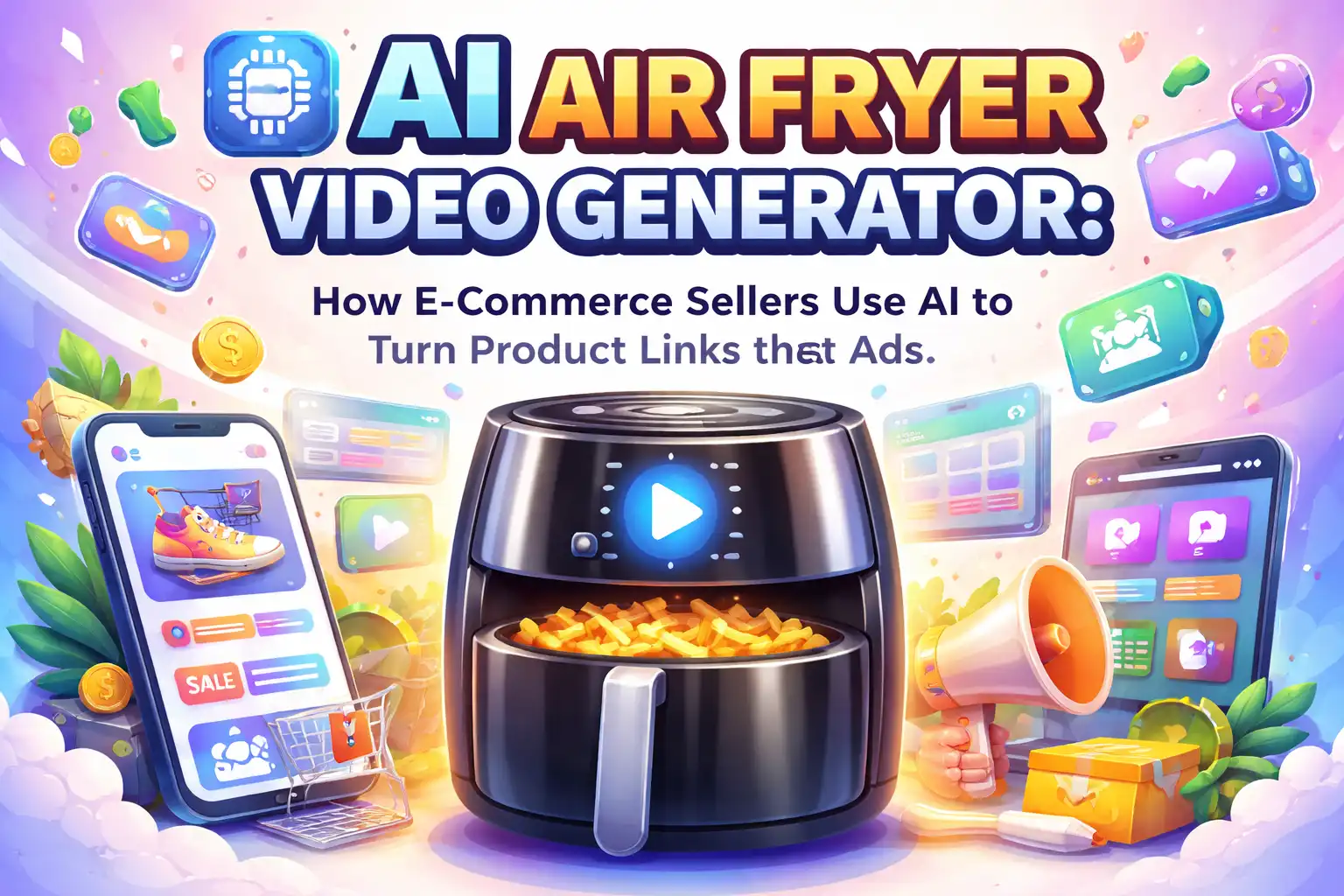
Open your cross‑border e‑commerce dashboard and stare at that air‑fryer product link—you know that “just posting the link” is far from enough; TikTok Shop and Instagram Reels need brand videos, not static pages. Manually creating a 15‑second video ad—from scriptwriting to storyboard, from recording voice‑over to adding subtitles, then editing, rendering, and exporting—takes at least an afternoon. Yet the product’s golden promotion window may be only a few days. With the AI Air Fryer Video Generator, paste the URL into the input box and you’ll have a ready‑to‑run ad video in 60 seconds. This isn’t a concept demo; it’s a workflow that cross‑border e‑commerce sellers are already using.
How the AI Video Generator Solves Sellers’ Video‑Production Bottlenecks
Traditional video‑ad production is a real barrier for small and medium sellers. Suppose you list an air‑fryer and need a 15‑second TikTok ad: first you brainstorm the script framework, then design each storyboard frame, hire a voice actor for the narration, have an editor sync footage and audio, and finally render and export. Completing this whole pipeline conservatively takes 3–6 hours. Outsourcing a single video easily costs over ¥500. Even worse, traffic peaks in the first few days after a product goes live; by the time your video is ready, competitors have already finished a round of ad testing.
The AI video generator works completely differently. Take VEONIB as an example: sellers simply paste the air‑fryer product link into the input box. The system automatically parses the product page’s title, description, and main image, then generates an opening hook, a full script, frame‑by‑frame storyboards, and scene stills. The entire creative‑generation process finishes in 60–90 seconds, without any designer involvement or prompt writing. The underlying training data isn’t a generic large model; it’s built from real e‑commerce ad spend data, so the hooks and scripts are naturally conversion‑oriented.
(YouTube: https://runwayml.com)
The value of this workflow for sellers’ daily operations lies in reducing creative costs, speeding up testing, and eliminating reliance on designers. You can generate multiple versions of hooks and scripts for the same product, run A/B tests, and see which opening boosts click‑through rates. Supported e‑commerce platforms include Shopify, Amazon, TikTok Shop, WooCommerce, Temu, AliExpress, Etsy, eBay, and other major channels. Output formats are compatible with 9:16, 1:1, and 16:9 aspect ratios, corresponding to Instagram Reels, YouTube Shorts, and Facebook feed. Sellers can first generate a free video preview to see if the AI‑generated creative fits their product, then decide whether to export the final video.
Video Strategy for Air‑Fryer‑Type Products: Scenario‑Based and Pain‑Point‑Focused
Air‑fryer video ads have very distinct characteristics: heavy on scenario demonstration, emphasizing healthy low‑oil cooking, and comparing with traditional deep‑frying results. Buyers want to see the food’s color change inside the basket, the crispness at the moment it’s lifted, and the imagined sound of a bite, not just the product’s appearance. According to HubSpot’s marketing blog, “process‑showcase” content in short videos has a completion rate over 40 % higher than static product displays—especially relevant for air fryers.
The hook generator inside the AI video generator can craft opening copy for these products. For an air‑fryer, the system might produce “This $30 gadget changed my entire breakfast routine” or “Still frying chicken nuggets in a traditional oil pan?” Such hooks use contrast and intrigue to grab attention in the first two seconds. The storyboard builder automatically plans the frame‑by‑frame sequence from placing ingredients in the basket to the finished dish, and outputs scene stills so sellers can preview each shot’s composition.
Choosing script length directly affects platform fit. TikTok and Instagram Reels 15‑second versions suit fast‑paced hooks + result displays; YouTube Shorts 30‑second versions can add more steps; 60‑second versions are ideal for detailed comparisons. AI supports voice‑overs in 30 languages and automatic subtitles, a highly practical value for global sellers: the visual part (cooking process, ingredient changes) is universally understood, while only the voice‑over and subtitles need localization. VEONIB fills this gap perfectly. Once a video is generated, switching languages lets you cover multiple markets without re‑creating visual content.
From URL to Ad Video: The Three‑Step Workflow in Practice

Step 1: Paste the product URL. Sellers copy the product link from Shopify, Amazon, TikTok Shop, etc., and paste it into the AI video generator’s input box. No image upload or form filling required—just the link.
Step 2: AI generates a preview. The system parses product information—title, description, price, main image—and then outputs a full set of creative assets: 3–5 opening hooks, a complete script, frame‑by‑frame storyboards, and scene stills for each frame. Sellers can review all assets at this stage; if unsatisfied, they can regenerate unlimited times. This free preview mechanism lowers the trial barrier to zero—no credit card, no upfront fees.
Step 3: Adjust and export. Sellers can manually edit hook text and script content, choose voice‑over language and tone, and tweak subtitle style. After confirming, they click Render, and the system synthesizes the final video. Most videos finish rendering within 60–90 seconds, never longer than 3 minutes. Users can close the page and do other tasks, then return to download once rendering is complete. Output formats support 9:16 (TikTok, Reels), 1:1 (Facebook), and 16:9 (YouTube). Each exported video belongs to the user and can be used for any paid ad or organic channel without royalty restrictions.
There is an honest limitation to acknowledge: AI‑generated videos lack the tactile realism of actual product footage. The non‑stick coating texture of an air‑fryer, the crisp details on food surfaces, the sheen of rising steam—all depend on real‑world filming and are hard for AI to fully reproduce. Recommended workflow: first use AI to quickly generate a structurally complete preview video to test market response; if the data looks good, supplement with a few real‑life shots to replace key texture moments. This retains AI’s speed advantage while preserving authenticity at conversion‑critical points.
FAQ
Does the AI video generator require payment? What can the free preview do?
The free preview costs nothing and does not require a credit card. Sellers can submit product links at any time, and the system generates full hooks, scripts, storyboards, and scene stills, all viewable. Payment is only required when exporting the final video.
Can I edit the AI‑generated script and voice‑over myself?
Yes. Before exporting, sellers can edit any hook line, scene description, or voice‑over narration. The system will automatically re‑render the matching version, no manual syncing needed.
Who owns the copyright of the exported video? Can it be used for TikTok and Facebook ads?
The video copyright belongs to the user. Each exported video can be used on any commercial channel—including TikTok, Facebook, Instagram, YouTube, etc.—for paid ads or organic content without additional royalties.
Are product links from all e‑commerce platforms supported?
Most major platforms are supported, including Shopify, Amazon, TikTok Shop, WooCommerce, Temu, AliExpress, Etsy, eBay. As long as the product page structure can be parsed, a video can be generated. A few custom‑built independent sites may require manual information supplementation.
How long does video rendering usually take?
Most 60‑90‑second videos finish rendering within 60 seconds; 4K or longer (over 60 seconds) versions may take up to 3 minutes. Rendering runs in the background, allowing users to close the page and continue other work.
Share Article