Sora and Runway generate visuals, not shoppable videos: the gap lies in the script, subtitles, and voice‑over pipeline

Marketers turn product selling points into a prompt, feed it to Sora or Runway, and in minutes receive a stunning visual clip. They upload it to the ad platform, check the data after a couple of days, and the completion rate and conversion fall short of expectations. I’ve seen this scenario more than once, and the conclusion is always the same: the tool provides visuals, not a finished video that can drive sales.
Sora, Runway and similar text‑to‑video tools produce raw footage, not marketing‑ready videos. The conversion of a shoppable video depends on three elements: a hook script, selling‑point subtitles, and voice‑over narration—precisely the parts that visual tools do not handle. By returning the visual tool to the material‑generation stage and adding script, subtitles, and voice‑over, the video becomes valuable for advertising.
The visual gap is not within the scope of comparison. First, position these tools as material‑generation stages, then see how the pipeline can be completed.
Why Sora and Runway can produce visuals but cannot drive sales
OpenAI’s Sora was first publicly demoed in February 2024, after which text‑to‑video tools exploded, yet e‑commerce ad teams have not seen a “copy‑and‑paste‑to‑run” workflow. They output raw footage, not marketing videos. The conversion structure of a shoppable video is built from three components: a hook script that decides whether viewers stay in the first few seconds, selling‑point subtitles that let muted, scrolling users understand the message, and voice‑over that conveys emotion and trust. The visual tools cover none of these three aspects.
“Visually appealing” and “sales‑driving” are two separate evaluation criteria. Visuals address visual attraction; information structure addresses conversion. No matter how high the image quality, it cannot replace the latter. Directly uploading Sora or Runway‑generated material to TikTok or Reels yields suboptimal performance; the issue is not image quality but missing conversion layers. Before scaling the material, ensure the conversion layer is completed. For a breakdown, see the Automated Video Ads Scaling Guide.
| Pipeline stage | Output of generic visual tool | Essential for shoppable video |
|---|---|---|
| Script structure | Missing | Must have |
| Subtitles | Missing | Must have |
| Voiceover | Missing | Must have |
| Selling‑point conveyance | Depends on prompt description | Structured presentation |
| Platform adaptation and batch production | One‑by‑one generation | Pre‑set per spec, batch by link |
Shoppable video pipeline: script first, subtitles and voice‑over later
The shoppable video pipeline follows a largely fixed order: script first, then subtitles and voice‑over.
The script addresses retention. The first three seconds determine whether the user scrolls away; the hook must be delivered within this window, using contrast or price anchors works. The ordering of selling points matters; users have limited patience, so the most important two or three points should be placed early, with a final call‑to‑action at the end. Without a script, subtitles and voice‑over cannot be discussed.
Subtitles address comprehension in muted scenarios. Vertical‑format copy must stay within the safe area, leaving margins on both sides for UI occlusion; keywords are prefixed and highlighted so users can instantly see what is being sold. On TikTok, Reels, Shorts, many users watch without sound, so missing subtitles mean a break in information delivery.
Voice‑over handles emotion and trust. The pacing, pauses, and emphasis of narration determine whether a UGC‑style voice‑over feels like a real recommendation. An often‑overlooked point: for global markets, subtitles and voice‑over are the levers that allow reuse of the same footage—swap subtitles and voice‑over, and the same set of shots can serve another language market. Therefore, the priority of script, subtitles, and voice‑over should come before visual generation.
In terms of duration, the 15‑, 20‑, and 30‑second formats correspond to different advertising goals: 15 seconds for reach, 20 seconds for the mainstream feed slot, and 30 seconds for fuller selling‑point coverage. Tool requirements for each stage can be consulted in the AI Video Tool Selection Comparison for E‑commerce Scenarios.
Text‑to‑video and shoppable video tools are two separate functions
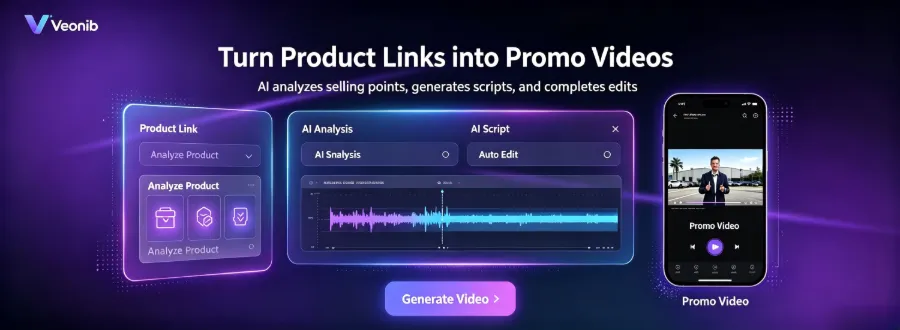
Separate the tools by function: Sora and Runway handle raw footage, while script, subtitles, and voice‑over require a separate process to fill in. They are not substitutes but different stations on the production line.
The order of the workflow directly determines rework costs. In a real case, a team generated polished footage with Sora and Runway, skipped script and subtitles, and launched the ad. After 48–72 hours, completion and conversion fell short, so they withdrew the material to add script, subtitles, and voice‑over. The rework cost was higher than if they had followed the full pipeline from the start. The more dazzling the visuals, the easier it is to mask missing conversion structure—viewers mistakenly think it’s ready to run. If the script comes after the visuals, it’s hard to backtrack.
In contrast to “visuals first, then structure”, another workflow starts from the product link: AI parses product information, generates script and storyboard, then produces the visuals, with script, subtitles, and voice‑over compressed into a single pipeline. VEONIB is one implementation of this workflow. The difference lies not in visual quality but in whether the conversion structure is defined before generation. A launchable shoppable video typically runs 15–30 seconds, and a single footage segment produced by a visual tool is often just one of the shots.
The order difference is especially evident in fast‑moving consumer goods; the beverage product link to product‑page video example serves as a reference.
Public feedback from e‑commerce teams on this workflow can be found in G2 user reviews, where discussions focus on script quality and multi‑platform adaptation.
Four steps for e‑commerce teams to implement this pipeline
E‑commerce teams typically follow four steps to implement this pipeline.
Determine the advertising platform and duration specification. TikTok, Reels, and Shorts have different aspect ratios and pacing; first choose the platform, then decide on 15, 20, or 30 seconds to avoid repeated trimming later.
Write the script and subtitle draft first. Place the hook in the first three seconds, order selling points by importance, and mark keywords and price positions in the subtitle draft. Once this is done, the information structure is fixed.
Produce voice‑over and subtitle tracks in parallel. Record the narration first, then align the subtitle track to the voice‑over timeline; for multiple languages, swap the voice‑over and replace the subtitle track synchronously, yielding a multilingual master in one go.
Generate or acquire visual material, then assemble and export. Teams without editing skills can combine the previous steps—using a link‑to‑video tool like VEONIB, paste the product link, and generate script, storyboard, subtitles, and voice‑over in one go, then export an MP4.
Link‑to‑video workflows produce a video in about 60 seconds on average, whereas traditional editing takes hours. The same applies to B2B hardware categories; see the complete record in the B2B hardware one‑click video generation case study.
After the final video is generated, remember to archive it. The SEONIB one‑click authorization sync process can chain authorization and retrieval, exporting the appropriate specifications for Shopify, Amazon, and TikTok Shop as required.
Archive multilingual and ad versions according to naming conventions; reviewing them after three months can save a lot of rework time. Once the pipeline runs smoothly, the role of the visual tool becomes simple: it only provides material, while the remaining steps are handled by the script, subtitles, and voice‑over line.
FAQ
Q1: Can video material generated by Sora be used directly for e‑commerce ads?
It is not recommended to launch it directly. Sora produces raw footage and lacks the three conversion layers—script, subtitles, and voice‑over—so direct launch results in low completion rates and poor conversion. Complete these three layers before uploading to the ad platform.
Q2: Why do AI‑generated visuals look stunning, yet the ad performance is average?
Because the evaluation criteria differ. Visual quality addresses visual appeal, while ad performance depends on the information structure: hook in the first three seconds, selling‑point subtitles, and voice‑over pacing. The more dazzling the visuals, the easier it is to overlook whether the conversion layer is in place.
Q3: Without editing skills, can I turn a product link directly into a shoppable video?
Yes. Paste the product link into a link‑to‑video tool; it will parse the product information and generate script, storyboard, subtitles, and voice‑over, outputting an MP4 without ever touching editing software. The video is usually produced in under 60 seconds.
Q4: What components does a qualified TikTok shoppable video usually contain?
A script hook, selling‑point subtitles, voice‑over narration, vertical‑format visuals, and an ending call‑to‑action—none can be omitted. Duration is 15–30 seconds; the first three seconds retain the user, and subtitles convey information in muted scenarios.
Q5: How should Runway and Sora be positioned in e‑commerce video production?
Treat them as material‑generation stages responsible for producing raw footage. Script, subtitles, and voice‑over need a separate pipeline to fill in, or the whole process can be merged using a link‑to‑video workflow. Using them as visual tools yields the highest efficiency.
Share Article