How Dropshipping Sellers Can Achieve Efficient Growth with AI Marketing
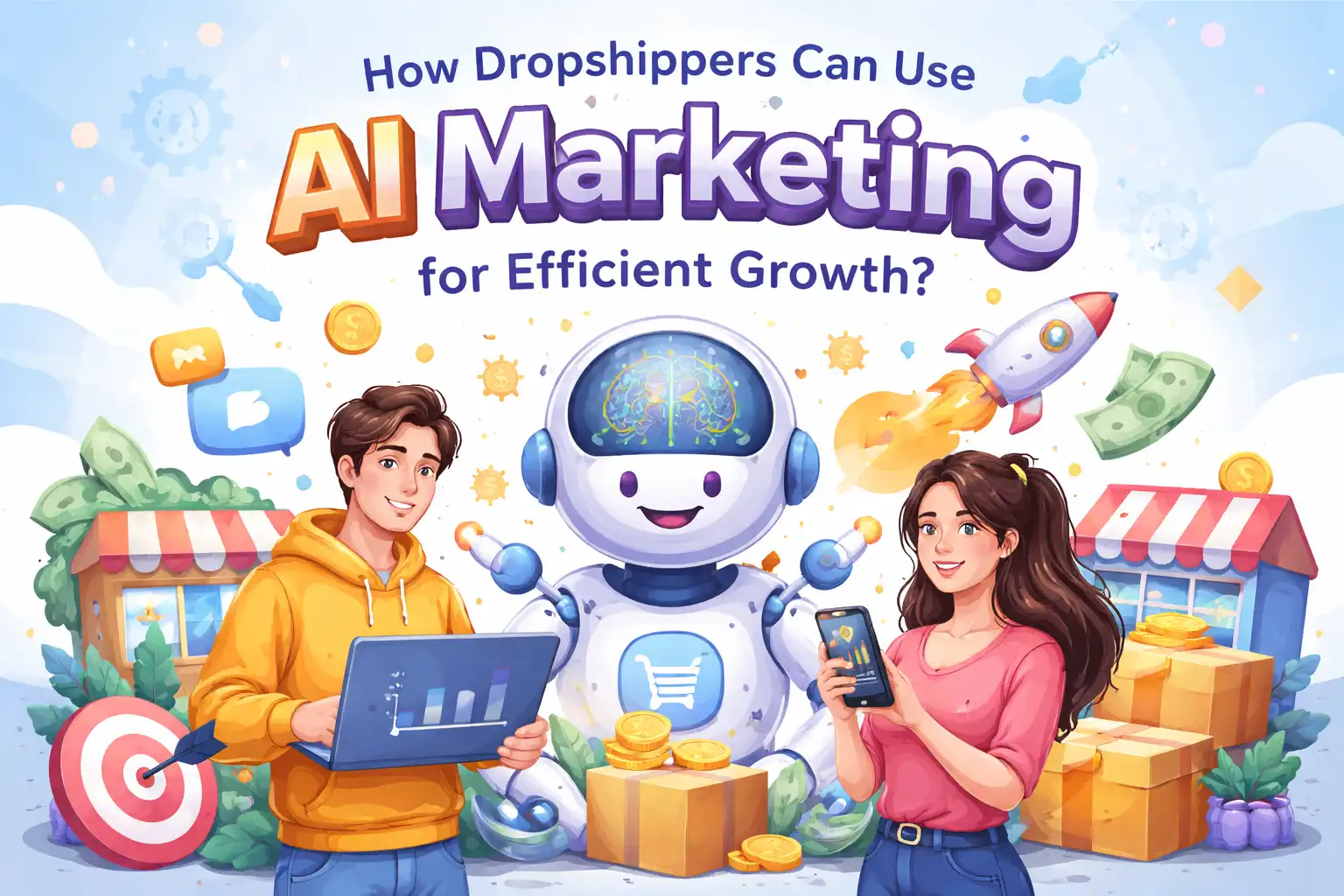
Dropshipping sellers who run independent sites need to launch 10 new SKUs each month. Creating each ad—from writing the script, sourcing assets, filming, to editing for multiple platforms—takes at least 3–6 hours. Outsourcing to freelancers costs $200–$500 per ad, and the quality can be inconsistent. As a result, ads often go live too late, missing the window for a hot product. Even worse, testing consumes budget without yielding enough data, leaving sellers unsure which hook or visual actually works. AI marketing isn’t meant to replace human judgment; it transforms “time‑intensive” processes into data‑driven automation, starting from the product selection stage.
Traditional Marketing Challenges in Dropshipping and How AI Breaks Them
The pain of manually creating ads lies in the serial nature of each step. Writing a script, finding reference material, filming or cutting out images, editing, adding voice‑overs and subtitles, then exporting different sizes for Facebook Ads Manager and TikTok Shop—any step can become a bottleneck. Launching one SKU per week is already a stretch, let alone testing 5–10 products simultaneously.
Product‑selection tools can provide trend data, but the creative bottleneck remains unsolved. Most dropshipping teams have only 1–2 people handling all marketing content, making it almost impossible to produce multiple ad variants at scale. If an ad’s CTR falls short, you have to go through the entire production process again after adjustments.
AI intervenes at three points: creative generation replaces manual scripts and storyboards; delivery optimization adjusts bids and audiences in real time; analytics tell you which hook boosted conversion within 24 hours. You don’t need to implement all three at once, but starting with the most labor‑intensive creative stage usually yields the quickest results.
AI‑Powered Product Selection and Market Insight
Many sellers think product selection is just experience and luck, but there’s a wealth of exploitable data underneath. AI tools can scrape competitors’ trends from Google Trends and Facebook’s Ads library, then combine sentiment analysis of product reviews to extract the pain points users repeatedly mention—these become natural entry points for ad copy. NLP models like ChatGPT can condense thousands of reviews into 3–5 high‑frequency keywords, a speed boost orders of magnitude faster than manual work.
After using AI product‑selection tools, the success rate of test launches rises by about 15 %. For dropshipping, that’s significant—each failed test saves enough ad spend to test 2–3 more SKUs. AI in the selection phase also provides a hidden value: it explains why a product might sell well, not just what sells. The consumer language extracted by NLP can be directly copied into ad copy, naturally boosting conversion rates.
Combining a dedicated AI product‑selection tool with a general large model turns product selection from guesswork into a data‑backed inference process. However, AI‑recommended hot products still require human judgment on supply‑chain feasibility and logistics—AI can’t help there.
AI Ad Creative and Video Production—Balancing Speed and Quality
Once a product is selected, the speed of ad creative generation determines how much traffic you can capture. The traditional workflow—script, asset sourcing, editing, voice‑over, final rendering—takes at least 3 hours per ad. AI compresses this chain to under a minute: paste the product link, and the system automatically generates hooks, scripts, storyboards, voice‑overs, and the final video, supporting 9:16, 1:1, and 16:9 ratios with a single click.
The industry already has several tools that can do this, such as RunwayML’s AI video generation technology for basic video creation and Adobe Firefly for commercial licensing. For dropshipping sellers, the truly game‑changing tools are those that can parse a product link and output end‑to‑end ad videos.
A mature example is VEONIB—it starts by analyzing the product link, automatically extracts selling points, generates multiple hooks, full scripts, and storyboard frames, then renders a high‑definition video—all within a minute. This means a seller who adds three new products daily can obtain ten ad variants for testing in ten minutes instead of waiting two days for outsourced production.
If you’re interested in the exact workflow, see the Shopify Product AI Video Ad Creation Guide, which breaks down each step from pasting the link to exporting the video.
Commercial licensing safety is another crucial aspect. Whether AI‑generated video assets can be used in paid ads varies by platform. The Adobe Firefly commercial‑use AI video documentation is a useful reference, but it’s best to choose tools that explicitly guarantee commercial ownership.
The biggest value of AI video tools isn’t cost saving; it’s the confidence to test many more creative variants. In the manual era, a poorly performing ad would usually get a minor copy tweak and another run, rarely a complete overhaul. AI lets you generate ten completely different hooks and scripts at once, making the hunt for a “viral hook” a different magnitude of effort. Data backs this up—AI video generation averages 60 seconds per video, cutting creative production costs by about 90 %.
VEONIB’s AI hook generator can produce a variety of eye‑catching opening lines, from “POV: You found the one lamp you’ll ever need to buy” to “Stop buying candles that don’t diffuse scent.” Based on a large corpus of high‑conversion e‑commerce ads, these AI‑generated openings outperform intuition‑written ones by over 20 % in conversion. For small‑budget dropshipping teams, the article How Small E‑Commerce Stores Can Compete with Big Brands Using AI Video offers practical tips.
AI‑Driven Ad Delivery and Automated Optimization
With creative assets ready, the next step is delivery. Facebook Ads Manager and TikTok Ads both have AI‑powered bidding and audience‑optimization features, but many sellers simply enable them and walk away. The effective approach is to close the loop between AI material production and AI delivery optimization—generate 5–10 ad variants, bulk‑import them into the ad platform, and let the system automatically allocate budget to the best‑performing variants based on 24‑hour CTR and ROAS, pausing the underperformers.
The key is material diversity. If you only generate 2–3 variants, AI delivery optimization has limited impact because there isn’t enough choice. AI provides “volume supply,” making the subsequent optimization meaningful. After applying AI delivery optimization, average ROAS improves by 20 %–35 %. This uplift isn’t from a single operation; it’s the cumulative effect of denser material, timely shutdowns, and more precise targeting.
When choosing AI tools, consider compatibility with your ad platform. If a tool outputs native formats (e.g., 9:16 MP4), you can import directly into Ads Manager or TikTok Ads. Some tools require post‑processing, adding extra steps. Test a full end‑to‑end pipeline before committing. The comparison article AI Video Tools Comparison: Which Is Better? outlines the differences among mainstream options.
A 2023 case study is worth remembering: a dropshipping team generated 50 ads with AI for Black Friday without any audience targeting or frequency control. Within two weeks, ROAS fell from 3.1 to 1.2; exposure was massive, but conversion hit a historic low. The AI‑generated material was fine, but the AI delivery optimization wasn’t “set‑and‑forget”—bid caps, audience exclusions, and daily budget limits still required human oversight. The problem wasn’t the AI tool but the team’s blind budget increase after seeing high exposure, ignoring signals of audience mismatch. They eventually cut 80 % of the ad sets and manually re‑filtered, then gradually recovered.
Scaling Operations: System Integration of AI Marketing and Pitfalls
Connecting product selection, creative, delivery, and data analysis into an automated workflow is the ultimate goal for scaling. AI data from the selection stage can automatically push keywords into the script generator; the resulting videos feed directly into the ad platform; conversion data loops back to inform product selection—this closed loop is the biggest lever of AI marketing.
Automation platforms like Zapier can link the various tools. For example, when an AI product‑selection tool flags a product as high‑potential, it can trigger creative generation and push the result to the ad management queue. After full AI integration, a team’s marketing headcount can shrink from five to one or two, but that doesn’t mean you can ignore oversight. The article How to Automatically Turn Product Links into Video Ads provides a clear step‑by‑step guide to building such a workflow.
Two common pitfalls:
Over‑reliance on AI leading to brand homogenization. If every dropshipping seller uses the same AI tools, ad styles converge—identical hook templates, visual structures, and voice‑over rhythms. Users eventually can’t tell who the original creator is. Inject brand‑specific elements into the automated pipeline—consistent color palettes, a fixed intro logo, unique subtitle styles. AI can assist but lacks brand memory; you must define and embed those rules.
Neglecting data privacy and platform compliance. Some AI video generators have unclear licensing boundaries; using them in paid ads can trigger copyright disputes. Always verify commercial‑use licensing terms before adopting a tool. AI can’t replace human judgment on brand tone, outlier review, and strategic decisions—e.g., whether to pause a campaign when a competitor drops prices suddenly.
FAQ
Q1: Is AI marketing really effective for dropshipping?
Yes, provided the workflow is set up correctly. Multiple teams report that AI‑generated front‑end assets cut production time by 90 %, while AI delivery optimization lifts ROAS by 20 %–35 % on average. Poor results usually stem from homogeneous creative or misconfigured delivery strategies.
Q2: Will platforms flag AI‑generated ad videos as low quality?
It depends on the asset quality. If the AI video is clear, voice‑over sounds natural, and the visuals match the copy, platforms treat it the same as any other content. In 2025, major ad platforms evaluate material based on CTR and completion rates, not on generation method. However, videos with jittery frames, unstable frame rates, or misaligned subtitles will be down‑ranked.
Q3: Can sellers without technical backgrounds quickly adopt AI marketing tools?
Most tools require only pasting a product link, clicking “generate,” and exporting the video—no coding or design skills needed. A 30‑minute walkthrough of the full process is enough to get started. More complex automation (e.g., Zapier triggers) may need a bit of learning, but basic asset generation has virtually no barrier.
Q4: How much budget is needed to use AI tools?
Entry‑level options are pay‑as‑you‑go, charging only when you export a finished video; costs range from free to a few dollars per video. Subscription plans typically cost $20–$100 per month, depending on generation volume and resolution. Compared with outsourcing at $200–$500 per ad, the annual AI tool cost may equal the price of outsourcing just two ads.
Q5: Can AI completely replace human ad optimizers?
No. AI excels at repetitive execution and pattern recognition, but cross‑cycle strategic adjustments, competitor response, and macro budget allocation still require human experience. The ideal model is AI handling 80 % of execution while humans oversee the remaining 20 % for review and strategic decisions.
Share Article