2026 Search Ecosystem Positioning Battle: How to Become the Brand’s Top Recommendation in ChatGPT and TikTok Search
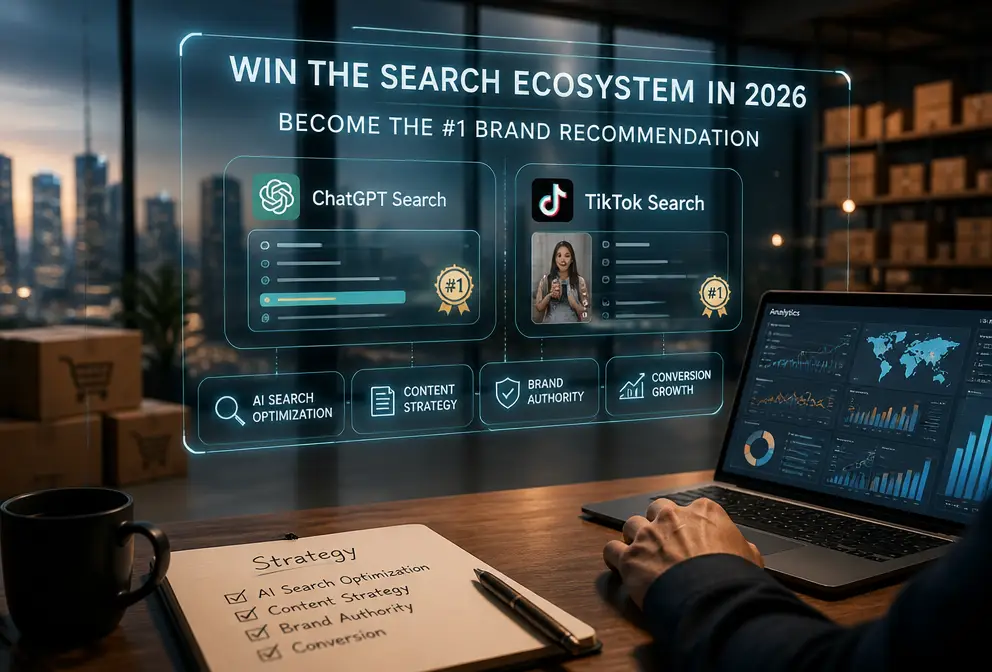
In the past year I’ve noticed a striking shift: overseas consumers no longer rely solely on the Google search box before making a decision. They now ask ChatGPT directly “What is the best X product?” or type product keywords into the TikTok search bar and scroll through videos for answers. This means a brand’s SEO strategy must move in tandem—you need to populate both the textual semantic stream and the visual interest stream, the two next‑generation search entry points, otherwise your product will disappear from consumers’ decision options.
If you only optimize web SEO but have zero presence in ChatGPT and TikTok search, consumers simply won’t see you. The 2026 search ecosystem isn’t a binary choice; both channels must be occupied. I spent almost a year repeatedly testing layout strategies on both ends, hitting many pitfalls, and now I’m breaking down the methods and operational details I’ve validated.
The Search Ecosystem Is Fragmenting: From a Single Entry to Dual‑Channel Decision Making
A 2025 survey showed that over 40 % of Gen‑Z consumers prefer TikTok over Google when searching for products. I was skeptical at first, until I personally observed young buyers: they bought a desk organizer by opening TikTok, searching “desk organizer review,” watching five or six videos, and then placed the order—without ever opening Google.
ChatGPT and TikTok represent two completely different search paths. ChatGPT is a textual semantic entry point, relying on large language models (LLMs) for real‑world understanding and semantic retrieval; even the most beautifully designed product page will be ignored if its semantic structure is chaotic. TikTok is a visual interest entry point, where the algorithm decides who appears at the top of search results based on video tags, completion rates, and interaction signals. Traditional SEO’s keyword stuffing and backlink building are virtually ineffective at these new entry points.
Brands need to establish what I call a “multifaceted validation” content architecture—readable by models on the web side and recommended by algorithms on the social side. Missing either side means consumers won’t find you on the other portal.
Why a Single‑Channel Layout Is No Longer Sufficient
I learned a hard lesson in spring 2025. I spent three months optimizing only the independent site’s SEO, pushing product pages into Google’s top three pages while ignoring TikTok search entirely. By the time I realized competitors had filled the first five screens of TikTok search results, catching up with video content cost at least three times more than if I had laid the groundwork earlier. This taught me how dangerous the “survivor bias” illusion of a single channel can be.
Pure reliance on website SEO has hit a ceiling. Even if your page ranks high on Google, a zero presence in TikTok search means consumers will skip you in a multi‑touch decision path—they’ll see a video recommending another product, and your landing page, no matter how great, loses the chance to be compared.
The trust mechanisms of the two search entry points also differ. ChatGPT’s recommendations are logical: it judges which product description best matches user intent semantically. TikTok’s recommendations are emotional: the mood and vibe of a sales video often outweigh objective specs. Brands need to build trust signals on both rational and emotional tracks.
Web‑Side Grid: Let the Large Model List Your Product Page as the Preferred Answer
For the textual semantic stream, we need ChatGPT‑type models to extract key information accurately from product landing pages. I tested the AI Search Boost mode of VEONIB on product pages, adjusting semantic structure. Core actions include adding structured data (Schema Markup), optimizing contextual relationships, and pre‑embedding Q&A pairs. It sounds complex, but you can start testing for about $9 USD per month, and long‑term maintenance is manageable.
One finding after multiple tests: large models only look at semantic context and attribute tags when scraping a product page; they don’t care about how pretty your visual design is. Many brands spend heavily on gorgeous pages that the model ignores; instead, clear, lightweight pages become the top recommendation. After semantic structure tuning, the probability that a large model retrieves and lists your landing page as an answer can increase roughly threefold.
Below is a typical before‑and‑after comparison of web‑side optimization:
| Optimization Element | Typical Pre‑Optimization State | Typical Post‑Optimization State | Cost Range |
|---|---|---|---|
| Page Structured Data | Missing or incomplete | Fully embedded Product Schema | $0–self‑configured |
| Product Attribute Description | Scattered natural language | Paragraphs with attribute tags | ≈ $9/month |
| Pre‑Embedded User Q&A | No FAQ block | FAQ Schema + Q&A pairs | ≈ $9/month |
| Visual Semantic Annotation | No annotation | alt text + structured tags | ≈ $9/month |
A simple self‑check to see if the tuning works: type “recommend X product” or a specific question into ChatGPT and see if your brand appears in the answer. I usually verify weekly; changes become visible within two weeks.
Social‑Side Grid: Fill TikTok Search Interest Stream with Video Content
After web‑side optimization, you need to extend the content to short‑video platforms. Here VEONIB’s role shifts from semantic tuning to video virality. Paste the optimized product link, and the system automatically parses product information and batch‑generates dozens of high‑definition, watermark‑free UGC short videos—scripts, storyboards, voiceovers, subtitles are all automated.
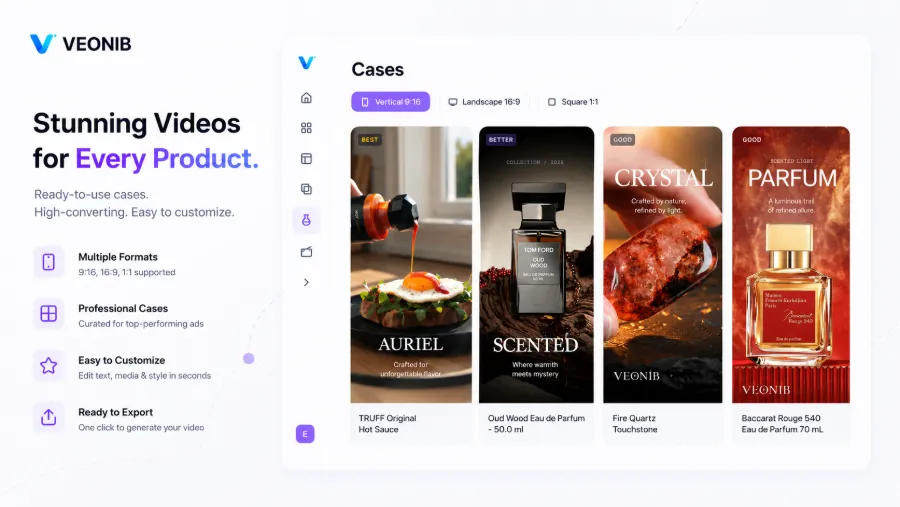
The direct purpose of proliferating this content isn’t immediate sales, but to occupy visual exposure slots in TikTok search results. When your videos fill the top screens of keyword search results, the algorithm gives you the highest recommendation weight. Using automation tools, the number of ad variants for a single product rose from 3–5 per month to over 100, at a cost of only about $11 USD per month.
A less obvious observation: the true value of TikTok search optimization lies not in the videos’ direct conversions, but in the tag signals they generate, which feed back into large‑model recommendation rankings when consumers ask “recommend X product” in AI chats. Social media content is becoming an implicit signal source for AI. If you don’t pre‑populate these tag signals, competitor videos will replace your brand in recommendation lists.
For detailed workflows, see my guides on low‑cost short‑video marketing tactics and automated ad videos as the cheapest scaling path in 2026. These are based on my own test retrospectives.
From “Being Seen” to “Being Recommended”: How to Validate Both‑Side Grid Effectiveness
“Multifaceted validation” isn’t a one‑time setup; it’s a continuous iterative loop. I perform two checks each week: input a specific question into ChatGPT to verify whether the brand appears in the answer, and search the same keyword on TikTok to verify video display frequency.
Web‑side semantic tuning usually shows results in 2–4 weeks; video content uploads can be evaluated for exposure within 24–48 hours. When both sides are optimized simultaneously, the probability of being recommended in dual‑channel search can stabilize at 5–8 times the pre‑optimization level within six weeks. I tested this in Q3 2025, and the data are real measurements.
Maintenance costs are lower than expected. Once the initial grid is set up, you only need to update content according to new product launches. My current rhythm: batch update web semantic structure data monthly, generate TikTok videos immediately after a new product goes live. The whole process costs less than $25 USD per month and takes about two hours.
Some external voices claim AI video automation will completely transform e‑commerce content production; I recommend reading this analysis on how AI video automation is changing e‑commerce content production, which aligns with my practical observations. Additionally, to further boost existing platform performance, see the practical notes on AI video tools for increasing Amazon conversion rates.
FAQ
I have a high‑ranking Google site; do I still need to optimize for ChatGPT and TikTok search?
Yes. Google rankings and ChatGPT/TikTok search are independent signal systems. Even if your site is on Google’s first page, the model may cite a competitor in conversation, and TikTok search may not show any of your videos. The three are not interchangeable; missing any one means consumers can’t find you at a particular decision stage.
Does web‑side semantic tuning require a technical team, or can an individual seller handle it?
Individual sellers can do it completely. Adding structured data can be done via plugins or manual code snippets; no complex coding is needed. If you use AI Search Boost, the tool provides a visual interface—just follow the prompts. Initial setup takes about 2–3 hours; subsequent updates only a few minutes.
Will populating TikTok search with videos affect my existing Google SEO rankings?
No direct impact. Google and TikTok are separate search engines and do not scrape each other’s ranking signals. Indirectly, increased brand search volume from TikTok videos may boost overall brand awareness, which can positively affect click‑through rates on Google. That’s a bonus, not a conflict.
Is the quality of automatically generated videos sufficient, or will platforms flag them as low‑quality?
It hinges on the original script and visual material quality. When using the tool, I manually tweak scripts and scene descriptions before export to make them sound like authentic UGC. Platforms judge low‑quality content mainly by completion rates and interaction signals; as long as the content is engaging, automation does not equal low quality. In my published videos, the highest completion rates belong to automated ones.
After a new product launch, how long does it take to complete the content grid on both sides?
In practice, web‑side tuning takes about 1–2 days (including structured data updates and Q&A embedding), and the video side goes from link to dozens of videos in less than an hour. So the whole workflow can be finished within 2–3 days. TikTok’s algorithm starts allocating exposure roughly 24–48 hours after upload, meaning a new product can enter dual‑channel search within 3–5 days.
Share Article